To save content items to your account,
please confirm that you agree to abide by our usage policies.
If this is the first time you use this feature, you will be asked to authorise Cambridge Core to connect with your account.
Find out more about saving content to .
To save content items to your Kindle, first ensure no-reply@cambridge.org
is added to your Approved Personal Document E-mail List under your Personal Document Settings
on the Manage Your Content and Devices page of your Amazon account. Then enter the ‘name’ part
of your Kindle email address below.
Find out more about saving to your Kindle.
Note you can select to save to either the @free.kindle.com or @kindle.com variations.
‘@free.kindle.com’ emails are free but can only be saved to your device when it is connected to wi-fi.
‘@kindle.com’ emails can be delivered even when you are not connected to wi-fi, but note that service fees apply.
Chapter 7 studies how Kasımpaşa, nearby the Arsenal, transformed into working-class neighborhoods, focusing on the complicated connections between migration networks, labor coercion, industrial production, and urban modernization.Utilizing wage and population records, it demonstrates how shipbuilding was central to the district’s demography and culture, and how regional and occupational networks were significant in settlement patterns. It investigates the connections between forced labor draft (particularly from the Black Sea coasts and Alexandria/Egypt), the increasing visibility of bachelors, the settlement of working-class families, and the urban policies and elite perceptions towards the district. It investigates the social, cultural, and economic divergence between Kasımpaşa and the adjacent Galata-Pera axis in Istanbul, the epicenter of urban reforms in the Tanzimat Era. It highlights the emergence of a working-class culture, and analyzes the proletarian experiences of working-class families and the increasing contention between working-class men and women and the Ottoman state, by focusing particularly on strikes and petitioning.
Chapter 6 analyses the connections between trans-imperial labor migration and Ottoman industrial and urban modernization in the nineteenth century. In a context marked by the mechanization of industrial production through technology transfer, the increasing political-economic ties between the Ottoman and British states, and the scarcity of workers with mechanical skills in Istanbul, hundreds of British industrial workers migrated to Istanbul to work mostly in the arsenal, as well as some other state factories. This chapter narrates the history of these workers and the community they established in Hasköy beginning with the mechanization efforts in the 1830s until the economic crisis in the mid-1870s. It analyses the larger context of British workers’ migration from Britain, their relations with the Ottoman state officials and local workers, and their experiences in the workplace and the city. It demonstrates how their contentious relationship and effective struggles pushed the state authorities to deploy skilled military workers, who were the products of the processes described in the previous chapter, to decrease and eliminate its dependence on them.
This chapter analyzes the transformations in Argentinean society since the 1970s, describing how the symbolic and material repercussions of deindustrialization concentrated on vulnerable segments of the population. Neoliberal reforms not only undermined the means of sustenance for poor families but also dislocated much of the taken-for-granted attitudes and habits that organized life in working-class neighborhoods. Regardless of their specific experiences, respondents highlight that when jobs were plentiful life was difficult yet predictable. Residents of poor areas had a sense of what they needed to do in order to make a living, keep their relatives safe, and accumulate resources. Widespread joblessness, state neglect, and violence affected the set of agreed-upon expectations and meanings at the core of working-class culture, which allowed people to organize their daily lives and interact with each other with a degree of confidence.
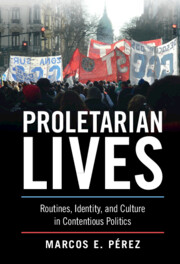
Based on multi-year ethnographic fieldwork on the Unemployed Workers' Movement in Argentina (also known as the piqueteros), Proletarian Lives provides a case study of how workers affected by job loss protect their traditional forms of life by engaging in progressive grassroots mobilization. Using life-history interviews and participant observation, the book analyzes why some activists develop a strong attachment to the movement despite initial reluctance and frequent ideological differences. Marcos Pérez argues that a key appeal of participation is the opportunity to engage in age and gender-specific practices associated with a respectable blue-collar lifestyle threatened by long-term socioeconomic decline. Through their daily involvement in the movement, older participants reconstruct the routines they associate with a golden past in which factory jobs were plentiful, younger activists develop the kind of habits they were raised to see as valuable, and all members protect communal activities undermined by the expansion of poverty and violence.
Recommend this
Email your librarian or administrator to recommend adding this to your organisation's collection.