To save content items to your account,
please confirm that you agree to abide by our usage policies.
If this is the first time you use this feature, you will be asked to authorise Cambridge Core to connect with your account.
Find out more about saving content to .
To save content items to your Kindle, first ensure no-reply@cambridge.org
is added to your Approved Personal Document E-mail List under your Personal Document Settings
on the Manage Your Content and Devices page of your Amazon account. Then enter the ‘name’ part
of your Kindle email address below.
Find out more about saving to your Kindle.
Note you can select to save to either the @free.kindle.com or @kindle.com variations.
‘@free.kindle.com’ emails are free but can only be saved to your device when it is connected to wi-fi.
‘@kindle.com’ emails can be delivered even when you are not connected to wi-fi, but note that service fees apply.
This chapter explores the complex relationship between extractive industries, sustainable development, and Indigenous treaty law. It begins by examining the international law guidance available for extractive industries, analysing frameworks and principles that promote responsible and sustainable practices in resource extraction while considering the social, economic, and environmental dimensions. This chapter then focuses on the specific challenges of oil and gas exploration, highlighting the impacts on Indigenous communities and emphasizing the importance of meaningful consultation, consent, and fair benefit-sharing in alignment with Indigenous treaty rights. Furthermore, it explores the mining sector’s implications for sustainable development, considering the social, economic, and environmental aspects and emphasizing the role of Indigenous treaty law in ensuring responsible practices, equitable resource distribution, and the protection of Indigenous rights and lands. Thus, the chapter emphasizes the need for a balanced approach that respects Indigenous rights, integrates Indigenous perspectives and consent, and promotes sustainable practices.
This chapter presents agreements between Indigenous peoples and governments, specifically those in Bangladesh and Mexico that focus on their roles in promoting sustainable development. The introduction sets the stage for subsequent discussions by emphasizing the importance of global legal and policy frameworks in shaping these agreements, with the United Nations Declaration on the Rights of Indigenous Peoples (UNDRIP) and the global Sustainable Development Goals (SDGs). The two case studies from Bangladesh and Mexico are then analysed, shedding light on the unique characteristics, provisions, and outcomes of agreements between Indigenous peoples and governments in these contexts. A comparative analysis is conducted to identify commonalities, differences, and lessons learned from these case studies. Ultimately, the chapter concludes by highlighting the significance of ongoing dialogue, collaboration, and respect for Indigenous rights in achieving sustainable development goals globally. It underscores the importance of incorporating Indigenous perspectives and aspirations into the design and implementation of such agreements.
Research on the role of non-governmental organizations (NGOs) in collective action predicts they will not interact with grassroots groups, citing partnerships with corporations and states, the apolitical delivery of social services and accountability towards donors as disconnecting professionalized actors from volunteer-based grassroots groups. Using interviews with core activists in the movement confronting Canadian resource extraction abroad, I depart from this approach by investigating the mechanisms, or threads, that bind organizations into coordinated action. I find that NGOs and grassroots groups coordinate as a result of: shared values and environmental justice frames; the allocation of resources; and engagement in complimentary forms of advocacy driven by a division of labour and a diversity of tactics. My research develops existing approaches to theorizing coordinated action and invites scholarship on NGOization to include the conceptual toolkit provided by social movement theories to better account for NGO–grassroots dynamics.
Many localities in the United States are, or have been at some point in their past, economically dependent on a single industry. This leaves local governments vulnerable to capture by dominant firms. In such places, business interests may shape not only policy outcomes, but the size, structure, and capacity of government itself. Focusing on the case of eastern coal country in the twentieth century United States, this paper presents evidence that the coal industry hindered the growth of local government capacity where it was dominant. A difference-in-differences design and instrumental variables analysis show that coal-dependent counties employed fewer public workers, collected less tax revenue, and spent less on government services than comparable areas, with the latter two effects persisting long after the industry’s decline. These findings illustrate that local political economy in the early phases of institutional development can shape the trajectories of governance in lasting ways.
The epilogue begins with the reversion of the Bonin Islands to Japan in 1968, after twenty-three years of US postwar occupation. Reflecting on imperial nostalgia and the meanings attributed to a rising Pacific for the future of Japan, it returns to the book’s initial question about the Pacific’s place in the archipelago’s history. It argues that the ocean today is an “unending frontier,” a cognitive mode engraved in both the promise of continued economic expansion and in the hopes for a more sustainable economy. The effects of climate change raise new questions about the origins of industrial modernity. The epilogue suggests conceptual models inspired at ocean currents to rethink diachronic historical causations and challenge teleology. With the first industrial revolution in Asia, Japan’s imperial emergence lives in the upstream of present ecological transformations. Studying the historical processes that direct state and industry interests to specific places within the dynamic seascapes of currents, habitats, and mineral deposits, embed the human relationship with the ocean in its historically grown, volumetric dimension.
Drawing on an ongoing conflict over hydrocarbon development in a protected area in Southern Bolivia, this chapter explores resource frontiers as key sites of juristocratic reckoning, where international and national discourses of rights are simultaneously invoked and undermined by violent processes of accumulation by dispossession. A leading example of transformative constitutionalism, Bolivia’s 2009 Constitution defined the country as a “Plurinational State” and recognized an array of new rights for Indigenous, originary, and peasant peoples, including in relation to territory and the environment. Yet state dependence on natural gas extraction has produced a widening gap between legal discourse and practice. This chapter asks: What new forms of politics emerge as communities at extractive frontiers reckon with the possibilities and limits of law and rights to confront ongoing processes of environmental dispossession? The arrival of oil companies in the Tariquía Reserve catalyzed a wave of human rights education in remote rural communities, yet a series of failed constitutional challenges have exposed the limits of law and rights as instruments to counter state-led extraction. Rather than turning away from rights, the chapter argues that community activists in Tariquía see themselves as custodians of the 2009 Constitution against the state. Their embodied praxis of territorial defense points to a form of juristocratic politics from below, in which the state’s monopoly on political and legal authority is called into question.
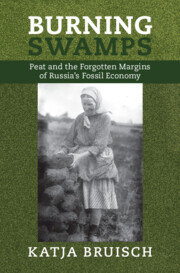
For nearly a century, seasonal, often female, manual labor remained fundamental to making peat available for industrial enterprises and electric power plants. Focusing on the trajectories of peat workers, this chapter discusses the seasonal nature and gendered organization of labor. It reveals that, as an embodied, more than-human activity, peat extraction was an experience marked by social inequality and difference as well as by the uncertain material environments of extraction sites, where the weather, dysfunctional technology, and the physical interaction with peat caused injuries and accidents. Examining the overlapping temporalities, modes of production, and agencies (human and nonhuman) in the making of peat fuel, this chapter foregrounds the forgotten margins of Russia’s fossil economy as focal points of the intertwined exploitation of humans and nature upon which it relied.
This groundbreaking environmental history recounts the story of Russia's fossil economy from its margins. Unpacking the forgotten history of how peat fuelled manufacturing industries and power plants in late Imperial and Soviet Russia, Katja Bruisch provides a corrective to more familiar historical narratives dominated by coal, oil, and gas. Attentive to the intertwined histories of matter and labor during a century of industrial peat extraction, she offers a fresh perspective on the modern Russian economy that moves beyond the socialism/capitalism binary. By identifying peat extraction in modern Russia as a crucial chapter in the degradation of the world's peatlands, Bruisch makes a compelling case for paying attention to seemingly marginal places, people, and resources as we tell the histories of the planetary emergency.
Across more than seven centuries (c. 1350–600 BC), the Assyrian Empire established political dominance and cultural influence over many settlements in the Ancient Near East. Assyrian policies of resource extraction, including taxation and tribute, have been extensively analysed in textual and art historical sources. This article assesses the impact of these policies on patterns of wealth within mortuary material—one of the most conservative forms of culture, deeply rooted in group identity. The author argues that a trend of decreasing quality and quantity of grave goods over time supports models emphasising the heavy economic burden of Assyrian administration on its subjects.
The historical trajectory of states-in-waiting was determined by many overlapping factors: their international-legal status vis-à-vis the United Nations, their popular support within their territories, the presence or absence of regional allies, their role in global Cold War politics, as well as the influence and impact of their international advocates, who often served as the connectors between these geopolitical spheres. In addition, a territory’s possession (or lack) of economic resources desired by multinational corporations shaped the pathways of particular nationalist claimants. In Southern Africa, the presence of natural resources made advocacy networks thick, overladen, multiple, and intertwined. Beyond the international-legal dimensions of Namibia’s struggle for national liberation, the territory was integrated within international politics through mining interests. Claims to territory and its resources are central to the demand for sovereignty.
Chapter 2 explores the Ecuadorean rainforest landscape, its inhabitants, and their first interactions with the oil industry before large-scale oil extraction started in the late 1960s. It starts by looking back at the millennia of gradual changes when the history of crude oil and the tropical rainforest environment started to intersect. An exploration of the geographical properties of the Amazon landscapes, as well as their flora and fauna including human inhabitants, visualizes the lively environment encountered by the first oilmen visiting the area in the period between the 1920s and the 1960s. Two multinational oil companies, the Leonard Exploration Company and Shell, undertook major efforts to discover petroleum reserves in the Ecuadorean Amazon. Even though their exploration programs failed in the end, their pioneering work of mapping and surveying the rainforest and its subsoil laid the foundation for large-scale petroleum extraction decades later.
Chapter 6 turns to the potential extraction of metals from areas beyond national jurisdiction: Antarctica, the deep seas and outer space. Each of these areas contains, with varying degrees of plausibility, large reserves of metals that are indispensable for a global transition towards sustainability, particularly in the energy and transportation sectors. At the same time, extractive operations would be virtually certain to generate various types of adverse environmental impacts while also raising challenging questions related to fairness and equity: in different ways, the legal regimes applicable to each of these three areas beyond national jurisdiction give effect to collective rights that are most clearly enshrined in the concept of the common heritage of humanity. The chapter assesses institutional responses to this technological field under three international institutions: the Antarctic Treaty System, the United Nations Convention on the Law of the Sea, and the Outer Space Treaty.
Volume 1 of The Cambridge History of Global Migrations documents the lives and experiences of everyday people through the lens of human movement and mobility from 1400 to 1800. Focusing on the most important typologies of preindustrial global migrations, this volume reveals how these movements transformed global paths of mobility, the impacts of which we still see in societies today. Case studies include those that arose from the demand for free, forced, and unfree labor, long- and short-distance trade, rural/urban displacement, religious mobility, and the rise of the number of refugees worldwide. With thirty chapters from leading experts in the field, this authoritative volume is an essential and detailed study of how migration shaped the nature of global human interactions before the age of modern globalization.
Almost 100 years ago, the American Geographical Society (AGS) published an edited volume titled Problems of Polar Research, which started with the assumption that much remained to be learned about the Arctic and Antarctica. Edited by the geographer W. L. G. Joerg, an employee of the AGS, the volume contained chapters by many of the leading polar authorities of the day, most of whom were active participants in exploration and science.1 ‘Problems’ had a double meaning: the authors referred to inadequacies and gaps in the contemporary state of knowledge, but also to the excitement of the potential for advancing understanding in difficult conditions. The volume sought to inspire its readers to think further and address the challenges. We approached this present volume with a similar view.
Recent studies relate the introduction of Early Neolithic flint mining practices to the migration and rapid expansion of agricultural groups from north-western continental Europe into present-day Britain and southern Scandinavia. Here, the authors critically analyse this hypothesis, using a case study from south-western Sweden to demonstrate how transregional processes played out locally with their own dynamics, c. 4000 BC. They conclude that migration and population change only partly can explain what happened during the centuries immediately before and after 4000 BC. Local variation in human-material relationships also needs to be considered.
From William Bartram to John James Audubon to Susan Fenimore Cooper, early American writers on natural history challenged anthropomorphic thinking and human exceptionalism. Imagining human diminishment amid scenes of natural wonder, they offered a way forward in thinking about “the world we did not make” (William Cronon) that remains largely untraveled today.
Over the past 600 years, commodity frontiers – processes and sites of the incorporation of resources into the expanding capitalist world economy – have absorbed ever more land, ever more labour and ever more natural assets. In this paper, we claim that studying the global history of capitalism through the lens of commodity frontiers and using commodity regimes as an analytical framework is crucial to understanding the origins and nature of capitalism, and thus the modern world. We argue that commodity frontiers identify capitalism as a process rooted in a profound restructuring of the countryside and nature. They connect processes of extraction and exchange with degradation, adaptation and resistance in rural peripheries. To account for the enormous variety of actors and places involved in this history is a critical challenge in the social sciences, and one to which global history can contribute crucial insights.
Local Content and Sustainable Development in Global Energy Markets analyses the topical and contentious issue of the critical intersections between local content requirements (LCRs) and the implementation of sustainable development treaties in global energy markets including Africa, Asia, Europe, North America, Latin America, South America, Australasia and the Middle East While LCRs generally aim to boost domestic value creation and economic growth, inappropriately designed LCRs could produce negative social, human rights and environmental outcomes, and a misalignment of a country's fiscal policies and global sustainable development goals. These unintended outcomes may ultimately serve as disincentive to foreign participation in a country's energy market. This book outlines the guiding principles of a sustainable and rights-based approach – focusing on transparency, accountability, gender justice and other human rights issues – to the design, application and implementation of LCRs in global energy markets to avoid misalignments.
In 2016, Rwanda began extracting methane gas from Lake Kivu, an innovative project designed to reduce the risk of a deadly spontaneous gas release while providing clean and renewable power to an energy-strapped region. Based on qualitative research in Rwanda from 2016 to 2019, Doughty, Uwizeye, and Uwimana use the Kivu methane extraction project to ask, How do we balance urgent electrification needs with responsible energy policies that respond to environmental risks, particularly in post-conflict contexts? Analyzing the Kivu methane projects as “green extractive humanitarianism” provides cautions within the promises of sustainability and “green capitalism.”
Formerly marginal areas are increasingly the focus of extractive mega-projects, which are framed as necessary for economic growth and a modern industrial economy. Yet there are concerns that such projects are unjustly displacing local populations, facilitated through the alliances of local elites with foreign investors. This article asks, who are the winners and losers from oil exploration in the Turkana region of Kenya? Using longitudinal ethnographic research on the dynamics of local government, oil exploration, and pastoralist livelihoods in Turkana, Mkutu and Mdee highlight how current processes may exacerbate inequality and marginalization, with the potential for increasingly violent consequences.