To save content items to your account,
please confirm that you agree to abide by our usage policies.
If this is the first time you use this feature, you will be asked to authorise Cambridge Core to connect with your account.
Find out more about saving content to .
To save content items to your Kindle, first ensure no-reply@cambridge.org
is added to your Approved Personal Document E-mail List under your Personal Document Settings
on the Manage Your Content and Devices page of your Amazon account. Then enter the ‘name’ part
of your Kindle email address below.
Find out more about saving to your Kindle.
Note you can select to save to either the @free.kindle.com or @kindle.com variations.
‘@free.kindle.com’ emails are free but can only be saved to your device when it is connected to wi-fi.
‘@kindle.com’ emails can be delivered even when you are not connected to wi-fi, but note that service fees apply.
Do Black and non-Black elected officials differ in how much of their rhetorical outreach is centered on high-profile racial issues? We address this question in Chapter 4. We argue that discussions of high-profile racial topics represent a reactive form of outreach. In contrast, elected officials engage in proactive racial rhetorical representation when they discuss issues which are not politically salient. Using a combination of over 500 race-related terms and google trends data, we identify high-profile forms of racial outreach which include racial issues like voting rights and discussions of popular Black public figures like Rep. John Lewis, Martin Luther King Jr, and Rosa Parks. We combine this analysis with our previously coded press releases and tweets to explore the percent of racial outreach which contains reference to a high-profile topic. We find that a smaller proportion of racial outreach from Black elected officials in press releases and on Twitter are centered on high-profile topics than racial outreach from White, Latino/a, and Asian American elected officials. We further test our hypothesis that Black elected officials will speak about lower profile topics by exploring whether discussions of police reform are greater during periods where Black Lives Matter is being searched more on google. We find that when Black Lives Matter is a high-profile topic, non-Black elected officials are more likely to speak out about police reform. The salience of Black Lives Matter in the public is a weaker predictor of these same discussions for Black elected officials. Overall, this chapter demonstrates than when Black elected officials speak about race, they are more likely to discuss topics which are not in the public eye.
From his 1982 conviction for killing a police officer and death sentence to the 2010 commutation of that sentence to life-in-prison-without-parole, Mumia Abu-Jamal has experienced and studied mass incarceration intimately as a political prisoner. At the local level, Mumia’s case is a microcosm of the period of the 1970s and 1980s in Philadelphia – the highpoint of rogue white supremacy within the city’s police department and the District Attorney’s office. At the macro level, the period of his incarceration spans the decades of exponential carceral expansion in the US that began in the 1980s. In the more than four decades since his 1982 conviction, the Abu-Jamal has penned thirteen books and thousands of short radio commentaries from prison, most notably Live from Death Row, which features harrowing, first-hand accounts of aging men and their struggles for medical care in the face of physical illness, younger men who are psychically and spiritually pulverized by guard brutality, barbarous conditions, humiliating body cavity strip searches, and the unnatural social isolation of death row imprisonment.
Chapter 4 examines the consequences when the state does not protect the security of people within its realm because of their race, and how this negligence intersects with the contemporary criminal justice system. The chapter focuses on current arguments surrounding Black Lives Matter and similar movements in Latino and Native communities regarding state violence against communities of color. The primary sources examine several criminal justice protections provided under the Constitution, consider the Fourteenth Amendment’s requirements of state and federal governments, and question how the government protects the people against itself and from White majorities. Readers may engage with the continuing debates around the responsibility of governments to ensure that policing is not racialized and consider the most just specific policies or legal interpretations focusing on the accountability of state actors. The chapter conncludes by exploring the potential of the constitutional requirement of a jury of peers for criminal prosecution may hinder the exercise of state-sanctioned racialized violence.
Chapter 5 addresses new challenges that emerged for the Movimiento Negro during the COVID−19 pandemic. During the crisis, many Afrodescendants saw their precarious and sometimes informal housing and employment situations worsen. Additionally, the international media attention of the Black Lives Matter movement in the wake of George Floyd’s murder invigorated the Movimiento Negro’s efforts to address police brutality and criminal (in)justice, as witnessed in numerous newspaper articles and virtual discussions on the theme, “Police Brutality Exists Here [Argentina] Too!” Here, I engage with Christina Sharpe’s concept of “wake work” as a disruptor of the immanence and imminence of Black death to analyze two pandemic-era campaigns that were about sustaining Black life: a mutual aid campaign to secure food, medicine, and housing for vulnerable African and Afrodescendent populations and a series of web events and projects to continue discussions about racism in Argentina at the community, national, and international level. The data suggests that despite fractures in the movement that emerged because of the pandemic, the movement is still gaining traction in institutional spaces.
The murder of George Floyd at the hands of Minneapolis police over Memorial Day weekend ignited sustained protests across the country and placed the issue of race front and center. As we show in this chapter, by September, more than two-thirds of our survey respondents report positive views of the Black Lives Matter movement. While the salience of race began to fade as the general election campaign unfolded, we find that political characteristics of citizens, such as party attachment and partisan media exposure, influence support for the social justice movement and support for law enforcement. Further, psychological predispositions consistently and significantly influence views of social protests and policing. For example, people’s level of racial resentment produces powerful changes in their views of the protests and police from September to October. Finally, attitudes about racial justice and policing influence overall impressions of Biden and Trump, producing significant changes in people’s views of the candidates during the first months of the fall campaign.
This chapter discusses the current trends at the reformed Court against the backdrop of recent reform initiatives, as well as the general atmosphere of widespread negative feedback and backlash since the 2010s. To do so, it relies on the results of the content analysis carried out on the case law between 1967 and 2016, a close reading of some of the recent landmark judgments, and the insights gathered from elite interviews conducted with current and former judges. This assessment shows the extent to which the reformed Court resorts to selective forbearance. I find that the reformed Court, challenged by widespread negative feedback, selectively pays heed to member states’ concerns. That is, it continues a progressive line of reasoning when it comes to certain core obligations, such as the obligation to refrain from using excessive force while policing or the provision of legal protection and remedy. Yet, it adopts a more forbearing attitude towards certain other obligations, such as the obligation to uphold the non-refoulement principle, the provision of sufficient medical care in detention centers, or the provision of acceptable detention conditions to (irregular) migrants or asylum seekers.
This chapter challenges legislative and judicial efforts to immunize police officers from all but the most outrageous misconduct by finding “objectively reasonable” virtually all uses of force by officers and providing “qualified immunity” in the rare instance when the use of force is deemed excessive. This failure to provide any sort of check or deterrent against the use of force by armed, implicitly biased officers improperly strengthens the weapon in weaponized racial fear and further empowers bias-motivated individuals to act on their biases.
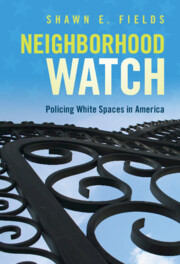
Although racism has plagued the American justice system since the nation's colonial beginnings, private White Americans are taking matters into their own hands. From racist 911 calls and hoaxes to grassroots voter suppression and vigilante 'self-defense,' concerted efforts are made every day by private citizens to exclude Black Americans from schools, neighborhoods, and positions of power. Neighborhood Watch examines the specific ways people police America's color line to protect 'White spaces.' The book charts how these actions too often result in harassment, arrest, injury, or death, yet typically go unchecked. Instead, these actions are promoted and encouraged by legislatures looking to expand racially discriminatory laws, a police system designed to respond with force to any frivolous report of Black 'mischief,' and a Supreme Court that has abdicated its role in rejecting police abuse. To combat these realities, Neighborhood Watch offers preliminary recommendations for reform, including changes to the 'maximum policing' state, increased accountability for civilians who abuse emergency response systems, and proposals to demilitarize the color line.
A new wave of global social movements is being led by young Africans. In the same way that a wave of European Baby Boomers took to the streets demanding social change as teenagers and young adults in the student protests of 1968, this cohort of young Africans are at the forefront of similar protests. And young sub-Saharan Africans are using social media to push back against tradition and fight for change, as exemplified by Nigeria’s #endSARS protests against police brutality. Driven by Twitter – at the movement’s peak in October 2020, 48 million #endSARS tweets were posted in just 10 days – #endSARS constituted the country’s most significant protest movement since pro-democracy rallies in the 1990s. Threatened by the power of platforms such as Twitter, the frequency and duration of internet shutdowns by governments across Africa is steadily increasing – in June 2021, the Nigerian government suspended Twitter in the country. For many young Nigerians #endSARS was a real political awakening. The protests created the recognition that young people could be a powerful political force, combined with the more brutal understanding that the establishment will respond violently to perceived challenges.
We join Eduardo Bonilla-Silva’s structural theory of the racialized U.S. social system with a situational methodology developed by Arthur L. Stinchcombe and Irving Goffman to analyze how law works as a mechanism that connects formal legal equality with legal cynicism. The data for this analysis come from the trial of a Chicago police detective, Jon Burge, who as leader of an infamous torture squad escaped criminal charges for more than thirty years. Burge was finally charged with perjury and obstruction of justice, charges that obscured and perpetuated the larger structural reality of a code of silence that enabled racist torture of more than a hundred Black men. This case study demonstrates how the non-transparency of courtroom sidebars plays an important role in perpetuating systemic features of American criminal injustice: a code of silence, racist discrimination, and legal cynicism.
High levels of crime are a key driver of emigration from Latin America and the Caribbean. But can emigration change public opinion about how best to respond to crime? Focusing on the political economy of remittances—the money migrants send to their families and communities—this study argues that emigration can increase support for violent responses to crime. Migrants’ families often spend remittances on investment goods, which makes them more vulnerable to crime and more supportive of violence to protect themselves. An analysis of AmericasBarometer data finds that remittance recipients are more likely both to fear crime and to be victims of crime than nonrecipients. They are also more approving of vigilantism, more tolerant of police bending the law to apprehend criminals, and more supportive of deploying the military in crime fighting. These findings contribute to our knowledge of the consequences of international migration for political development in migrant-sending countries.
Chapter 8 investigates the effects of group empathy on attitudes regarding a variety of policy changes that took place after Trump’s election. We examine how group empathy affects support for the Trump administration’s border wall and family separation policies, as well as its attempts to end the Obama-era DACA program. We also revisit Trump’s travel and immigration ban on several Muslim countries after he turned his controversial campaign promise into government policy via executive order. We further explore how group empathy influences opinions about some other group-related political issues such as hurricane relief for Puerto Rico, misappropriation of Native American names, symbols, and imagery in sports, as well as removal of Confederate statues and monuments. Finally, we examine the relationship between group empathy and support for contemporary social movements, namely Black Lives Matter, #MeToo, and LGBTQ rights. In all these tests, we find that group empathy is a powerful determinant of public reactions to the Trump administration’s policies above and beyond partisanship, ideology, and many other predispositions including racial resentment, even for issues concerning non-racial/ethnic marginalized outgroups.
Chapter four details the evolution of, and the repressive capacity and methods of Bahrain's security services. In particular it focuses on the police, for which most historical and current data is available. Ranging from the personalist explanations of repression, such as why Charles Belgrave himself engaged in beating detainees, to the institutionalisation of deviance, chapter three looks at how personal integrity violations in Bahrain are intrinsically tied up with the country’s institutional and political structures. It also explores how Al Khalifa conservatism underlined by Saudi fear of Iranian expansionism has informed a militant and coercive policy of repression. In particular, the chapter notes that while the British established the police and continued to play an important role concerning training and technical assistance, a shift in power occurred leading up to and following 1971. Following Independence, the increasing Al Khalifa and Saudi control, coupled with diminishing British influence on policy, led to a more systemically repressive coercive apparatus; one in which the British influence became hidden behind the legal distancing of ‘Independence’. As well as detailing the emergence of the police force, this chapter argues how tactics such as mass arrests and torture have emerged, not simply because of the criminalisation of the Shiʿa threat, but due to the embedded discrimination and sectarianism that pervades the security forces and the ruling regime.
Recommend this
Email your librarian or administrator to recommend adding this to your organisation's collection.