To save content items to your account,
please confirm that you agree to abide by our usage policies.
If this is the first time you use this feature, you will be asked to authorise Cambridge Core to connect with your account.
Find out more about saving content to .
To save content items to your Kindle, first ensure no-reply@cambridge.org
is added to your Approved Personal Document E-mail List under your Personal Document Settings
on the Manage Your Content and Devices page of your Amazon account. Then enter the ‘name’ part
of your Kindle email address below.
Find out more about saving to your Kindle.
Note you can select to save to either the @free.kindle.com or @kindle.com variations.
‘@free.kindle.com’ emails are free but can only be saved to your device when it is connected to wi-fi.
‘@kindle.com’ emails can be delivered even when you are not connected to wi-fi, but note that service fees apply.
The introduction provides historical and theoretical framings for this book. It situates the American military presence in postwar China within two interconnected contexts of China’s civil war confrontations and America’s global occupation. It engages with existing historiographies by locating China in the American empire and locating America in Communist propaganda. Through the micro-lens of the everyday, it also analyzes the actual and critical links between grassroots frictions and Sino-US relations.
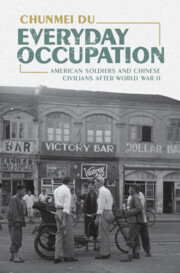
'In this rich history of everyday encounters between US soldiers and Chinese civilians, Chunmei Du explores their entangled relations from the end of World War II to the founding of the People's Republic of China. Drawing upon official, popular and personal accounts from both countries, Du examines the sensorial, material, and symbolic exchanges that took place between GIs and ordinary Chinese people-stall vendors, pedestrians, rickshaw pullers, 'Jeep girls,' and suspected thieves. Through the conceptual lens of the everyday, this book reveals how interactions such as traffic accidents, sexual relations, theft, and black-market dealings, impacted larger political dynamics during this pivotal era. Du shows how mundane struggles made imperialism and sovereignty tangible, fueling anti-American sentiment. Meanwhile, these encounters fostered informal diplomacy, shaping identities and forging new bonds that left a lasting imprint on both countries. This title is also available as Open Access on Cambridge Core.'
Recommend this
Email your librarian or administrator to recommend adding this to your organisation's collection.