To save content items to your account,
please confirm that you agree to abide by our usage policies.
If this is the first time you use this feature, you will be asked to authorise Cambridge Core to connect with your account.
Find out more about saving content to .
To save content items to your Kindle, first ensure no-reply@cambridge.org
is added to your Approved Personal Document E-mail List under your Personal Document Settings
on the Manage Your Content and Devices page of your Amazon account. Then enter the ‘name’ part
of your Kindle email address below.
Find out more about saving to your Kindle.
Note you can select to save to either the @free.kindle.com or @kindle.com variations.
‘@free.kindle.com’ emails are free but can only be saved to your device when it is connected to wi-fi.
‘@kindle.com’ emails can be delivered even when you are not connected to wi-fi, but note that service fees apply.
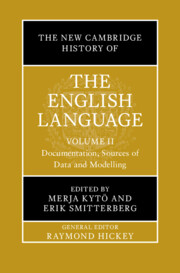
The New Cambridge History of the English Language is aimed at providing a contemporary and comprehensive overiew of English, tracing its roots in Germanic and investigating the contact scenarios in which the language has been an active participant. It discusses the various models and methodologies which have been developed to analyse diachronic data concisely and consistently. The new history furthermore examines the trajectories which the language has embarked on during its spread worldwide and presents overviews of the varieties of English found throughout the world today.
This volume considers the various kinds of text which document the history of the English language. It looks closely at vernacular speech in writing and the broader context of orality along with issues of literacy and manuscripts. The value of text corpora in the collection and analysis of historical data is demonstrated in a number of chapters. A special focus of the volume is seen in the chapters on genre and medium in the textual record. Various types of evidence are considered, for instance, journalistic work, medical writings, historiography, grammatical treatises and ego documents, especially emigrant letters. A dedicated section examines the theories, models and methods which have been applied to the textual record of historical English, including generative and functionalist approaches as well as grammaticalisation and construction grammar. In addition, a group of chapters consider the English language as found in Beowulf and the writings of Chaucer and Shakespeare.
The New Cambridge History of the English Language is aimed at providing a contemporary and comprehensive overiew of English, tracing its roots in Germanic and investigating the contact scenarios in which the language has been an active participant.
Recommend this
Email your librarian or administrator to recommend adding this to your organisation's collection.