To save content items to your account,
please confirm that you agree to abide by our usage policies.
If this is the first time you use this feature, you will be asked to authorise Cambridge Core to connect with your account.
Find out more about saving content to .
To save content items to your Kindle, first ensure no-reply@cambridge.org
is added to your Approved Personal Document E-mail List under your Personal Document Settings
on the Manage Your Content and Devices page of your Amazon account. Then enter the ‘name’ part
of your Kindle email address below.
Find out more about saving to your Kindle.
Note you can select to save to either the @free.kindle.com or @kindle.com variations.
‘@free.kindle.com’ emails are free but can only be saved to your device when it is connected to wi-fi.
‘@kindle.com’ emails can be delivered even when you are not connected to wi-fi, but note that service fees apply.
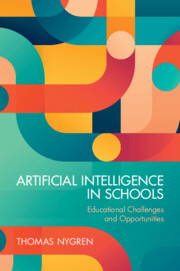
Designed for educators, researchers, and policymakers, this insightful book equips readers with practical strategies, critical perspectives, and ethical insights into integrating AI in education. First published in Swedish in 2023, and here translated, updated, and adapted for an English-speaking international audience, it provides a user-friendly guide to the digital and AI-related challenges and opportunities in today's education systems. Drawing upon cutting-edge research, Thomas Nygren outlines how technology can be usefully integrated into education, not as a replacement for humans, but as a tool that supports and reinforces students' learning. Written in accessible language, topics covered include AI literacy, source awareness, and subject-specific opportunities. The central role of the teacher is emphasized throughout, as is the importance of thoughtful engagement with technology. By guiding the reader through the fastevolving digital transformation in education globally, it ultimately enables students to become informed participants in the digital world.
Education systems were never previously designed for thriving – especially not by everybody. They now need to be, in the face of humanity's predicament. Education's purpose must be explicitly reconceived. Individual outcomes, even if defined as competencies (knowledge, skills, attitudes and values), are necessary but insufficient. Rethinking purpose is motivating and profound work. It is already an important focus in business, politics and civic society. For schools, COVID-19 has deepened the need to rethink their purpose. Schools are still needed, but they must be reinvented. Governments and systems need to support schools in the shift; some already are, including Finland, British Columbia, and New Zealand. The state needs to embrace alternative, broader outputs of schools. The personal experiences of two school leaders in the UK making the shift show how even in unconducive systems, progress is possible.
Recommend this
Email your librarian or administrator to recommend adding this to your organisation's collection.