To save content items to your account,
please confirm that you agree to abide by our usage policies.
If this is the first time you use this feature, you will be asked to authorise Cambridge Core to connect with your account.
Find out more about saving content to .
To save content items to your Kindle, first ensure no-reply@cambridge.org
is added to your Approved Personal Document E-mail List under your Personal Document Settings
on the Manage Your Content and Devices page of your Amazon account. Then enter the ‘name’ part
of your Kindle email address below.
Find out more about saving to your Kindle.
Note you can select to save to either the @free.kindle.com or @kindle.com variations.
‘@free.kindle.com’ emails are free but can only be saved to your device when it is connected to wi-fi.
‘@kindle.com’ emails can be delivered even when you are not connected to wi-fi, but note that service fees apply.
Regional governance systems may resolve the dilemmas of global financial integration, and the Eurozone is the most advanced attempt to do so. The Euroland sovereign debt crisis is a test of this proposition but the outcome finds the EU wanting. The first section places EMU in the broader context of financial liberalisation. The next section shows that we have long known that financial liberalisation is associated with financial instability, demanding robust governance. The subsequent section examines the reaction to the Eurozone crisis, and argues that the lessons available were poorly learned. Although the EU and ECB revealed leadership and crisis management capacity in the financial market phase, the sovereign debt phase of the crisis was less successfully handled, producing conflict among Eurozone members. As a result the Eurozone hangs in the balance.
One puzzle that the crises of the past three years have thrown up is why the financial crisis of the period 2008–09 and the sovereign debt crisis of 2010 had such a different political-institutional fall-out on the Euro area. In both, governments were essentially trying to avert a banking collapse. The Euro area passed the stress test of the financial crisis in the period 2008–09 surprisingly well, especially when compared with the US. By contrast, the turmoil in peripheral countries’ bond markets since late 2009 required the suspension of constitutive principles of economic governance and was a disaster for European political integration. This paper tries to offer an explanation.
This article looks beyond economic explanations of the financial crisis in Iceland, and focuses on the political preconditions for the crisis. The argument is that liberalization of the economy, privatization of the banking sector and lax regulation, together with looting strategies from investors, explain both the rise and fall of the financial sector in Iceland. By examining the historic development of the Icelandic financial sector from 1991 until 2008, I show how fundamental changes, through liberalization and Europeanization, in the economic system made the crisis possible. Data have been collected from official government documents, newspapers, research papers and published reports.
The financial crisis increased the importance of the member states at the expense of European Union (EU) rules on the single market and Economic and Monetary Union. The commission allowed exceptions that could become lasting if the economic downturn persists. At the same time, the EU has supported stronger financial market regulation, but not in corporate governance, where the member states retain reserved powers. The EU only gets and keeps institutions that the member states support.
Political science has, in the past 40 years, developed into a multi-dimensional discipline, training thousands of political scientists who have entered a variety of professions. Its development in Iceland over 40 years has been remarkable, from its small beginnings in 1970 to hosting the largest political science conference in Europe in 2011. However, as the ECPR's founders taught us, political science must always be aware of new challenges and be prepared to innovate and adapt to new realities. The financial crisis that hit Iceland and the world economy in 2008 embodies significant challenges to the discipline, but also opportunities – and notably the opportunity to retrieve the dominance that market economics secured in the past over many political economy analyses. The specific experience of Iceland, as a small state in the north, represents a wake-up call for the discipline, raising key questions relating to the contribution political science can make to understanding the current transformation and to the capacity of the discipline to maintain its relevance.
This article critically assesses the claim that smaller states may be structurally and socially pre-disposed towards more effective government performance. A review of recent experience in Iceland and Ireland indicates that the domestic characteristics that have been argued to foster superior small state performance can, under certain conditions of size and homogeneity, contribute to government failures. Furthermore, experience in these states suggests that high levels of social cohesion and homogeneity may increase the risk of a specific social phenomenon (‘Volkthink’) with adverse consequences for public policy.
The 2007–2009 financial crisis has led to considerable debate about the role of financial industry actors in global regulatory processes. This article seeks to contribute to this debate by assessing when and why financial industry actors mobilise in order to influence securities markets regulations. Do these mobilisation patterns suggest undue influence by a small set of powerful industry actors, or do they reflect the engagement of a more diverse set of actors representing broader public interests? It is argued that variation in mobilisation patterns is a function of: (1) institutional opportunity (the openness and accessibility of regulatory politics); and (2) demonstration effects (how crises increase the salience of regulatory issues). Empirical analyses suggest that the financial crisis diminished the diversity of mobilising actors. This trend, however, is reversed when the news media disseminate information about the costs of weak financial regulation and thereby increase the salience of regulatory issues.
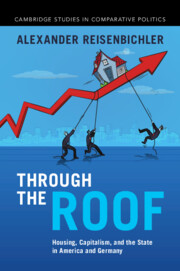
Housing is a defining issue of our time, driving a persistent affordability crisis, financial instability, and economic inequality. Through the Roof examines the crucial role of the state in shaping the housing markets of two economic powerhouses – the United States and Germany. The book starts with a puzzle: Free-market America has vigorously supported homeownership markets with generous government programs, while social-market Germany has slashed policy support for both homeownership and rental markets throughout the past century. The book explains why the two nations have adopted such radically different and unexpected housing policy approaches. Drawing on extensive archival material and interviews with policymakers, it argues that contrasting forms of capitalism – demand-led in the United States and export-oriented in Germany – resulted in divergent housing policies. In both countries, these policies have subsequently transformed capitalism itself.
Housing is the defining issue of our time, driving a persistent affordability crisis, financial instability, and economic inequality. Through the Roof examines the crucial role of the state in shaping the housing markets of two economic powerhouses-the United States and Germany. The book starts with a puzzle: laissez-faire America has vigorously supported homeownership markets with generous government programs, while social democratic Germany has slashed policy support for both homeownership and rental markets. The book explains why both nations have adopted such radically different and unexpected housing policy approaches. Drawing on extensive archival material and interviews with policymakers, it argues that contrasting forms of capitalism-demand-led in the United States and export-oriented in Germany-resulted in divergent housing policies. In both countries, these policies have subsequently transformed capitalism itself.
Chapter 8 emphasises that the transition to financialised banking was no easy shift and only saw exceptional profits for a limited amount of time for European banks, if compared to US banks. This challenges accounts of financialisation that see the transition to US investment banking as a straightforward shift towards higher profits compelled by securities markets. The chapter documents the problems and contradictions that banks experienced internally and externally, and the resistance of Deutsche Bankers to the practices of liability management (LM) as they experienced losses of their traditional power and autonomy over banking practices. This chapter thus shows how unlikely it was initially for Deutsche to transform so thoroughly towards US finance. It argues that LM is better understood as a necessity to accommodate the higher costs, risks and logics of banking in US money markets. While the financial calamity of 2008 propelled a rethink of Deutsche’s path, financialised banking is not easily reversed, and German banks continue to struggle with the need to raise USD funding. As such, we should worry about banks’ USD funding gap as key source of vulnerability and risk. While a few select US banks have excelled in mastering LM as a powerful technique to flexibly (mis-) match their balance sheets, everyone else suffers from the fallout of the relentless near crisis mode of global finance.
This chapter maps out the trajectory of British postmodern fiction in three specific phases: a gradual emergence characterised by slowly increasing textual experimentation in the 1960s and 1970s; a second phase notable for a high level of fictional critique of the political and economic order in the 1980s and 1990s; and a third period in the early twenty-first century, by which point both the techniques and ideas associated with postmodern literature had become so commonplace that they could no longer be considered critically oppositional. In identifying these phases, the chapter departs from Fredric Jameson’s famous suggestion that postmodernism embodies the cultural logic of late capitalism and is therefore completely unable to generate any effective criticism of the dominant ideology of global capitalist societies and shows that at its height British postmodern fiction constituted a genuinely critical form of writing with regard to that ideology.
This chapter describes the critical and speculative capacities of the Occupy novel, or contemporary novels that represent Occupy Wall Street and the Occupy movement more broadly. It argues that such fiction represents the financialization of everyday life, that is, the colonization of personal life and political subjectivity by Wall Street or finance capital. In doing so, it returns the question of social class to the center of US political debates. However, the Occupy novel also speculates on the possibilities of postcapitalist social life; it treats Occupy Wall Street as prefiguring new kinds of economic relations and social conducts. The chapter frames the Occupy novel in terms of its predecessor, the fiction of the post-2008 financial recession (“crunch lit”). Whereas crunch lit diagnoses financialization as a problem of households (personal debt, family crisis, and so on), the Occupy novel asks whether literature (and art in general) might have the capacity to engage in social struggle, to imagine new forms of public life.
In 2020, Lebanon faced one of the worst financial crises since the 1800s, as reported in major news outlets. Severe shortages in the central bank’s US dollar reserves triggered a full financial collapse, compounding crises in sectors like electricity, water, and fuel. This chapter explores the roots of Lebanon’s financial crisis by analyzing its deep dependency on the US dollar. It argues that this reliance traces back to colonial mercantilist influences embedded within Lebanon’s central bank. The chapter highlights recurring patterns in the bank’s historical development, shaped by colonial rationalities. First, it conceptualizes the establishment of Lebanon’s central bank under French colonial rule as a means to monopolize their currency, favor French financial markets, and control the region through debt relations. Second, it shows how these colonial rationalities persisted even after decolonization, becoming entrenched in the bank’s operations. The chapter concludes that these colonial influences have ingrained foreign currency dependency, continuing to shape Lebanon’s contemporary financial landscape.
This conversation addresses the impact of artificial intelligence and sustainability aspects on corporate governance. The speakers explore how technological innovation and sustainability concerns will change the way companies and financial institutions are managed, controlled and regulated. By way of background, the discussion considers the past and recent history of crises, including financial crises and the more recent COVID-19 pandemic. Particular attention is given to the field of auditing, investigating the changing role of internal and external audits. This includes a discussion of the role of regulatory authorities and how their practices will be affected by technological change. Further attention is given to artificial intelligence in the context of businesses and company law. As regards digital transformation, five issues are reflected, namely data, decentralisation, diversification, democratisation and disruption.
The epilogue covers the development from Basel I to III and reflections on the evolution of capital regulation in the long run. Particular emphasis is given to the divergence of risk-weighted and risk-unweighted capital ratios among large, global banks – most of which have their roots in the nineteenth century. The chapter calls for a fundamental reassessment of banking regulation. From a historical perspective, regulatory frameworks are highly path dependent and seldom fundamentally reconsidered, aiming to increase financial stability. Moreover, once we accept a certain degree of banking instability in modern banking, the focus should be on who covers losses and how significant such losses can potentially be without the involvement of the public.
In chapter 3, preparing for crisis, the narrative begins. It is told mainly chronologically and this chapter deals with the period between May 11 and May 19, but only after a brief focus on January 1931 where Harry Siepmann on the basis of the socalled Bagehot model considers what to do in case of a major financial crisis in Europe. The Bagehot model for a lender of last resort and its inadequacy in the face of an international crisis, is a theme that goes through the book’s narrative. On May 11 the Credit Anstalt failure is made known and the central bankers get ready to make sense of the information they get from Austria and elsewhere. The BIS sends Francis Rodd to Vienna and the chapter follows him closely as he communicates his findings back to the BIS and Bank of England. In a world where debt is abundant and credit scarce, Rodd presents a plan to the upcoming BIS board meeting.
After a brief introduction to the outbreak of the Austrian Credit Anstalt crisis in May 1931 and the early response by central bankers from Bank of England, the BIS and the New York Federal Reserve Bank, this chapter proceeds to present the book’s overall issues and main concepts, which will be used as a heuristic framework throughout the narrative. The main concepts of the book are radical uncertainty, sensemaking, narrative emplotment, imagined futures and epistemic communities. In the chapter, I discuss how these concepts are helpful in understanding central bankers’, and other actors’, decision-making and practices in the five month from May through September. The chapter also discusses my analytical strategy and presents the empirical material, which comes from the Bank of England, Bank for International Settlements, the Federal Reserve Bank of New York, the J.P. Morgan Archive, the Rothschild Archive and a few others. At the end of the chapter, I present the structure of the book.
Chapter 1 discusses the shift in Britain’s paper currency from being backed by the metallic standard to becoming an inconvertible currency. It explains how Britain’s war against Revolutionary France disrupted the nation’s fiscal and monetary system, leading to the provincial financial panics that preceded the financial crisis of 1797. This chapter highlights the declaration movement, a nationwide phenomenon where people declared their acceptance of paper currency as money. The movement was not limited to the metropolis and English financial centres, but also occurred across English provinces, Scotland and Ireland. This chapter examines the participants of the movement and argues that its success was due to its inclusive nature, which united people despite their geographical, political and economic differences. It concludes that the declaration movement represented the currency voluntarism that Edmund Burke identified as a key aspect of Britain’s democratic monetary system. This belief in the communal and voluntary nature of currency circulation facilitated the transition to the new regime of inconvertible paper money.
Chapter 7 introduces students to the monetary and financial dimensions of East Asian international relations, which are fragmented regionally while tied closely with the Western-dominated monetary order. Monetary power is arguably as important as military power, but it is not well understood and not commonly included in an IR textbook. As a social construction, monetary and financial power are related to but not equivalent to productive power. East Asia does not stand in isolation, because its contemporary monetary and financial practices and theories are integrated into the global system. Thus, this chapter examines U.S. dollar hegemony. Following a broader discussion of the exchange-rate regimes adopted by East Asian nations, the chapter discusses the 1997–1998 Asian Financial Crisis, a monumental event in post-war East Asian international relations triggered by a currency crisis. The chapter ends with a discussion of the 2008 Great Recession.
We find significant evidence of model misspecification, in the form of neglected serial correlation, in the econometric model of the U.S. housing market used by Taylor (2007) in his critique of monetary policy following the 2001 recession. When we account for that serial correlation, his model fails to replicate the historical paths of housing starts and house price inflation. Further modifications allow us to capture both the housing boom and the bust. Our results suggest that the counterfactual monetary policy proposed by Taylor (2007) would not have averted the pre-financial crisis collapse in the housing market. Additional analysis implies that the burst of house price inflation during the COVID-19 pandemic was not caused by the deviations from the Taylor rule that occurred during this period.