To save content items to your account,
please confirm that you agree to abide by our usage policies.
If this is the first time you use this feature, you will be asked to authorise Cambridge Core to connect with your account.
Find out more about saving content to .
To save content items to your Kindle, first ensure no-reply@cambridge.org
is added to your Approved Personal Document E-mail List under your Personal Document Settings
on the Manage Your Content and Devices page of your Amazon account. Then enter the ‘name’ part
of your Kindle email address below.
Find out more about saving to your Kindle.
Note you can select to save to either the @free.kindle.com or @kindle.com variations.
‘@free.kindle.com’ emails are free but can only be saved to your device when it is connected to wi-fi.
‘@kindle.com’ emails can be delivered even when you are not connected to wi-fi, but note that service fees apply.
This chapter reconstructs the argument of two essays, Of Suicide’ and ‘Of the Immortality of the Soul’, which were published posthumously. In these essays Hume defends that in specific circumstances suicide is morally acceptable and shows himself critical about the doctrine of a ‘future state’. Comparing the two essays with Part 12 of the Dialogues, I elucidate how Hume left us posthumously a testimony of his ambition to counter the religious spirit of his age. In the Dialogues Philo’s challenges Cleanthes’ view that religion forms a necessary support of morality. In ‘Of Suicide’ and ‘Of the Immortality of the Soul’, Hume attacks in a more openly provocative way the Christian morality of his age. As I show in a second part of this chapter, Hume’s views were in the eighteenth century still controversial. It is no coincidence that one of the first editions of the two polemic essays contained a translation of two letters of Rousseau’s Héloïse which offered a more nuanced view on the moral acceptability of suicide and the sacredness of human life. Apparently, some contemporaries were convinced Hume could learn from Rousseau: whether today this view would still prevail, I leave to the reader to decide.
In section 11 of the Enquiry concerning Human Understanding [EHU], “Of a Particular Providence and of a Future State,” Hume attempts to sketch a method for natural theology, a method that establishes clear limits as to what natural theology can show. Unsurprisingly, he does so in the form of a dialogue. I argue that this dialogue is important because, in it, Hume offers a response to the reasoning Butler employs in the Analogy of Religion (1736) in order to establish the existence of a providential God, or what Butler calls a “moral governor” of the universe. Appreciating Hume’s strategy in this dialogue helps us better appreciate Hume’s more radical position in the Dialogues Concerning Natural Religion and suggests a way of understanding the significance of Philo’s reversal in the final section. I claim that what appears to be a concession to religion actually turns out to have significant irreligious implications when considered as an extension of Hume’s response to Butler in EHU 11.
Much of Hume’s Dialogues Concerning Natural Religion is spent debating the experimental design argument for the existence of God. A change of scene occurs in the ninth part of the Dialogues when the character of Demea presents an a priori cosmological argument that purports to demonstrate God’s necessary existence. The argument is then criticized by the characters of Cleanthes and Philo. The conversation in the ninth part of the dialogue has occasioned a mixed legacy. For some scholars, the objections raised by Cleanthes and Philo to the cosmological argument in Part 9 are persuasive and inspiring, whereas for others the objections are ineffective and overrated. This paper critically assesses the mixed legacy of Hume against the cosmological argument, in particular, one of Cleanthes’s famous objections to do with a collection of twenty particles of matter. This objection has had a lasting impact in the philosophy of religion literature in the form of the much disputed, ‘Hume-Edwards Principle’ (HEP). However, I claim that the HEP misrepresents the text on two counts, and that via the spokesperson of Cleanthes, Hume’s point against the cosmological argument has yet to be fully appreciated by critics.
This interpretive chapter attends to an often overlooked feature of the Dialogues: the tone of its repeated disputes. It asks what is the meaning of the tone and probes its value. To do so, it begins with a consideration of character in a dual-sense: the moral character of these disputes between literary characters. It argues that critical engagement with characterization via the lens of literary theory reveals that it is a category mistake to reduce the voice of a fictional character (e.g., Philo) to that of a real person (e.g., Hume). It further contends that if we think of each fictional character as merely a solitary component of a larger narrative flow we are more likely to focus on the basic action that is internal to the narrative, that is: disagreement, rather than who the character speaks for. Finally, it claims that the virtuous disagreement between interlocutors here rehearses an ethics of responsiveness that can be viewed as pointing towards a moral element. Hume’s dramatic sensibilities obscure the ethical temperament of the disagreements yet their posture reflects a gestural phenomenon of responsiveness (per Elise Springer) that might come close to expressing Hume’s ideal form of religion.
This paper examines the themes of history, psychology, and epistemology in Hume’s Natural History of Religion. In the first half, I argue that the origin of religion Hume seeks to uncover in this work is psychological rather than chronological: he is looking for religion’s origin in human nature rather than human history. In doing so, I reject the common view, going all the way back to Hume’s near contemporary Dugald Stewart, that the Natural History is a work of “conjectural history”. Examination of the work itself, and of the use of the term “history” at the time, corroborates the view that a “natural history” of religion, for Hume and his contemporaries, was an early form of what we would now call a theory of religious psychology.
There are significant ambiguities in how “atheism” is to be understood or interpreted. Having considered these, we turn to Hume’s arguments and assess to what extent his views in the Dialogues should be interpreted in these terms. While it is evident that Hume opposed “superstition” and that he was, in this sense, plainly an irreligious thinker, this does not settle the question of his “atheism”. Although Hume has been read by some as an theist of a minimal kind, and by others as a sceptic or agnostic, both these accounts are rejected. Hume was, it is argued, a “hard sceptical atheist”, by which we understand him to take the view that we have probable (non-dogmatic) grounds for denying the theist hypothesis in all its forms. His “speculative atheism” is accompanied by a “practical atheism” which, while firmly opposed “superstition”, is willing to ally itself with both sceptics and those theists (or deists) who share Hume’s opposition to “superstition”.
I take this chapter as an opportunity to ask what Hume might think of rational religious belief given developments in philosophy of religion, epistemology and contemporary cognitive science of religion (which explores the natural roots of religion). To that end, I will consider some basic findings in the cognitive science of religion concerning the origins of religion in human nature. I will also reflect on some significant developments in twentieth-Century philosophy, including recent developments in religious epistemology, that I think Hume might have found insightful. I will argue that twenty-first-century Hume, perhaps ironically in line with the thought of Alvin Plantinga and Nicholas Wolterstorff (who in turn align themselves with Thomas Reid), would defend rational belief in God.
Hume’s Dialogues contains one of the most efficient and rhetorically effective – and consequently influential statements of the problem (or problems) of evil in literature. In the last three parts of the Dialogues, we can see much of the shape of the contemporary debate on the problem, in its various aspects. But, familiar though the main lines of that debate might be, Hume’s presentation of the issues in dramatic form throws up some less familiar angles, as well as posing a question concerning his own views on religion. This chapter will follow the course of the discussion as it unfolds, taking points more or less in the order in which they arise, but organised around the various problems of evil. It ends with a brief consideration of the wider consequences of the discussion.
Darwin read the Dialogues while still formulating his theory of evolution by natural selection. And one might suspect that he would have found there much to please and put to use. But he had already encountered Humean critiques of the argument from design, together with quite effective responses in the work of William Paley. Moreover, in the wake of his reading of Dialogues, Darwin placed greater and greater weight on the on the very sort of analogy that Hume had targeted in Dialogues, that is, drawing similarities between the natural world and products of human design, in service of the inference that the natural world was also designed. Darwin came to reject the conclusion of the argument from design, but his alternative, evolution by natural selection, also relied, heavily, on an analogy between nature and human artifice, the breeder’s art. But an important passage in the conclusion to the Origin suggests an important influence of the Dialogues, especially when taken together with Darwin’s quite wide-ranging reading of Hume.
At points in the Dialogues Philo appears to favor the Stratonian theory that matter is endued with an inherent principle of self-organization—the hypothesis that order is endogenous to matter, and need not be imposed by any external organizing principle such as thought, design, cosmological pollination or insemination. Moreover, on two occasions Philo seems to say that it is “plausible” or even “probable” that the self-organization of matter proceeds by absolute necessity, such that if we could “penetrate into the intimate nature of bodies”, we would be able to see that it “was absolutely impossible, they could ever admit of any other disposition.” (DNR 6.12, 9.10) I first consider Philo’s purposes in advancing the Stratonian hypothesis, and in framing this theory in the language of absolute necessity. I show that Philo’s reasoning here is ad hominem, and proceeds upon a number of methodological assumptions that Philo himself does not share. I also consider Hume’s own purposes in having Philo feint in this way, and suggest that Hume intends to deliver a message about the pointlessness of hankering after ultimate explanations in natural theology and philosophy.
This essay examines the relationship between sceptical attitudes and religious belief in David Hume’s Dialogues concerning Natural Religion. Understanding Hume’s thoughts on scepticism is one of the most important – if not the most important – keys to unlocking his thoughts on the legitimacy of reasoning in mathematics, science and philosophy. Intense controversies swirl around his explicit arguments and analyses of sceptical themes in his A Treatise of Human Nature and Enquiry concerning Human Understanding along with various essays. While some argue that Hume’s approach to scepticism changes in these various works, especially between the Treatise and Enquiry, this essay shows how examining Hume’s discussion in his Dialogues sheds light on his overall stance toward scepticism. And this understanding of his approach in turn opens up new ways of looking at how the various characters in the Dialogues can be read as advocating or illustrating Hume’s epistemological stance. Exploring these issues will also allow us to see how Hume anticipates certain aspects of contemporary debates about reasoning about the nature of logic in general and counterpossible reasoning more specifically.
Plato writes narrated (as distinct from dramatic) dialogues in his ‘middle’ period. Some are narrated throughout, others are introduced and sometimes interrupted by a dramatic frame dialogue, highlighting the fictiveness of the conversation being represented. In one group, Socrates himself narrates conversations he had with boys or teenagers or young men: Charmides, Lysis, Euthydemus. Here Plato pursues themes appropriate to the genre of ‘erotic’ dialogue, where narration can exhibit the comedy of interactions between his characters. Sometimes another speaker recounts a conversation in which Socrates participated: Phaedo, Symposium, Parmenides (Theaetetus is an abortive further example; Protagoras, narrated by Socrates himself, has many affinities with Symposium). These three dialogues employ distancing mechanisms coupled with ostentatious but self-defeating claims of veracity and reliability, indicating remoteness from what Socrates himself in fact taught. Finally, I take up the suggestion that Plato sticks with the mode of narrated dialogue in Republic because he has by now developed theoretical scruples about the ethical propriety of direct dramatic representation.
This volume offers perspectives on examples of key ingredients in Plato’s writing: particularly of argument, allegory, images, and myth, of intertextuality, and of paradox, but also his characterization of speakers he portrays in dialogue, now through narration, now direct dramatic presentation, and his assumed readerships. All the essays included were prompted by perception of something problematic: either in a passage within a dialogue itself, or in the way scholarship had tackled or failed to tackle a topic. First come three approaching the corpus as a whole, three different vantage points. The next group of three focus on arguments and disputants within the overall argumentative structure of three very different dialogues: Gorgias, Cratylus, and Parmenides. A third group contains two studies of celebrated imaginative fictions – the Noble Lie and the Cave – that perform key but unstraightforward roles in the philosophical strategy of the Republic. The final six chapters discuss the Laws. They explore further literary and philosophical dimensions of Plato’s writing in the last and longest of his dialogues, nowadays yielding up more philosophical rewards than was once the case.
In this opening chapter, I attempt to situate Plato’s philosophizing and literary production in its historical context. The evidence external to the dialogues that such an enterprise can rely on is either scrappy or suspect, or both. So what I offer here is a series of snapshots. They follow a chronological sequence, from Plato’s relationship with Socrates and the Athens that executed him; through his momentous first visit to Italy and Sicily and its impact on his thinking about politics and philosophy; to the founding of the Academy, Plato’s rivalry with Isocrates, and the birth of the theory of Forms; and ending with the worlds of the late dialogues.
11. Social theories develop and transform in and through dialogues that simultaneously take place in multiple interactions and dialogues between the creator of a theory and numerous other factors. They provide us with rich evidence of struggles and tensions between:
creative individuals and powerful institutions dominated by political, ideological, and religious forces
general patterns of thought in specific time periods due to cultural and historical influences (zeitgeist)
creative individuals and audiences (peers, the public)
creative individuals and their doubts, hopes, and imagined others.
Throughout these dialogues, we have observed responses to the question ‘who is the individual and what is society’, which dominated Moscovici’s thinking throughout his life. They also answered another query that he kept raising: ‘what is “social” about social psychology’ (Moscovici, 1972/2000, p. 54)? To that end, the theory of social representations and communication is approaching its goal. It has showed who the Self is and who Others are, and who is individual and what is society. By following this path, and by exploring in a holistic manner the dynamic and complex phenomena in daily practices, such as health, education, politics, and ecology, it has the potential of becoming an anthropology of modern culture.
This chapter discusses Pope Gregory the Great’s ideas about visions and the afterlife, and how they were received in the early middle ages. To provide a fuller picture of Gregory’s ideas about afterlife visions, the chapter discusses his thought more generally about visions and dreams, especially the two main themes of this thought: the nature of dreams and visions, as ways through which invisible realities might be perceived; and the nature of afterlife visions, especially whether they represented the afterlife allegorically or as it was. The reception of Gregory’s ideas was influenced by the existing tradition of narrating afterlife visions and the way his works were excerpted and abbreviated to suit new needs. This process made Gregory known both as a proponent of the reality of visions and the author of a teaching critical of dreams, and his Dialogues an influential source of imagery for afterlife visions.
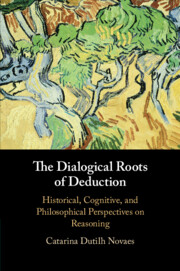
This comprehensive account of the concept and practices of deduction is the first to bring together perspectives from philosophy, history, psychology and cognitive science, and mathematical practice. Catarina Dutilh Novaes draws on all of these perspectives to argue for an overarching conceptualization of deduction as a dialogical practice: deduction has dialogical roots, and these dialogical roots are still largely present both in theories and in practices of deduction. Dutilh Novaes' account also highlights the deeply human and in fact social nature of deduction, as embedded in actual human practices; as such, it presents a highly innovative account of deduction. The book will be of interest to a wide range of readers, from advanced students to senior scholars, and from philosophers to mathematicians and cognitive scientists.
We analyzed the conversational corpora of two German and two English children to investigate how the different use types of the adversative connectives aber and but influence the probability of monologically versus dialogically constructed utterances in the first year of use. Our findings show that children produce adversative connectives mainly in dialogic structures for illocutionary and theme-management purposes, but that the use types of adversative connectives lead to a different distribution of monologic and dialogic clause combinations. The results suggest that monologic and dialogic realizations as a function of text type must be considered when describing the developmental trajectory of the different use types of adversative connectives.
This chapter considers the collective body of writings associated with the ninth-century court of Alfred for the purpose of reconstructing the books available to Alfred and his circle. Three of these texts, the Pastoral Care, the Dialogues and the Ecclesiastical History, are fairly close translations of the original works, all of which were well known in earlier Anglo-Saxon England. The Alfredian version is the earliest evidence for the knowledge of the Consolatio in England. The possibility that the Alfredian circle drew on a commentary on the Latin Boethius has been much discussed. The main source of the Old English Orosius is the fifth-century Latin text of Paulus Orosius, entitled Historiae adversum paganos libri septem. The annals known as the Anglo-Saxon Chronicle are thought first to have been compiled in King Alfred's circle during the last decade of the ninth century.
Recommend this
Email your librarian or administrator to recommend adding this to your organisation's collection.