To save content items to your account,
please confirm that you agree to abide by our usage policies.
If this is the first time you use this feature, you will be asked to authorise Cambridge Core to connect with your account.
Find out more about saving content to .
To save content items to your Kindle, first ensure no-reply@cambridge.org
is added to your Approved Personal Document E-mail List under your Personal Document Settings
on the Manage Your Content and Devices page of your Amazon account. Then enter the ‘name’ part
of your Kindle email address below.
Find out more about saving to your Kindle.
Note you can select to save to either the @free.kindle.com or @kindle.com variations.
‘@free.kindle.com’ emails are free but can only be saved to your device when it is connected to wi-fi.
‘@kindle.com’ emails can be delivered even when you are not connected to wi-fi, but note that service fees apply.
This chapter asks the first of three questions about aid projects: what happens when politics is made central to its work. Charitable humanitarianism usually promotes itself as operating outside of politics. In Southern Africa, the Clutton-Brocks practised a form of inter-racial cooperation with the politics very much left in. The Cold Comfort Farm experiment near Harare was an affront to white minority rule. Clutton-Brock was deported, and his chief collaborator, Didymus Mutasa, was imprisoned. It failed as a practical aid project. Yet the grassroots initiative inspired others to establish similar ventures elsewhere: at Nyafaru on the border with Mozambique; in Malawi; and, most significantly, in Ruvuma in Tanzania. The memoirs and biographies of many Zimbabwean political leaders mention Clutton-Brock and Cold Comfort Farm for not only alleviating poverty through cooperative self-help but also for placing the spotlight on the underlying causes of poverty: the racist legislation of the Rhodesian government, particularly in regard to land tenure and ownership.
The chapter presents a novel perspective on exit, expanding it beyond physical migration from one country to another. It introduces the idea of death as a permanent form of exit, emphasizing its substantial influence on political dynamics. The text posits that voter exit is a critical factor in the survival of regimes, complementing various strategies employed by ruling parties to maintain their grip on power. This chapter also discusses the literature on dominant parties and different regime types. This chapter lays the groundwork for the rest of the book, exploring these themes in greater depth and detail. Exit, through migration and mortality, is a pivotal element for understanding the complexities of political stability and regime longevity.
There are many explanations for the survival of long-serving political parties, from access to state wealth to the use of excessive violence. A yet unexplored reason, particularly for parties that have survived under extreme conditions, is voter exit. In Death, Diversion, and Departure, Chipo Dendere shows that voter exit creates new opportunities for authoritarian regime survival. With an empirical focus on Zimbabwe, Dendere centers two types of voter exit: death and migration. She shows how the exit of young, urban, and working professional voters because of mass death due to the AIDS pandemic and mass migration in the wake of economic decline has increased the resilience of a regime that may have otherwise lost power. With authoritarianism on the rise globally and many citizens considering leaving home, Death, Diversion, and Departure provides timely insights into the impact of voter exit.
Cross-border remittances from South Africa have played a central role in the food availability and well-being of migrant labour households in semi-arid Zimbabwe. However, the outbreak of the COVID-19 pandemic and containment measures introduced by both the South African and Zimbabwean governments hampered the cross-border remittance system and the movement of goods. This paper explores the food provisioning and availability impacts of the changes brought by the cocktail of policy measures on migrant sending households, and whether these households were able to find alternative food sources locally. The study highlights a precarious situation for affected households, which saw their main source of food provisioning curtailed. It argues that the situation was further aggravated by the risk associated with alternative remittance channels, and the non-availability of local alternatives for these households, which were excluded from accessing food parcels/aid by the criteria used to determine beneficiaries. The paper demonstrates the vulnerability of migrant labour households to economic and labour market changes.
This section draws on previous chapters to compare Zimbabwe to other resource-wealthy states in Southern Africa, particularly Botswana, Namibia, South Africa, and Zambia. In all these states, resource sector policy has been essential to these states’ historical and institutional development. However, this chapter looks at how, even given many advantages and a level of development that was once ahead of these states regarding state capacity and democratization, Zimbabwe has fallen distinctly behind these other states. An overview of the resource sector shows that timing matters as other resource sectors are far more institutionalized than Zimbabwe and, while often leaving much to be desired, have not led to the same level of institutional and political decline. While these other states have had many of the same challenges and have had extreme difficulties, Zimbabwe has nonetheless been at the far end of the bell curve when it comes to resource curse dynamics.
This chapter introduces the central puzzle of this study: why, in contrast to other states in Southern Africa, have Zimbabwean democratic institutions stagnated or even declined since independence in 1980? To begin to answer this question, an overview of the resource sector in Zimbabwe, particularly the large diamond found in 2006, and the development of institutions since Zimbabwe became independent in 1980, is given. Furthermore, an institutional analysis, a brief overview of past studies, and a research design are outlined. In terms of case selection, Zimbabwe is placed in the overall population of cases when it comes to resource curse dynamics, and the concept of the “opaque” state is defined. Furthermore, Zimbabwe is defined in terms of democratization and state capacity, concepts that will be used throughout the study.
This chapter draws on past theories of ownership structure in the oil sector and applies them to the alluvial diamond sector in Zimbabwe. The alluvial diamond sector in Zimbabwe presents a natural experiment for understanding ownership structure in that the state and ruling party have been the same since 2006. Still, at least six different ownership regimes have been attempted. This chapter traces each of these and examines how the unpredictability of ownership in the diamond sector has often led to large-scale diamond smuggling and a regulatory framework reflective of political dynamics. The unpredictability of ownership has, in and of itself, caused difficulty in the Zimbabwean diamond sector and has reflected the unpredictability of state institutions. Thus, this chapter argues that past approaches that have been developed to examine the oil sector of states have some relevance for states that have a large amount of alluvial diamond wealth. However, the unique ability for a large amount of diamond wealth to be smuggled into a small space has made the significant increase in diamond wealth since 2006 a challenge for the formal economy and state capacity.
This chapter focuses on past literature on resource-wealthy countries and examines how alluvial diamond wealth may present unique challenges for states. State theory is discussed, and the “opaque” state concept is compared and contrasted with these. Then, an overview of different arguments that have been made to explain the relative decline of Zimbabwean institutions is given. Most of these can fall into three central categories: the psychology of leaders in ZANU-PF, the failure of economic policy, and external sanctions. The large diamond find in eastern Zimbabwe in 2006 is presented as a “critical juncture” for Zimbabwean institutions. Thus, this chapter places Zimbabwe in the overall population of cases when it comes to resource wealth and compares and contrasts how past approaches to resource politics, which have heavily focused on the oil sector, provide a roadmap for examining alluvial diamond wealth. However, this research must also be built upon as different resources, particularly a rapid increase in alluvial diamond wealth in the case of Zimbabwe, bring various challenges to state capacity and democratization.
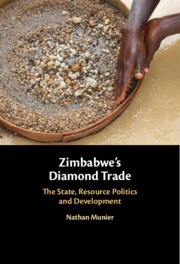
What happens when states experience a rapid increase in resource wealth? This book examines the significant diamond find in eastern Zimbabwe in 2006, possibly the largest in over 100 years, and its influence on the institutional trajectory of the country. Nathan Munier examines how this rapid increase in resource production shaped the policies available to political actors, providing a fresh understanding of the perpetuation of ZANU-PF rule and the variation in the trajectory of institutions in Zimbabwe compared to other Southern African states. This study places Zimbabwe amongst the overall population of resource-wealthy countries such as such as Angola, Botswana, Namibia and South Africa, especially those that experience a significant increase in production. In doing so, Munier contributes to the understanding of resource politics, political economy, and comparative African politics.
Global crises have wreaked havoc on the world economy, causing severe instability and retrenchment of employees in many countries. This necessitates interrogating the retrenchment laws that seek to resolve issues and encourage fruitful outcomes throughout the work ecosystem. This article explores stakeholders’ perceptions of Zimbabwe’s retrenchment laws. The research utilised a qualitative approach with 68 participants, including employers, employees, trade unionists, legal practitioners, and labour consultants. The study revealed that employers were not utilising available special measures to avoid retrenchment. Stakeholders faced challenges such as difficulties in interpreting the retrenchment sections in the Labour Act, distance, processes which are lengthy and costly, and compliance. Further, this study underscores the tension between organisational survival and employee rights, framed through proximity justice and organisational justice theories. The primary recommendation is that retrenchments should be carefully planned, well-thought-out, and purposefully carried out in order to prevent legal disputes. Employers should exercise patience to carry out a thorough analysis of the problems before retrenching employees. Although this research sought to increase knowledge of retrenchment laws, such findings call for additional research using longitudinal and cross-sectional field surveys.
In this chapter, we problematise the concept of mother tongue education in Africa in regard to the following: (i) UNESCO’s problem-solving paradigm applied to the African educational scenario; (ii) the role played by literacy as an epistemological framework in mother tongue education; (iii) the role of public education vs non-state actors as well as the role of language activism in this context; and (iv) mother tongue education as a bridge to reinforce a sense of community and sharing. We also discuss the politics of mother tongue education in Zimbabwe. By doing so, we prioritise the Zimbabwean perspective and experience in regard to language issues, avoiding the reproduction of South African-dominant interpretations of Zimbabwe.
Mental illness affects an estimated 500 million people globally, with 85% living in low- and medium-income countries (LMICs). Research has shown that people with mental illness are over-represented in the criminal justice system compared with the general population. There is limited information available on institutional attitudes towards mental illness in LMICs.
Aims
This study aimed to examine mental health literacy (MHL) and mental health stigma (MHS) among Zimbabwe Prisons and Correctional Service (ZPCS) officers.
Method
A cross-sectional study using an online survey was conducted among ZPCS officers (N = 163) between August and December 2022. Data were collected using the Mental Health Literacy Scale (MHLS) and Attitudes Towards Mentally Ill Offenders (ATMIO). The primary hypothesis was that increased MHL is inversely related to MHS in this group.
Results
A significant inverse correlation was found between MHL and MHS (r = 0.36, P < 0.001). A regression analysis controlling for age and sex showed that MHLS is a statistically significant component in this model, indicating that MHL is associated with reduced MHS (P < 0.001).
Conclusions
In this group, increased MHL is associated with decreased MHS. This suggests that interventions to increase MHL should be further evaluated in these settings.
Pentecostal charismatic churches that preach prosperity gospel in Zimbabwe have attracted a youthful membership. In the context of a deeply uncertain economic future, young Pentecostal Christians devise performativity strategies for optimizing their chances of converting prosperity gospel into material prosperity. These strategies include sartorial elegance in adorning counterfeit suits, the performance of obedience, and the use of social media technologies. The picture that emerges is a complex and at times contradictory one in which the potential realization of upward spiritual and social mobility rests, ultimately, on the transformative and volatile nature of value. Data for this project was collected in Harare through ethnographic research and interviews over a year-long period.
Little is known about the prevalence of post-traumatic stress disorder (PTSD) in emerging adults living with HIV in low-income countries.
Aims
Determine prevalence of trauma exposure, prevalence of probable PTSD and conditional prevalence of probable PTSD for different traumatic events; and better understand the experiences of individuals with HIV and PTSD.
Method
This mixed method study used secondary data from a cross-sectional survey of people (N = 222) aged 18 to 29 living with HIV in Zimbabwe and primary qualitative data collection. The PTSD Checklist for DSM-5 (PCL-5) and the Life Events Checklist for DSM-5 (LEC-5) were used to measure PTSD and exposure to traumatic events, both translated to Shona. In-depth interviews (n = 8) with participants who met the criteria for probable PTSD were analysed using thematic analysis.
Results
In all, 68.3% [95% CI (61.4–74.1)] of participants reported exposure to at least one traumatic event. The observed prevalence of probable PTSD was 8.6% [95% CI (5.2–13.0)], most observed following exposure to fire or explosion 29.0% [95% CI (13.0–45.0)] and sexual assault 27.8% [95% CI (7.2–48.7)]. Probable PTSD was also more prevalent following multiple exposure to trauma; four and six events, N = 4 (21%) [95% CI (5.1–8.8)] each, two and three events N = 3 (15.7%) [95% CI (5.9–9.2)] each, and five events N = 1 (5.4%) [95% CI (7.5–9.6)]. Qualitative results indicated that HIV stigma exacerbated psychological distress from trauma.
Conclusions
Despite trauma exposure being common, prevalence of probable PTSD was not high, but was higher in those with multiple exposures. Participants described coping strategies, including social support and religious thinking.
During the Nigerian Civil War, France became the main supplier of military assistance to the secessionist Biafra. In a neo-imperial pursuit to weaken the potential regional hegemon Nigeria, it secretly provided arms and ammunition to the Biafrans in collusion with Côte d'Ivoire and Gabon. Yet the driving force behind this Franco-African arms triangle was not the Elysée, but the Ivorian president Félix Houphouët-Boigny. Newly unearthed documentary evidence from French archives enables this article to break new historiographical ground: firstly, to show the Elysée's sheer reluctance to militarily assist Biafra and lack of a coherent policy in doing so; secondly, to confirm Houphouët-Boigny as the “mastermind” behind the arming of Biafra, as well as to identify his Cold War motivations; thirdly, to uncover Gabonese president Omar Bongo's increasing agency and influence in the scheme; fourthly, to demonstrate that it was the Ivorian and Gabonese presidents who transformed the arms triangle into a square by bringing the Rhodesians and, especially, the South Africans in; and, finally, to retrace the emergence and functioning of the “African-French” military assistance to Biafra at the policy level not only from Paris's, but also Abidjan's and Libreville's perspectives.
Systematic priority setting is necessary for achieving high-quality healthcare using limited resources in low- and middle-income countries. Health technology assessment (HTA) is a tool that can be used for systematic priority setting. The objective of this study was to conduct a stakeholder and situational analysis of HTA in Zimbabwe.
Methods
We identified and analyzed stakeholders using the International Decision Support Initiative checklist. The identified stakeholders were invited to an HTA workshop convened at the University of Zimbabwe. We used an existing HTA situational analysis questionnaire to ask for participants’ views on the need, demand, and supply of HTA. A follow-up survey was done among representatives of stakeholder organizations that failed to attend the workshop. We reviewed two health policy documents relevant to the HTA. Qualitative data from the survey and document review were analyzed using thematic analysis.
Results
Forty-eight organizations were identified as stakeholders for HTA in Zimbabwe. A total of 41 respondents from these stakeholder organizations participated in the survey. Respondents highlighted that the HTA was needed for transparent decision making. The demand for HTA-related evidence was high except for the health economic and ethics dimensions, perhaps reflecting a lack of awareness. Ministry of Health was listed as a major supplier of HTA data.
Conclusions
There is no formal HTA agency in the Zimbabwe healthcare system. Various institutions make decisions on prioritization, procurement, and coverage of health services. The activities undertaken by these organizations provide context for the institutionalization of HTA in Zimbabwe.
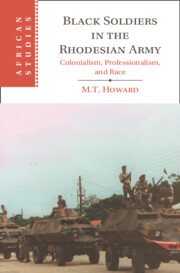
During Zimbabwe's war of liberation (1965–80), fought between Zimbabwean nationalists and the minority-white Rhodesian settler-colonial regime, thousands of black soldiers volunteered for and served in the Rhodesian Army. This seeming paradox has often been noted by scholars and military researchers, yet little has been heard from black Rhodesian veterans themselves. Drawing from original interviews with black Rhodesian veterans and extensive archival research, M. T. Howard tackles the question of why so many black soldiers fought steadfastly and effectively for the Rhodesian Army, demonstrating that they felt loyalty to their comrades and regiments and not the Smith regime. Howard also shows that units in which black soldiers served – particularly the Rhodesian African Rifles – were fundamental to the Rhodesian counter-insurgency campaign. Highlighting the pivotal role black Rhodesian veterans played during both the war and the tumultuous early years of independence, this is a crucial contribution to the study of Zimbabwean decolonisation.
The doctrine of subrogation, like many other legal principles in Zimbabwean insurance law, has evolved with changing times. The position in Zimbabwe (which was adopted from English law) is that a subrogated insurer who intends to enforce the insured's right to recover compensation for the insured loss from a third party can only do so in the name of the insured. The reason is that the insured is the custodian of legal rights against the third party; the insurer's rights only relate to the insured and not the third party. This research discusses legal developments in South African law and how they may be adopted in Zimbabwe in order to advance the rights of the parties in subrogation proceedings.
The chapter seeks to understand how the 2030 Agenda expressed through the Sustainable Development Goals (SDGs) and climate urbanism reconfigure urban planning and related processes in Zimbabwe. As discourses of climate change and sustainability have gained traction, urban planning plays a critical role in achieving carbon-free societies. Through the case study of three Zimbabwean cities (Harare, Bulawayo and Gweru), the chapter aims to highlight opportunities and challenges presented to urban planning by Agenda 2030. The chapter employs primary and secondary data sources to understand how urban planning in Africa, and particularly in Zimbabwe, is being shaped by the climate discourse. As such, the chapter contends that there is a seemingly discernible paradigm shift in terms of urban planning processes in Zimbabwe, which seems to be drifting towards a multilateral planning vision dominated by climate-centred urban planning policies. It must be noted that climate-centred urbanisation will be useful in future in curbing and dealing with pandemics like COVID-19. However, it should be noted that climate-centred urban planning processes seem to be more abstract thinking than operationalisation. Finally, the chapter suggests ways to promote a pragmatic shift from abstract thinking to operationalisation of climate-friendly urban planning.