To save content items to your account,
please confirm that you agree to abide by our usage policies.
If this is the first time you use this feature, you will be asked to authorise Cambridge Core to connect with your account.
Find out more about saving content to .
To save content items to your Kindle, first ensure no-reply@cambridge.org
is added to your Approved Personal Document E-mail List under your Personal Document Settings
on the Manage Your Content and Devices page of your Amazon account. Then enter the ‘name’ part
of your Kindle email address below.
Find out more about saving to your Kindle.
Note you can select to save to either the @free.kindle.com or @kindle.com variations.
‘@free.kindle.com’ emails are free but can only be saved to your device when it is connected to wi-fi.
‘@kindle.com’ emails can be delivered even when you are not connected to wi-fi, but note that service fees apply.
Chapter 2 considers the desire to escape impressionism which shaped Yeats’s early writings. Yeats’s formative visual interests are usually discussed in terms of the tastes he inherited from his Pre-Raphaelite father, but in his early verse and criticism he would often also express hatred for, and a desire to escape, French art of the later nineteenth century. In his writings of the 1890s and 1900s, it is the paintings of Édouard Manet which most disturb Yeats, appearing repeatedly to threaten his early theories of symbolism. Time and again, Yeats strove to counter them with the art of Titian, which came to serve as a paradigm for his own evolving poetics. The present chapter considers the antagonism in Yeats’s thought between modern French painting and the art of the Renaissance, as well as the cognate binaries (of hard outline against glimmering colour, unity against disunity) this came to encompass, before exploring their formative influence on the symbolist poetics he was developing at the turn of the century.
Chapter 7 examines representations of the afterlife: the heavens and purgatory. Venetian artists created some of the most spectacular visions of paradise of the century, works that pulse with vibrancy and life, deploying a series of artistic devices to insist on the veracity of the supernatural. Venice was also home to one of the earliest and most comprehensive purgatorial cycles in Italy, a theme that became an ever more popular one as the seventeenth century progressed.
This chapter studies the painted representation of mirror reflections and the female nude in High Renaissance art, from Giorgione’s bella donna at her toilet to the Rokeby Venus. Situating this imagery within the cultural contexts of betrothal and marriage, it highlights the allegorical relationship between the female nude and the mirror reflection as the conjoined pictorial emblems of Renaissance art’s beauty.
This letter comments on the affinities between prudence and moderation. It starts from the definition of prudence given by the sixteenth-century Spanish writer Baltasar Gracián in his classic book, The Pocket Oracle and the Art of Prudence (1647), and then examines the different faces of prudence as illustrated by Titian’s famous Allegory of Prudence.
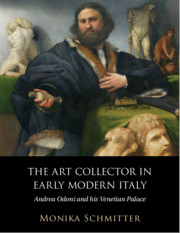
Lorenzo Lotto's Portrait of Andrea Odoni is one of the most famous paintings of the Italian Renaissance. Son of an immigrant and a member of the non-noble citizen class, Odoni understood how the power of art could make a name for himself and his family in his adopted homeland. Far from emulating Venetian patricians, however, he set himself apart through the works he collected and the way he displayed them. In this book, Monika Schmitter imaginatively reconstructs Odoni's house – essentially a 'portrait' of Odoni through his surroundings and possessions. Schmitter's detailed analysis of Odoni's life and portrait reveals how sixteenth-century individuals drew on contemporary ideas about spirituality, history, and science to forge their own theories about the power of things and the agency of object. She shows how Lotto's painting served as a meta-commentary on the practice of collecting and on the ability of material things to transform the self.
Recommend this
Email your librarian or administrator to recommend adding this to your organisation's collection.