To save content items to your account,
please confirm that you agree to abide by our usage policies.
If this is the first time you use this feature, you will be asked to authorise Cambridge Core to connect with your account.
Find out more about saving content to .
To save content items to your Kindle, first ensure no-reply@cambridge.org
is added to your Approved Personal Document E-mail List under your Personal Document Settings
on the Manage Your Content and Devices page of your Amazon account. Then enter the ‘name’ part
of your Kindle email address below.
Find out more about saving to your Kindle.
Note you can select to save to either the @free.kindle.com or @kindle.com variations.
‘@free.kindle.com’ emails are free but can only be saved to your device when it is connected to wi-fi.
‘@kindle.com’ emails can be delivered even when you are not connected to wi-fi, but note that service fees apply.
This chapter explores works by two contemporary London-based Black British playwrights who also direct, produce, and perform: debbie tucker green and Mojisola Adebayo. Examining plays produced and performed between 2005 and 2019, the chapter suggests that both women create distinctive work that combines singular dramaturgy with transformative politics, shifting the framing of spectatorial perspective. They are also known for making innovative, experimental, and poetical work at the intersection of aesthetics and politics. The chapter traces the Blochian utopian possibility of ‘something’s missing’ (etwas fehlt) in tucker green’s dramaturgy of refusal. In her plays, the chapter suggests, we can identify what Herbert Marcuse’s called ‘the Great Refusal’, which develops a utopian sensibility via negation. Frequently working class, Black, and female, tucker green’s belligerent characters reveal to audiences what is missing in their difficult lives, how everything should be different in Britain. In Adebayo’s work, forged in the community-led Black Mime Theatre in the 1990s, utopian possibility forms part of the affective spectatorial encounter with her theatre. Whilst Adebayo’s plays are less abrasive, they similarly highlight what is missing. The transformative energy of her dramaturgy can be seen in utopian foretastes of alternative lives, in which Black, queer, and de-colonial modes of intersubjectivity become possible.
A conversation curated from an online event, Decolonising the Arts in Latin America: Anti-Racist Irruptions in the Art World. Artists from different parts of Latin America talk about their work from a decolonial and anti-racist perspective. Participants include Miriam Álvarez, director of the Mapuche theatre company El Katango; Alejandra Ejido, director of the Afro-Argentine company Teatro en Sepia; Ashanti Dinah Orozco, Afro-Colombian poet and Afro-feminist activist; Rafael Palacios, founder and director of the Afro-contemporary dance company Sankofa Danzafro; and Arissana Pataxó and Denilson Baniwa, Brazilian Indigenous visual artists.
Based on conversations between the authors, two of them directors of theatre companies, one Afro and the other Mapuche, in Argentina, we examine the construction of theatrical poetics, which question colonial criteria of creativity and build alternative spaces for drama production in Argentina. We discuss the development of anti-racist staging practices, which go beyond recognition politics, centring the stage as a point of reconnection of subalternised social trajectories and presenting the lives of Mapuches and Afro-descendants in all their complexity. We focus on four axes: a) theatrical poetics as a way to move and generate community via affective interventions; b) theatre as a method of research into Afro and Mapuche histories and lives in their multiplicity and which can generate dramaturgies that challenge ideologies of a European nation; c) procedures that seek to decolonise the bodies of actresses and audiences, using gestures and embodied memories, and to challenge stereotypes about racialised women; and d) a reconceptualisation of the notion of body-territory to analyse how, using the stage, forms of life are reconstructed in all their heterogeneity. Both companies challenge the project of a white-colonial Argentina and bring politics to art.
A little over a month after the storming of the Bastille, the royal theatre censor was keen to highlight that the Declaration of the Rights of Man and Citizen may have seemingly abolished censorship, but like a phoenix from the ashes, it would rise again at the hands of his fellow citizens. He was proved right. This study explores why that was the case, opening with an examination of contemporaneous definitions of censorship, an overview of the theatrical world at the time in France, and an analysis, using archival material from the regimes from 1788 to 1818, of how theatre could shape the public consciousness. The central argument here is that theatre censorship allowed contemporaries to influence what thousands of people saw (or not), and thus the internalized effects of these plays to shape the world around them.
There is a modern expectation that since Shakespearean theatre is in some respects a popular art form, it should represent ordinary people in a positive or sympathetic light. This hope is frustrated at many points by the hierarchical structure of early modern culture, and its consequent tendency to identify the common people with whatever is ignoble and disorderly – an identification which is deepened, in plays as in society more generally, by the conventional image of the people as a nameless, fickle, and latently rebellious crowd. The pejorative force of these associations is complicated, however, by the fact that something like that very crowd is present in the theatre itself, watching, even co-creating, the show. It is as a formal dimension of the entertainment that ‘the people’ most tellingly take possession of Shakespeare’s stage.
This chapter introduces the discussion of the ineluctable obsolescing of the technological apparatus of theatre. Opening with a discussion of the representation of technological and human obsolescence in Star Trek, this chapter repositions the work of media archaeology, which typically excludes theatre from its purview. And yet, in its attention to the operational dimension of lost, dead, or passing technological instruments, media archaeology locates a network of inquiry profitably directed toward theatre. In a reading of the work of Thomas Elsaesser, Wolfgang Ernst, Jussi Parikka, Rebecca Schneider, and others, this chapter introduces the ways apparatus, nostalgia, and obsolescence provide a lens for thinking contemporary theatre.
Drawing on over 150,000 pages of archival material and hundreds of manuscripts, this is the very first book-length study of theatre censorship in France – both in Paris and the provinces – between the end of the Ancien Régime and the Restoration. Clare Siviter explores the period through the lenses of both traditional bureaucratic notions of censorship and the novel concept of 'lateral censorship', which encompasses a far greater cast of participants, including authors, theatres, critics and audiences. Applying this dual methodology to three key topics – religion, mœurs, and government – she complicates political continuities and ruptures between regimes and questions how effectively theatre censorship worked in practice. By giving a voice back to individual French men and women not often recorded in print, Siviter shows how theatre censorship allowed contemporaries to shape the world around them and how they used theatre to promote or oppose the state, even at its most authoritarian.
Theatre does not merely use technology – it is a technology. In this paradigm-shifting study, W. B. Worthen shows how the dynamics of obsolescence and affective nostalgia that shape the passing of technologies into history also shape and reshape theatrical practice. Locating theatre within rather than outside the orbit of media studies, Theatre as Technology traces the theatre's absorption of, and absorption by, digital culture. Treating subjects as wide-ranging as pandemic-era Zoom theatre, on-stage video and sound technologies, and artificial intelligence, Worthen locates a moment of transformational change in the idea of the theatre, change prompted by the theatre's always-changing, and so always obsolescing, material technologies.
Arts-mediated HIV/AIDS education received significant funding from Ghana’s donor partners and global health institutions during the first two decades of the pandemic. Yet these interventions had a mixed impact. On the one hand, there was – and continues to be – near universal awareness of HIV/AIDS, including risk factors and health outcomes. On the other hand, low condom use and persistent stigma suggest that knowledge has not translated into sexual health protective behaviours and psychosocial support. In Chapter 4, I examine how the arts were incorporated into HIV/AIDS interventions, focusing on the use of mass media campaigns to raise awareness and educate, and on ‘folk media’ to educate and empower communities. I discuss a study that applied a narrative approach to examine local knowledge and lived experience, the findings of which illustrate important contrasts between community and indigenous healing system responses to HIV/AIDS and official health service responses. I will conclude with reflections on what these insights yield for developing more robust arts-based HIV interventions in the future.
This chapter maps the prolific appearance of nautch sundaris (beauties) and jans (beloveds) in South Asian popular visual culture in a period of growing anti-colonial nationalism and anti-nautch regulation in India. Visual traces of dancer-actresses are studied alongside established theatre history primary texts to re-presence the overlooked labour of dancing, a fundamental part of innovative and seditious vernacular dramaturgies that inaugurated modern Bengali drama. Part I, ‘The Age of Mechanical Reprodarshan’, narrates the intimacy of the red-light district and the popular printing presses of Kansaripara Art Studio and Chorebagan Art Studio in Calcutta. It argues that actress-dancers proliferated in print in the unique visual participatory space of darshan. Part II, ‘The Sundaris (Beauties)’ traces the many sundaris – real and fictional – appearing in popular visual prints and in Calcutta’s theatres. Part III, ‘The Jans (Beloveds)’ examines nautch on the humble and ubiquitous matchbox label. A reading of the real and fictional beloveds – Khorshed Jan, Pokhraj Jan, Sanichar Jan, Bani Jan and the celebrated Gauhar Jan (1873 –1930) – explores how the circulation of the Jan series on matchboxes brought about a change in modes of patronage and spectatorship for nautch in the subcontinent in the early twentieth century.
In a time of colonial subjugation, subaltern, illicit and courtesan dancers in India radically disturbed racist, casteist and patriarchal regimes of thought. The criminalized 'nautch' dancer, vilified by both British colonialism and Indian nationalism, appears in this book across multiple locations, materials and timelines: from colonial human exhibits in London to open-air concerts in Kolkata, from heritage Bengali bazaar art to cheap matchbox labels and frayed scrapbooks, and from the late nineteenth century to our world today. Combining historiography and archival research, close reading of dancing bodies in visual culture, analysis of gestures absent and present, and performative writing, Prarthana Purkayastha brings to light rare materials on nautch women, real and fictional outlawed dancers, courtesans and sex-workers from India. Simultaneously, she decolonises existing ontologies of dance and performance as disappearance and advocates for the restless remains of nautch in animating urgent debates on race, caste, gender and sexuality today.
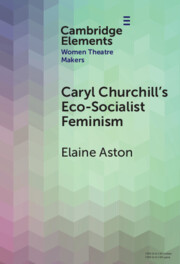
Pivotal to Caryl Churchill's What If If Only (2021) is the ghost of a democratic future that never happened. Framed by What If If Only, if-only yearnings for a democratic future are seminal to this Element with its primary attentions to the feminist, socialist and ecological values of Churchill's theatre. Arguing for the triangulation of the latter, the study elicits insights into: the feeling structures of Churchill's plays; reparative strategies for the renewal of an eco-feminist-socialist politics; the conceptualisation of the 'political is personal' to understand the negative emotional impact that an anti-egalitarian regime has on people's lives; and relations between dystopian criticality and utopian desire. Hannah Proctor's notion of 'anti-adaptive healing' is invoked to propose a summative understanding of Churchill's theatre as engaging audiences in anti-adaptive, resistant feelings towards a capitalist order and healing through a utopic sensing that an alternative future is desirable and still possible.
Throughout the early Stuart period, Catholic seminarians at the Venerable English College, Rome, staged elaborate religious plays for multinational audiences on a nearly annual basis, typically Neo-Latin dramas about martyred English saints. This study shares original archival findings to critically reconstruct the many varieties of music featured in these productions, from French solo song to English madrigals and balletts. This collection of dramatic music includes surviving evidence of English compositions performed in seventeenth-century Italy. The author argues that by embracing foreign musical cultures while also deploying their own musical talents, repertoires, practices, and patronage in service to dramatizations of Catholic martyrdom, this English community was uniquely positioned to build cultural, social, and political connections between Britain and the European Continent during a significant period of rising English hegemony in the Mediterranean region and wider world.
This chapter explores the verse drama, a genre favoured by Michael Field and by several other Victorian poets, including Robert Browning, Alfred, Lord Tennyson, and Algernon Charles Swinburne. This chapter sets Michael Field’s verse dramas in the wider contexts of nineteenth- and early-twentieth-century drama and theatre, including debates about the New Drama (epitomised by Henrik Ibsen), ‘Shakespeare-philia’, and the modernist movement, such as T. S. Eliot’s verse plays.
This chapter chronicles the wide range of theatrical styles at the end of the nineteenth century. In addition to the melodrama, farce, and pantomime popular throughout the century, the period saw the development of more experimental forms such as the well-made play and Naturalism. Michael Field as dramatists were both inspired and confounded by this range of theatrical possibility. While their prose drama A Question of Memory was performed by J. T. Grein’s Independent Theatre Society, the majority of their dramatic work – written in intricate verse, historically rich, and often requiring elaborate staging – proved unperformable during their lifetimes. The chapter argues that in this Michael Field were representative of late-Victorian women dramatists more broadly: while many of the plays associated with the New Drama told women’s stories, the act of telling remained the prerogative of men.
In this chapter, Sarah Parker interviews Tom Floyd and Sophie Goldrick of Shadow Opera about the process of creating Veritable Michael, an opera and podcast inspired by Michael Field’s life and work. Tom Floyd is the Artistic Director of Shadow Opera and Sophie Goldrick is the Producer and mezzo-soprano, who sings the part of Katharine Bradley in the show. In this interview, they respond to questions about how they originally conceived the piece, why opera is a suitable form for telling Katharine Bradley and Edith Cooper’s story, how the collaborative creative process worked, and how audiences have reacted to the performance and the podcast.
In this chapter, Ben Levitas investigates forms of distance and temporal indeterminacy legible in the latter-day revivalist drama of Marina Carr and Brian Friel. In their works, strategies of distance, of “paratheatricality,” seek not to avoid representation but to link it to more authentic experiences for the audience. Both playwrights create a theatre of hope, a theatre for and of the future that testifies to a continuance of the Revival’s main themes and concerns (particularly with respect to time), despite their rejection of the idealism of so many early revivalist works. Friel and Carr achieve a transposition of dramatic life from the stage to the audience – that is to say, from the stage to actual life – which is, in its turn, captured in the dramatic work. Theatrical words are forms of political action insofar as strategies of performative distance and alienation find their place in dramatic productions that support a “grammar of change.”
The academic concept of ‘intermediality’ presents a challenge to traditional artistic boundaries, offering a refreshed sense of the relationship between different kinds of media. This chapter relates such ideas to modernism, considering the work of a group of writers who showed a fascination with the stage but primarily achieved fame in genres other than performed drama. It begins by examining a tension within Ezra Pound’s work: his desire to engage with the stage and yet to dismiss the significance of theatre. The discussion then references the work of James Joyce, D. H. Lawrence, Virginia Woolf, Rabindranath Tagore, and Kōbō Abe. Ultimately, although ‘intermediality’ is sometimes assumed to apply more specifically to a later historical era of advanced media technology, this chapter shows how intermedial thinking can apply productively to modernist cultural products of the earlier twentieth century.
This chapter covers the multivalent, multidirectional relationship that developed between theatre and philosophy during the modernist era. It begins with the rise of German idealism in the eighteenth and nineteenth centuries and its influence on Friedrich Nietzsche’s landmark The Birth of Tragedy Out of the Spirit of Music. From Nietzsche’s own sway over a new generation of dramatists worldwide, the chapters expands to consider other thinkers taken as influences by global theatre-makers as well as leading philosophers and theorists around the world who took explicit interest in the stage. The chapter also explores the tensions inherent in these relationships, including open disavowals of philosophic influence by prominent dramatists and outright criticisms of the entire philosophical project by members of the avant-garde. In both its avowals of influence and disavowals of the same, the interaction between theatre and philosophy in the modernist age proved to be enormously generative for both.
Douglas Clark reveals how moments of willing and will-making pervade English Renaissance drama and play a crucial role in the depiction of selfhood, sin, sociality, and succession. This wide-ranging study synthesizes concepts from historical, legal, philosophical, and theological studies to examine the dramatic performance of the will as both an internal faculty and a legal document. Clark establishes the diverse connections that Shakespeare, Jonson, Middleton, and a range of overlooked playwrights of the early Elizabethan era made between different types and understandings of the will. By doing so, he reveals the little-understood ethical issues to which they gave rise in relation to the mind, emotions, and soul. Understanding the purpose of the will in its multiple forms was a central concern for writers of the time, and Clark shows how this concern profoundly shaped the depiction of life and death in both Elizabethan and Jacobean drama. This title is part of the Flip It Open programme and may also be available as open access. Check our website Cambridge Core for details.