To save content items to your account,
please confirm that you agree to abide by our usage policies.
If this is the first time you use this feature, you will be asked to authorise Cambridge Core to connect with your account.
Find out more about saving content to .
To save content items to your Kindle, first ensure no-reply@cambridge.org
is added to your Approved Personal Document E-mail List under your Personal Document Settings
on the Manage Your Content and Devices page of your Amazon account. Then enter the ‘name’ part
of your Kindle email address below.
Find out more about saving to your Kindle.
Note you can select to save to either the @free.kindle.com or @kindle.com variations.
‘@free.kindle.com’ emails are free but can only be saved to your device when it is connected to wi-fi.
‘@kindle.com’ emails can be delivered even when you are not connected to wi-fi, but note that service fees apply.
The essay reviews the ebb and flow of Jewish conversions to Catholicism, as well as the ambiguous process of categorizing religious identity. It examines the types of accusations launched against conversos, as well as the motivations for such accusals and their gendered nature. The essays discusses the truthfulness of surviving Inquisition records. It compares trials from the Spanish Inquisition’s first decades to those of later years, with particular attention to the presence of Jewish converts from Portugal. These trials demonstrate the complicated, ongoing interactions among Jews, New Christians, and so-called “Old Christians” throughout the Spanish Empire and around the world. The end of the chapter notes the decline of trials for Judaizing in the eighteenth century.
As the Gospel of Truth is read on its own terms, and not through the lens of Irenaeus’s hostility, points of contact come to light with other early gospel literature. The most extensive parallels are with Johannine theology, but echoes of the Gospel of Matthew are also perceptible along with thematic links to the Gospel of Thomas.
The so-called Holiness Code of Leviticus highlights the importance of ethical living if Israel is to be holy as God is holy. This chapter discusses the historical-critical arguments around the composition of the Holiness Code but focuses mainly on bridge Leviticus creates between the holiness of Israel’s tent and God’s tent. Ethical purity is as important as ritual purity in Leviticus and requires holiness in every aspect of Israel’s life.
The theology of Leviticus is also deeply concerned with holiness in time and setting a liturgical rhythm for the people of Israel. The focus on cultic calendars and seasonal festivals is important in understanding how Leviticus views holiness. The rhythms of the people are directed by God’s creation in Genesis and his salvific works in Exodus. These are tied into seasonal harvest and celebrations for the flourishing of God’s people.
This chapter explores the priestly theology of space within the tabernacle and how this expands to the holy land where Israel will dwell. The tabernacle and God’s abiding presence are the center of all holiness for the priestly authors. Only ordained priests may approach his holiness. The consecration of the altar is a high point in the theology of Leviticus and has an impact on its theology of the land and the Jubilee.
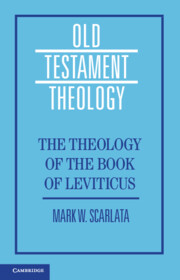
Leviticus is often considered to be one of the most challenging books of the Bible because of its focus on blood sacrifice, infectious diseases, and complicated dietary restrictions. Moreover, scholarly approaches have focused primarily on divisions in the text without considering its overarching theological message. In this volume, Mark W. Scarlata analyses Leviticus' theology, establishing the connection between God's divine presence and Israel's life. Exploring the symbols and rituals of ancient Israel, he traces how Leviticus develops a theology of holiness in space and time, one that weaves together the homes of the Israelites with the home of God. Seen through this theological lens, Leviticus' text demonstrates how to live in the fullness of God's holy presence and in harmony with one another and the land. Its theological vision also offers insights into how we might live today in a re-sacralized world that cherishes human dignity and cares for creation.
The Healing on the Sabbath parable’s focus on higher and lower standing at a feast affirms humility over ostentation. Evoked is the grand meal given by Joseph in honor of his brothers who, on account of his high and their low standing, could not sit with him at his table.
Researchers regularly use large survey studies to examine public political opinion. Surveys running over days and months will necessarily incorporate religious occasions that can introduce variation in public opinion. Using recent survey data from Israel, this study demonstrates that giving surveys on religious occasions (e.g., the Sabbath, Hannukah, Sukkot) can elicit different opinion responses. These effects are found among both religious and non-religious respondents. While incorporating these fluctuations is realistic in longer-term surveys, surveys fielded in a short window inadvertently drawing heavily on a holiday or holy day sample may bias their findings. This study thus urges researchers to be cognizant of ambient religious context when conducting survey studies.
Chapter 10 shows how what began with philosophy’s rendering God superfluous ended in a war against the God of Abraham. Here we have the singularity of the Holocaust, which lies in a singular assault on the Jewish people as the perennial witnesses to that God the God of Abraham. Drawing on the testimony of the Holocaust diaries, written within the whirlwind of the assault on God, this chapter demonstrates that this defining feature of the Holocaust can be seen, for example, in the Nazis’ use of the holy calendar in the execution of their actions, in the prohibitions against prayer and Sabbath observance, in the destruction of synagogues and Hebrew Bibles, and in the targeting of children, elders, and mothers. What the diaries reveal about the essence of Holocaust that the historians cannot, it is argued, is this: The Holocaust was the systematic annihilation of not just of the bodies but of the souls of the Jews as a means of annihilating the God of the Jews. It is unprecedented and unparalleled.
It is a truism that we live in a secular and disenchanted world. This chapter explores what is at stake in our abandonment/eclipse/rejection of a characterization of this world and its life as sacred. Wirzba examines how modern writers came to experience their life as fragmented and disconnected from a sacred cosmos, and how this feeling for life results in varying forms of homelessness. The forced migration of peoples and the destruction of homeplaces in never-before-seen rates testifies to a need to reinvigorate the sense that places are homes for living and for the cherishing of life as a sacred gift. What our refugee world and our mass extinction time needs is a recovery of the goodness, beauty, and hospitable character of our given life.
Moving beyond the familiar focus on the radical puritan reaction, Chapter 3 examines the full range of expressed opposition to the Laudian programme, not just from hard-line puritans, but also from conformists including those in the senior ranks of the Church. These arguments consistently adopted a remarkably conservative mode of defending established orthodoxy in doctrine and practice against recent Laudian innovations, with even puritans invoking the Prayer Book and the 1604 Canons. Even radical presses run by sectarians abroad could juggle with more conservative rhetoric. Most of the arguments of the famous anti-Laudian puritans Henry Burton, John Bastwick and William Prynne still followed more conservative lines (despite the violence of their language) although they radicalised after their punishments. The Scottish opposition to the new Prayer Book, it is argued, was mostly directed against pre-Laudian grievances (with the exception of Robert Baillie’s Ladensium Autokatakrisis which was aimed at English MPs in the Short Parliament). The chapter also analyses the Short Parliament and opposition to the etcetera oath, noting that tactical moderation still meant that the pre-eminent (although not the sole) mode of public debate concerning the Church of England was a conservative one that left the door open for moderate reforms.
The late Roman rabbinic period may be considered the formative period of Jewish festivals. In the early part of this period some festivals were added to those of the Bible, while in the latter part only fast days were added to the calendar. The written sources for portraying the early history of the festivals are the Apocrypha and Pseudepigrapha, the writings of Philo at the beginning of the first century, and the writings of Josephus towards the end of that century. The first day of the month was an important day in the Jewish calendar and the Torah prescribed special sacrifices on that day. The earliest evidence of people gathering together on the Sabbath, found in the Synoptic Gospels, Josephus, and apocryphal sources, is from the time when the Temple still existed. Most of the special dates established in the Second Temple period were connected to the Maccabees and their victories over their enemies.
Recommend this
Email your librarian or administrator to recommend adding this to your organisation's collection.