To save content items to your account,
please confirm that you agree to abide by our usage policies.
If this is the first time you use this feature, you will be asked to authorise Cambridge Core to connect with your account.
Find out more about saving content to .
To save content items to your Kindle, first ensure no-reply@cambridge.org
is added to your Approved Personal Document E-mail List under your Personal Document Settings
on the Manage Your Content and Devices page of your Amazon account. Then enter the ‘name’ part
of your Kindle email address below.
Find out more about saving to your Kindle.
Note you can select to save to either the @free.kindle.com or @kindle.com variations.
‘@free.kindle.com’ emails are free but can only be saved to your device when it is connected to wi-fi.
‘@kindle.com’ emails can be delivered even when you are not connected to wi-fi, but note that service fees apply.
This chapter attends to the legacies of Indian Ocean migrations in Indian contexts, where nationalist politics also underwent a process of conflating national identity with not just territory, but with women as integral to that territorial sense of nationhood. Specifically, it examines queer desire and the gendered construction of the nation through Mauritian writer Ananda Devi’s novel Indian Tango (2007). Devi rewrites Satyajit Ray’s cinematic adaptation (1984) of Rabindranath Tagore’s influential national allegory Ghare-Bāire (The Home and the World) (1916) from a transnational queer feminist perspective. Examining the novel’s intertextual relationship with Tagore’s text, Ray’s film, and early twentieth century anti-indenture discourses, the chapter argues that Devi reorients feminine desire towards an erotic autonomy that reimagines diasporic affiliation and challenges the control of female sexuality within the heterosexual family as the basis of the nation. The assertion of diasporic connection through female erotic autonomy doubly deconstructs the Indian nationalist subject defined through the exclusion of the diasporic other as well as the queer female other.
This chapter connects the threads from the preceding two chapters by examining representations of “India” as part of the social, cultural, and physical landscape of Eastern Africa in fictional works by African authors of Indian descent. In Sophia Mustafa’s In the Shadow of Kirinyaga (2002) and Barlen Pyamootoo’s Bénarès (1999), the diasporic imagination cites and sites symbolic Indian spaces within local African contexts hierarchized by race, class, gender, and ethnicity. Placing these texts in a shared but differentiated discourses of race, colonialism, and nationalism in Mauritius and East Africa, the chapter demonstrates that they inscribe Indian cultural spaces in diasporic locations not to express nostalgia for a distant homeland or to make cultural claims on the locality; but instead, their diasporic imagination moves through local, unresolved histories of colonial, racial, and gendered violence, uniquely sustained by ongoing forms of displacement and dispossession. Anarchival movements in these texts uncover Black migration histories as entangled and interdependent with Indian diasporic insinuation of transnational ties.
This chapter considers the afterlives of slavery in the Indian Ocean through Mauritian writer Shenaz Patel’s Le silence des Chagos (2005), about the expulsion of the inhabitants of the Chagos archipelago from their islands in the wake of late twentieth-century Indian Ocean militarization. Images and narratives circulating in the global media often portray the suffering of Chagossians as a human rights violation, abstracting the event from the particular legacies of slavery, colonialism, and anti-Blackness that continue to weigh on the displaced community. By contrast, Le silence des Chagos tells the story of their expulsion by adapting Chagossians’ testimonies into a novelistic form. Patel’s testimonial fiction constructs a repository of images that enables a sensory and subjective experience of the past. As a composite of these images, the exilic consciousness uncovers Chagossians’ most recent experiences of exile as an extension of the racialized violence in the past. The novel remaps the Indian Ocean enabling a position to critique geopolitical networks of power in the region and identify convergences with Black diasporic accounts of Atlantic crossings.
The Indian Ocean has long connected people, objects, and ideas across continents and cultures. This book asks how contemporary writers reimagine the Indian Ocean through literary figurations of the past. In doing so, it offers an oceanic perspective for rethinking the paradigms of postcolonialism by way of rich historical context and intertextual readings of Afro-Asian fiction. Drawing on historiographical research, archival theory, and literary analysis, this book explores how writers including Amitav Ghosh, Abdulrazak Gurnah, Sophia Mustafa, Ananda Devi, Shenaz Patel, and Barlen Pyamootoo imaginatively probe the historical and cultural legacies of transoceanic pasts within the political contradictions and identarian divisions of the postcolonial present. Traveling between South Asia and Eastern Africa and between the past and the present through literary, filmic, theoretical, and archival texts, this book contends that any understanding of South Asian or African present is incomplete without a consideration of their entangled pasts.
There is limited analysis of the adoption of luxury tourism strategies in Africa. Such strategies promise lower ecological impact and higher tourism revenues. Through an analysis of economic data and secondary literature, as well as interviews conducted in Mauritius, Botswana, and Rwanda, this article examines why once luxury tourism strategies are adopted and do not deliver expected results, some countries reverse these strategies while others do not. Contrary to recent African political economy literature, this paper shows that “democratic” governments (Mauritius, Botswana) with shorter-term horizons have more flexibility in adapting their strategies compared to “authoritarian” governments with longer-term horizons (Rwanda).
Humans often participate in physically harmful and demanding rituals with no apparent material benefits. Although such behaviours have traditionally been explained using the lens of costly signalling theory, we question whether the canonical theory can be applied to the case of human cooperative signals and introduce a modification of this theory based on differential benefit estimation. We propose that along with cooperative benefits, committed members also believe in supernaturally induced benefits, which motivate participation in extreme rituals and stabilize their effects on cooperative assortment. Using Thaipusam Kavadi as a prototypical costly ritual, Tamil (ingroup) and Christian (outgroup) participants in Mauritius (N = 369) assessed the cost and benefits of Kavadi participation or hiking. We found that ingroup participants estimated material costs as larger than outgroups, physical costs as lower, and benefits as larger. These findings suggest that estimated costs may vary by modality and cultural expectations (e.g. Kavadi participants are not supposed to display pain), while supernaturally induced benefits were consistently reported as larger by ingroups compared to outgroups. We conclude that differential estimation of ritual benefits, not costs, are key to the persistence of extreme rituals and their function in the assortment of committed members, underscoring the role of differential estimation in the cognitive computation of signal utility.
Setting sail from Gujarat across the western Indian Ocean, Chapter 2 disembarks on Mauritius, an island of sugar plantations located between South Asia, Africa, and Australia. At the heart of the chapter is Bel Ombre, a sugar plantation owned by a Gujarati merchant from the port city of Rander and the site of his residence in the late nineteenth century. In Gujarat, old merchant homes erase the wider oceanic context of plantation capitalism, slavery, and indentured labor. An emphasis on family itineraries displaces economic profits and proscribed intimacies. To track these points of contact in the late nineteenth century, the chapter analyzes colonial records of plantation ownership in the notarial records in autopsies, letters of helps, and other documents from the Protector of Immigrations records in the Mauritius National Archive in order to understand the broader context of racial capitalism that shaped life in Gujarat’s ports. The chapter argues that plantations – paradigmatic sites of colonial capital – were intimately connected to Gujarat’s havelis. In doing so it provides a critical understanding of family and belonging beyond the endogamous merchant family.
Chapter 5, focusing mainly on Mauritius and British Guiana, examines the ongoing dialogue between indentured workers, magistrates, public commentators, and colonial administrators over the laws governing labor and their underlying principles. By the 1860s and 1870s, the increasing dissonance between Indians’ perceptions of justice and their legal entitlements and magistrates’ hardening line toward labor discipline and public order had prompted more-direct resistance on the part of laborers. State representatives, in response, defended their actions by portraying Indian indentured workers as a largely docile population that benefited from the colonial labor system but was veined through with moral failings and subject to the cynical influence of disruptive individuals. The fissures between the overseer-state and its charges, already apparent even in its early years, were growing into a yawning chasm as a system that billed itself as supportive of “free labor,” Liberal principles, and moral colonial rule increasingly abandoned its paternalist guise to advocate and practice coercion, restriction of labor mobility, and, when deemed necessary, violent suppression of collective action.
This fourth chapter assesses how indenture grew from its modest beginnings in British Guiana and Mauritius into a global labor system linking the breadth of Britain’s plantation colonies. With the parliamentary critics of slavery and indenture in abeyance and labor organization established as a keystone of colonial and imperial governance in the colonies where it was employed, the overseer-state was free to expand across the empire. It still faced structural, legal, and moral challenges. The most significant obstacle, for the supporters of indenture, was reconciling a system that was exploitative and inherently unfree with the discourses of Liberalism, “free labor,” moral colonization, and just rule. This, in many respects, was the imperial project in microcosm, and the responses of policy, practice, and public discourse adopted to defend indenture developed in tandem with the broader redefinition of the British Empire as a whole.
Chapter 3 argues that during the crucial transition from slavery to apprenticeship and thence to indenture and “free labor” in the 1830s, the state’s oversight of colonial labor systems became one of the most prominent and powerful aspects of colonial governance. The chapter first assesses the central role of the post-emancipation state in colonial labor management in Jamaica, Britain’s most populous, politically prominent, and wealthy colony in the Americas. It then explores the first attempts to introduce Indian indentured labor in British Guiana and Mauritius, examining the motivations for the adaptation of this centuries-old labor system to a nineteenth-century context. In the Indian Ocean World, the state apparatus of ameliorated slavery was merged with the preexisting models of coerced labor that had been employed in southern India and Ceylon, and with established practices of penal transportation. This initial attempt to expand the indenture system from its modest origins, mired in mismanagement and public scandal, was a failure.
This second chapter examines how the employment of local official and judicial venues became a common practice as enslaved African-Caribbeans sought to engage the new rights and resources provided to them. They faced an uphill battle, since the discourse of racial inferiority was programmed into the system. Nonetheless, their actions forced all of those involved to wrestle with the role of the state in regulating slavery, the balance between public order and individual rights, the use of coercion and violence within the new regulatory framework of ameliorated slavery, and competing concepts of morality and justice. These interactions shaped the character of the overseer-state in a multitude of ways, from altering the approaches of local officials to different aspects of plantation life to serving as leverage for antislavery activists in Parliament, and even to prompting internal conflicts over how justice was defined and to what extent, if at all, enslaved Africans were entitled to it.
The right to freedom of thought is protected under Section 11 of the Constitution of Mauritius. It is a fundamental right which at first glance can be read as a qualified right, that is, one which can be limited under certain circumstances as long as the restrictions are lawful, proportionate and reasonably justified in a democratic society. This chapter will provide an overview of the Mauritian legal system followed by an outline of the constitutional protection of civil and political rights in Mauritius. The discussion will then turn to a normative analysis of the right to freedom of thought in Mauritius, with consideration of how it should be construed as an absolute right instead of a qualified right. The chapter will then review the limitation test for qualified rights under the Constitution. Finally, there will be an examination of the few cases relating specifically to freedom of thought. The whole discussion will shed light on how there is in the Mauritian context a poor and declining understanding of the fundamental processes that afford protection for constitutional rights generally and protection for the right to freedom of thought specifically.
This article reconstructs the first outbreak of epidemic dropsy recorded in documentary evidence, which occurred in Calcutta, Mauritius, and northeastern India and Bengal in 1877–80. It uses current medical knowledge and investigations into the wider historical contexts in which the epidemic occurred to re-read the colonial medical literature of the period. It shows that colonial policies and structures in the context of variable enviro-climatic conditions increased the likelihood that an epidemic would break out, while also increasing the vulnerability of certain populations to infection and mortality. Additionally, it shows how the trans-regional nature of the epidemic contributed to varying understandings of the disease between two colonial medical establishments, which influenced each other in contradictory ways. The article’s core contributions are to recent trans-regional perspectives on disease transmission and colonial medical knowledge production in the Indian Ocean World.
Volume 1 of The Cambridge History of Global Migrations documents the lives and experiences of everyday people through the lens of human movement and mobility from 1400 to 1800. Focusing on the most important typologies of preindustrial global migrations, this volume reveals how these movements transformed global paths of mobility, the impacts of which we still see in societies today. Case studies include those that arose from the demand for free, forced, and unfree labor, long- and short-distance trade, rural/urban displacement, religious mobility, and the rise of the number of refugees worldwide. With thirty chapters from leading experts in the field, this authoritative volume is an essential and detailed study of how migration shaped the nature of global human interactions before the age of modern globalization.
Understanding the distributional impact of the COVID-19 crisis on the labour market and ultimately on the living standards of the population is key to designing adequate policy responses to shield individuals’ and families’ livelihoods. This article illustrates the impact of COVID-19 on the labour market as well as on living standards in the case of a small open economy: Mauritius. We present descriptive evidence based on a unique set of telephone household surveys, representative of the Mauritian population, conducted between May 2020 and March 2021. We find that women had a higher risk of losing their job and leaving the labour force, reversing a decade-long trend of increasing labour force participation. Low-skill workers in sectors that depend on global demand – and even more so if employed informally – together with women were more likely to be affected by the crisis. One in three households reported a loss in income since the start of the pandemic, and the probability of experiencing this shock increases with the number of household members who lost their job and who were employed informally. From a policy perspective, our findings underscore the negative distributional consequences of the pandemic and provide substantive evidence for the viability of a further proactive policy stance to shield the livelihoods of vulnerable households during the economic recovery phase.
The radiated tortoise and Aldabra giant tortoise were used as ecological replacements for the extinct Mauritian tortoise Cylindraspis inepta. Aldabra giant tortoises were better adapted as seed dispersers and grazers, and have become the species of choice. It is intended to remove the radiated tortoises from Round Island. It is suggested there was an open grazing climax plant community maintained by tortoises with heliophilous native plants that have adaptations to avoid being grazed or browsed and respond to grazing with prostrate growth form. The Aldabra giant tortoises fed on fallen fruits and spread the seeds of hardwood trees, screw-pines and palms in their droppings that subsequently demonstrated enhanced germination and growth rates. Preliminary work was done on Ile aux Aigrettes before the release on Round Island. The tortoises have established grazed areas colonised by the native tussock grass Chrysopogon argutus that the tortoises do not graze and is benefiting from reduced competition from the fast-growing non-native grasses.
Theorizations of slavery in the Indian Ocean world often draw upon analyses of enslavement in the anglophone Black Atlantic world, productively highlighting continuities between systems of unfree labor migration across oceans. This chapter, however, focuses mainly on how enslavement in the Indian Ocean diverged from Atlantic models, and the implications this has had for the literatures of slavery. If the anglophone Black Atlantic can be considered a sphere of autobiographical speech and legal silence, the Indian Ocean world of enslavement is one of autobiographical silence, but legal speech. The rich heteroglossia of Indian Ocean legal records stands in contrast to portrayals of the Atlantic Ocean slave trade as a process of silencing and erasure. The existence of these legal records affects the representation of the enslaved in later, fictional narratives of slavery, which share an interest in voice, testimony, and the law. After a brief summary of the historical contexts of slavery in the Indian Ocean world, this chapter examines depictions of enslaved voices in legal archives and fictional works. The final section turns to literatures of indenture, a more recent form of coerced labor migration, to suggest why we should not consider indenture as simply a continuation of slavery.
This chapter focuses on those Madagascar Youths sent to the neighbouring Indian Ocean island of Mauritius. This group has received scant attention in the literature although they constituted the second largest group of Madagascar Youths despatched abroad for training under British supervision in the two decades following the British capture of the island in 1810. They numbered about thirty-five and were mostly males but included at least four females. In as much as the archives permit, the chapter examines their experiences on Mauritius where a substantial proportion of the slave population were Malagasy, and where the white population feared a Malagasy revolt.
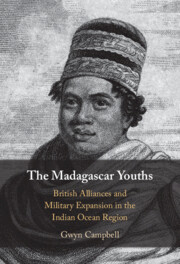
In 1820, King Radama of Imerina, Madagascar signed a treaty allowing approximately one hundred young Malagasy to train abroad under official British supervision, the so-called 'Madagascar Youths'. In this lively and carefully researched book, Gwyn Campbell traces the Youths' untold history, from the signing of the treaty to their eventual recall to Madagascar. Extensive use of primary sources has enabled Campbell to explore the Madagascar Youths' experiences in Britain, Mauritius and aboard British anti-slave trade vessels, and their instrumental role in the modernisation of Madagascar. Through this remarkable history, Campbell examines how Malagasy-British relations developed, then soured, providing vital context to our understanding of slavery, mission activity and British imperialism in the nineteenth century.
Michael Walling here looks back over the first twenty-five years of Border Crossings, the company he founded in 1995. The article explores the company’s intercultural remit, placing it within the wider context of multicultural and intercultural performance and policy, and the relationship between intercultural theory and practice. Structural questions around finance and organization are juxtaposed with an assessment of the dynamics of cross-cultural devising and the ethics of these collaborations. This article also explores Border Crossings’ text-based work, its curation of the ORIGINS Festival of First Nations and related ceremonies, and the company’s direct engagement with policy in the European Union. It is accompanied by a comprehensive chronology of the company’s productions. Michael Walling is Artistic Director of Border Crossings and Visiting Professor at Rose Bruford College. He has directed numerous productions across four continents, including opera as well as theatre.