To save content items to your account,
please confirm that you agree to abide by our usage policies.
If this is the first time you use this feature, you will be asked to authorise Cambridge Core to connect with your account.
Find out more about saving content to .
To save content items to your Kindle, first ensure no-reply@cambridge.org
is added to your Approved Personal Document E-mail List under your Personal Document Settings
on the Manage Your Content and Devices page of your Amazon account. Then enter the ‘name’ part
of your Kindle email address below.
Find out more about saving to your Kindle.
Note you can select to save to either the @free.kindle.com or @kindle.com variations.
‘@free.kindle.com’ emails are free but can only be saved to your device when it is connected to wi-fi.
‘@kindle.com’ emails can be delivered even when you are not connected to wi-fi, but note that service fees apply.
This chapter provides a comprehensive analysis of the War of Attrition, a conflict between Israel and Egypt that lasted from 1967 to 1970. The chapter explores the political and social processes triggered by the war, as well as the significant involvement of the Soviet Union and increased US aid to Israel. It also delves into the limited scope of the war, with both sides aiming for a strategy of exhaustion The chapter highlights the role of Israeli Defense Minister Moshe Dayan in shaping the country’s military strategy during the war. Dayan’s advocated for Israeli concessions and partial settlement with Egypt, arguing that the opening and reconstruction of the Suez Canal could generate positive dynamics for promoting peace. Another aspect is the social impact of the war on Israeli society, revealing the emergence of cracks in the national consensus. The war was long-lasting and resulted in heavy losses, leading to discontent and criticism from various levels of society. Despite this, the war ultimately demonstrated Israel’s military strength and ability to withstand pressure from a much larger opponent.
The chapter provides a detailed account of the decision-making processes that led to strategic surprise in the Yom Kippur War 6 of October 1973 and the battles during the first days of the war. The chapter highlights the differences in opinion among Israeli military leaders regarding the best approach to defending against an Egyptian attack, with some advocating for a flexible defense and others favoring a rigid defense with strongpoints. Ultimately, political considerations led to the adoption of a rigid defense strategy integrated with some mobile units. The chapter also explores the misunderstandings and communication issues that occurred during the first hours of the war that led to Israel’s military failures, particularly with regards to the delayed call-up of reserve units but also the air force. Israel’s counter offensive on the 8 of October failure in its southern front is also analyzed.
The chapter provides a detailed account of the second part of Yom Kippur War, starting with the turning point in the war on October 12. It highlights the existential danger that Israel’s leaders believed they faced before the turning point and how Israel’s leaders strategized and made a bold move to cross the canal and encircle Egypt’s Third Army, a move that changed the course of the war. It also discusses the differences in approach between Dayan and Elazar in achieving a ceasefire and how Israel’s leaders used a ruse or move to force one of their enemies to lay down their arms. It also sheds light on the difficult decisions that leaders must make during times of crisis, such as Dayan’s decision to give the order to prevent more losses that could weaken the new defense line. The chapter also discusses the aftermath of the war, including the establishment of a National Commission of Inquiry, the Agranat Commission, to examine the war’s prelude and conduct until October 8. It held the military echelon responsible for the catastrophe, a decision which escalated antigovernment protests and calls for Dayan’s and Meir’s resignations.
The Cold War conflicts in Korea and Vietnam, fought in the context of the Geneva Conventions of 1949, differed in the nature of surrender. After the first year of the Korean War, the war became a stalemate. However, the fighting ended only with an armistice two years later. The delay resulted in part from an ideological dispute between the belligerents. American negotiators insisted that POWs be allowed to refuse repatriation to the country for which they fought; the Communists insisted on compulsory repatriation. The armistice allowed POWs to choose, and the Communists were internationally embarrassed because large numbers of Chinese and North Koreans refused repatriation. The major American intervention in Vietnam was fought primarily as a guerrilla campaign, with some large-scale battles. The Americans made little headway, and protests against the war expanded. After Nixon won the 1968 presidential election, he first tried carrot and stick means to convince the Viet Cong and the North Vietnamese to cease fighting. When these failed, he and Kissinger maneuvered to end the American intervention by any means necessary. The Paris Peace Accords granted nearly all the enemies’ demands so that the United States could withdraw American troops. Withdrawal amounted to utter surrender.
This chapter offers three case studies to illustrate the main theoretical claim of this book. The rise of ISIS was animated by a narrative of historical humiliation of Sunnis by “apostates.” This narrative featured key elements of our account of humiliation in international affairs – from dismissal of past promises to contempt towards cultural and geographical realities. Russia’s foreign policy in the last two decades is also deeply tied with a sense of national humiliation, both reflected and manufactured by Vladimir Putin, according to which Russia has been displaced and discarded as a serious world power by the United States and its NATO allies. Finally, we look at the 1973 Middle East war as an example of a conflict fueled by a need to reverse an earlier humiliation. Egypt’s primary aim in this war was to erase or counteract the humiliation it suffered in the 1967 war with Israel. Interestingly, in this case, the officials who negotiated the war’s conclusion took the sentiment’s potency into account as they designed the terms of the ceasefire and armistice.
Hanoi entered into negotiations with Washington and Saigon in 1968–9, Chapter 4 explains, but merely to probe and sow division among its enemies. But then unsettling circumstances intervened, including the Sino-Soviet Border War of early 1969; the death a few months later of Ho Chi Minh, who, despite his lack of influence over communist decision-making, remained the venerable face of the Vietnamese struggle for reunification and independence and thus an important public relations tool; and, finally, Nixon’s decisions to “Vietnamize” the anticommunist war effort in the South and then to authorize incursions into Cambodia and Laos. The period 1969–71 was marked by uncertainty and indecisiveness as communist decision-makers reassessed their strategic priorities and placed greater emphasis on alternative modes of struggle. Concerned about potential diplomatic isolation and the loss of Soviet and Chinese support, Le Duan decided to go-for-broke once more. The 1972 Easter Offensive was an abject disaster. Hanoi then tried its luck at the bargaining table, resulting in the Paris peace agreement of 1973 and the suspension of the Fourth Civil War for Vietnam.
Chapter 5 concentrates on Streit’s efforts as a political lobbyist, primarily with the Atlantic Union Committee (AUC), a Washington lobby group and vocal proponent of Atlanticism during the 1950s and into the 1960s. If Streit’s federal union project represented one version of Atlanticism, the AUC’s extended give-and-take with Congress acted as a midwife to the emergence in the early 1960s of an opposing version. Imagined as a community of transatlantic elites centered in and on the United States, this Atlanticism continues to dominate Washington politics today.
This chapter examines the ways in which the Geneva conference of late 1976, as the culmination of American efforts to push forward with majority rule talks, failed to reach any meaningful results. Part of the failure had to do with the end of President Ford’s administration and the end of Secretary of State Henry Kissinger’s role in the Rhodesia crisis. Much of the chapter analyzes the diplomatic roles of Robert Mugabe and Joshua Nkomo, and how they interacted with American, British, and African diplomats and leaders during the conference. The Zairian leader Mobutu was also involved in assessing the African leaders, and his observations of Mugabe and Nkomo are discussed. The chapter shows how Mugabe managed to make the most of the otherwise failed Geneva talks to solidify his leadership role in ZANU, and how after the conference, he and ZANLA leader Tongogara removed the ZIPA leaders by having them imprisoned in Mozambique in early 1977. The chapter also examines British, American, South African, and Rhodesian views of the future prospects of the Zimbabwean nationalist leaders.
This chapter mainly concerns the shuttle diplomacy of the US secretary of state, Henry A. Kissinger, in 1976. Kissinger made two trips to Africa in 1976, hoping to influence Cold War conflicts in southern Africa. Kissinger succeeded, with South African help, to force the Rhodesian prime minister, Ian Smith, to concede to the concept of majority rule in two years. Plans were then put in motion for an all-parties conference in Geneva, run by the British. This chapter examines the pre-conference diplomacy, including attempts by Mugabe and Nkomo to have those military leaders from ZANLA who were accused of the murder of Herbert Chitepo released by the Zambians. This chapter includes coverage of discussions between Kissinger and the South Africans, the British, and with Tanzanian president Julius Nyerere. There is also discussion of a letter by Bishop Muzorewa charging Nyerere and Mozambique’s Samora Machel of keeping him and Reverend Sithole from reaching the liberation forces in Mozambique and Tanzania.
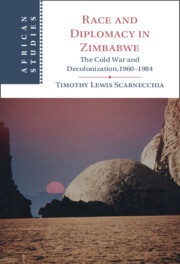
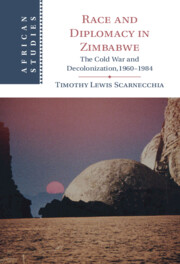
The 'Rhodesian crisis' of the 1960s and 1970s, and the early-1980s crisis of independent Zimbabwe, can be understood against the background of Cold War historical transformations brought on by, among other things, African decolonization in the 1960s; the failure of American power in Vietnam and the rise of Third World political power. In this history of the diplomacy of decolonization in Zimbabwe, Timothy Scarnecchia examines the rivalry between Joshua Nkomo and Robert Mugabe, and shows how both leaders took advantage of Cold War racialized thinking about what Zimbabwe should be. Based on a wealth of archival source materials, Scarnecchia uncovers how foreign relations bureaucracies in the US, UK, and South Africa created a Cold War 'race state' notion of Zimbabwe that permitted them to rationalize Mugabe's state crimes in return for Cold War loyalty to Western powers. This title is also available as Open Access on Cambridge Core.
This chapter reveals the popular origins of the Nixon-Mao summit. It argues that people-to-people diplomacy and nonstate actors made a fundamental contribution to the beginning of Sino-American rapprochement in 1971. Private US organizations – chief among them the National Committee on US-China Relations – helped change American minds about the need for engagement with the People’s Republic of China. Thereafter, people-to-people interactions were the first means by which direct contact between China and the United States resumed—through ping-pong diplomacy but also a raft of other 1971 visits by American scientists, students, and ideologically-motivated travelers. This chapter also analyzes the impression formed of China by some of the first American visitors to the country since the Cultural Revolution. It concludes with the negotiations over the structure of the exchange program that took place between the Chinese government and US state and nonstate actors in 1971 and 1972, including during the Nixon–Mao summit of February 1972.
Despite the conflicts in cultural exchanges that disrupted his first year in office, Gerald Ford hoped to use exchange diplomacy as one means to realize a successful summit trip to China in December 1975. This chapter shows, however, that this tactic proved largely unsuccessful: Ford’s primary interlocutor, Deng Xiaoping, was uninterested in expanding cultural ties before an improvement in the diplomatic relationship – even if the vice premier could not hide his interest in deeper Sino-American scientific cooperation. Growing Chinese interest in the US science and technology was already well known to American scientists and, while Ford and Henry Kissinger declined to exploit this interest to political ends, the Committee on Scholarly Communication with the People’s Republic of China (PRC) advocated that the United States must demand something more in return for the benefits that China was gaining from scientific exchange with the United States. Meanwhile, American politicians outside of the executive branch sought to fill the void left by Ford’s limp China policy during their own visits to the PRC – but often met the same uncompromising, even bellicose, Chinese response that Ford and Kissinger had grown used to.
This conclusion elaborates three implications of the arguments of this book. First, it argues that the importance of exchange diplomacy in Sino-American rapprochement demonstrates the limits of Henry Kissinger’s understanding of rapprochement as dictated by geostrategic maneuvering and high-level diplomacy. We need, this conclusion posits, a more holistic account of Sino-American diplomacy to fully explain the development of that relationship through the 1970s. Second, this conclusion argues that the interconnection between Sino-American exchange and high diplomacy offers a case study of the value in connecting transnational and diplomatic history – an insight that has implications for both fields. Third and finally, the conclusion reflects on the lessons we can draw from the US-China exchange relationship of the 1970s in understanding the prospects for Sino-American cooperation in the twenty-first century.
The high watermark in the Sino-American relationship during the Henry Kissinger era came in 1973 with the creation of “liaison offices,” or de facto embassies, in each capital: These liaison offices further deepened and formalized the diplomatic relationship after the Richard Nixon–Mao Zedong summit of 1972 and would remain the closest that the two governments would come to establishing official diplomatic relations before Kissinger left government in January 1977. This chapter reveals that – in cause, conception, and execution – liaison offices were a direct outgrowth of the exchange relationship. Other new milestones in that relationship were also set in 1973, not least during the visit of the largest cultural delegation yet to travel to the People’s Republic of China: the Philadelphia Orchestra. However, 1973 also saw the first signs of new tensions in exchange diplomacy as lingering Sino-American disagreements about Cambodia and Taiwan, as well as turbulent Chinese domestic politics, led to confrontations in cultural contacts and during a Congressional delegation to China led by Senator Warren Magnuson.
Chapter 12 shows how the Federal Republic’s booming economy created new challenges and expectations. Currency crises wracked the West, leading to the final breakdown of the Bretton Woods order. Together with other leaders of the newly expanded EC of Nine, Brandt and finance minister Helmut Schmidt instituted a “joint float” of European currencies (excluding Britain, Ireland, and Italy). The Nixon administration tried to slow the EC’s momentum by proposing a “Year of Europe” that would cement U.S. leadership; Bonn was again caught between the United States and France, with both countries fearing that West Germany had become “Finlandized” as a result of its Ostpolitik. Brezhnev’s visit to Bonn, along demands raised by Yugoslavia, Poland, and Romania, showed that West German prosperity had raised expectations of financial generosity. Brandt’s Germany began to play a more visible role in Middle Eastern diplomacy, and in September East and West Germany were finally able to join the United Nations. The EC-9 undertook steps toward greater coordination of foreign policy, particularly at the UN, and Brandt insisted that West Germany was there to act as a European power.
The two decades from 1969 marked the tightening of Israel–US strategic ties. With the Cold War becoming more and more predominant in the America view of the Arab–Israeli conflict, American presidents, from Richard Nixon to Ronald Reagan, justified the tightening strategic relations between the two nations in the role Israel would ostensibly play in the defence of the Middle East against Soviet expansion. It did not really matter that Israel would not play that role; for Israel, the idealism that was prevalent in the relations between the two nations was not solid enough, and Israeli leaders gladly recited the Cold War rhetoric in their communication with American officials. Visually, the Arab–Israel conflict played a significant role in the conduct of the relations between the two countries, from the attempts to deal with the consequences of the 1967 June War to the 1982 Lebanon War. These, though, were only a minor irritation in what became deeper and closer ties, encompassing economic and industrial ties, the deepening of cultural connections and intensification of strategic cooperation, mainly in intelligence sharing and development of technologies.
This chapter examines the ways in which the Geneva conference of late 1976, as the culmination of American efforts to push forward with majority rule talks, failed to reach any meaningful results. Part of the failure had to do with the end of President Ford’s administration and the end of Secretary of State Henry Kissinger’s role in the Rhodesia crisis. Much of the chapter analyzes the diplomatic roles of Robert Mugabe and Joshua Nkomo, and how they interacted with American, British, and African diplomats and leaders during the conference. The Zairian leader Mobutu was also involved in assessing the African leaders, and his observations of Mugabe and Nkomo are discussed. The chapter shows how Mugabe managed to make the most of the otherwise failed Geneva talks to solidify his leadership role in ZANU, and how after the conference, he and ZANLA leader Tongogara removed the ZIPA leaders by having them imprisoned in Mozambique in early 1977. The chapter also examines British, American, South African, and Rhodesian views of the future prospects of the Zimbabwean nationalist leaders.
This chapter mainly concerns the shuttle diplomacy of the US secretary of state, Henry A. Kissinger, in 1976. Kissinger made two trips to Africa in 1976, hoping to influence Cold War conflicts in southern Africa. Kissinger succeeded, with South African help, to force the Rhodesian prime minister, Ian Smith, to concede to the concept of majority rule in two years. Plans were then put in motion for an all-parties conference in Geneva, run by the British. This chapter examines the pre-conference diplomacy, including attempts by Mugabe and Nkomo to have those military leaders from ZANLA who were accused of the murder of Herbert Chitepo released by the Zambians. This chapter includes coverage of discussions between Kissinger and the South Africans, the British, and with Tanzanian president Julius Nyerere. There is also discussion of a letter by Bishop Muzorewa charging Nyerere and Mozambique’s Samora Machel of keeping him and Reverend Sithole from reaching the liberation forces in Mozambique and Tanzania.
The 'Rhodesian crisis' of the 1960s and 1970s, and the early 1980s crisis of independent Zimbabwe, can be understood against the background of Cold War historical transformations brought on by, among other things, African decolonization in the 1960s; the failure of American power in Vietnam and the rise of Third World political power at the UN and elsewhere. In this African history of the diplomacy of decolonization in Zimbabwe, Timothy Lewis Scarnecchia examines the relationship and rivalry between Joshua Nkomo and Robert Mugabe over many years of diplomacy, and how both leaders took advantage of Cold War racialized thinking about what Zimbabwe should be, including Anglo-American preoccupations with keeping whites from leaving after Independence. Based on a wealth of archival source materials, including materials that have recently become available through thirty-year rules in the UK and South Africa, it uncovers how foreign relations bureaucracies the US, UK, and SA created a Cold War 'race state' notion of Zimbabwe that permitted them to rationalize Mugabe's state crimes in return for Cold War loyalty to Western powers.
This chapter analyzes the political debates in the United States about arms sales to Iran and Saudi Arabia in the late 1970s and early 1980s. When the United States “lost Iran” in 1979, the presidential administrations of Jimmy Carter and then Ronald Reagan identified regional instability as a threat to the security of the oil-rich Persian Gulf and “global economic health.” Both administrations turned to arms sales as a means to secure alliances in the face of American vulnerability. In this context, the burgeoning military sales relationship between the United States and Saudi Arabia arrived through an Iranian workshop. Congressional debates about the sale of fighter jets and AWACS to both nations, as well as the corporate lobbying of the Bechtel Corporation, reveal important logical columns in this shift to a more aggressive foreign policy based on military relationships: the link between economic growth and US Cold War legitimacy, the importance of military sales to the US domestic economy, and the crucial place of weapons transfers in good relations with the ruling monarchies in Iran and then Saudi Arabia. When it came to the regional security of the Middle East and secure flows of its oil, this was the time when military force began to become the premier instrument of US diplomacy for a new global age.