To save content items to your account,
please confirm that you agree to abide by our usage policies.
If this is the first time you use this feature, you will be asked to authorise Cambridge Core to connect with your account.
Find out more about saving content to .
To save content items to your Kindle, first ensure no-reply@cambridge.org
is added to your Approved Personal Document E-mail List under your Personal Document Settings
on the Manage Your Content and Devices page of your Amazon account. Then enter the ‘name’ part
of your Kindle email address below.
Find out more about saving to your Kindle.
Note you can select to save to either the @free.kindle.com or @kindle.com variations.
‘@free.kindle.com’ emails are free but can only be saved to your device when it is connected to wi-fi.
‘@kindle.com’ emails can be delivered even when you are not connected to wi-fi, but note that service fees apply.
A framing case study describes the trial of Hissène Habré, the deposed leader of Chad who was prosecuted for multiple international crimes in Senegal. The chapter then discusses international criminal law. The chapter first discusses major principles of international criminal law and its evolution. It next discusses the key elements for establishing criminal guilt, including: the definition of core crimes; modes of responsibility and liability; and possible defences. Finally, the chapter surveys the major institutions that enforce international criminal law by discussing the operations of the International Criminal Court and the assertion of universal jurisdiction by domestic courts.
This chapter argues that Soviet crimes at times of war were both widespread and complex in their origin, goals, logic, and trajectory. It distinguishes and explains several forms of Soviet criminality during its defensive war against Germany in 1941–1945: crimes against humanity and war crimes, both perpetrated by agents of the state and often in accordance with explicitly formulated state policy; troop crimes, not guided by state policy but often understood to be in its fulfilment by the perpetrators; and a variety of violent and criminal behaviour emanating from small group bonding, both within the military and outside of it. The chapter explains their origins and charts the reasons why there was so much silence about the criminality of the Soviet war effort after victory.
Changing legal environments create new opportunities for legal mobilization by civil society groups. At stake is mobilization in Germany and Europe for the prosecution of agents of the Syrian Assad regime accused of committing core international crimes. Changes in the legal environment include the (a) spread of universal jurisdiction; (b) increasing use of “crimes against humanity”; (c) new prosecutorial and policing units specialized in core international crimes; and (d) new prosecutorial practices, such as structural investigations. Coinciding with an influx of Syrian refugees, these opportunities give rise to a collaborative network of (I)NGOs that feed witnesses and evidence into prosecutorial agencies. Interaction between agencies and (I)NGOs contributes to the transnational ordering of criminal law and constitutes a Prosecutorial-NGO (P-NGO) Complex. (I)NGOs finally diffuse court narratives to a broad audience and shape public knowledge of grave violations of human rights. We focus on the P-NGO Complex for the al-Khatib universal jurisdiction trial before the Higher Regional Court in Koblenz, Germany. Empirical tools include an analysis of (I)NGO network structures and websites, interviews with court observers, activists, and prosecutorial staff, and an analysis of media reporting.
Edited by
Grażyna Baranowska, Friedrich-Alexander-Universität Erlangen-Nürnberg,Milica Kolaković-Bojović, Institute of Criminological and Sociological Research, Belgrade
In armed conflicts, when people massively go missing, enforced disappearance is prohibited both by the ICPPED and customary international humanitarian law (IHL). While IHL is the primary regulator in armed conflicts, ICPPED complements and reinforces IHL protection from enforced disappearance including by providing more direct legal basis for the State Parties then customary nature of the matching IHL provisions which are often elusive for national practitioners. Obligation under ICPPED to introduce enforced disappearance as an autonomous and continuous domestic crime should provide potentially strong accountability mechanism given the absence of enforced disappearance from underlying offences considered war crimes and the contextual limitations of enforced disappearance as a crime against humanity and may also help break the silence about the disappeared. Limitation of the ICPPED’s definition of enforced disappearance as state-sponsored crime may be overcome in armed conflicts by the commensurate IHL prohibition which applies to non-state actors too.
Chapter 3 is a close reading of several documents and transcripts of the Case of Duch of the Cambodia Tribunal. Interestingly, notions of humanity and inhumanity were used by several parties: prosecutors, attorneys for civil parties but also the defendant’s lawyer and Duch himself declared that the latter was dehumanised. In a second move, these findings will be put in a philosophical context by bringing them in conversation with the work of Hannah Arendt, thus showing the structure of dehumanisation and rehumanisation.
Despite being outlawed, attacks on cultural heritage remain a pervasive feature in atrocity contexts, the effects of which are compounded by a relative deficit of accountability at the international level. To remedy this gap, the Office of the Prosecutor (OTP) of the International Criminal Court (ICC) issued Policy on Cultural Heritage. However, crimes against cultural heritage are not fully articulated in the Court’s governing instruments. To leverage the protective scope of the Court, the Policy adopts a human rights understanding of cultural heritage which I frame in terms of distinctive relationships between heritage and atrocity crimes. The Policy fertilises a second argument shorthanded as world-building. Against world-destruction, the Policy erects an accountability architecture. Conceptually, it foregrounds an understanding of the world as a cultural construct around which social relations are organised. Crimes against heritage undercut the very notion of what it means to be human; disrupt cultural identification, transmission, and development processes; and deny present and future generations the ability to be specific kinds of cultural human beings. In those regards, this article adds to the world society research agenda of English School theory by examining how the Policy more fully develops the Court’s role as an agent for humanity.
The loss of human life and physical injuries through violence are an inherent consequence of armed conflict, including civil wars. Deliberate atrocities – such as war crimes, crimes against humanity, genocide, politicide and “ethnic cleansing” – have been a conspicuous feature of many wars. Civil wars – whether correctly or incorrectly from an empirical perspective – have often been regarded as particularly vicious, transgressing all norms of decency in the frequency and type of atrocities. This chapter explores several key questions that have arisen in the conflict analysis field in relation to atrocities in civil war – and war generally. Are atrocities specifically associated with certain “types” of civil war, such as separatist, ideological, intercommunal, or resource conflict? Are there patterns in terms of which types of actors – state or non-state rebel groups – are more likely to perpetrate atrocities? What motivates individuals and groups to perpetrate atrocities, and what “role,” if any, do such atrocities play in armed conflict? Do atrocities play a strategic role, or are they better understood as a manifestation of individual and group sadism, revenge, and hate or fear, spread in the contemporary era by social media? Are all combatants capable of perpetuating atrocities in the “right” circumstances? The chapter concludes with a discussion of the international norms that have emerged over the last century – which prohibit war crimes, crimes against humanity, and genocide – and the calls for accountability and justice after mass atrocities that have arguably made a significant although limited impact on conduct in war. As a part of this, “transitional justice” has emerged as an important topic, designed to address the societal impact and legacy of atrocities.
A hybrid legal discipline dealing with the relationships between the right to punish and state sovereignty, international criminal law (ICL) overturns classical conceptions of the state, law and justice. Its existence, foundations, scope and effectiveness are determined by the outcome of an attempt – which has proved more or less successful throughout the different phases of its evolution – to reconcile it with the founding principles of the modern state, sovereignty and legality, inherited from the Enlightenment. Adopting a historical perspective helps us its development, on either side of the pivotal moment represented by the creation of the League of Nations: the starting point marked by the 1919 Paris Conference and the immediate aftermath of the First World War; and the turning point marked by the work of the League and international legal doctrine in the interwar era. These two crucial phases saw a string of initiatives which, rather than failures, can be interpreted as a series of necessary transformations for the emergence of a new discipline and, more generally, a profound change in the global legal and judicial order.
This chapter explores the interaction between international human rights law (IHRL) and international humanitarian law (IHL), as well as international criminal law. It examines how IHRL influences the application and development of IHL and how human rights principles are integrated into international criminal procedures and substantive law. The chapter discusses the mutual reinforcement and potential conflicts between these branches of international law, highlighting the need for a coherent and integrated approach. It also explores the role of international courts and tribunals in applying and interpreting IHRL, IHL, and international criminal law, and the challenges in ensuring compliance and accountability.
Atrocity crimes and grand corruption: the chapter argues that adopting a “corruption lens” is useful to characterize and understand patterns of crimes against humanity, especially whether acts are widespread or systematic, whether there is a state or organizational policy, how high-ranking actors are tied to crimes by subordinates (“modes of liability”) and whether specific acts constitute crimes under the ICC’s Rome Statute. The chapter uses examples from Mexico and Venezuela to illustrate.
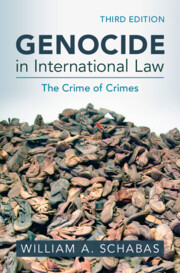
Genocide is sometimes called the ’crime of crimes’. The word was coined by Raphael Lemkin in 1944, then declared an international crime by the United Nations General Assembly. In 1948, the Genocide Convention was adopted. As the first human rights treaty of modern times, it constituted a significant intrusion into what had previously been a matter exclusively of domestic concern. This explains the narrow definition of the crime of genocide. It requires proof of an intent to destroy a national, ethnic, racial or religious group. Only a half century after its adoption did the Genocide Convention take on real significance with inter-State cases being filed at the International Court of Justice and many prosecutions at the International Criminal Tribunals for the former Yugoslavia and Rwanda. The Convention requires that States Parties punish genocide but they are also required to prevent it, even when it takes place outside their own territory. More than 150 States have ratified the Genocide Convention. Genocide is also prohibited under customary international law. It is generally agreed that the duty to punish genocide is a peremptory norm of international law (jus cogens).
The post-First World War minorities treaties regime was an initial attempt by international law to address the rights of national and ethnic minorities. Its shorcomings prompted Raphael Lemkin, in his book Axis Rule in Occupied Europe, to propose a new category of international crime that he named genocide. The International Military Tribunal prosecuted acts of genocide using the category of crimes against humanity. Several of the defendants were convicted of acts aimed at destruction of Europe’s Jewish population. However, crimes against humanity were confined to acts associated with aggressive war. At the first session of the United Nations General Assembly in 1946, a resolution on genocide was proposed in order to address the peacetime atrocities that were neglected in the Nuremberg judgment. The resolution recognized genocide as an international crime and called for preparation of a convention.
Acts of cultural genocide were deliberately excluded by the drafters of the Genocide Convention, although this was very controversial. The term ’cultural genocide’ is widely used and is not incorrect but it is not contemplated by the Genocide Convention. The line between cultural genocide and physical genocide is blurred in the case of ethnic cleansing, which does not necessarily involve the physical destruction of the group. The use of nuclear weapons may constitute an act of genocide.
This article provides a critical examination of the Moscow Mechanism, a rapid-response tool within the Organization for Security and Co-operation in Europe. Originally established in 1991 and rarely invoked during its first three decades of existence, the Mechanism has experienced a reinvigoration since Russia’s full-scale invasion of Ukraine in 2022, having been triggered six times, four of which were in response to alleged violations of international humanitarian law and international human rights law during the conflict. Drawing on the authors’ experience as experts in these four missions, the article offers a historical overview, explains the Mechanism’s procedural dynamics and assesses its unique features. Through a comprehensive analysis of its repeated use in respect of Ukraine, the article highlights both the strengths and limitations of the Moscow Mechanism, ultimately arguing that recent developments have revealed its full potential as an instrument for advancing international justice and accountability.
The 1948 Genocide Convention is a vital legal tool in the international campaign against impunity. Its provisions, including its enigmatic definition of the crime and its pledge both to punish and to prevent the 'crime of crimes', have now been considered in important judgments by the International Court of Justice, the international criminal tribunals and domestic courts. Since the second edition appeared in 2009, there have been important new judgments as well as attempts to apply the concept of genocide to a range of conflicts. Attention is given to the concept of protected groups, to problems of criminal prosecution and to issues of international judicial cooperation, such as extradition. The duty to prevent genocide and its relationship with the doctrine of the 'responsibility to protect' are also explored.
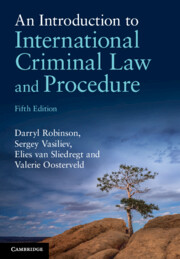
Building on the success of previous editions (Cryer et al.), this popular textbook is now expanded and updated in a 5th edition featuring two new co-authors, Elies van Sliedregt and Valerie Oosterveld. A market leader and one of the most globally trusted textbooks on international criminal law, it is known for its accessible and engaging tone and for an even-handed approach that is both critical and constructive. Comprehensively updated and rewritten, this new edition introduces readers to the main concepts of international criminal law, as well as the domestic and international institutions that enforce it, and addresses the latest challenges and controversies surrounding the International Criminal Court. Written by a team of international criminal lawyers who have extensive academic and practical experience in the field, the book engages with critical questions, political and moral challenges, and alternatives to international justice. It contains helpful references to other literature, making it a valuable research resource.
This chapter discusses the emergence of crimes against humanity, the main definitional features, and the most important jurisprudence on crimes against humanity. The chapter reviews historic references, the Nuremberg Charter, and evolution through international jurisprudence. The chapter examines the meaning of ‘widespread or systematic attack directed against a civilian population’, including the controversy over the meaning of ‘civilian’ and the many controversies about the ICC Statute Article 7 requirement of a ‘state or organizational policy’. The chapter reviews the jurisprudence on the prohibited acts (also referred to as ‘inhumane acts’), including murder, extermination, enslavement, deportation, forcible transfer, imprisonment, torture, rape, sexual slavery, enforced prostitution, forced pregnancy, enforced sterilization, other sexual violence, persecution, forced disappearance, apartheid, and other inhumane acts.
The ICC launched in 2002 to judge cases against individuals accused of war crimes, crimes against humanity, and genocide. It is unique among international institutions in this book in that it imposes its obligations upon individual persons rather than governments. This chapter shows the powers and limits on the authority of the ICC to punish people for large-scale atrocities. The practical power of the ICC is shaped by both the difficulty of apprehending people and the active work of those who wish to remain insulated from accountability.
The final substantive chapter of the book looks at how all these rules are implemented and enforced, and what mechanisms exist to hold violators of the law accountable for their acts. Common Article 1 of the Geneva Conventions requires states to ‘ensure respect’ for the rules of IHL, which is achieved through a range of measures such as education of the armed forces and civil society in the rules of IHL and entrenching the rules in domestic legislation. The chapter describes the roles of the ICRC, Protecting Powers and the International Humanitarian Fact-Finding Commission. The development and content of international criminal law are examined, including individual responsibility for war crimes, lesser violations of IHL, crimes against humanity and genocide, and the concept of command responsibility is explained. The growth in international and hybrid criminal tribunals is noted, as well as the roles played by the United Nations and other organisations in encouraging adherence to the rules of IHL. Finally the chapter examines mechanisms for implementation, enforcement and accountability in non-international armed conflict.
Much discussion over Russia's 2022 invasion of Ukraine focuses on the inability to charge aggression. However, another approach might be available: charging this under the ICC crimes against humanity (CAH) residual clause. First proposed in 2010 by Benjamin Ferencz, who lamented the circumscribed reach of aggression under the ‘Kampala Compromise’, the proposal has met with scepticism, primarily given that textbook aggression targets military forces, not civilians. Yet, civilian populations disproportionately bear the brunt of the violence of modern aggression (often being its direct targets). Russia's 2022 invasion is but the most recent and compelling example. Thus, this article resuscitates Ferencz's proposal, arguing that Russian leaders could be charged with using illegal force as a CAH under the residual clause. This approach would have practical advantages: initiating aggression in the Kremlin links liability to Putin much more directly for killing Ukrainian civilians, and charging it as CAH opens human victims to ICC participation and reparations. There are theoretical advantages, too, with utilitarian/retributive objectives better satisfied. Moreover, Ferencz's approach is better than recently proposed alternatives: using aggression merely as a gravity/liability modes/sentencing enhancer or alleging breach of the right to self-determination as the residual clause gravamen (arguably creating problems with victim group identification).