To save content items to your account,
please confirm that you agree to abide by our usage policies.
If this is the first time you use this feature, you will be asked to authorise Cambridge Core to connect with your account.
Find out more about saving content to .
To save content items to your Kindle, first ensure no-reply@cambridge.org
is added to your Approved Personal Document E-mail List under your Personal Document Settings
on the Manage Your Content and Devices page of your Amazon account. Then enter the ‘name’ part
of your Kindle email address below.
Find out more about saving to your Kindle.
Note you can select to save to either the @free.kindle.com or @kindle.com variations.
‘@free.kindle.com’ emails are free but can only be saved to your device when it is connected to wi-fi.
‘@kindle.com’ emails can be delivered even when you are not connected to wi-fi, but note that service fees apply.
Chapter 8 summarises and concludes the analysis presented in the previous chapters. As highlighted throughout the book, the power of the courts to effectively protect freedom of expression is limited in the face of global digital networks and powerful private technology companies. This makes it all the more important to recognise not only the individual but also the institutional dimension of fundamental rights as objective value judgements under constitutional law, the implementation of which falls under the state’s duty to protect. Given the enormous technical and social complexity of the digital revolution, this task can only be accomplished through legislation.
How are unanimity negotiations commonly settled in the EU Council of Ministers? Important contributions have been made to our understanding of the ‘consensual’ decision‐making dynamics in the Council, but most studies focus on explaining the sheer absence of votes in legislative decision making under the qualified majority rule. This study seeks to explain how vetoes are averted, or curtailed, in unanimity decision making. These unanimity negotiations are explained as attempts to induce or prevent high‐level exposure. The degree of exposure in turn depends on the degree of lower level contestation. A process tracing analysis of one prolonged debate is performed from the perspective of one Member State – the Netherlands – which played a very prominent obstructing role. By analysing when, why and where (at what level) the Dutch won or lost, one can come closer to understanding the dynamic interplay between the different Council levels.
Democracy manifests itself in a range of ways and is an imperfect, dynamic struggle for collective decision-making. This article discusses the multifaceted processes of deliberative democratic praxis found in traditional Māori society. Central to decision-making in te ao Māori, hui provide formal and informal structures for deliberative democracy, precedent setting, learning, and transformation through consensus making, inclusive debate, and discussion across all levels of society. Rather than coercion and voting, rangatira relied on a complex mix of customary values and accomplished oratory skills to explore issues in family and community meetings and in public assemblies. Decisions made through inclusive deliberative processes practiced in hui established evident reasoning and responsibility for all community members to uphold the reached consensus. This article claims that practicing deliberative democracy as a fundamental way of life, learned through ongoing active and meaningful participation throughout childhood, improves the integrity of democratic decision-making.
Non-profit organizations (NPO) for mental health are becoming significant actors. Here, their roles in welfare society as understood in research are identified and analyzed. Results from recent research publications on the mental health field are synthesized and categorized in order to find out their origin, theoretical orientation, and view on mental health NPO’s in relation to the public welfare systems. Relevant publications are primarily from the US, empirically oriented, and addressing surveys on both individual and organizational level. NPOs were most often seen as consensus-oriented service organizations, while very few (4%) were seen as conflict-oriented advocates (i.e., anti-professional). It is concluded that these NPOs are most often studied as complements or alternatives to existing public welfare services rather than on their own terms, and that research on the topic lacks more complex theoretical attempts.
Chantal Mouffe's conceptualization of a deliberatively forged consensus as a hegemony and her assertion that adversarial politics best nurtures the conditions of freedom have had a profound influence on contemporary democratic thought. This article takes a critical view of this trend, arguing that a norm of consensus is a very precondition, rather than impediment, for the kind of pluralistic democracy Mouffe and other agonists wish to promote. It is asserted that Mouffe's dehistoricized refutation of consensus lacks causal or explanatory relevance to how concrete actors embedded in empirical situations relate to one another and that the very preparedness to find something acceptable about another is at the heart of what it means to treat others justly.
With the help of a grant from the Joseph Rowntree Charitable Trust, the de Borda Institute and the New Economics Foundation did some research into decision making. The binary majority vote is often inadequate and inaccurate, and it was thought that perhaps a multi-option procedure of preferential voting would be more suitable for a modern, pluralist society. As part of that project, an experiment was conducted on the web, based on a Modified Borda Count. The subject of discussion was the UK controversy about how to fund the political process. After a critique of dichotomous decision making and an introduction to consensus voting, this article describes the experiment, analyses the vote and makes recommendations for any future exercise.
What does a democratically-productive form of mourning look like in America? David McIvor’s Mourning in America and Simon Stow’s American Mourning argue that it entails the embrace of ambivalence about self and other. Democratically-productive mourning pushes against the tendencies toward idealization and demonization. Embracing ambivalence enables us to move to more effective political engagement in the context of both collaboration and conflict. It allows us to understand that the process of mourning must be ongoing both to protect us from political excesses to which we are prone and to push society toward justice.
This article examines the consensus-conflict divide within contemporary democratic theory as manifested in the works of Jürgen Habermas, Chantal Mouffe, Jacques Rancière, and John Rawls. It relates the democratic crisis diagnosis to the presence of this conceptual divide and suggests overcoming it by focusing on the work of Michel Foucault, especially his concept of the “rectangle of the good parrhesia.” Foucault's analysis goes beyond conflict-consensus through its positive and creative reconceptualization of political authority featuring a transformative capacity linked to the idea of telling the truth.
Sums of the ratings that judges assign to wines are a near universal method of determining the winners and losers of wine competitions. Sums are easy to calculate and easy to communicate, but seven flaws make sums of ratings a perilous guide to relative quality or preference. Stars & Bars combinatorics show that the same sum can be the result of billions of compositions of ratings and that those compositions, for the same sum, can contain dispersion that ranges from universal consensus to apparent randomness to polar disagreement. Order preference models can address both order and dispersion, and an example using a Plackett–Luce model yields maximum likelihood estimates of top-choice probabilities that are a defensible guide to relative quality or preference.
Neurofibromatosis type 1 (NF1) is a genetic disorder. Up to 50% of NF1 patients develop plexiform neurofibromas (PN). Despite revisions in diagnostic standards, there remains a lack of consensus on referral, treatment, monitoring and transition processes for NF1-PN. The study aimed to establish a Canada-wide consensus on the best practice for referral and management of patients with NF1-PN to help generate guidance where evidence on the long-term use of MEK inhibitors is lacking.
Methods:
The study used a modified Delphi method. The steering committee (SC) identified 4 topics of focus and developed 44 consensus statements. Following ratification, 43 statements were developed into an online survey sent to 113 healthcare practitioners (HCPs) involved in NF1-PN management across Canada. Respondents used a 4-point Likert scale to indicate agreement with each statement. The threshold for consensus agreement was 75%.
Results:
A total of 56 responses were received, predominantly from Ontario. Most respondents were neuro-oncologists (34%) and had over 11 years of experience (57%). Consensus was reached on 41 of 43 statements (95%), enabling the SC to develop recommendations for NF1-PN patient care and a treatment algorithm outlining key timings for treatment and management.
Conclusions:
To our knowledge, this is the first national Delphi consensus on NF1-PN. Strong agreement was seen from HCPs on critical timings in NF1-PN treatment and management. The proposed recommendations and treatment algorithm provide a framework to enhance patient care and support ongoing research into optimizing care for NF1-PN patients, not just in Canada but globally.
Norway is an active player in international climate politics, with strong consensus on the issue underpinned by cross-party Climate Settlements. Despite this, Norway has only marginally reduced its domestic greenhouse gas emissions. Moreover, attempts to establish a new Climate Settlement in 2021 failed. Does this failure constitute a break with Norway’s consensual climate tradition, and is this good or bad news for climate policy? In this chapter, we investigate whether and to what extent the consensus characterizing the 2000s and 2010s contributed to climate policy development or stasis. Focusing on two key sectors – petroleum and transport – we find that key Norwegian climate policies have developed through a dynamic tension of depoliticization and repoliticization over time, with mixed effects. We identify reasons for depoliticization and repoliticization and argue that it is useful to embrace agnosticism in the debate over politicization versus policy stability, instead exploring this on an empirical and contextual basis. Moreover, we uncover a dynamic of politicization in one policy area affecting policy development in another, arguing that such spillover effects warrant analytical attention.
DLT and cryptoassets are a digital solution to the perennial issue of how to establish a single source of truth. Because digital data entries can easily be altered or copied, we have relied on trusted third parties to keep a master copy of any digital asset registry – until DLT enabled digital equivalents to physical cash and bearer instruments. Instead of a trusted record keeper, DLT relies on a distributed network of nodes that each hold a copy of the ledger. The data are typically stored in a time-stamped sequence of blocks, i.e., a blockchain. Different types of consensus mechanisms exist to keep each copy of the ledger synchronised and to prevent malicious actors from altering the registered information. This technology is democratising the privilege of running a trusted asset registry, thus facilitating new business models in so-called decentralised finance (DeFi) which emulate conventional financial processes with software replacing middlemen, such as banks, depositories, and exchanges. This has resulted in so-called token offerings and more than 10,000 different cryptoassets worth more than USD 1 trillion in aggregate.
Chapter 4 is dedicated to the concept of informality as a crucial legal concept for the understanding of trilogues. It begins from a twofold observation. First, the informal nature of trilogues is stated in black and white in a significant variety of legal instruments. Secondly, the role of legal scholarship is to make sense of that unequivocal characterization. Drawing on institutional theory, this chapter argues that informality is a full-blown concept of EU law, and it sets about defining its characteristics. To that end, it compares trilogues with two other informal bodies, namely the Euro Group and the Informal Council meetings. The core idea of this chapter is that the codification of informality translates into legal terms the intention of the institutions to protect certain spaces from an excessive penetration of legal normativity. This intention, in turn, is indicative of the desire to preserve those spaces for the emergence of powerful social frameworks where genuine exchanges among actors may occur; exchanges that should be conducive to compromise.
The focus of stylistics has always been on text, and in particular the meaningful effect of choices made within texts, rather than, for example, thematic, authorial or historical approaches to the data it studies. This remains the core emphasis of this most well-connected of subdisciplines. However, in understanding the structure and meaning of text, we are naturally likely to become interested in the cognitive effects of these textual choices on readers, and in the cognitive effort involved in processing texts. This has been an increasingly common avenue of exploration in stylistics since the late 1990s and is a core concern of contemporary stylistician. In this chapter and in Chapter 6 the authors focus on what has come to be known generally as cognitive stylistics. The term cognitive poetics is also in use, though the precise distinction between the two activities is not always obvious.
In the situation where subjects independently rank order a fixed set of items, the idea of a consensus ordering of the items is defined and employed as a parameter in a class of probability models for rankings. In the context of such models, which generalize those of Mallows, posterior probabilities may be easily formed about the population consensus ordering. An example of rankings obtained by the Graduate Record Examination Board is presented to demonstrate the adequacy of these generalized Mallows' models for describing actual data sets of rankings and to illustrate convenient summaries of the posterior probabilities for the consensus ordering.
This paper presents a bimatrix structure for examining ordinal partial rankings. A set of axioms is given similar to those of Kemeny and Snell (1962) and Bogart (1973), which uniquely determines the distance between any pair of such rankings. The l1 norm is shown to satisfy this set of axioms, and to be equivalent to the Kemeny and Snell distance on their subspace of weak orderings. Consensus formation is discussed.
This chapter examines Daniel Boorstin’s contention that historically Americans’ special genius grew from taking a practical, nonideological approach to politics and government. For Boorstin, this approach allowed Americans, unfettered by ideology, to react to changing circumstances with deliberation and confidence. Boorstin argued that even the American Civil War was a nonideological conflict, emerging from a practical sectional disagreement over the need to manage the slavery question. Since Boorstin, scholarship has revealed that he failed to grasp the ideological nature of American politics in the Age of Civil War and the conflicting ideologies that drove North and South to war. Given the horrific conflict, the sweeping nature of emancipation, and the promise, later abandoned, of full citizenship to African Americans, how can the nation now have confidence that the political “genius” of American politics can survive the current era of polarization and disillusionment?
Edited by
Ottavio Quirico, University of New England, University for Foreigners of Perugia and Australian National University, Canberra,Walter Baber, California State University, Long Beach
Climate change will intensify water scarcity, especially in the Middle East and North Africa (MENA). The European Union’s Green Deal ‘new growth strategy’ promotes a policy agenda that underscores the need to support regions at risk while moving forward with adaptation and mitigation measures. In MENA, transboundary water use and dispute is intrinsic to the region, exacerbating environmental risks of desertification, rising temperatures and increased rainfall variability. Water management is central to effective climate and adaptation policy, as water access is a key determinant of socioeconomic stability and development. This stability is central to intergovernmental cooperation on climate initiatives and has undermined progress on this front in the region since the 1950s. The water sector is a core aspect of climate adaptation and mitigation, particularly as the hydrological cycle will be severely impacted by climate change. Therefore, effective water policy and resource management is the critical node of effective climate mitigation and adaptation in MENA.
There are many different types of regulatory instruments and tools. Chapter 6 classifies and examines regulatory tools according to their underlying technique or ‘modality’ of control or source of influence, examining five such modalities in turn: command, competition, communication, consensus and code (or ‘architecture’). This chapter also considers algorithmic regulation and the role of reputation as a form of regulation.
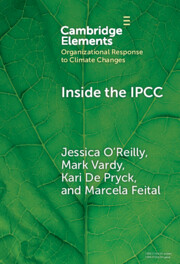
Inside the IPCC explores the institution of the Intergovernmental Panel on Climate Change (IPCC) by focusing on people's experiences as authors. While the budget and overall population of an IPCC report cycle is small, its influence on public views of climate change is outsized. Inside the IPCC analyzes the social and human sides of IPCC report writing, as a complement to understanding the authoritative reports that underwrite policy decisions at many scales of governance. This study shows how the IPCC's social and human dimension is in fact the main strength, but also the main challenge facing the organization, but also the main challenge facing the organziation. By stepping back to reveal what goes into the making of climate science assessments, Inside the IPCC aims to help people develop a more realistic, and thus, more actionable, understanding of climate change and the solutions to deal with it. This title is also available as Open Access on Cambridge Core.