To save content items to your account,
please confirm that you agree to abide by our usage policies.
If this is the first time you use this feature, you will be asked to authorise Cambridge Core to connect with your account.
Find out more about saving content to .
To save content items to your Kindle, first ensure no-reply@cambridge.org
is added to your Approved Personal Document E-mail List under your Personal Document Settings
on the Manage Your Content and Devices page of your Amazon account. Then enter the ‘name’ part
of your Kindle email address below.
Find out more about saving to your Kindle.
Note you can select to save to either the @free.kindle.com or @kindle.com variations.
‘@free.kindle.com’ emails are free but can only be saved to your device when it is connected to wi-fi.
‘@kindle.com’ emails can be delivered even when you are not connected to wi-fi, but note that service fees apply.
This chapter systematizes the comparison of the Nigerian and Saudi cases to offer four primary insights about the past and future trajectories of economic liberalization in resource-wealthy, autocratic and hybrid regimes. First, at the level of political actors, the Nigerian organized private sector appears dynamic and competitive in its pursuit of procedural rents when compared to the ossified Saudi Chambers of Commerce. Second, at an historical level, the Saudi and Nigerian histories of corporate law reform share a common experience of initial foreign importation, before a process of local tailoring and, eventually, their liberalization becoming rent-conditional. Third, at a theoretical level, the diverse causal processes evidenced within the two cases illustrates the potential for greater causal processes within the flexible rent-conditional reform (RCR) framework. Fourth, considering the potential global transition to a lower-carbon economy, the application of the RCR theory suggests diverging future potentials of liberalization in high- and low-cost oil producers, and potential newfound relevance for non-fuel mineral producers.
What is the relationship between Chinese migrants and China? Can modern Chinese migration be compared to colonization? This article examines how Chinese intellectuals in the first half of the twentieth century grappled with these questions through their writings in Dongfang zazhi (东方杂志, 1904–1948) and Nanyang yanjiu (南洋研究, 1928–1944). It shows that although these intellectuals acknowledged the territorial dimensions of Chinese migration—particularly in Southeast Asia—they defined colonization through the European model and stressed the fundamental differences between Chinese migration and Western or Japanese colonialism. Their perspectives also evolved over time, from initially advocating colonization and racial vitality in the early twentieth century, to proclaiming a different path after the Republican Revolution in 1911, and later to reimagining post-Second World War Chinese migration as not just a nationalist project but also a movement of decolonization and localization. The article highlights the case of Li Changfu, a pioneering scholar whose writings epitomized these evolving perspectives and illustrated the efforts among Chinese intellectuals to move beyond both the Western colonial framework and the China-centred national model in formulating a world-historical approach. Yet their attempts also revealed enduring tensions, including the tendency to essentialize Chinese identity even as they sought to break from colonial and national paradigms and construct new narratives. Their engagement with the ‘colonial question’ offers fresh insight into contemporary historiographical debates over the role of colonialism and empire-buiding in Chinese history.
As linguists theorize about language endangerment and loss (LEL), we must understand the big picture: the coexistence of languages in particular polities and how the competition that sometimes arises is resolved. Many concerns have been voiced about LEL since the early 1990s, but theoretical developments regarding language vitality lag far behind linguists’ current investment in language advocacy. While discussing issues such as the failure to connect the subject matter to language evolution in general, the framing of LEL as deleterious almost exclusively to ‘indigenous peoples’, a lack of historical time depth, and the omission of the ecological factors in typical approaches to LEL, I argue that linguistics should theorize about language vitality more adequately than has been the case to date.
Charity Hudley, Mallinson, and Bucholtz's (2020) target article details the urgent need for linguistics as a field to develop its theoretical, analytical, and political engagement with issues of race and racism. We agree with Charity Hudley et al.'s assertion that the ‘hegemonic whiteness’ of linguistics as a field ‘has been profoundly damaging both for linguistic scholarship and for linguistics as a profession’ (p. e211). In this response, we wish to expand upon this point specifically in regard to how linguists and linguistics relate to Indigenous peoples and their languages. We outline key respects in which academic linguistics has, or might be seen to have, perpetuated harm against Indigenous peoples. We also outline strategies for mitigating harm and supporting the language work done by members of Indigenous communities.
In this response to Mufwene's (2017) target article we discuss the benefits and disadvantages of extending the ecology metaphor into studies of language vitality, focusing on contexts from the South Pacific. We show that an ecological perspective allows us to focus on the local and particular and can help us to avoid a simplistic reliance on broad phenomena such as ‘globalization’ to account for language endangerment and loss (LEL). However, we contend that this endeavor runs the risk of abstracting away from the human experience of LEL into a ‘survival of the fittest’ or ‘balance sheet’ approach. We conclude that, while it has benefits, the ecology metaphor does not ultimately offer a compelling basis for an overarching theory of language vitality.
This chapter offers a close analysis of the Uniformitarian Principle and its use as a conceptual tool for understanding and narrating language contact and language change, paying special attention to the social life of Anguillian, the English-lexifier Creole language of Anguilla, the most northerly of the Caribbean’s Leeward Islands. The language and aspects of the situation of contact that led to its emergence are described from a novel uniformitarian perspective that integrates insights from general linguistics, Communication Accommodation Theory, and the analysis of early colonial-era archives.
Many western settler states are undertaking processes to improve Indigenous-settler relations. The primary focus is Canada, with some discussion of Australia, Aotearoa New Zealand, and the United States of America. This Element highlights myths promoted by explorers, settlers, and the state about Indigenous Peoples and history. It engages with and attempts to correct a selection of the misperceptions that have developed over the many centuries. I argue that the first 'foundational history wars' were advanced by European explorers, travellers, and settlers through the promotion of negative myths about Indigenous Peoples, as an accompaniment to settler colonialism. I distinguish these from 'modern history wars' from the 1960s to the 1990s. The goal is to provide a fuller history which critically engages settler myths, privileges Indigenous perspectives, and offers a robust and informed critique of dominant historical narratives. The larger goal is to promote truth as a necessary accompaniment to reconciliation.
Two centuries after independence, is colonialism still a valid explanation for Spanish America’s inequities and lagging economic performance? This chapter makes the case that the legacies of colonialism run at a deeper and much more local level than commonly acknowledged and publicly discussed. In particular, factoring-in the administrative practices of the Spanish Empire reveals how eighteenth-century office-selling undermined local governance in numerous ways: Shaping the spatial distribution of authoritarian and ethnic enclaves; the recurrence of violent conflict in certain areas; and ultimately, the under-provision of public goods leading to subnational differences in living standards we observe today. The chapter also outlines the limits of current explanations – focused on factor endowments, national institutions, or postcolonial state-building – to explain local-level differences. The chapter concludes with a roadmap describing the rest of the book.
In Perspectives, I lay out the broad historical concerns of the study. Historians viewing the transformation of the East India Company from a trading corporation to an imperial power have tended to focus on the eighteenth century, rightly seeing this as the moment when large swathes of land in the Indian subcontinent were annexed. What I offer as an alternative is an argument that the ideological, legal, political and economic requisites for the acquisition of land were laid in the seventeenth century. The founding charter empowered the Company to annex lands in non-Christian countries, and from the outset the Company embarked on a determined quest to realize that ambition. It met, however, determined resistance from Mughal authorities and rival imperial powers, and only with the passage of time and migration to the Coromandel Coast beyond Mughal control did it first gain the rights to a permanent settlement at Madras, later to be followed under very different circumstances by Bombay and Calcutta.
The first chapter explores the background to the 1600 Charter setting out the conditions for the establishment of the East India Company. Here I am interested in the rights of acquisition inherited from the exploratory age of the Tudor state rather than the more familiar story of its formal constitution. The language of charters granted to trading companies revealed something of the discursive complexity shaped by European powers striving to legitimize claims to overseas territory. England had few jurists of note and so the state drew partially and selectively on Roman and common law to foreground the precept of possession, not least because it conveniently rendered obsolete all challenges to the means of acquisition. The chartered companies of unprecedented size, capital and ambition which rose to power in the second half of the sixteenth century inherited this repertoire of legal pluralism but found in practice that the quest for conquest of overseas territory was compromised by geography and the existence of rival European powers with similar ambitions.
This chapter addresses questions concerning history and international law. First, it focuses on what traditionally has been, until relatively recently, the relationship between international law and history, including the history of international law itself. Second, this chapter reflects on the globalization of international law and its ambiguous nature and results, combining empowerment and disempowerment. In particular, it highlights that the ambiguity of the globalization of international law has been on display not only with the connection between modern international law and Western power in the context of colonization but also with decolonization since, to a large extent, after decolonization, this connection has continued in the form of neocolonization. The chapter refers as well to the ambiguity of the globalization of international law in relation to the rise of the individual as an international rights holder in the framework of international human rights. Ultimately, international law has both alienating and emancipatory effects.
In settler colonies such as the United States, Canada, Australia, and Aotearoa New Zealand, “memory wars” have, driven by conflicting narratives about colonial history, intensified in recent years. Indigenous counter-narratives challenge Euro-centric master narratives, particularly in public spaces such as museums and monuments. This article explores the impact of such conflicts on national identity, focusing on Aotearoa New Zealand, where the history of colonization has long been framed as a relatively benign process, underpinned by the Treaty of Waitangi. Through application of a comprehensive narratological framework, the article reveals how the Waitangi Treaty Grounds’ permanent exhibition, Ko Waitangi Tēnei: This is Waitangi, employs the quest masterplot to weave Māori memories of the mid-1800s New Zealand Wars into the national master narrative. The analysis highlights that this narrative emplotment – by “naturalizing” the events of the New Zealand Wars – serves to elide difficult questions about colonial violence, thus protecting the image of a tolerant and respectful nation. More generally, the article contributes to our understanding of national identity construction in the context of difficult histories, while also advancing theoretical approaches to narratology in museum storytelling.
This article links two borderlands: the Italo-Slovene and the Slovene-Hungarian in the aftermath of the First World War. It focuses on the wartime refugees from the hinterlands of Trieste who, in accordance with agrarian reform, which the Yugoslav state began in 1919, were settled as colonists on the new Hungarian-South Slav border in the early 1920s. By using memoir literature and “ego documents,” the article tackles several aspects, including the refugee experience and social assistance during the First World War, the political motivation of the land reform, and the lived experiences of the colonists. In Yugoslavia, the agrarian problem was considered to be one of the most important issues facing the new state. The land reform aimed to solve social and national problems more than to improve the agricultural production of the state. In the example of the Prekmurje region, this article aims to show that interwar colonization succeeded in impacting the Hungarian–Slovene language border but failed miserably to ensure social transformation and security for the impoverished population.
The conclusion highlights the book’s main theoretical contributions and briefly sketches avenues for further research. It develops the monograph’s contribution to existing constructivist scholarship, which consists in demonstrating how international relations’ macro-concepts originate from ordinary and extraordinary interactions. The book’s primary focus is on the visual gaze. Yet representants can target other senses, and more research is necessary to direct attention to other sensory stimuli. Second, the Conclusion stresses the book’s contributions to the booming literature on recognition and misrecognition. The monograph can provide new perspectives for studying processes of colonization and decolonization as moments of misrecognition and recognition. It can also guide the analysis of struggles of recognition over sovereignty claims in the contemporary era. Concerns about recognition are crucial for questions about the future of the liberal international order. The chapter directs attention to representants for interpreting the efforts of major players from the periphery and the semi-periphery to acquire something akin to great power status. Other, hitherto more marginalized international actors, such as indigenous communities, and some terrorist networks are equally seeking changes in representants. The Conclusion also opens questions about how changes in communication technologies might trigger changes in representants that can have broader systemic effects.
This perspective article takes up the challenge of articulating a political epistemology for extinction studies, centered around how both the systematic-scientific and mythopoetic traditions conceive of the idea of preservation. Political epistemology offers a solution to this for impasse because it asks the question of the social orientation or “end” of knowledge formations, thereby questioning what the larger goal of preservation might be. By focusing on the example of the thylacine, I outline one strand of what a political epistemology for contemporary justifications of preservation in the Museum might look like. Then I discuss how the mode of storytelling in extinction studies also conceives of preservation. Finally, I introduce the idea of replenishment as contrary to the preservation, focused on the cultural practices of Indigenous peoples in North East Arnhem Land, and ask whether new developments in the techno-scientific tradition will begin to turn to replenishment as well.
This article discusses Japan's colonization of Korea in the context of world time. Korea was a unique colony as it was one of the last to be colonized in the world. Japanese colonizers pushed a heavy-handed “military policy”, mainly because of the sharp resistance at their accession to power in the period 1905-1910. In 1919 when mass movements swept colonial and semi-colonial countries, including Egypt and Ireland, Koreans too rose up against Japan's rule. Stung by wide resistance by Koreans in March and April 1919 as well as general foreign reproach, Japanese leaders adopted a “modern” practice by starting the imperial “cultural policy” in mid-1919. The most important consequence of the cultural policy was the integral role Korean industry soon had in linking the metropole with hinterland economies, and it is from this point that we can date Japan's specific brand of architectonic capitalism that has influenced Northeast Asia down to the present.
How did literature and politics blend in nineteenth-century oratory? This chapter argues that the admixture was always particular. Thus it begins by explicating three moments of ordinary oratorical practice in Philadelphia in 1855: a gubernatorial inaugural by James Pollock, an oration by the student Jacob C. White Jr. at the Institute for Colored Youth, and a speech by delegate Mary Ann Shadd at the Colored National Convention. Themes germane to nineteenth-century oratory emerge from these examples: its ubiquity and variety, the interactions of oratorical and print cultures, the critical role of audiences in producing meanings of oratorical events, and the ephemeral characteristics of embodied performance. Further, the emphasis in these examples on freedom, citizenship, learning, leadership, and democratic life highlights political debates on racial justice, slavery, colonization, and emigration, demonstrating the myriad ways in which oratory in the nineteenth-century United States can supply an avenue into culture, voice, and lived experience that helps explain trajectories to our own time.
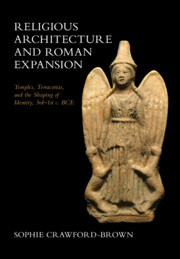
Religious Architecture and Roman Expansion uses architectural terracottas as a lens for examining the changing landscape of central Italy during the period of Roman military expansion, and for asking how local communities reacted to this new political reality. It emphasizes the role of local networks and exchange in the creation of communal identity, as well as the power of visual expression in the formulation and promotion of local history. Through detailed analyses of temple terracottas, Sophie Crawford-Brown sheds new light on 'Romanization' and colonization processes between the 3rd and 1st centuries BCE. She investigates the interactions between colonies and indigenous communities, asking why conquerors might visually emulate the conquered, and what this can mean for power relations in colonial situations. Finally, Crawford-Brown explores the role of objects in creating cultural memory and the intensity of our need for collective history-even when that 'history' has been largely invented.
The emergence of a systematic literature around land-surveying in the late first century AD affords an ideal opportunity to study the development of an ars within the scientific culture of specialized knowledge in the early Roman Empire. The variegated methods that belonged to the historical inheritance of surveying practice challenged the construction of a discrete and coherent disciplinary identity. The surveying writings of Frontinus and Hyginus evince several strategies intended to produce a systematic and explanatory conception of the ars. These include rationalizing explanations of key surveying terminology and practice with a view to natural first principles and an accounting of surveying methods in interdisciplinary perspective with astronomy, natural philosophy, and mathematics. While these earliest surveying works pose several unique challenges, they ultimately provide a precious window onto the challenges and opportunities that greeted the emergence of an ars in the fervid scientific culture of the period.
Explores relationship of law to communal agriculture in three contexts; Indigenous communal grazing; Spanish and Mexican land grants; and Colorado state law of property rights.