To save content items to your account,
please confirm that you agree to abide by our usage policies.
If this is the first time you use this feature, you will be asked to authorise Cambridge Core to connect with your account.
Find out more about saving content to .
To save content items to your Kindle, first ensure no-reply@cambridge.org
is added to your Approved Personal Document E-mail List under your Personal Document Settings
on the Manage Your Content and Devices page of your Amazon account. Then enter the ‘name’ part
of your Kindle email address below.
Find out more about saving to your Kindle.
Note you can select to save to either the @free.kindle.com or @kindle.com variations.
‘@free.kindle.com’ emails are free but can only be saved to your device when it is connected to wi-fi.
‘@kindle.com’ emails can be delivered even when you are not connected to wi-fi, but note that service fees apply.
This chapter advances three arguments about the politics of company creation regulation in Saudi Arabia in the first two decades of the twenty-first century. First, the liberalization of these regulations was rent-conditional. The formation and implementation of these policies occurred during periods of rising or high oil rents, but were absent during the downward trend in oil prices between June 2014 and January 2016. Second, relative to earlier periods, the ability of business and religious elites to veto economic reforms was diminished. Third, in light of this shift, the threat of popular unrest to regime stability had a non-trivial, causal effect upon the pursuit and pausing of company creation liberalization. Non-elite pressure on the Al Saud’s rule reached an unparalleled fever pitch during the Arab Spring. Record-breaking transfer payments to appease discontent were feasible in 2011, allowing regulatory liberalization to continue. However, when the fiscal realities of the 2014 oil price slump became apparent, liberalization and public munificence were sacrificed to inhibit the development of economic power outside the regime’s coalition and to maintain comparatively high military spending. Only once oil rents recovered would the reform agenda be revived.
This essay considers how the rural and tribal have been obscured from prevailing scholarly accounts of unrest and protest in the years since the Arab Uprisings of 2010–2012, and what this might mean for wider scholarly theorizations of protest and revolution. It draws on fieldwork in central Jordan, especially with Hirak Dhiban, where historical circumstances render visible dynamics also significant elsewhere. It takes as a heuristic binary two broad discursive modalities of seemingly dissimilar collective action that in fact reference and relate to each other in various revealing ways: on the one hand the politically populist and self-consciously leftist Hirak protest movements, prominent in the waves of protest since 2011, and on the other hosha—"tribal clashes.” It considers how contestations over the legitimacy, revolutionary potential, and moral valence of protests often hinge on discursive claims that, in a sense, Hirak is hosha, or hosha, Hirak. It engages with anthropological theories to interpret protest as a generative and affective process, rooted in local histories and imaginaries, even while responding to wider events. It calls for a broader reappraisal of where revolutionary potential is located and how it is recognized in anthropological and historical scholarship.
Scholars have recently begun to examine how authoritarian rulers cooperate with each other in order to fend off popular challenges to their power. During the Arab Spring the states of the Gulf Cooperation Council (GCC) supported fellow authoritarian regimes in some cases while backing opposition movements in others. Existing theoretical approaches fail to explain this variation. Advancing the study on authoritarian cooperation, this article develops a theoretical approach that sets out to explain how authoritarian regimes reach their decisions. Drawing on poliheuristic foreign policy analysis, it argues that perceptions of similarity serve as a filter for estimating threats to regime survival at home. If regimes perceive the situation in other countries as similar to their own, supporting other authoritarian regimes becomes the only acceptable strategy. In contrast, if perceptions of similarity are low, regimes also consider other options and evaluate their implications beyond the domestic political arena. Applying this framework to the example of the GCC states during the Arab Spring, the analysis reveals covariation between perceptions of similarity and threat among GCC regimes, on the one hand, and their strategies, on the other.
With a history of civic associations turned political, and an ongoing sociopolitical transformation in Egypt, social entrepreneurship (SE) has proliferated as an alternative to traditional forms of civic engagement such as charities on one hand and open activism on the other. Yet, situated between a desire for change, and the overpowering state and market logics, SE has been both limited and shaped by neoliberal and local-authoritarian visions. Using Egypt as the case, this study combines in-depth interviews with civil society practitioners, and field observation at an SE incubator, to examine how SE came to embody a desire for change using publicly sanctioned logics, all while enacting practices that preserve/revitalize a social movement in abeyance. By examining SE as part of a larger phenomenon in this particular moment of transition, this timely research allows us to investigate a link between social movements and SE not as two separate phenomena but as different ways of approaching the same thing: creating social transformation.
Scores of young men and women were killed by regime forces during the Arab Spring in Egypt (2011–2013). Their photographs assumed iconic proportions, meandering online and off through countless acts of creative remediation. This essay examines the different kinds of social and political work that these photographs came to play during this period, including as indexes of the revolutionary cause and as mediators of revolutionary subjectivities at a distance. This essay departs from extant studies of visual cultures of secular martyrdom or funerary portraiture framed by notions of commemoration, and instead stresses contingent presence grounded in the specific liminal temporality of the revolutionary process. In this temporal limbo, photographs of martyrs often blurred conventional boundaries between representations and their referents. Established visual conventions of funerary portraiture were turned upside down, and portraits of martyrs were understood not as representations of the dead, but as alive and present, sometimes more alive than the dwindling group of dedicated revolutionaries.
This chapter summarizes the main findings, arguments, and contributions of the book. It reviews the theoretical arguments and discusses promising avenues for further research on revolution and counterrevolution. Then it explains how the book’s findings speak to a number of scholarly and public debates. First, for scholars of violence and nonviolence, who have argued that unarmed civil resistance is more effective at toppling autocrats than armed conflict, the book raises questions about the tenacity of the regimes established through these nonviolent movements. Second, it speaks to scholarship on democratization, highlighting the important differences between transitions effected through elite pacts versus those brought about through revolutionary mobilization. Third, it offers lessons about how foreign powers can help or hinder the consolidation of new democracies. Next, the chapter discusses implications for Egypt and the broader Middle East, including the possibility that future revolutions might avoid the disappointing fates of the 2011 revolutions. The chapter ends by reflecting on what the book has to say about our current historical moment, when rising rates of counterrevolution appear to be only one manifestation of a broader resurgence of authoritarian populism and reactionary politics worldwide.
This chapter analyzes the popular dimensions of Egypt’s 2013 counterrevolution, using an original dataset of protests during the post-revolutionary transition. It shows that Egypt’s revolutionaries were unable to consolidate the social support of the revolution, and that this failure allowed counterrevolutionaries to channel broad disaffections with revolutionary rule into a popular movement for restoration. The dataset covers the final eighteen months of the transition and includes approximately 7,500 contentious events sourced from the major Arabic-language newspaper Al-Masry Al-Youm. These data reveal, first, the extent to which social mobilization persisted after the end of the eighteen-day uprising. The transition period was awash with discontent and unrest, much of it over nonpolitical issues like the deterioration of the economy, infrastructure problems, and unmet labor demands. Second, statistical analyses show that this discontent came to be directed against Mohamed Morsi’s government. The earliest and most persistent anti-Morsi protests emerged in places where the population had long been highly mobilized over socio-economic grievances. Later, they also began to emerge in places with large numbers of old regime supporters. Ultimately, these two groups – discontented Egyptians and committed counterrevolutionaries – came together to provide the social base for the movement that swept the military back to power.
This chapter analyzes Egypt’s 2011 revolution and 2013 coup, one of the most prominent counterrevolutions of the 21st century. Drawing on approximately 100 original interviews with Egyptian politicians and activists, it argues that Egypt’s counterrevolution only became possible when revolutionaries squandered their initial capacity to hold the old regime’s military in check and presented them with an opportunity to rebuild their popular support. Specifically, the chapter makes the following claims: (1) revolutionary forces began the transition with considerable leverage over the former regime, grounded in their ability to threaten a return to mass mobilization and their backing from the United States; (2) after Mohamed Morsi was elected president, his administration’s poor management of the post-revolutionary governance trilemma, particularly its decision to prioritize the concerns of old regime elements over those of his secularist allies, caused the revolutionary coalition to fracture and Washington to begin questioning its support; and (3) these developments created opportunities for the military to bolster its domestic and foreign support and sapped revolutionaries’ capacity to resist a counterrevolutionary coup. Ultimately, the chapter concludes that, though the task facing Egypt’s revolutionary leaders was not easy, a counterrevolutionary end to the transition was far from a foregone conclusion.
Chapter 1 introduces the main arguments, findings, and contributions of the book. Counterrevolution is a subject that has often been overlooked by scholars, even as counterrevolutions have been responsible for establishing some of history’s most brutal regimes, for cutting short experiments in democracy and radical change, and for perpetuating vicious cycles of conflict and instability. The chapter reveals some of the most important statistics from the book’s original dataset of counterrevolution worldwide. These statistics raise a number of puzzling questions, which motivate the theoretical argument about counterrevolutionary emergence and success. After previewing this argument, the chapter discusses the main contributions of the book, including to theories of revolution, democratization, and nonviolence; to ongoing debates about Egypt’s revolution and the failures of the 2011 Arab Spring; and to our understanding of the present-day resurgence of authoritarianism worldwide. It finishes by laying out the multi-method research strategy and providing an overview of the chapters to come.
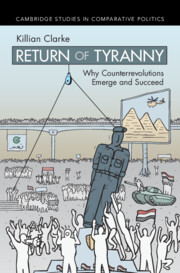
Why do some revolutions fail and succumb to counterrevolutions, whereas others go on to establish durable rule? Marshalling original data on counterrevolutions worldwide since 1900 and new evidence from the reversal of Egypt's 2011 revolution, Killian Clarke explains both why counterrevolutions emerge and when they are likely to succeed. He forwards a movement-centric argument that emphasizes the strategies revolutionary leaders embrace both during their opposition campaigns and after they seize power. Movements that wage violent resistance and espouse radical ideologies establish regimes that are very difficult to overthrow. By contrast, democratic revolutions like Egypt's are more vulnerable, though Clarke also identifies a path by which they too can avoid counterrevolution. By preserving their elite coalitions and broad popular support, these movements can return to mass mobilization to thwart counterrevolutionary threats. In an era of resurgent authoritarianism worldwide, Return of Tyranny sheds light on one particularly violent form of reactionary politics.
This chapter argues that an adequate assessment of revolutions (and the role of law in revolutions) is often stymied by historical exclusions and theoretical myopia. Historical exclusions centralise certain experiences and present sanitized and one-sided narratives of the revolutionary experiences they centralise, especially with respect to violence, slavery, and colonialism. On the basis of such ideological uses of history, theoretical accounts paper over these social and political realities in order to legitimate particular revolutionary constitutions and to elevate them to the status of a paradigm or ideal type. This paradigm serves as the yardstick by which other experiences are assessed. The main feature of this paradigm is that it postulates a distinction between political and social revolutions. It presents the American Revolution of 1776 as an exemplar for the political revolution that concerns itself with the establishment of government under law. In contrast, the French Revolution of 1789 is presented as an exemplar for the social revolution that also seeks to tackle social injustice. The deficiency of this paradigm construction is not merely methodological, but also substantive and normative. It reduces the plurality of the revolutionary phenomena, it ignores the revolution’s dialectical nature, and it presents a certain type of revolutionary constitutions as ones that legitimate the polity.
This chapter presents several examples of peaceful social movements having a significant, durable impact, and going through an initial irregular phase, when an inflection point (i.e., singularity) is reached. New social movement (NSM) theory is presented, as participating in pursuing a “big idea” that emphasizes social issues, accomplished through social relations, symbols, and identities based in the culture. Several examples are analyzed. The civil rights movement is dicussed, the inception (initial singularity) of which is attributed to Rosa Parks, who refused to comply with a bus-driver’s order to leave her seat in the “colored” section for a white passenger once the “white” section was full, and the bottom-up initiative of boycotting buses as a reaction to Rosa Parks’ incarceration, plus the carpooling civic initiative. In the Basque Country the terrorism of ETA suddenly and unexpectedly (singularity) stopped, as a result of societal peace-seeking orientation and specific (cooperation-based) economic development. The Polish Underground Peaceful Solidarity Movement succeeded through an aggregation of multiple societal bottom-up freedom initiatives. The initial Tunisian Arab Spring movement, called the Jasmine Revolution, was an unexpected and unpredicted people’s reaction to the corrupt government, successfully initiating substantial changes. Similarly, the Arab Spring movement in other countries (e.g. Egypt) unexpectedly brought cross-religious people’s cooperation and mutual support. Ukrainian Euromaidan was perceived as a “critical case of mass protests,” leading to a governmental change from pro-Soviet to pro-Western orientation. It united people from various locations and social strata, preparing the nation to resist any further pressures.
The conclusion sums up the main arguments of the book on the formative albeit discreet role of caravan trade in the political economy of the Middle East both during and after the Ottoman period. It draws on this history to challenge recent directions in the history of the Middle East by advocating for inner perspectives on connections thanks to the crossing of endogenous documentation (in Arabic and in Ottoman) with foreign sources, more attention for legacy, resilience and slowness in a period of rapid technological and political transformation. The history of caravan supports a new way of considering the Middle East from inside. It also offers insights on the background of debates over past carbonisation and present decarbonisation.
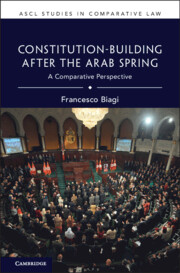
How were post-Arab Spring constitutions drafted? What are the most significant elements of continuity and change within the new constitutional texts? What purposes are these texts designed to serve? To what extent have constitutional provisions been enforced? Have the principles of constitutionalism been strengthened compared to the past? These are some of the key questions Francesco Biagi addresses. Constitution Building After the Arab Spring. A Comparative Perspective examines seven national experiences of constitution building in the Arab world following the 2011 uprisings, namely those of Morocco, Algeria, Tunisia, Libya, Egypt, Syria, and Jordan. This interdisciplinary book, based largely on the author's own work and research in the region, compares these seven national experiences through four analytical frameworks: constitution-drafting and constitutional reform processes; separation of powers and forms of government; constitutional justice; and religion, women and non-Muslims within the framework of citizenship.
Chapter 8 evaluates the argument that ruling monarchs are more effective than other types of autocrats at avoiding blame through delegation. It does so by drawing on cross-national data from around the world in addition to more specific comparisons of monarchies and republics in the Middle East. First, the chapter establishes that ruling monarchs tend to share power more credibly than presidential autocrats both in the Middle East and beyond, and it shows that this difference is recognized by people living in these regimes. Next, the chapter draws on an original survey experiment administered in Jordan, Morocco, Egypt, and Tunisia, in addition to data on constitutions, to demonstrate that monarchs benefit from reduced expectations that they will govern and be held responsible for policy outcomes. These expectations imply that delegation by ruling monarchs will be more in line with how the public expects responsibility to function in the political system. The chapter concludes by tracing patterns of opposition during the Arab Spring and analyzing cross-national protest data to show that monarchs are less likely than other dictators to be targeted by mass opposition when the public is dissatisfied, suggesting their advantages in avoiding blame contribute to their resiliency.
Forms of violence and the literary avenues for expressing them constitute allegorical worlds that place them on the fringes of literature. Such worlds submerged under the normative conception of world assert their existence through violent bonds and alliances. Against the predominantly secular and centrist underpinnings in the world literature debate, the chapter construes worlds through malleable, multiple, and contra-normative temporal coordinates. World-making through violence, as Yasmina Khadra’s The Attack, Kae Bahar’s Letters from a Kurd, and Ahmed Saadawi’s Frankenstein in Baghdad show, unfolds deep within such temporalities where vernacular renditions of divine and organized vengeance have an insurgent mode. Contesting secular notions of the sublime as something to be revealed to the subject at the end of reason, the insurgent sublime manifests as an intrasecular force invoked on a whim at the limit of reason. This intrasecular sublime is salient to Sinan Antoon’s The Corpse Washer and Omar Robert Hamilton’s The City Always Wins, wherein death and dead bodies become breeding sites of violent alliances. Death in the two novels enables a thanatopolitical resistance where acts of naming, washing, resurrecting, and ennobling the dead lend themselves to a critique of necropolitical technologies that manufacture death as though it were a commodity.
Even after the Arab Spring, it has been thought that Arab youth are not deeply invested in the political parties of North Africa. In fact, quite a few are affiliated with various parties but the reasons for their choices and the means by which the parties seek to attract them have been little explored. In this chapter, we look at the choices both male and female youngsters make in deciding whether to affiliate with one or another of the Moroccan political parties. Often, we see, it is less a matter of ideological attachment than social connection, less a way of showing philosophic solidarity than exploring personal identity. The repercussions of this, especially for the more fundamentalist parties and for the monarchy’s approach to them, demonstrate that the encounter with organized political attachment is often more subtle than the overt programs of the parties would seem to indicate.
This chapter explores how autocrats use propaganda to explicitly threaten repression, which often occurs via codewords. Threats of repression remind citizens of the consequences of dissent, but they are costly. When propaganda apparatuses seek credibility, threatening repression makes persuading citizens of regime merits more difficult. Threats of repression also endow sensitive moments with even more significance to citizens. We show that propaganda-based threats of repression are more common where electoral constraints are non-binding. Even as Ben Ali was losing power in Tunisia, for instance, his propaganda apparatus chose to concede citizen frustrations and emphasize the government’s determination to do better, rather than advertise the military’s loyalty and training, both routinely cited during the succession crisis in Uzbekistan. We find that Cameroon’s Paul Biya issues threats in English, but not in French; his political in-group is francophone, his out-group anglophone. We find that the CCP is far more likely to explicitly threaten repression in the Xinjiang Daily, which targets the ethnic Uyghur out-group, and on the anniversaries of ethnic separatist movements.
Hybrid warfare is a widely interpreted and highly contested concept and also a label for opponents and targets in conflict or competition in international relations. It is often projected as being something underhand undertaken by the other, however, this chapter examines the conceptual and operational history of Western hybrid warfare. This refers to creating suitable environmental conditions in the information and cognitive domain as a means to subvert a target government and bring about regime change.
Corruption in the Middle East and North Africa is both widely prevalent and a puzzle because it is so resistant to reform. This book will engage with democratic transitions in Egypt and Tunisia to better understand why these countries saw so little change in terms of cronyist relations between businesses and the state.