


1. Introduction
The precise understanding of how fluctuation energy is transported and dissipated through nonlinear interactions between flow structures across a wide range of scales is an outstanding challenge in the studies of turbulence. In wall-bounded turbulence, the large separation between the inner and outer length scales is a distinctive feature at high Reynolds numbers ( ${\textit{Re}}$
), and interactions across these scales are crucially involved in the dynamical and statistical processes of the flow (e.g. Cho, Hwang & Choi Reference Cho, Hwang and Choi2018; Lee & Moser Reference Lee and Moser2019). In particular, above the near-wall region, there exist a large number of hierarchically organised energy-containing motions, the size of which varies from their distance from the wall to the outer length scale (Townsend Reference Townsend1976; Marusic & Monty Reference Marusic and Monty2019). With increasing
${\textit{Re}}$
), and interactions across these scales are crucially involved in the dynamical and statistical processes of the flow (e.g. Cho, Hwang & Choi Reference Cho, Hwang and Choi2018; Lee & Moser Reference Lee and Moser2019). In particular, above the near-wall region, there exist a large number of hierarchically organised energy-containing motions, the size of which varies from their distance from the wall to the outer length scale (Townsend Reference Townsend1976; Marusic & Monty Reference Marusic and Monty2019). With increasing ${\textit{Re}}$
, the overall impact of these motions becomes more pronounced. It also manifests as the increased peak values in the streamwise velocity variances and the enhanced dissipation of turbulent kinetic energy (e.g. de Graaff et al. Reference De Graaff and Eaton2000; Marusic & Kunkel Reference Marusic and Kunkel2003; Hwang Reference Hwang2024; Pirozzoli Reference Pirozzoli2024), although there is a different view proposed recently (see e.g. Chen & Sreenivasan Reference Chen and Sreenivasan2021, Reference Chen and Sreenivasan2022; Monkewitz Reference Monkewitz2022). Of particular interest in this study is the fluctuation in wall shear stress, a central property of near-wall turbulence relevant to many engineering applications.
${\textit{Re}}$
, the overall impact of these motions becomes more pronounced. It also manifests as the increased peak values in the streamwise velocity variances and the enhanced dissipation of turbulent kinetic energy (e.g. de Graaff et al. Reference De Graaff and Eaton2000; Marusic & Kunkel Reference Marusic and Kunkel2003; Hwang Reference Hwang2024; Pirozzoli Reference Pirozzoli2024), although there is a different view proposed recently (see e.g. Chen & Sreenivasan Reference Chen and Sreenivasan2021, Reference Chen and Sreenivasan2022; Monkewitz Reference Monkewitz2022). Of particular interest in this study is the fluctuation in wall shear stress, a central property of near-wall turbulence relevant to many engineering applications.
In his early study, Townsend (Reference Townsend1976) speculated that shear stress on the wall contains a slowly fluctuating part, linked with the ‘inactive’ part of energy-containing motions in the logarithmic and outer regions. These inactive motions are defined to be with little Reynolds shear stress due to the boundary condition on the wall, which prevents the formation of the wall-normal velocity. In the last decade, there has been growing evidence on the presence of such inactive motions in the vicinity of the wall (e.g. Hwang Reference Hwang2015; Lee & Moser Reference Lee and Moser2015; Hwang Reference Hwang2016; Deshpande, Monty & Marusic Reference Deshpande, Monty and Marusic2020). Strong correlations have also been consistently observed between the large-scale components of velocity fields across the entire wall-normal locations (e.g. Hoyas & Jiménez Reference Hoyas and Jiménez2006; Hutchins & Marusic Reference Hutchins and Marusic2007; Mathis, Hutchins & Marusic Reference Mathis, Hutchins and Marusic2009), indicating that they may be the consequence of a transfer of energy from the outer flow to the near-wall flow (Lee & Moser Reference Lee and Moser2019; Deshpande et al. Reference Deshpande, Vinuesa, Klewicki and Marusic2024; Yin, Hwang & Vassilicos Reference Yin, Hwang and Vassilicos2024). More recent research has used observed fluctuations in wall shear stress to propose a unified scaling for velocity variance and to extrapolate velocity fields further from the wall (Smits et al. Reference Smits, Hultmark, Lee, Pirozzoli and Wu2021).
Despite the recent progress mentioned, it remains to be understood how these inactive motions near the wall statistically scale and are dynamically formed, especially at high ${\textit{Re}}$
. Given their origin, the size of inactive motions (say
${\textit{Re}}$
. Given their origin, the size of inactive motions (say $l$
) is supposed to be much larger than that of energy-containing motions in the near-wall region, such as streaks (Kline et al. Reference Kline, Reynolds, Schraub and Runstadler1967) and quasi-streamwise vortices (Jeong et al. Reference Jeong, Benney, Schoppa and Kim1997), i.e.
$l$
) is supposed to be much larger than that of energy-containing motions in the near-wall region, such as streaks (Kline et al. Reference Kline, Reynolds, Schraub and Runstadler1967) and quasi-streamwise vortices (Jeong et al. Reference Jeong, Benney, Schoppa and Kim1997), i.e. $l \gg \delta _\nu (\equiv \nu /u_\tau$
, where
$l \gg \delta _\nu (\equiv \nu /u_\tau$
, where $\nu$
and
$\nu$
and $u_\tau$
are the kinematic viscosity and friction velocity, respectively). Furthermore, they do not carry wall-normal velocity fluctuations, indicating that the related turbulence production must be negligible. Therefore, if pressure transport at such large length scales is assumed to be negligible (Lee & Moser Reference Lee and Moser2019, see also § 3.2), the inactive motions would be driven primarily by turbulent transport near the wall and subsequently contribute to dissipation of the turbulence on the wall. We note that the rate of streamwise dissipation at the wall,
$u_\tau$
are the kinematic viscosity and friction velocity, respectively). Furthermore, they do not carry wall-normal velocity fluctuations, indicating that the related turbulence production must be negligible. Therefore, if pressure transport at such large length scales is assumed to be negligible (Lee & Moser Reference Lee and Moser2019, see also § 3.2), the inactive motions would be driven primarily by turbulent transport near the wall and subsequently contribute to dissipation of the turbulence on the wall. We note that the rate of streamwise dissipation at the wall, $\epsilon _{{w}}$
, relates directly to the streamwise wall-shear-stress fluctuation,
$\epsilon _{{w}}$
, relates directly to the streamwise wall-shear-stress fluctuation, ${\tau }_{{w}}'$
:
${\tau }_{{w}}'$
:
 \begin{equation} \epsilon _{{w}}=-\nu \langle ({\tau }_{{w}}^{\prime}/\mu )^2\rangle , \end{equation}
where $\mu$
is fluid viscosity and
$\mu$
is fluid viscosity and $\langle \boldsymbol{\cdot }\rangle$
is an average in time and in homogeneous directions.
$\langle \boldsymbol{\cdot }\rangle$
is an average in time and in homogeneous directions.

Figure 1. Two-dimensional spectral densities in polar-log coordinates of $u'^2$
and
$u'^2$
and $\epsilon _{{w}}$
,
$\epsilon _{{w}}$
, $k_{\textit{ref}} = 1/ (50\,000\delta _v)$
: (a)
$k_{\textit{ref}} = 1/ (50\,000\delta _v)$
: (a) $E_{u'^2}^\#$
at
$E_{u'^2}^\#$
at $y^+ = 15$
,
$y^+ = 15$
, ${\textit{Re}}_\tau = 5200$
, Poiseuille,
${\textit{Re}}_\tau = 5200$
, Poiseuille, $\psi = 13$
(b)
$\psi = 13$
(b) $E_{\epsilon _{{w}}}^\#$
,
$E_{\epsilon _{{w}}}^\#$
, ${\textit{Re}}_\tau = 5200$
, Poiseuille,
${\textit{Re}}_\tau = 5200$
, Poiseuille, $\psi = 0.67$
(c)
$\psi = 0.67$
(c) $E_{u'^2}^\#$
at
$E_{u'^2}^\#$
at $y^+ = 15$
,
$y^+ = 15$
, ${\textit{Re}}_\tau = 500$
, Couette,
${\textit{Re}}_\tau = 500$
, Couette, $\psi = 45$
(d)
$\psi = 45$
(d) $E_{\epsilon _{{w}}}^\#$
,
$E_{\epsilon _{{w}}}^\#$
, ${\textit{Re}}_\tau = 500$
, Couette,
${\textit{Re}}_\tau = 500$
, Couette, $\psi = 4.4$
. Here, the contour levels are suitably chosen to reveal the similarities between the spectral densities of
$\psi = 4.4$
. Here, the contour levels are suitably chosen to reveal the similarities between the spectral densities of $u'^2$
and
$u'^2$
and $\epsilon _{{w}}$
. https://www.cambridge.org/S0022112025108446/JFM-Notebooks/files/figure01/Fig01.ipynb. See § 2 for the mathematical definition of spectral densities in polar-log coordinates.
$\epsilon _{{w}}$
. https://www.cambridge.org/S0022112025108446/JFM-Notebooks/files/figure01/Fig01.ipynb. See § 2 for the mathematical definition of spectral densities in polar-log coordinates.
The shear-stress fluctuations (or dissipation) on the wall are also related to near-wall velocity fluctuations. In the region close to the wall, the streamwise turbulent kinetic energy (TKE) is approximated as
 \begin{equation} \langle u'u' \rangle ^+ = \epsilon _{{w}}^+(y^+)^2+ O((y^+)^3), \end{equation}
where $u'$
is the streamwise velocity fluctuation and the superscript
$u'$
is the streamwise velocity fluctuation and the superscript $(\boldsymbol{\cdot })^+$
denotes normalisation with
$(\boldsymbol{\cdot })^+$
denotes normalisation with $u_\tau$
and
$u_\tau$
and $\nu$
. Figure 1 shows the two-dimensional spectral densities of
$\nu$
. Figure 1 shows the two-dimensional spectral densities of $u'^2$
at
$u'^2$
at $y^+=15$
and
$y^+=15$
and $\epsilon _{{w}}^+$
in the polar-log coordinates (see § 2 for their definition) for plane Poiseuille flows, driven by a pressure gradient, and Couette flows, driven by boundary movement. Both spectral densities share strong structural similarities, and their importance for Poiseuille flows has been discussed extensively in Smits et al. (Reference Smits, Hultmark, Lee, Pirozzoli and Wu2021). Recently, in relation to (1.2), Chen & Sreenivasan (Reference Chen and Sreenivasan2021) proposed that the wall dissipation is possibly bounded in the limit of
$\epsilon _{{w}}^+$
in the polar-log coordinates (see § 2 for their definition) for plane Poiseuille flows, driven by a pressure gradient, and Couette flows, driven by boundary movement. Both spectral densities share strong structural similarities, and their importance for Poiseuille flows has been discussed extensively in Smits et al. (Reference Smits, Hultmark, Lee, Pirozzoli and Wu2021). Recently, in relation to (1.2), Chen & Sreenivasan (Reference Chen and Sreenivasan2021) proposed that the wall dissipation is possibly bounded in the limit of ${\textit{Re}} \rightarrow \infty$
and the influence of near-wall bursting on wall dissipation would play a key role in understanding how the peak streamwise turbulence intensity in the near-wall region would scale with
${\textit{Re}} \rightarrow \infty$
and the influence of near-wall bursting on wall dissipation would play a key role in understanding how the peak streamwise turbulence intensity in the near-wall region would scale with ${\textit{Re}}$
. From this perspective, a precise understanding of the nature of turbulent transport in the near-wall region would illuminate the physical process that underpins the scaling of the near-wall turbulence intensity with
${\textit{Re}}$
. From this perspective, a precise understanding of the nature of turbulent transport in the near-wall region would illuminate the physical process that underpins the scaling of the near-wall turbulence intensity with ${\textit{Re}}$
(Chen & Sreenivasan Reference Chen and Sreenivasan2021; Hwang Reference Hwang2024; Jimenez Reference Jimenez2024; Pirozzoli Reference Pirozzoli2024)
${\textit{Re}}$
(Chen & Sreenivasan Reference Chen and Sreenivasan2021; Hwang Reference Hwang2024; Jimenez Reference Jimenez2024; Pirozzoli Reference Pirozzoli2024)
The objective of this study is to explore the statistical structure and scaling of turbulent transport associated with wall-shear-stress fluctuations. The primary focus is given to the streamwise wall-shear-stress fluctuations. We consider two different forms of wall-bounded turbulence across various ${\textit{Re}}$
: Poiseuille and Couette flows chosen for their different large-scale behaviours. In Couette flows, the large-scale structures in the outer region are very energetic due to the non-zero turbulence production and mean shear at the channel centre. It was observed that a simulation domain with a streamwise length of
${\textit{Re}}$
: Poiseuille and Couette flows chosen for their different large-scale behaviours. In Couette flows, the large-scale structures in the outer region are very energetic due to the non-zero turbulence production and mean shear at the channel centre. It was observed that a simulation domain with a streamwise length of $L_x = 100\pi \delta$
(
$L_x = 100\pi \delta$
( $\delta$
is half the height of the channel) did not adequately encompass these structures present in Couette flows at
$\delta$
is half the height of the channel) did not adequately encompass these structures present in Couette flows at ${\textit{Re}}_\tau = 500$
where
${\textit{Re}}_\tau = 500$
where ${\textit{Re}}_\tau$
is the friction Reynolds number (Lee & Moser Reference Lee and Moser2018): see also Hoyas & Oberlack (Reference Hoyas and Oberlack2024) for this issue at higher
${\textit{Re}}_\tau$
is the friction Reynolds number (Lee & Moser Reference Lee and Moser2018): see also Hoyas & Oberlack (Reference Hoyas and Oberlack2024) for this issue at higher ${\textit{Re}}$
. In contrast, in Poiseuille flows, the production at the channel centre is zero due to vanishing mean shear and Reynolds shear stress at the location. Therefore, the large-scale structures tend to be significantly less energetic than those in Couette flows.
${\textit{Re}}$
. In contrast, in Poiseuille flows, the production at the channel centre is zero due to vanishing mean shear and Reynolds shear stress at the location. Therefore, the large-scale structures tend to be significantly less energetic than those in Couette flows.
This paper is organised as follows. In § 2, we briefly introduce the datasets to be used and the statistical analysis tool (two-dimensional spectra of the energy budget in the polar-log coordinate). The nature of wall-dissipation spectra and the related turbulent-transport spectra are studied in § 3 with their scaling behaviour. A summary, a discussion and implications of the results are finally presented in § 4.
2. Streamwise spectral energy and its budget
The present study uses the results of direct numerical simulations (DNS) of turbulent flows (Lee & Moser Reference Lee and Moser2015, Reference Lee and Moser2018). These results are produced using the simulation software from Lee, Malaya & Moser (Reference Lee, Malaya and Moser2013), which employs Fourier-spectral methods to calculate derivatives in the streamwise ( $x$
) and spanwise (
$x$
) and spanwise ( $z$
) directions, along with the seventh-order basis spline methods for derivatives in the wall-normal (
$z$
) directions, along with the seventh-order basis spline methods for derivatives in the wall-normal ( $y$
) direction: for detailed information on the simulation methodology, the reader may refer to previous studies (Lee et al. Reference Lee, Malaya and Moser2013; Lee & Moser Reference Lee and Moser2015, Reference Lee and Moser2018). Throughout this study,
$y$
) direction: for detailed information on the simulation methodology, the reader may refer to previous studies (Lee et al. Reference Lee, Malaya and Moser2013; Lee & Moser Reference Lee and Moser2015, Reference Lee and Moser2018). Throughout this study, $u$
,
$u$
, $v$
and
$v$
and $w$
indicate the velocity component in the streamwise, wall-normal and spanwise directions, respectively, and the prime denotes the fluctuations. Also,
$w$
indicate the velocity component in the streamwise, wall-normal and spanwise directions, respectively, and the prime denotes the fluctuations. Also, $p$
denotes the pressure.
$p$
denotes the pressure.
To understand the behaviour in the streamwise wall dissipation and its origin, we consider the following spectral energy balance:
 \begin{equation} \frac {\partial E_{u'^2}}{\partial t} = E_{u'^2}^P+ E_{u'^2}^\varPi +E_{u'^2}^T+ E_{u'^2}^D - E_{u'^2}^{\epsilon }=0, \quad \forall (k_x, y, k_z) \end{equation}
where
 \begin{align} E_{u'^2} &= \langle \hat {u}' \hat {u}'^* \rangle _{\mathcal{T}}, \end{align}
 \begin{align} E_{u'^2}^P &= -\langle \hat {u}' \hat {v}'^* + \hat {u}'^* \hat {v}'\rangle _{\mathcal{T}} \frac {\partial \langle u \rangle }{\partial y}, \end{align}
 \begin{align} E_{u'^2}^\varPi &= - \left \langle \hat {u}'\widehat {\frac {\partial p'}{\partial x}}^*+ \hat {u}'^*\widehat {\frac {\partial p'}{\partial x}}\right \rangle _{\mathcal{T}}, \end{align}
 \begin{align} E_{u'^2}^D &= \displaystyle \nu \left \langle -k^2 \hat {u}' \hat {u}'^* + \frac {\partial ^2 \hat {u}' \hat {u}'^*}{\partial y^2} \right \rangle _{\mathcal{T}}, \end{align}
 \begin{align} E_{u'^2}^T &= \displaystyle -\left \langle \hat {u}'^* \widehat {\frac {\partial u_k' u'}{\partial x_k}} + \hat {u}'\widehat {\frac {\partial u_k' u'}{\partial x_k}}^* \right \rangle _{\mathcal{T}}, \end{align}
 \begin{align} E_{u'^2}^\epsilon &= 2\nu \left \langle \widehat {\frac {\partial u'}{\partial x_k}}\widehat {\frac {\partial u'}{\partial x_k}}^* \right \rangle _{\mathcal{T}} \end{align}
are the spectral densities of $\langle u'u' \rangle$
, its rate of production, streamwise pressure transport, diffusion transport and turbulent transport, and dissipation, respectively. Here,
$\langle u'u' \rangle$
, its rate of production, streamwise pressure transport, diffusion transport and turbulent transport, and dissipation, respectively. Here, $\langle \boldsymbol{\cdot }\rangle _{\mathcal{T}}$
denotes the average over time,
$\langle \boldsymbol{\cdot }\rangle _{\mathcal{T}}$
denotes the average over time, $(\boldsymbol{\cdot })^*$
the complex conjugate, and
$(\boldsymbol{\cdot })^*$
the complex conjugate, and $(\widehat {\boldsymbol{\cdot }})$
indicates the Fourier transform in the
$(\widehat {\boldsymbol{\cdot }})$
indicates the Fourier transform in the $x$
and
$x$
and $z$
directions. Also,
$z$
directions. Also, $u_k$
is the velocity component in the
$u_k$
is the velocity component in the $x_k$
direction where the subscript
$x_k$
direction where the subscript $k$
is the repeating variable.
$k$
is the repeating variable.
For the two-dimensional spectral density of a statistical quantity as a function of $k_x$
and
$k_x$
and $k_z$
,
$k_z$
, $E(k_x,k_z)$
, the rescaled spectral density in the polar-log coordinates,
$E(k_x,k_z)$
, the rescaled spectral density in the polar-log coordinates, $ E^\#$
, is used (here,
$ E^\#$
, is used (here, $k_x$
and
$k_x$
and $k_z$
represent the wavenumbers in the
$k_z$
represent the wavenumbers in the $x$
and
$x$
and $z$
directions, respectively). This form of presentation of the spectral density is introduced to scrutinise the isotropy and the contributions from the
$z$
directions, respectively). This form of presentation of the spectral density is introduced to scrutinise the isotropy and the contributions from the $k_x=0$
or
$k_x=0$
or $k_z=0$
modes (Lee & Moser Reference Lee and Moser2019):
$k_z=0$
modes (Lee & Moser Reference Lee and Moser2019):
 \begin{equation} E^\#(k_x^\#, k_z^\#) = k^2 E(k_x,k_z) /\xi , \end{equation}
where
 \begin{equation} k_x^\# = \xi k_x / k, \quad k_z^\# = \xi k_z / k, \quad k = \sqrt {k_x^2 + k_z^2}, \end{equation}
with $\lambda =2\pi /k$
. Here,
$\lambda =2\pi /k$
. Here, $k_{\textit{ref}}$
is an arbitrary reference wavenumber, and
$k_{\textit{ref}}$
is an arbitrary reference wavenumber, and $\xi = \ln (k/k_{\textit{ref}})$
. For inner scaling of the spectra,
$\xi = \ln (k/k_{\textit{ref}})$
. For inner scaling of the spectra, $k_{\textit{ref}}^+=1/50\,000$
and, for outer scaling,
$k_{\textit{ref}}^+=1/50\,000$
and, for outer scaling, $k_{\textit{ref}}\delta =1/100$
are chosen. Here,
$k_{\textit{ref}}\delta =1/100$
are chosen. Here, $k_{\textit{ref}}$
determines the distance from the origin in the polar-log coordinates, and
$k_{\textit{ref}}$
determines the distance from the origin in the polar-log coordinates, and $\xi$
is a logarithmic measure of the distance from the origin. Therefore,
$\xi$
is a logarithmic measure of the distance from the origin. Therefore, $k_{\textit{ref}}$
should be smaller than the smallest wavenumber of interest, so that
$k_{\textit{ref}}$
should be smaller than the smallest wavenumber of interest, so that $\xi$
is positive. Also, if
$\xi$
is positive. Also, if $k_{\textit{ref}}$
is too small, it may unnecessarily move the plots away from the origin, making it difficult to see the details of the spectra. In this study, we use
$k_{\textit{ref}}$
is too small, it may unnecessarily move the plots away from the origin, making it difficult to see the details of the spectra. In this study, we use $k_{\textit{ref}} = 1/(50\,000\delta _\nu )$
for inner scaling and
$k_{\textit{ref}} = 1/(50\,000\delta _\nu )$
for inner scaling and $k_{\textit{ref}} = 1/(100\delta )$
for outer scaling, where
$k_{\textit{ref}} = 1/(100\delta )$
for outer scaling, where $\delta _\nu$
and
$\delta _\nu$
and $\delta$
are the viscous inner and outer length scales, respectively. Note that the integration of
$\delta$
are the viscous inner and outer length scales, respectively. Note that the integration of $E^\#$
over
$E^\#$
over $k_x^\#$
and
$k_x^\#$
and $k_z^\#$
remains the same as the integration of
$k_z^\#$
remains the same as the integration of $E$
over
$E$
over $k_x$
and
$k_x$
and $k_z$
.
$k_z$
.
3. Wall dissipation and turbulent transport
3.1. Streamwise wall dissipation
We start by showing the spectral density of the dissipation rate of $\langle u'^2 \rangle$
at the wall, denoted by
$\langle u'^2 \rangle$
at the wall, denoted by $E^{\epsilon _{{w}}}_{u'^2}$
,
$E^{\epsilon _{{w}}}_{u'^2}$
,
 \begin{equation} E^{\epsilon _{{w}}}_{u'^2} = E^{\epsilon }_{u'^2}(y = 0)= 2 \nu \left \langle \widehat {\frac {\partial {u}'}{\partial y}}\widehat {\frac {\partial \hat {u}'}{\partial y}}^*\right \rangle _{\mathcal{T},\;y=0}, \end{equation}
in figures 2 and 3 for Poiseuille flow. The pre-multiplied spectral density of $u'^2$
dissipation,
$u'^2$
dissipation, $k^2E^{\epsilon _{{w}}}_{u'^2}$
from (2.2a
) is a function of
$k^2E^{\epsilon _{{w}}}_{u'^2}$
from (2.2a
) is a function of $k_x$
,
$k_x$
, $k_z$
,
$k_z$
, $u_\tau$
,
$u_\tau$
, $\nu$
and
$\nu$
and $\delta$
. In the region close to the wall,
$\delta$
. In the region close to the wall, $\partial /\partial y \sim O(1/\delta _\nu )$
can be assumed. Also, the energy-containing length scale
$\partial /\partial y \sim O(1/\delta _\nu )$
can be assumed. Also, the energy-containing length scale $\delta _\nu$
is identical to the Kolmogorov length scale, becoming the smallest possible length scale. We assume a sufficiently high
$\delta _\nu$
is identical to the Kolmogorov length scale, becoming the smallest possible length scale. We assume a sufficiently high ${\textit{Re}}_\tau$
, so that the effect of the mean pressure gradient in Poiseuille flow is negligible in this region – for example, the effect of the mean pressure gradient on turbulent production becomes less than
${\textit{Re}}_\tau$
, so that the effect of the mean pressure gradient in Poiseuille flow is negligible in this region – for example, the effect of the mean pressure gradient on turbulent production becomes less than $1\,\%$
for
$1\,\%$
for $y^+\lesssim 10$
at
$y^+\lesssim 10$
at ${\textit{Re}}_\tau \gtrsim 10^3$
(see (3.5)). For
${\textit{Re}}_\tau \gtrsim 10^3$
(see (3.5)). For $k_x \sim O(1/\delta _\nu )$
and
$k_x \sim O(1/\delta _\nu )$
and $k_z \sim O(1/\delta _\nu )$
, the Buckingham Pi analysis leads the inner-scaled dimensionless pre-multiplied spectral density of
$k_z \sim O(1/\delta _\nu )$
, the Buckingham Pi analysis leads the inner-scaled dimensionless pre-multiplied spectral density of $E^{\epsilon _{{w}}}_{u'^2}$
to be only a function of
$E^{\epsilon _{{w}}}_{u'^2}$
to be only a function of $k_x^+$
and
$k_x^+$
and $k_z^+$
, i.e.
$k_z^+$
, i.e.
 \begin{equation} \frac {k^2 E^{\epsilon _{{w}}}_{u'^2}(k_x,k_z)}{u_\tau ^2 \delta _\nu ^{-2}} = \frac {(k^+)^2 E^{\epsilon _{{w}}}_{u'^2}(k_x^+,k_z^+)}{u_\tau ^2 \delta _\nu ^{-2}} =f(k_x^+,k_z^+). \end{equation}
Figure 2 confirms this analysis, as the spectral density $E^{\epsilon _{{w}}}_{u'^2}$
for
$E^{\epsilon _{{w}}}_{u'^2}$
for $k_x^\#\simeq 0$
and
$k_x^\#\simeq 0$
and $\lambda ^+=100$
(or
$\lambda ^+=100$
(or $k_z^\#=3.5$
) is approximately
$k_z^\#=3.5$
) is approximately ${\textit{Re}}$
-invariant. We note that this is also analogous to the behaviour observed for
${\textit{Re}}$
-invariant. We note that this is also analogous to the behaviour observed for $\langle u'^2 \rangle$
in previous studies (e.g. Hoyas & Jiménez Reference Hoyas and Jiménez2006; Lee & Moser Reference Lee and Moser2015, Reference Lee and Moser2019, see Appendix B).
$\langle u'^2 \rangle$
in previous studies (e.g. Hoyas & Jiménez Reference Hoyas and Jiménez2006; Lee & Moser Reference Lee and Moser2015, Reference Lee and Moser2019, see Appendix B).

Figure 2. Inner-scale normalised two-dimensional spectral densities in polar-log coordinates of $\epsilon _{{w}}$
for Poiseuille flows,
$\epsilon _{{w}}$
for Poiseuille flows, $k_{\textit{ref}} = 1/ (50\,000\delta _v)$
. (a)
$k_{\textit{ref}} = 1/ (50\,000\delta _v)$
. (a) ${\textit{Re}}_\tau = 550$
(b)
${\textit{Re}}_\tau = 550$
(b) ${\textit{Re}}_\tau = 1000$
(c)
${\textit{Re}}_\tau = 1000$
(c) ${\textit{Re}}_\tau = 2000$
(d)
${\textit{Re}}_\tau = 2000$
(d) ${\textit{Re}}_\tau = 5200$
. https://www.cambridge.org/S0022112025108446/JFM-Notebooks/files/figure02/Fig02.ipynb.
${\textit{Re}}_\tau = 5200$
. https://www.cambridge.org/S0022112025108446/JFM-Notebooks/files/figure02/Fig02.ipynb.

Figure 3. Outer-scale normalised two-dimensional spectral densities in polar-log coordinates of $\epsilon _{{w}}$
for Poiseuille flows,
$\epsilon _{{w}}$
for Poiseuille flows, $k_{\textit{ref}} = 1/ (100\delta )$
. (a)
$k_{\textit{ref}} = 1/ (100\delta )$
. (a) ${\textit{Re}}_\tau = 550$
(b)
${\textit{Re}}_\tau = 550$
(b) ${\textit{Re}}_\tau = 1000$
(c)
${\textit{Re}}_\tau = 1000$
(c) ${\textit{Re}}_\tau = 2000$
(d)
${\textit{Re}}_\tau = 2000$
(d) ${\textit{Re}}_\tau = 5200$
. https://www.cambridge.org/S0022112025108446/JFM-Notebooks/files/figure03/Fig03.ipynb.
${\textit{Re}}_\tau = 5200$
. https://www.cambridge.org/S0022112025108446/JFM-Notebooks/files/figure03/Fig03.ipynb.
As discussed in § 1, the length scale of inactive motions is much larger than that of energy-containing motions in the near-wall region. Given that the largest possible wall-parallel length scale is $\delta$
, the pre-multiplied spectral density of
$\delta$
, the pre-multiplied spectral density of $E^{\epsilon _{{w}}}_{u'^2}$
for
$E^{\epsilon _{{w}}}_{u'^2}$
for $k_x \sim O(1/\delta )$
and
$k_x \sim O(1/\delta )$
and $k_z \sim O(1/\delta )$
is written as
$k_z \sim O(1/\delta )$
is written as
 \begin{equation} \frac {k^2 E^{\epsilon _{{w}}}_{u'^2}(k_x,k_z)}{u_\tau ^2 \delta _\nu ^{-2}}= \frac {(k \delta )^2 E^{\epsilon _{{w}}}_{u'^2}(k_x\delta ,k_z\delta ,\delta /\delta _\nu )}{u_\tau ^2 \delta _\nu ^{-2}}=g(k_x\delta ,k_z\delta ;{\textit{Re}}_\tau ), \end{equation}
where ${\textit{Re}}$
-dependence appears due to the presence of the two different length scales,
${\textit{Re}}$
-dependence appears due to the presence of the two different length scales, $\delta _\nu$
and
$\delta _\nu$
and $\delta$
. A weak
$\delta$
. A weak ${\textit{Re}}$
-dependence is confirmed from the outer-scaled spectral intensity in figure 3; although the spectral density around the peak location at
${\textit{Re}}$
-dependence is confirmed from the outer-scaled spectral intensity in figure 3; although the spectral density around the peak location at $k_x^\#\simeq 0$
and
$k_x^\#\simeq 0$
and $\lambda /\delta =1$
(or
$\lambda /\delta =1$
(or $k_z^\#\simeq 2.5$
) does not exhibit a visible
$k_z^\#\simeq 2.5$
) does not exhibit a visible ${\textit{Re}}$
-dependence, the region around
${\textit{Re}}$
-dependence, the region around $k_z\simeq 2k_x$
and
$k_z\simeq 2k_x$
and $\lambda /\delta =1$
(
$\lambda /\delta =1$
( $k_x^\#\simeq 1.5$
and
$k_x^\#\simeq 1.5$
and $k_z^\# \simeq 2.5$
) shows a gradual weakening in the spectral density with increasing
$k_z^\# \simeq 2.5$
) shows a gradual weakening in the spectral density with increasing ${\textit{Re}}_\tau$
.
${\textit{Re}}_\tau$
.

Figure 4. Dissipation rate of $\langle u'^2 \rangle ^+$
at walls,
$\langle u'^2 \rangle ^+$
at walls, $\epsilon _{{w}}$
for Couettte (
$\epsilon _{{w}}$
for Couettte ( $\circ$
) and Poiseuille (
$\circ$
) and Poiseuille ( $\square$
) flows at various
$\square$
) flows at various ${\textit{Re}}_\tau$
: (a) total and inner-scale-filtered
${\textit{Re}}_\tau$
: (a) total and inner-scale-filtered $\epsilon _{{w}}$
; (b) inner-scale-filtered
$\epsilon _{{w}}$
; (b) inner-scale-filtered $\epsilon _{{w}}$
, magnification of (a); (c) outer-scale-filtered
$\epsilon _{{w}}$
, magnification of (a); (c) outer-scale-filtered $\epsilon _{{w}}$
for Couette flow; (d) outer-scale-filtered
$\epsilon _{{w}}$
for Couette flow; (d) outer-scale-filtered $\epsilon _{{w}}$
for Poiseuille flow; (e) difference between
$\epsilon _{{w}}$
for Poiseuille flow; (e) difference between $\epsilon _{{w}}$
and the sum of inner-scale-filtered
$\epsilon _{{w}}$
and the sum of inner-scale-filtered $\epsilon _{{w}}$
and outer-scale-filtered
$\epsilon _{{w}}$
and outer-scale-filtered $\epsilon _{{w}}$
(Poiseuille flow for
$\epsilon _{{w}}$
(Poiseuille flow for ${\textit{Re}}_\tau \gt 1000$
). https://www.cambridge.org/S0022112025108446/JFM-Notebooks/files/figure04/Fig04.ipynb.
${\textit{Re}}_\tau \gt 1000$
). https://www.cambridge.org/S0022112025108446/JFM-Notebooks/files/figure04/Fig04.ipynb.

Figure 5. Filtered budget terms near the wall of Poiseuille flows. (a,b) Production; (c,d) pressure transport; (e,f) turbulent transport; (g,h) viscous transport; (i,j) dissipation rate. https://www.cambridge.org/S0022112025108446/JFM-Notebooks/files/figure05/Fig05.ipynb.

Figure 6. Filtered budget terms near the wall of Couette flows. (a,b) Production; (c,d) pressure transport; (e,f) turbulent transport; (g,h) viscous transport; (i,j) dissipation rate. https://www.cambridge.org/S0022112025108446/JFM-Notebooks/files/figure06/Fig06.ipynb.
Figure 4 shows the rate of streamwise dissipation on the wall, together with its high- and low-pass filtered values using inner- and outer-scaled cutoff wavelengths, $\lambda ^+=1000$
and
$\lambda ^+=1000$
and $\lambda /\delta =1$
, respectively. We note that for
$\lambda /\delta =1$
, respectively. We note that for ${\textit{Re}}_\tau \lt 1000$
there is an overlap part between the two filtered quantities. From this viewpoint, these properties are more useful as
${\textit{Re}}_\tau \lt 1000$
there is an overlap part between the two filtered quantities. From this viewpoint, these properties are more useful as ${\textit{Re}}_\tau$
is sufficiently large. The rate of streamwise dissipation on the wall increases with
${\textit{Re}}_\tau$
is sufficiently large. The rate of streamwise dissipation on the wall increases with ${\textit{Re}}$
, similar to the well-known streamwise turbulence intensity near the wall (figure 4
a). When the high-pass filter with
${\textit{Re}}$
, similar to the well-known streamwise turbulence intensity near the wall (figure 4
a). When the high-pass filter with $\lambda ^+=1000$
is applied (figure 4
b), the dissipation rate remains approximately constant in Couette flow at all the Reynolds numbers, consistent with (3.2). In Poiseuille flow, it is seen to asymptotically approach the constant value observed in Couette flow. This difference can be explained with the streamwise mean momentum equation of Poiseuille flow given by
$\lambda ^+=1000$
is applied (figure 4
b), the dissipation rate remains approximately constant in Couette flow at all the Reynolds numbers, consistent with (3.2). In Poiseuille flow, it is seen to asymptotically approach the constant value observed in Couette flow. This difference can be explained with the streamwise mean momentum equation of Poiseuille flow given by
 \begin{equation} \frac {{\rm d}U^+}{{\rm d}y^+}-\langle u'v'\rangle ^+=\left (1-\frac {y^+}{{\textit{Re}}_\tau }\right )\!, \end{equation}
where $U^+$
is the mean streamwise velocity. Here, the
$U^+$
is the mean streamwise velocity. Here, the ${\textit{Re}}$
-dependent last term stems from its mean streamwise pressure gradient. From (3.4), the peak value of the rate of turbulence production is obtained as
${\textit{Re}}$
-dependent last term stems from its mean streamwise pressure gradient. From (3.4), the peak value of the rate of turbulence production is obtained as
 \begin{equation} P^+(y_p^+)= \frac {1}{2}\left (1-\frac {y_p^+}{{\textit{Re}}_\tau }\right )\!, \end{equation}
where $P^+\equiv -2\langle u'v' \rangle ^+ {\rm d}U^+/{\rm d}y^+$
and
$P^+\equiv -2\langle u'v' \rangle ^+ {\rm d}U^+/{\rm d}y^+$
and $y_p^{+}$
is its peak wall-normal location near the wall. In Couette flow,
$y_p^{+}$
is its peak wall-normal location near the wall. In Couette flow, $P^+(y_p^+)= 1/2$
for all Reynolds numbers due to the absence of the
$P^+(y_p^+)= 1/2$
for all Reynolds numbers due to the absence of the ${\textit{Re}}$
-dependent term (i.e. the mean-streamwise-pressure-gradient term) in (3.4). In the near-wall region, turbulence production occurs for
${\textit{Re}}$
-dependent term (i.e. the mean-streamwise-pressure-gradient term) in (3.4). In the near-wall region, turbulence production occurs for $\lambda ^+\lt 1000$
(Lee & Moser Reference Lee and Moser2019, see also figures 5 and 6 for the filtered budget terms, and figure 11 in the Appendix A for the unfiltered budget terms.) Then, the related dissipation at
$\lambda ^+\lt 1000$
(Lee & Moser Reference Lee and Moser2019, see also figures 5 and 6 for the filtered budget terms, and figure 11 in the Appendix A for the unfiltered budget terms.) Then, the related dissipation at $\lambda ^+\lt 1000$
would be directly affected by the production, implying that it would asymptotically reach a constant value as
$\lambda ^+\lt 1000$
would be directly affected by the production, implying that it would asymptotically reach a constant value as ${\textit{Re}}\rightarrow \infty$
, consistent with figure 4(b).
${\textit{Re}}\rightarrow \infty$
, consistent with figure 4(b).
When the streamwise-dissipation rate is low-pass filtered with $\lambda /\delta =1$
(figure 4
c,d), the remaining part becomes substantially small. However, the small filtered streamwise-dissipation rate decays slowly with
$\lambda /\delta =1$
(figure 4
c,d), the remaining part becomes substantially small. However, the small filtered streamwise-dissipation rate decays slowly with ${\textit{Re}}$
, consistent with the outer-scaled spectral intensity of
${\textit{Re}}$
, consistent with the outer-scaled spectral intensity of $E^{\epsilon _{{w}}}_{u'^2}$
in figure 3 and the dimensional analysis in (3.3). Given that the dissipation rate for
$E^{\epsilon _{{w}}}_{u'^2}$
in figure 3 and the dimensional analysis in (3.3). Given that the dissipation rate for $\lambda ^+\lt 1000$
is asymptotically constant (figure 4
b) and that for
$\lambda ^+\lt 1000$
is asymptotically constant (figure 4
b) and that for $\lambda /\delta \gt 1$
decays with
$\lambda /\delta \gt 1$
decays with ${\textit{Re}}$
(figure 4
c,d), the increase in the rate of total streamwise dissipation on the wall with
${\textit{Re}}$
(figure 4
c,d), the increase in the rate of total streamwise dissipation on the wall with ${\textit{Re}}$
must be driven primarily by
${\textit{Re}}$
must be driven primarily by $E^{\epsilon _{{w}}}_{u'^2}$
for
$E^{\epsilon _{{w}}}_{u'^2}$
for $1000 \delta _\nu \lt \lambda \lt \delta$
at high
$1000 \delta _\nu \lt \lambda \lt \delta$
at high ${\textit{Re}}$
(figure 4
e). Note that the range
${\textit{Re}}$
(figure 4
e). Note that the range $1000 \delta _\nu \lt \lambda \lt \delta$
exists only for sufficiently high
$1000 \delta _\nu \lt \lambda \lt \delta$
exists only for sufficiently high ${\textit{Re}}$
(specifically,
${\textit{Re}}$
(specifically, ${\textit{Re}}_\tau \gt 1000$
). For such cases, the contribution to wall dissipation from this intermediate range can be expressed as
${\textit{Re}}_\tau \gt 1000$
). For such cases, the contribution to wall dissipation from this intermediate range can be expressed as $\epsilon _{{w},\,1000 \delta _\nu \lt \lambda \lt \delta }^+ = \epsilon _{{w}}^+ - \epsilon _{{w},\,\lambda ^+ \lt 1000}^+ - \epsilon _{{w},\,\lambda \geqslant \delta }^+$
, and the increase of
$\epsilon _{{w},\,1000 \delta _\nu \lt \lambda \lt \delta }^+ = \epsilon _{{w}}^+ - \epsilon _{{w},\,\lambda ^+ \lt 1000}^+ - \epsilon _{{w},\,\lambda \geqslant \delta }^+$
, and the increase of $\epsilon _{{w}}^+$
from
$\epsilon _{{w}}^+$
from ${\textit{Re}}_\tau =1000$
to
${\textit{Re}}_\tau =1000$
to ${\textit{Re}}=5000$
in Poiseuille flow is almost identical to that of
${\textit{Re}}=5000$
in Poiseuille flow is almost identical to that of $\epsilon _{{w},\,1000 \delta _\nu \lt \lambda \lt \delta }^+$
. By definition, this is the length scale associated with the logarithmic layer, supporting the idea of Townsend (Reference Townsend1976) that shear stress on the wall contains a fluctuating part associated with energy-containing motions in the log and outer regions. We also note that the same behaviour was also observed from the near-wall streamwise velocity variances (Hwang Reference Hwang2024; Pirozzoli Reference Pirozzoli2024, see also Appendix B), consistent with the relation (1.2).
$\epsilon _{{w},\,1000 \delta _\nu \lt \lambda \lt \delta }^+$
. By definition, this is the length scale associated with the logarithmic layer, supporting the idea of Townsend (Reference Townsend1976) that shear stress on the wall contains a fluctuating part associated with energy-containing motions in the log and outer regions. We also note that the same behaviour was also observed from the near-wall streamwise velocity variances (Hwang Reference Hwang2024; Pirozzoli Reference Pirozzoli2024, see also Appendix B), consistent with the relation (1.2).
3.2. Streamwise-spectral-energy budget in near-wall region
Now, we consider two low-pass filters with the cutoff wavelengths given by $\lambda ^+=1000$
and
$\lambda ^+=1000$
and $\lambda /\delta =1$
. Their applications to each of the energy-budget terms in (2.1) are shown in figures 5 and 6 for the near-wall region. When
$\lambda /\delta =1$
. Their applications to each of the energy-budget terms in (2.1) are shown in figures 5 and 6 for the near-wall region. When $\lambda ^+=1000$
is considered for the cutoff wavelength (left column of figures 5 and 6), the rates of turbulence production (
$\lambda ^+=1000$
is considered for the cutoff wavelength (left column of figures 5 and 6), the rates of turbulence production ( $P^+_{\lambda ^+\geqslant 1000}$
) and pressure transport (
$P^+_{\lambda ^+\geqslant 1000}$
) and pressure transport ( $\varPi ^+_{\lambda ^+\geqslant 1000}$
) are negligibly small, compared with the other budget terms. Therefore, in the near-wall region (say
$\varPi ^+_{\lambda ^+\geqslant 1000}$
) are negligibly small, compared with the other budget terms. Therefore, in the near-wall region (say $y^+ \lesssim 10$
), the following energy balance is obtained for the spectral density of streamwise TKE at
$y^+ \lesssim 10$
), the following energy balance is obtained for the spectral density of streamwise TKE at $\lambda ^+\geqslant 1000$
:
$\lambda ^+\geqslant 1000$
:
 \begin{equation} T^+_{\lambda ^+\geqslant 1000}+D^+_{\lambda ^+\geqslant 1000}-\epsilon ^+_{\lambda ^+\geqslant 1000}\simeq 0, \end{equation}
where $T$
,
$T$
, $D$
and
$D$
and $\epsilon$
are the rates of streamwise turbulent transport, viscous diffusion transport and dissipation, respectively. This energy balance is consistent with the concept of ‘inactive’ motions by Townsend (Reference Townsend1976), as these large streamwise motions near the wall do not contain Reynolds shear stress (or turbulence production, equivalently). More importantly, they are driven by turbulent transport,
$\epsilon$
are the rates of streamwise turbulent transport, viscous diffusion transport and dissipation, respectively. This energy balance is consistent with the concept of ‘inactive’ motions by Townsend (Reference Townsend1976), as these large streamwise motions near the wall do not contain Reynolds shear stress (or turbulence production, equivalently). More importantly, they are driven by turbulent transport, $T$
. Furthermore, given that turbulent transport must vanish at the wall (i.e.
$T$
. Furthermore, given that turbulent transport must vanish at the wall (i.e. $T^+_{\lambda ^+\geqslant 1000}=0$
at
$T^+_{\lambda ^+\geqslant 1000}=0$
at $y=0$
), (3.6) becomes
$y=0$
), (3.6) becomes
 \begin{equation} D^+_{\lambda ^+\geqslant 1000}-\epsilon ^+_{\lambda ^+\geqslant 1000}=0 \end{equation}
at $y=0$
. Since
$y=0$
. Since $T_{\lambda \gt 1000}^+\gt 0$
in the near-wall region, this acts as the source term for non-zero
$T_{\lambda \gt 1000}^+\gt 0$
in the near-wall region, this acts as the source term for non-zero $D_{\lambda \gt 1000}^+$
and
$D_{\lambda \gt 1000}^+$
and $\epsilon _{\lambda \gt 1000}^+$
(see figures 5
c and 6
c). We note
$\epsilon _{\lambda \gt 1000}^+$
(see figures 5
c and 6
c). We note $\int _\varOmega D_{\lambda \gt 1000}^+ {\rm d}y=0$
, where
$\int _\varOmega D_{\lambda \gt 1000}^+ {\rm d}y=0$
, where $\varOmega$
is the wall-normal domain. Therefore, this suggests that the energy of inactive motions driven by turbulent transport near the wall is transported to the wall by viscous diffusion, which ultimately contributes to dissipation on the wall for
$\varOmega$
is the wall-normal domain. Therefore, this suggests that the energy of inactive motions driven by turbulent transport near the wall is transported to the wall by viscous diffusion, which ultimately contributes to dissipation on the wall for $\lambda ^+\geqslant 1000$
. The same energy balance is obtained by low-pass filtering with
$\lambda ^+\geqslant 1000$
. The same energy balance is obtained by low-pass filtering with $\lambda /\delta =1$
as long as
$\lambda /\delta =1$
as long as ${\textit{Re}}_\tau$
is sufficiently high (right column of figures 5 and 6). However, for
${\textit{Re}}_\tau$
is sufficiently high (right column of figures 5 and 6). However, for ${\textit{Re}}_\tau \lt 1000$
, the outer-scaled filtered wavelength
${\textit{Re}}_\tau \lt 1000$
, the outer-scaled filtered wavelength $\lambda =\delta$
becomes
$\lambda =\delta$
becomes $\lambda ^+\lt 1000$
. Therefore, the filtered rate of production (
$\lambda ^+\lt 1000$
. Therefore, the filtered rate of production ( $P^+_{\lambda \geqslant \delta }$
) and the pressure transport (
$P^+_{\lambda \geqslant \delta }$
) and the pressure transport ( $\varPi ^+_{\lambda \geqslant \delta }$
) are no more negligible due to the contribution from the energy-containing motions in the near-wall region.
$\varPi ^+_{\lambda \geqslant \delta }$
) are no more negligible due to the contribution from the energy-containing motions in the near-wall region.
In figures 5 and 6, all the terms in (3.6) increase with ${\textit{Re}}$
, consistent with the observation in figure 4, where the increase of the streamwise wall dissipation with
${\textit{Re}}$
, consistent with the observation in figure 4, where the increase of the streamwise wall dissipation with ${\textit{Re}}$
originates primarily from
${\textit{Re}}$
originates primarily from $\epsilon ^+_{\lambda ^+\geqslant 1000}$
. Since the driving term in (3.6) is turbulent transport, we explore its two-dimensional spectral density near the wall further by decomposing into
$\epsilon ^+_{\lambda ^+\geqslant 1000}$
. Since the driving term in (3.6) is turbulent transport, we explore its two-dimensional spectral density near the wall further by decomposing into
 \begin{align} E_{u'^2}^{T^\bot } &= -\frac 12 \left \langle \frac {\partial \hat {u}'^* \widehat {u'v'}}{\partial y} + \frac {\partial \hat {u}' \widehat {u'v'}^*}{\partial y} \right \rangle _{\mathcal{T}}, \end{align}
 \begin{align} E_{u'^2}^{T^\|} &= E_{u'^2}^{T} - E_{u'^2}^{T^\bot }. \end{align}
Here, $\int _0^{2\delta} E_{u'^2}^{T^\bot } \mathrm{d}y = 0$
for all
$\int _0^{2\delta} E_{u'^2}^{T^\bot } \mathrm{d}y = 0$
for all $(k_x,k_z)$
, such that there is no net turbulent transport in the wall-normal direction by
$(k_x,k_z)$
, such that there is no net turbulent transport in the wall-normal direction by $E_{u'^2}^{T^\bot }$
. Similarly,
$E_{u'^2}^{T^\bot }$
. Similarly, $\iint _0^{\infty } E_{u'^2}^{T^\|} \mathrm{d}k_x \mathrm{d}k_z = 0$
for all
$\iint _0^{\infty } E_{u'^2}^{T^\|} \mathrm{d}k_x \mathrm{d}k_z = 0$
for all $y$
, and there is no net transfer between scales by
$y$
, and there is no net transfer between scales by $E_{u'^2}^{T^\|}$
at any given wall-normal distance. Hence,
$E_{u'^2}^{T^\|}$
at any given wall-normal distance. Hence, $E_{u'^2}^{T^\bot }$
represents turbulent transport in the wall-normal direction (e.g. energy transport from outer flow; Lee & Moser Reference Lee and Moser2019), while
$E_{u'^2}^{T^\bot }$
represents turbulent transport in the wall-normal direction (e.g. energy transport from outer flow; Lee & Moser Reference Lee and Moser2019), while $E_{u'^2}^{T^\|}$
signifies the inter-scale energy transfer at given wall-normal distances (e.g. inverse energy transfer from small to large scale; Cho et al. Reference Cho, Hwang and Choi2018; Kawata & Alfredsson Reference Kawata and Alfredsson2018; Lee & Moser Reference Lee and Moser2019).
$E_{u'^2}^{T^\|}$
signifies the inter-scale energy transfer at given wall-normal distances (e.g. inverse energy transfer from small to large scale; Cho et al. Reference Cho, Hwang and Choi2018; Kawata & Alfredsson Reference Kawata and Alfredsson2018; Lee & Moser Reference Lee and Moser2019).

Figure 7. Inner-scale normalised two-dimensional spectral densities of wall-normal transport and inter-scale transfer of $\langle u'^2\rangle$
in polar-log coordinates,
$\langle u'^2\rangle$
in polar-log coordinates, $y^+ = 5$
, Poiseuille flows,
$y^+ = 5$
, Poiseuille flows, $k_{\textit{ref}} = 1/ (50\,000\delta _v)$
: (a–d) wall-normal transport,
$k_{\textit{ref}} = 1/ (50\,000\delta _v)$
: (a–d) wall-normal transport, $T^\bot$
; (e–h) inter-scale transfer
$T^\bot$
; (e–h) inter-scale transfer $T^\|$
. (a)
$T^\|$
. (a) $T^\bot_{y^+ = 5}, {\textit{Re}}_\tau = 550$
(b)
$T^\bot_{y^+ = 5}, {\textit{Re}}_\tau = 550$
(b) $T^\bot_{y^+ = 5}, {\textit{Re}}_\tau = 1000$
(c)
$T^\bot_{y^+ = 5}, {\textit{Re}}_\tau = 1000$
(c) $T^\bot_{y^+ = 5}, {\textit{Re}}_\tau = 2000$
(d)
$T^\bot_{y^+ = 5}, {\textit{Re}}_\tau = 2000$
(d) $T^\bot_{y^+ = 5}, {\textit{Re}}_\tau = 5200$
(e)
$T^\bot_{y^+ = 5}, {\textit{Re}}_\tau = 5200$
(e) $T^{\|}_{y^+ = 5}, {\textit{Re}}_\tau = 550$
(f)
$T^{\|}_{y^+ = 5}, {\textit{Re}}_\tau = 550$
(f) $T^{\|}_{y^+ = 5}, {\textit{Re}}_\tau = 1000$
(g)
$T^{\|}_{y^+ = 5}, {\textit{Re}}_\tau = 1000$
(g) $T^{\|}_{y^+ = 5}, {\textit{Re}}_\tau = 2000$
(h)
$T^{\|}_{y^+ = 5}, {\textit{Re}}_\tau = 2000$
(h) $T^{\|}_{y^+ = 5}, {\textit{Re}}_\tau = 5200$
. https://www.cambridge.org/S0022112025108446/JFM-Notebooks/files/figure07/Fig07.ipynb.
$T^{\|}_{y^+ = 5}, {\textit{Re}}_\tau = 5200$
. https://www.cambridge.org/S0022112025108446/JFM-Notebooks/files/figure07/Fig07.ipynb.

Figure 8. Outer-scale normalised two-dimensional spectral densities of wall-normal transport and inter-scale transfer of $\langle u'^2\rangle$
in polar-log coordinates,
$\langle u'^2\rangle$
in polar-log coordinates, $y^+ = 5$
, Poiseuille flows,
$y^+ = 5$
, Poiseuille flows, $k_{\textit{ref}} = 1/ (100\delta )$
: (a–d) wall-normal transport,
$k_{\textit{ref}} = 1/ (100\delta )$
: (a–d) wall-normal transport, $T^\bot$
; (e–h) inter-scale transfer
$T^\bot$
; (e–h) inter-scale transfer $T^\|$
. (a)
$T^\|$
. (a) $T^\bot_{y^+ = 5}, {\textit{Re}}_\tau = 550$
(b)
$T^\bot_{y^+ = 5}, {\textit{Re}}_\tau = 550$
(b) $T^\bot_{y^+ = 5}, {\textit{Re}}_\tau = 1000$
(c)
$T^\bot_{y^+ = 5}, {\textit{Re}}_\tau = 1000$
(c) $T^\bot_{y^+ = 5}, {\textit{Re}}_\tau = 2000$
(d)
$T^\bot_{y^+ = 5}, {\textit{Re}}_\tau = 2000$
(d) $T^\bot_{y^+ = 5}, {\textit{Re}}_\tau = 5200$
(e)
$T^\bot_{y^+ = 5}, {\textit{Re}}_\tau = 5200$
(e) $T^{\|}_{y^+ = 5}, {\textit{Re}}_\tau = 550$
(f)
$T^{\|}_{y^+ = 5}, {\textit{Re}}_\tau = 550$
(f) $T^{\|}_{y^+ = 5}, {\textit{Re}}_\tau = 1000$
(g)
$T^{\|}_{y^+ = 5}, {\textit{Re}}_\tau = 1000$
(g) $T^{\|}_{y^+ = 5}, {\textit{Re}}_\tau = 2000$
(h)
$T^{\|}_{y^+ = 5}, {\textit{Re}}_\tau = 2000$
(h) $T^{\|}_{y^+ = 5}, {\textit{Re}}_\tau = 5200$
. https://www.cambridge.org/S0022112025108446/JFM-Notebooks/files/figure08/Fig08.ipynb.
$T^{\|}_{y^+ = 5}, {\textit{Re}}_\tau = 5200$
. https://www.cambridge.org/S0022112025108446/JFM-Notebooks/files/figure08/Fig08.ipynb.

Figure 9. Turbulent transport near the wall of Poiseuille flow, conditioned with the positive and negative part of the corresponding spectra: (a) wall-normal transport $T^\bot$
; (b) inter-scale transfer
$T^\bot$
; (b) inter-scale transfer $T^\|$
. https://www.cambridge.org/S0022112025108446/JFM-Notebooks/files/figure09/Fig09.ipynb.
$T^\|$
. https://www.cambridge.org/S0022112025108446/JFM-Notebooks/files/figure09/Fig09.ipynb.
Figures 7 and 8 show the inner- and outer-scaled spectral densities of $E_{u'^2}^{T^\bot }$
and
$E_{u'^2}^{T^\bot }$
and $E_{u'^2}^{T^\|}$
at
$E_{u'^2}^{T^\|}$
at $y^+ = 5$
in Poiseuille flow. The positive (red) peak region of
$y^+ = 5$
in Poiseuille flow. The positive (red) peak region of $E_{u'^2}^{T^\bot }$
appears at
$E_{u'^2}^{T^\bot }$
appears at $\lambda ^+\approx 100$
and
$\lambda ^+\approx 100$
and $k_x^\#\approx 0$
(figure 7
a–d), indicating the wall-normal energy transport from the elongated streaks (i.e. positive/negative streamwise velocity fluctuations elongated in the streamwise direction) in the buffer layer. The adjacent negative (blue) peak region at
$k_x^\#\approx 0$
(figure 7
a–d), indicating the wall-normal energy transport from the elongated streaks (i.e. positive/negative streamwise velocity fluctuations elongated in the streamwise direction) in the buffer layer. The adjacent negative (blue) peak region at $\lambda ^+\lt 100$
must imply an outward energy transport, given that the spectral density of the streamwise wall dissipation in this region is very small (see figure 2). In the spectra of
$\lambda ^+\lt 100$
must imply an outward energy transport, given that the spectral density of the streamwise wall dissipation in this region is very small (see figure 2). In the spectra of $E_{u'^2}^{T^\|}$
(figure 7
e–h), a negative (blue) peak region appears at
$E_{u'^2}^{T^\|}$
(figure 7
e–h), a negative (blue) peak region appears at $\lambda ^+\approx 100$
and
$\lambda ^+\approx 100$
and $k_x^\#\approx 0$
, characterising the wall-parallel energy transfer from the energy-containing length scale to the other length scales in the near-wall region. The positive (red) peak region in the same spectra appears at
$k_x^\#\approx 0$
, characterising the wall-parallel energy transfer from the energy-containing length scale to the other length scales in the near-wall region. The positive (red) peak region in the same spectra appears at $\lambda ^+\lt 100$
and
$\lambda ^+\lt 100$
and $k_x^\#\approx 0$
. We note that this peak value is comparable to the magnitude of the negative peak in the
$k_x^\#\approx 0$
. We note that this peak value is comparable to the magnitude of the negative peak in the $E_{u'^2}^{T^\bot }$
spectra. Given that these two peaks occur on a length scale smaller than
$E_{u'^2}^{T^\bot }$
spectra. Given that these two peaks occur on a length scale smaller than $\lambda ^+=100$
(i.e. classic energy cascade) and involve an outward energy transport, they would statistically represent the near-wall bursting (Kline et al. Reference Kline, Reynolds, Schraub and Runstadler1967) for the streamwise TKE.
$\lambda ^+=100$
(i.e. classic energy cascade) and involve an outward energy transport, they would statistically represent the near-wall bursting (Kline et al. Reference Kline, Reynolds, Schraub and Runstadler1967) for the streamwise TKE.
The inner-scaled spectral densities of $E_{u'^2}^{T^\bot }$
associated with the outward energy transport appear to be approximately
$E_{u'^2}^{T^\bot }$
associated with the outward energy transport appear to be approximately ${\textit{Re}}$
-independent (figure 7
a–d) – given the analysis in § 3.1, even if there exist some variations with
${\textit{Re}}$
-independent (figure 7
a–d) – given the analysis in § 3.1, even if there exist some variations with ${\textit{Re}}$
, it is expected that the extent will be as small as
${\textit{Re}}$
, it is expected that the extent will be as small as $\epsilon ^+_{\lambda ^+\lt 1000}$
relative to
$\epsilon ^+_{\lambda ^+\lt 1000}$
relative to $\epsilon ^+$
in figure 4. This is confirmed in figure 9, where the wall-normal and inter-scale turbulent transport are obtained by conditionally sampling positive and negative parts of the corresponding spectra shown in figure 7. Indeed, the approximate
$\epsilon ^+$
in figure 4. This is confirmed in figure 9, where the wall-normal and inter-scale turbulent transport are obtained by conditionally sampling positive and negative parts of the corresponding spectra shown in figure 7. Indeed, the approximate ${\textit{Re}}$
-independent behaviour of turbulent transport is only observed from
${\textit{Re}}$
-independent behaviour of turbulent transport is only observed from $T_\bot ^+$
associated with the loss of TKE (either to the near-wall and outer region; dashed lines in figure 9
a). Chen & Sreenivasan (Reference Chen and Sreenivasan2021) recently proposed that the bursting process in the near-wall region would cause the wall dissipation to vary with
$T_\bot ^+$
associated with the loss of TKE (either to the near-wall and outer region; dashed lines in figure 9
a). Chen & Sreenivasan (Reference Chen and Sreenivasan2021) recently proposed that the bursting process in the near-wall region would cause the wall dissipation to vary with ${\textit{Re}}$
, and this idea was central in the development of their asymptotic theory for scaling the peak streamwise variances with
${\textit{Re}}$
, and this idea was central in the development of their asymptotic theory for scaling the peak streamwise variances with ${\textit{Re}}$
in the near-wall region. However, the bursting-related turbulent transport (
${\textit{Re}}$
in the near-wall region. However, the bursting-related turbulent transport ( $\lambda ^+\lt 100$
in figure 7 and dashed lines in figure 9
a) do not support this idea, as they are approximately independent of
$\lambda ^+\lt 100$
in figure 7 and dashed lines in figure 9
a) do not support this idea, as they are approximately independent of ${\textit{Re}}_\tau$
. In fact, the spectra of
${\textit{Re}}_\tau$
. In fact, the spectra of $E_{u'^2}^{T^\bot }$
and
$E_{u'^2}^{T^\bot }$
and $E_{u'^2}^{T^\|}$
depend on
$E_{u'^2}^{T^\|}$
depend on ${\textit{Re}}$
most strongly for
${\textit{Re}}$
most strongly for $\lambda ^+\gt 1000$
like the wall-dissipation spectra in figure 2. This involves the wall-normal energy gain through the wall-normal transport and the inter-scale energy transport, as shown in figure 9 (see later for a further discussion). Furthermore, when the spectra of
$\lambda ^+\gt 1000$
like the wall-dissipation spectra in figure 2. This involves the wall-normal energy gain through the wall-normal transport and the inter-scale energy transport, as shown in figure 9 (see later for a further discussion). Furthermore, when the spectra of $E_{u'^2}^{T^\bot }$
and
$E_{u'^2}^{T^\bot }$
and $E_{u'^2}^{T^\|}$
are scaled by outer units, their
$E_{u'^2}^{T^\|}$
are scaled by outer units, their ${\textit{Re}}$
-dependent behaviour is qualitatively similar to that of wall dissipation in figure 3 – a small positive peak appears at
${\textit{Re}}$
-dependent behaviour is qualitatively similar to that of wall dissipation in figure 3 – a small positive peak appears at $\lambda /\delta \approx 1$
and
$\lambda /\delta \approx 1$
and $k_x^\#\approx 0$
, and the spectral densities for
$k_x^\#\approx 0$
, and the spectral densities for $\lambda /\delta \approx 1$
and
$\lambda /\delta \approx 1$
and $k_z \approx 2k_x$
slowly decay with
$k_z \approx 2k_x$
slowly decay with ${\textit{Re}}$
(figure 8).
${\textit{Re}}$
(figure 8).

Figure 10. Turbulent wall-normal transport, $T^+_\bot$
, and inter-scale transfer,
$T^+_\bot$
, and inter-scale transfer, $T^+_\|$
of
$T^+_\|$
of $\langle u'^2 \rangle ^+$
: (——)
$\langle u'^2 \rangle ^+$
: (——) $T^+_\bot$
, (– – –)
$T^+_\bot$
, (– – –) $T^+_\|$
. (a–b) Inner-scale filtered with
$T^+_\|$
. (a–b) Inner-scale filtered with $\lambda ^+=1000$
; (c–d) outer-scale filtered with
$\lambda ^+=1000$
; (c–d) outer-scale filtered with $\lambda =\delta$
. https://www.cambridge.org/S0022112025108446/JFM-Notebooks/files/figure10/Fig10.ipynb.
$\lambda =\delta$
. https://www.cambridge.org/S0022112025108446/JFM-Notebooks/files/figure10/Fig10.ipynb.
To further understand the nature of near-wall turbulent transport, $T_\bot$
and
$T_\bot$
and $T_\|$
obtained by integrating the related spectra for
$T_\|$
obtained by integrating the related spectra for $\lambda ^+\geqslant 1000$
and
$\lambda ^+\geqslant 1000$
and $\lambda \geqslant \delta$
are also shown in figure 10. For both Poiseuille and Couette flows, the values of
$\lambda \geqslant \delta$
are also shown in figure 10. For both Poiseuille and Couette flows, the values of $T_\bot$
and
$T_\bot$
and $T_\|$
increase with
$T_\|$
increase with ${\textit{Re}}_\tau$
, when the spectra of
${\textit{Re}}_\tau$
, when the spectra of $\lambda ^+\geqslant 1000$
are considered. In contrast, when
$\lambda ^+\geqslant 1000$
are considered. In contrast, when $\lambda \geqslant \delta$
is considered, the values of
$\lambda \geqslant \delta$
is considered, the values of $T_\bot$
and
$T_\bot$
and $T_\|$
decrease with
$T_\|$
decrease with ${\textit{Re}}_\tau$
. In all the cases considered here, the near-wall turbulent transport is dominated by that of the wall-normal,
${\textit{Re}}_\tau$
. In all the cases considered here, the near-wall turbulent transport is dominated by that of the wall-normal, $T_\bot$
, as it is found to be two to three times greater than its inter-scale counterpart,
$T_\bot$
, as it is found to be two to three times greater than its inter-scale counterpart, $T_\|$
. Given that
$T_\|$
. Given that $T_\bot$
is predominantly positive below
$T_\bot$
is predominantly positive below $y^+\simeq 10$
(figure 10), this transport originates mainly from
$y^+\simeq 10$
(figure 10), this transport originates mainly from $y^+\geqslant 10$
.
$y^+\geqslant 10$
.
4. Discussions
Thus far, we have explored the scaling behaviour of wall-shear-stress fluctuations in both Poiseuille and Couette flows through the rate of wall dissipation, focusing on its streamwise component. A dimensional analysis suggests the inner-scaling nature of the spectra of streamwise wall dissipation for $\lambda \sim O(\delta _\nu )$
and an
$\lambda \sim O(\delta _\nu )$
and an ${\textit{Re}}$
-dependent behaviour for
${\textit{Re}}$
-dependent behaviour for $\lambda \sim O(\delta )$
. This was confirmed by DNS data; in particular, the rate of streamwise wall dissipation only accounting for
$\lambda \sim O(\delta )$
. This was confirmed by DNS data; in particular, the rate of streamwise wall dissipation only accounting for $\lambda ^+ \leqslant 1000$
is approximately constant (Couette flow) or reaches the constant asymptotically on increasing
$\lambda ^+ \leqslant 1000$
is approximately constant (Couette flow) or reaches the constant asymptotically on increasing ${\textit{Re}}$
(Poiseuille flow), while that for
${\textit{Re}}$
(Poiseuille flow), while that for $\lambda \gt \delta$
consistently decays with
$\lambda \gt \delta$
consistently decays with ${\textit{Re}}$
. Subsequently, an energy-budget analysis was performed to relate this observation to the large streamwise motions near the wall (
${\textit{Re}}$
. Subsequently, an energy-budget analysis was performed to relate this observation to the large streamwise motions near the wall ( $y^+\leqslant 10$
), which are inactive in the sense that they do not involve Reynold shear stress or turbulence production. It was found that these motions are directly driven by near-wall turbulent transport, which exhibits the same
$y^+\leqslant 10$
), which are inactive in the sense that they do not involve Reynold shear stress or turbulence production. It was found that these motions are directly driven by near-wall turbulent transport, which exhibits the same ${\textit{Re}}$
-scaling behaviour with the wall dissipation. This was also observed for both the wall-normal and inter-scale turbulent transport at all the Reynolds numbers considered in Couette and Poiseuille flows.
${\textit{Re}}$
-scaling behaviour with the wall dissipation. This was also observed for both the wall-normal and inter-scale turbulent transport at all the Reynolds numbers considered in Couette and Poiseuille flows.
Given that the ${\textit{Re}}$
-scaling behaviours of the streamwise wall-dissipation spectra originate from turbulent-transport spectra near the wall, it is useful to investigate the turbulent transport a little further. In the Fourier space, the spectral density of turbulent transport is written as a convolution integral across the entire range of wavenumbers, i.e.
${\textit{Re}}$
-scaling behaviours of the streamwise wall-dissipation spectra originate from turbulent-transport spectra near the wall, it is useful to investigate the turbulent transport a little further. In the Fourier space, the spectral density of turbulent transport is written as a convolution integral across the entire range of wavenumbers, i.e.
 \begin{equation} E_{u'^2}^{T}(k_x,k_z) \sim \hat {u}^*(k_x,k_z)\iint _{-\infty }^{\infty }\hat {u}_k(k_x-s_1,k_z-s_2)\frac {\partial \hat {u}(s_1,s_2)}{\partial x_k} \textrm {d}s_1\textrm {d}s_2, \end{equation}
where $s_1$
and
$s_1$
and $s_2$
are dummy variables. Similar expressions may be written for both
$s_2$
are dummy variables. Similar expressions may be written for both $E_{u'^2}^{T^\bot }$
and
$E_{u'^2}^{T^\bot }$
and $E_{u'^2}^{T^\|}$
, given their definitions in (3.8).
$E_{u'^2}^{T^\|}$
, given their definitions in (3.8).
A triadic-wave-interaction form of turbulent transport in (4.1) suggests some possible origins for the ${\textit{Re}}$
-dependent behaviours of the large streamwise motions inactive in the near-wall region. First, given their large size relative to the wall-normal location of interest (
${\textit{Re}}$
-dependent behaviours of the large streamwise motions inactive in the near-wall region. First, given their large size relative to the wall-normal location of interest ( $y^+ \lesssim 10$
), these motions are expected to develop a ‘boundary layer’ near the wall. In other words,
$y^+ \lesssim 10$
), these motions are expected to develop a ‘boundary layer’ near the wall. In other words, $\hat {u}_j$
for
$\hat {u}_j$
for $\lambda ^+ \gt 1000$
near the wall would be a function of
$\lambda ^+ \gt 1000$
near the wall would be a function of ${\textit{Re}}$
to satisfy the no-slip boundary condition as in Prandtl’s laminar boundary layer (e.g. Schlichting & Gersten Reference Schlichting and Gersten2017). The degree to which each of
${\textit{Re}}$
to satisfy the no-slip boundary condition as in Prandtl’s laminar boundary layer (e.g. Schlichting & Gersten Reference Schlichting and Gersten2017). The degree to which each of $\hat {u}_j$
feels the wall would depend on its size (or horizontal wavelengths), since their length scales vary in the range of
$\hat {u}_j$
feels the wall would depend on its size (or horizontal wavelengths), since their length scales vary in the range of $O(\delta _\nu ) \ll l \lesssim O(\delta )$
. For the same reason, the time scale of
$O(\delta _\nu ) \ll l \lesssim O(\delta )$
. For the same reason, the time scale of $\hat {u}_j$
for each
$\hat {u}_j$
for each $k_x$
and
$k_x$
and $k_z$
would also matter in characterising the thickness of the boundary layer as in the Stokes second problem (e.g. Schlichting & Gersten Reference Schlichting and Gersten2017). However, perhaps more importantly, the form of (4.1) implies that each of
$k_z$
would also matter in characterising the thickness of the boundary layer as in the Stokes second problem (e.g. Schlichting & Gersten Reference Schlichting and Gersten2017). However, perhaps more importantly, the form of (4.1) implies that each of $\hat {u}_j$
is also a consequence of triadic interactions across all wavenumbers. Given that the length scale near the wall varies from
$\hat {u}_j$
is also a consequence of triadic interactions across all wavenumbers. Given that the length scale near the wall varies from $O(\delta _\nu )$
to
$O(\delta _\nu )$
to $O(\delta )$
, the most evident
$O(\delta )$
, the most evident ${\textit{Re}}$
-dependence of (4.1) would be given in its integration limit, such that
${\textit{Re}}$
-dependence of (4.1) would be given in its integration limit, such that
 \begin{equation} E_{u'^2}^{T}(k_x,k_z) \sim \hat {u}^*(k_x,k_z)\iint _{-c {\textit{Re}}_\tau /\delta }^{c {\textit{Re}}_\tau /\delta }\hat {u}_j(k_x-s_1,k_z-s_2)\frac {\partial \hat {u}(s_1,s_2)}{\partial x_j} \textrm {d}s_1\textrm {d}s_2, \end{equation}
where $c$
is a suitable constant that defines the compact support for
$c$
is a suitable constant that defines the compact support for $\hat {u}_j$
in the wavenumber space. Furthermore, the integrand itself is expected to be a function of
$\hat {u}_j$
in the wavenumber space. Furthermore, the integrand itself is expected to be a function of ${\textit{Re}}$
, as it involves interaction between three pairs of wavenumbers that vary from
${\textit{Re}}$
, as it involves interaction between three pairs of wavenumbers that vary from $O(1/\delta )$
to
$O(1/\delta )$
to $O(1/\delta _\nu )$
. This suggests that the way
$O(1/\delta _\nu )$
. This suggests that the way $\hat {u}_j$
for
$\hat {u}_j$
for $\lambda ^+ \gt 1000$
would feel the existence of the wall would be very different from that of laminar flow due to the triadic wave interactions involved.
$\lambda ^+ \gt 1000$
would feel the existence of the wall would be very different from that of laminar flow due to the triadic wave interactions involved.
The discussion indicates the complexities on the precise origin of the inactive motions near the wall. Previous studies have shown the existence of an inverse energy transfer from small to large $\lambda$
(Cho et al. Reference Cho, Hwang and Choi2018; Kawata & Alfredsson Reference Kawata and Alfredsson2018; Lee & Moser Reference Lee and Moser2019). Given that the wall-normal velocity of these motions is negligible and they are expected to be well correlated below
$\lambda$
(Cho et al. Reference Cho, Hwang and Choi2018; Kawata & Alfredsson Reference Kawata and Alfredsson2018; Lee & Moser Reference Lee and Moser2019). Given that the wall-normal velocity of these motions is negligible and they are expected to be well correlated below $y^+\simeq 10$
due to their large size, it is tempting to relate their dynamics to two-dimensional turbulence, where inverse energy cascade is known to be an important turbulent-energy-transport process (e.g. Boffetta & Ecke Reference Boffetta and Ecke2012, for a review). In relation to this, some recent studies have proposed the mechanism of energy transfer from small to large scale (Doohan et al. Reference Doohan, Willis and Hwang2021, Reference Doohan, Bengana, Yang, Willis and Hwang2022; Ciola et al. Reference Ciola, De Palma, Robinet and Cherubini2024). For example, in their numerical simulation where only the two spanwise length scales (
$y^+\simeq 10$
due to their large size, it is tempting to relate their dynamics to two-dimensional turbulence, where inverse energy cascade is known to be an important turbulent-energy-transport process (e.g. Boffetta & Ecke Reference Boffetta and Ecke2012, for a review). In relation to this, some recent studies have proposed the mechanism of energy transfer from small to large scale (Doohan et al. Reference Doohan, Willis and Hwang2021, Reference Doohan, Bengana, Yang, Willis and Hwang2022; Ciola et al. Reference Ciola, De Palma, Robinet and Cherubini2024). For example, in their numerical simulation where only the two spanwise length scales ( $\lambda _z^+=100,200$
) were considered, Doohan, Willis & Hwang (Reference Doohan, Willis and Hwang2021) showed that the near-wall inverse energy transfer takes place through the subharmonic instability (or transient growth) of the streaks in the buffer layer (Kline et al. Reference Kline, Reynolds, Schraub and Runstadler1967). An invariant solution of the Navier–Stokes equations underpinning this process was also found (Doohan et al. Reference Doohan, Bengana, Yang, Willis and Hwang2022). Taking a step further, Ciola et al. (Reference Ciola, De Palma, Robinet and Cherubini2024) recently proposed that detuned (or sideband) instabilities (general version of the subharmonic instability) of the buffer-layer streaks could be responsible even for the generation of large-scale structures in the logarithmic and outer regions. However, this scenario is not fully compatible with the simulation of Doohan et al. (Reference Doohan, Willis and Hwang2021), where the time scale of the related inverse energy transfer was found to be much shorter than the typical time scale of energy-containing motions in the log and outer region.
$\lambda _z^+=100,200$
) were considered, Doohan, Willis & Hwang (Reference Doohan, Willis and Hwang2021) showed that the near-wall inverse energy transfer takes place through the subharmonic instability (or transient growth) of the streaks in the buffer layer (Kline et al. Reference Kline, Reynolds, Schraub and Runstadler1967). An invariant solution of the Navier–Stokes equations underpinning this process was also found (Doohan et al. Reference Doohan, Bengana, Yang, Willis and Hwang2022). Taking a step further, Ciola et al. (Reference Ciola, De Palma, Robinet and Cherubini2024) recently proposed that detuned (or sideband) instabilities (general version of the subharmonic instability) of the buffer-layer streaks could be responsible even for the generation of large-scale structures in the logarithmic and outer regions. However, this scenario is not fully compatible with the simulation of Doohan et al. (Reference Doohan, Willis and Hwang2021), where the time scale of the related inverse energy transfer was found to be much shorter than the typical time scale of energy-containing motions in the log and outer region.
It is also important to note that the inverse transfer of energy from small to large scales is not the only important turbulent-transport process in the near-wall region (Lee & Moser Reference Lee and Moser2019). Indeed, the wall-normal turbulent transport below $y^+\simeq 10$
has been shown to be consistently greater than its inter-scale counterpart (figure 10). Furthermore, the wall-normal turbulent transport at
$y^+\simeq 10$
has been shown to be consistently greater than its inter-scale counterpart (figure 10). Furthermore, the wall-normal turbulent transport at $\lambda ^+\gt 1000$
is mostly positive for
$\lambda ^+\gt 1000$
is mostly positive for $y^+\lesssim 10$
and monotonically decays as
$y^+\lesssim 10$
and monotonically decays as $y\rightarrow 0$
(figure 7). This indicates that a great part of the near-wall turbulence at such wavelengths is a consequence of energy transfer towards the wall from above
$y\rightarrow 0$
(figure 7). This indicates that a great part of the near-wall turbulence at such wavelengths is a consequence of energy transfer towards the wall from above $y^+\approx 10$
. This observation is also consistent with recent observations on the direct transfer of energy and moment from the outer to the near-wall region (Deshpande et al. Reference Deshpande, Vinuesa, Klewicki and Marusic2024; Yin et al. Reference Yin, Hwang and Vassilicos2024). Here, it is worth recalling again that the large inactive motions near the wall contain very little wall-normal velocity. This implies that this energy and momentum transfer towards the wall is only possible through nonlinear interactions with the ‘active’ near-wall energy-containing motions at
$y^+\approx 10$
. This observation is also consistent with recent observations on the direct transfer of energy and moment from the outer to the near-wall region (Deshpande et al. Reference Deshpande, Vinuesa, Klewicki and Marusic2024; Yin et al. Reference Yin, Hwang and Vassilicos2024). Here, it is worth recalling again that the large inactive motions near the wall contain very little wall-normal velocity. This implies that this energy and momentum transfer towards the wall is only possible through nonlinear interactions with the ‘active’ near-wall energy-containing motions at $\lambda ^+\lt 1000$
(quasi-streamwise vortices, in particular), as these are the only motions containing the wall-normal velocity near the wall. This feature highlights that the scale interactions depicted by (4.1) in turbulent energy transport near the wall are presumably very different from those of two-dimensional turbulence.
$\lambda ^+\lt 1000$
(quasi-streamwise vortices, in particular), as these are the only motions containing the wall-normal velocity near the wall. This feature highlights that the scale interactions depicted by (4.1) in turbulent energy transport near the wall are presumably very different from those of two-dimensional turbulence.
Supplementary material
Computational Notebook files are available as supplementary material at https://doi.org/10.1017/jfm.2025.10844 and online at https://www.cambridge.org/S0022112025108446/JFM-Notebooks.
Funding
This research used resources of the Argonne Leadership Computing Facility, a US Department of Energy (DOE) Office of Science user facility at Argonne National Laboratory and is based on research supported by the US DOE Office of Science-Advanced Scientific Computing Research Program, under contract no. DE-AC02-06CH11357. Y.H. gratefully acknowledges financial support from the European Office of Aerospace Research and Development (FA8655-23-1-7023; Program Manager: Dr D. Smith).
Declaration of interests
The authors report no conflict of interest.
Data availability statement
Part of the data that support the findings of this study are openly available at https://lee.me.uh.edu.
Appendix A. Budget terms in near-wall regions
The budget terms of $\langle u'^2\rangle^+$
are shown in figure 11 for all
$\langle u'^2\rangle^+$
are shown in figure 11 for all ${\textit{Re}}_\tau$
considered in both Poiseuille and Couette flow.
${\textit{Re}}_\tau$
considered in both Poiseuille and Couette flow.

Figure 11. Budget terms, $B^+$
, of
$B^+$
, of $\langle u'^2 \rangle^+$
in near-wall regions: P - Poiseuille, C - Couette. https://www.cambridge.org/S0022112025108446/JFM-Notebooks/files/figure11/Fig11.ipynb.
$\langle u'^2 \rangle^+$
in near-wall regions: P - Poiseuille, C - Couette. https://www.cambridge.org/S0022112025108446/JFM-Notebooks/files/figure11/Fig11.ipynb.
Appendix B. Spectra and filtering of streamwise velocity fluctuations
Figures 12 and 13 show the two-dimensional spectral densities of $\langle u'^2 \rangle$
, denoted by
$\langle u'^2 \rangle$
, denoted by $E^\#_{u'^2}$
, in the polar-log coordinate for Poiseuille flow. Overall, the changes in the spectral densities of
$E^\#_{u'^2}$
, in the polar-log coordinate for Poiseuille flow. Overall, the changes in the spectral densities of $E^\#_{u'^2}$
with
$E^\#_{u'^2}$
with ${\textit{Re}}_\tau$
are very similar to those of
${\textit{Re}}_\tau$
are very similar to those of $\epsilon _w$
reported in figures 2 and 3: the spectral density around the peak location at
$\epsilon _w$
reported in figures 2 and 3: the spectral density around the peak location at $k_x^\#\simeq 0$
and
$k_x^\#\simeq 0$
and $\lambda /\delta =1$
(or
$\lambda /\delta =1$
(or $k_z^\#\simeq 2.5$
) does not exhibit a visible
$k_z^\#\simeq 2.5$
) does not exhibit a visible ${\textit{Re}}$
-dependence, but the region around
${\textit{Re}}$
-dependence, but the region around $k_z\simeq 2k_x$
and
$k_z\simeq 2k_x$
and $\lambda /\delta =1$
(
$\lambda /\delta =1$
( $k_x^\#\simeq 1.5$
and
$k_x^\#\simeq 1.5$
and $k_z^\# \simeq 2.5$
) gradually weakens with increasing
$k_z^\# \simeq 2.5$
) gradually weakens with increasing ${\textit{Re}}_\tau$
. The spectral densities are also seen to exhibit a good scale separation at a normalised wavelength,
${\textit{Re}}_\tau$
. The spectral densities are also seen to exhibit a good scale separation at a normalised wavelength, $\lambda ^+ = 1000$
(see also Lee & Moser Reference Lee and Moser2018, Reference Lee and Moser2019).
$\lambda ^+ = 1000$
(see also Lee & Moser Reference Lee and Moser2018, Reference Lee and Moser2019).

Figure 12. Two-dimensional spectral densities of Poiseuille flows in polar-log coordinates of $u'^2$
at
$u'^2$
at $y^+ = 15$
,
$y^+ = 15$
, $k_{\textit{ref}} =1/(50\,000\delta _v)$
. (a)
$k_{\textit{ref}} =1/(50\,000\delta _v)$
. (a) ${\textit{Re}}_\tau = 550$
(b)
${\textit{Re}}_\tau = 550$
(b) ${\textit{Re}}_\tau = 1000$
(c)
${\textit{Re}}_\tau = 1000$
(c) ${\textit{Re}}_\tau = 2000$
(d)
${\textit{Re}}_\tau = 2000$
(d) ${\textit{Re}}_\tau = 5200$
. https://www.cambridge.org/S0022112025108446/JFM-Notebooks/files/figure12/Fig12.ipynb.
${\textit{Re}}_\tau = 5200$
. https://www.cambridge.org/S0022112025108446/JFM-Notebooks/files/figure12/Fig12.ipynb.

Figure 13. Two-dimensional spectral densities of Poiseuille flows in polar-log coordinates of $u'^2$
at
$u'^2$
at $y^+ = 15$
,
$y^+ = 15$
, $k_{\textit{ref}} =1/(100\delta )$
. (a)
$k_{\textit{ref}} =1/(100\delta )$
. (a) ${\textit{Re}}_\tau = 550$
(b)
${\textit{Re}}_\tau = 550$
(b) ${\textit{Re}}_\tau = 1000$
(c)
${\textit{Re}}_\tau = 1000$
(c) ${\textit{Re}}_\tau = 2000$
(d)
${\textit{Re}}_\tau = 2000$
(d) ${\textit{Re}}_\tau = 5200$
. https://www.cambridge.org/S0022112025108446/JFM-Notebooks/files/figure13/Fig13.ipynb.
${\textit{Re}}_\tau = 5200$
. https://www.cambridge.org/S0022112025108446/JFM-Notebooks/files/figure13/Fig13.ipynb.

Figure 14. Streamwise velocity variances: (a,b) (——) $\langle u'^2 \rangle ^+$
, (–
$\langle u'^2 \rangle ^+$
, (– $\boldsymbol{\cdot}$
–)
$\boldsymbol{\cdot}$
–) $\langle u'^2 \rangle ^+_{\lambda ^+\lt 1000}$
, (– – –),
$\langle u'^2 \rangle ^+_{\lambda ^+\lt 1000}$
, (– – –), $\langle u'^2 \rangle ^+_{\lambda ^+\geqslant 1000}$
; (c,d) (——),
$\langle u'^2 \rangle ^+_{\lambda ^+\geqslant 1000}$
; (c,d) (——), $\langle u'^2 \rangle^+_{\lambda \ge \delta}$
. https://www.cambridge.org/S0022112025108446/JFM-Notebooks/files/figure14/Fig14.ipynb.
$\langle u'^2 \rangle^+_{\lambda \ge \delta}$
. https://www.cambridge.org/S0022112025108446/JFM-Notebooks/files/figure14/Fig14.ipynb.
By applying a high-pass filter with the cutoff threshold $\lambda ^+ = 1000$
to the
$\lambda ^+ = 1000$
to the $\langle u'^2 \rangle$
data, a universal behaviour in the small scale is observed like wall-shear-stress fluctuations in both Poiseuille and Couette flows (figure 14
a,b), which persists up to
$\langle u'^2 \rangle$
data, a universal behaviour in the small scale is observed like wall-shear-stress fluctuations in both Poiseuille and Couette flows (figure 14
a,b), which persists up to $y^+ \approx 70$
for various values of
$y^+ \approx 70$
for various values of ${\textit{Re}}$
. We note that the identified filtering threshold would be applicable to other canonical wall-bounded turbulent flows, such as pipe (Ahn et al. Reference Ahn, Lee, Lee, Kang and Sung2015; Pirozzoli et al. Reference Pirozzoli, Romero, Fatica, Verzicco and Orlandi2021; Yao et al. Reference Yao, Rezaeiravesh, Schlatter and Hussain2023) and boundary-layer flows (Sillero, Jiménez & Moser Reference Sillero, Jiménez and Moser2013; Samie et al. Reference Samie, Marusic, Hutchins, Fu, Fan, Hultmark and Smits2018), with the expectation of producing the same turbulence statistics on the small scale. Finally, when a low-pass filter with the cutoff threshold
${\textit{Re}}$
. We note that the identified filtering threshold would be applicable to other canonical wall-bounded turbulent flows, such as pipe (Ahn et al. Reference Ahn, Lee, Lee, Kang and Sung2015; Pirozzoli et al. Reference Pirozzoli, Romero, Fatica, Verzicco and Orlandi2021; Yao et al. Reference Yao, Rezaeiravesh, Schlatter and Hussain2023) and boundary-layer flows (Sillero, Jiménez & Moser Reference Sillero, Jiménez and Moser2013; Samie et al. Reference Samie, Marusic, Hutchins, Fu, Fan, Hultmark and Smits2018), with the expectation of producing the same turbulence statistics on the small scale. Finally, when a low-pass filter with the cutoff threshold $\lambda = \delta$
,
$\lambda = \delta$
, $\langle u'^2 \rangle$
near the wall (
$\langle u'^2 \rangle$
near the wall ( $y^+\lesssim 10$
) slowly decays with
$y^+\lesssim 10$
) slowly decays with ${\textit{Re}}_\tau$
(figure 14
c,d), consistent with the behaviour observed in the filtered wall dissipation,
${\textit{Re}}_\tau$
(figure 14
c,d), consistent with the behaviour observed in the filtered wall dissipation, $\epsilon _w$
(figure 4
c,d).
$\epsilon _w$
(figure 4
c,d).


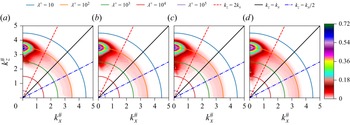


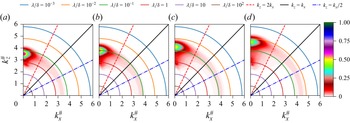


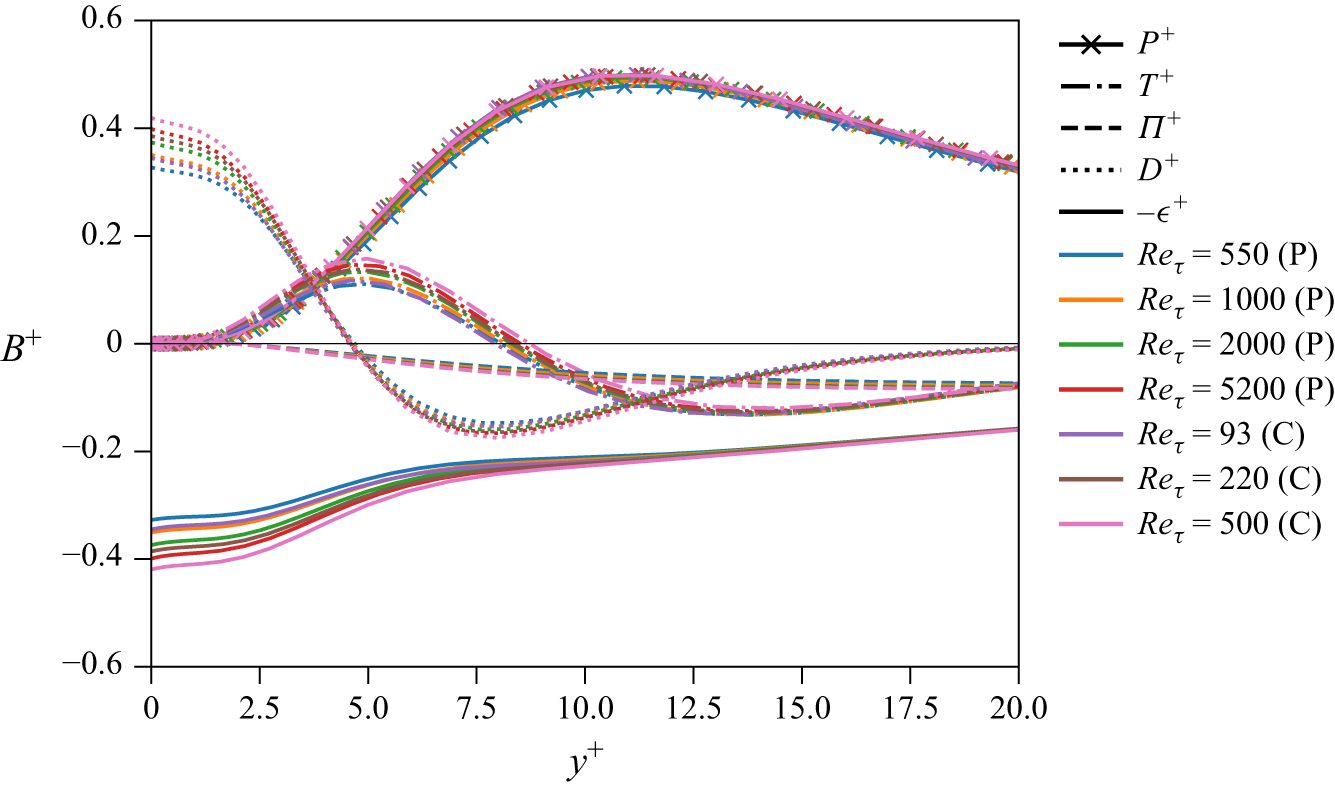


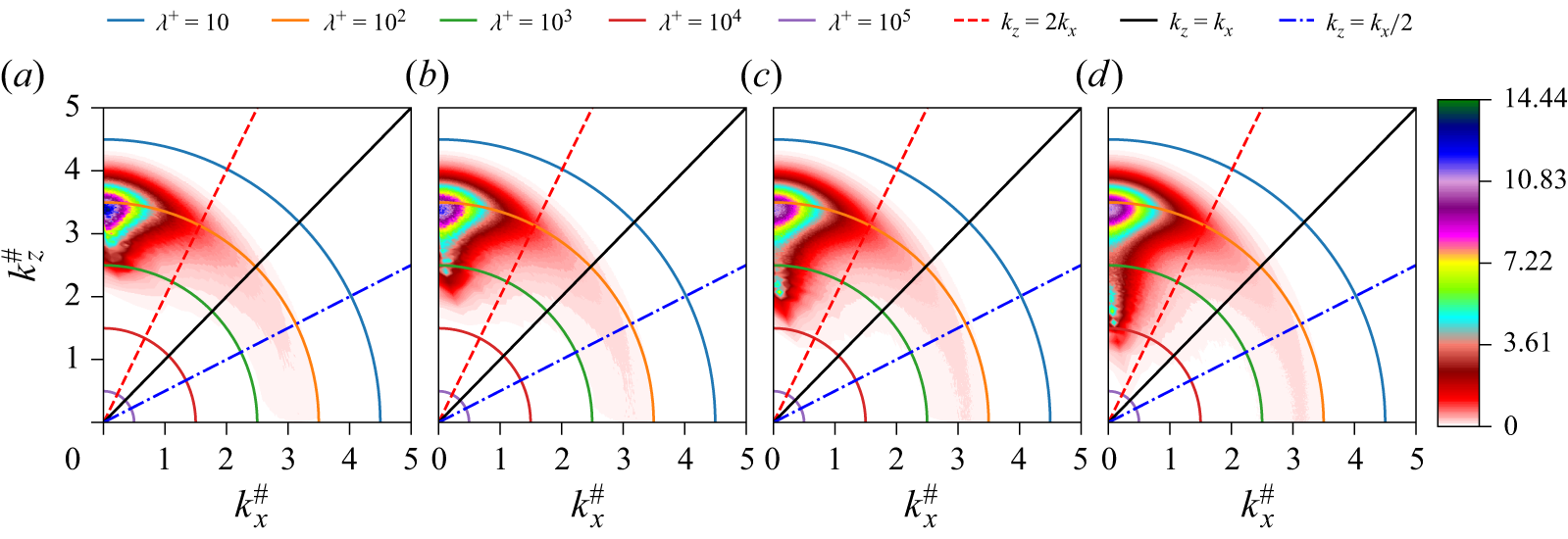


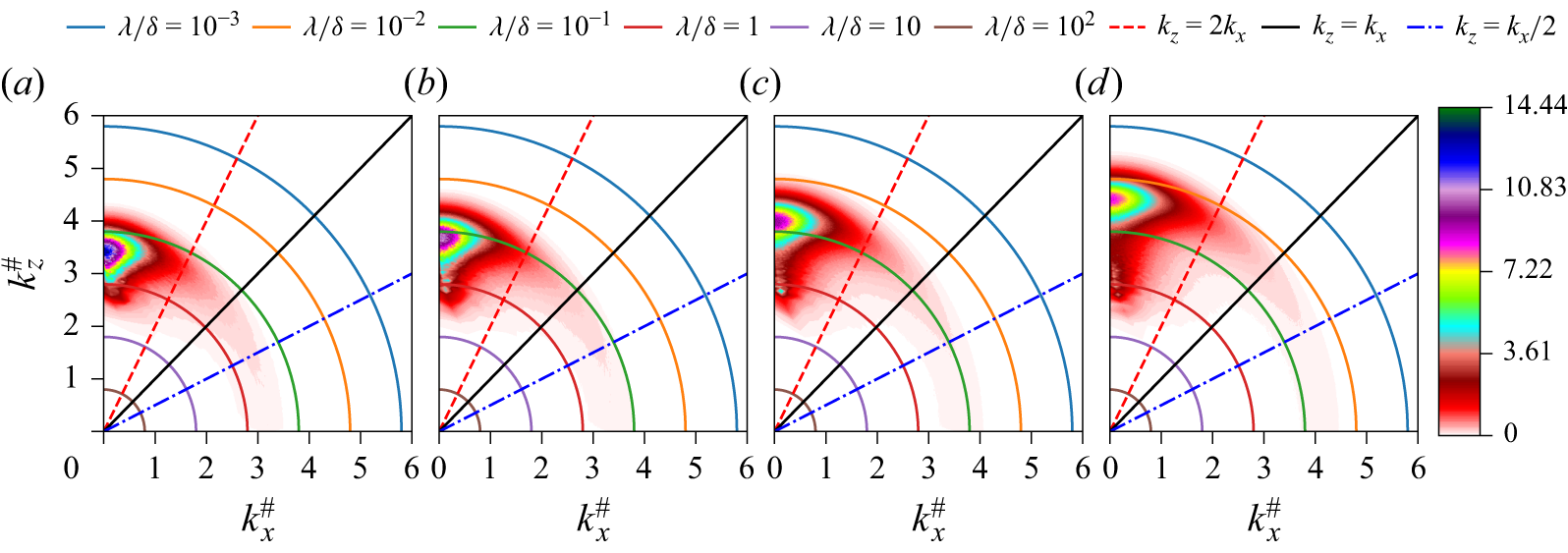


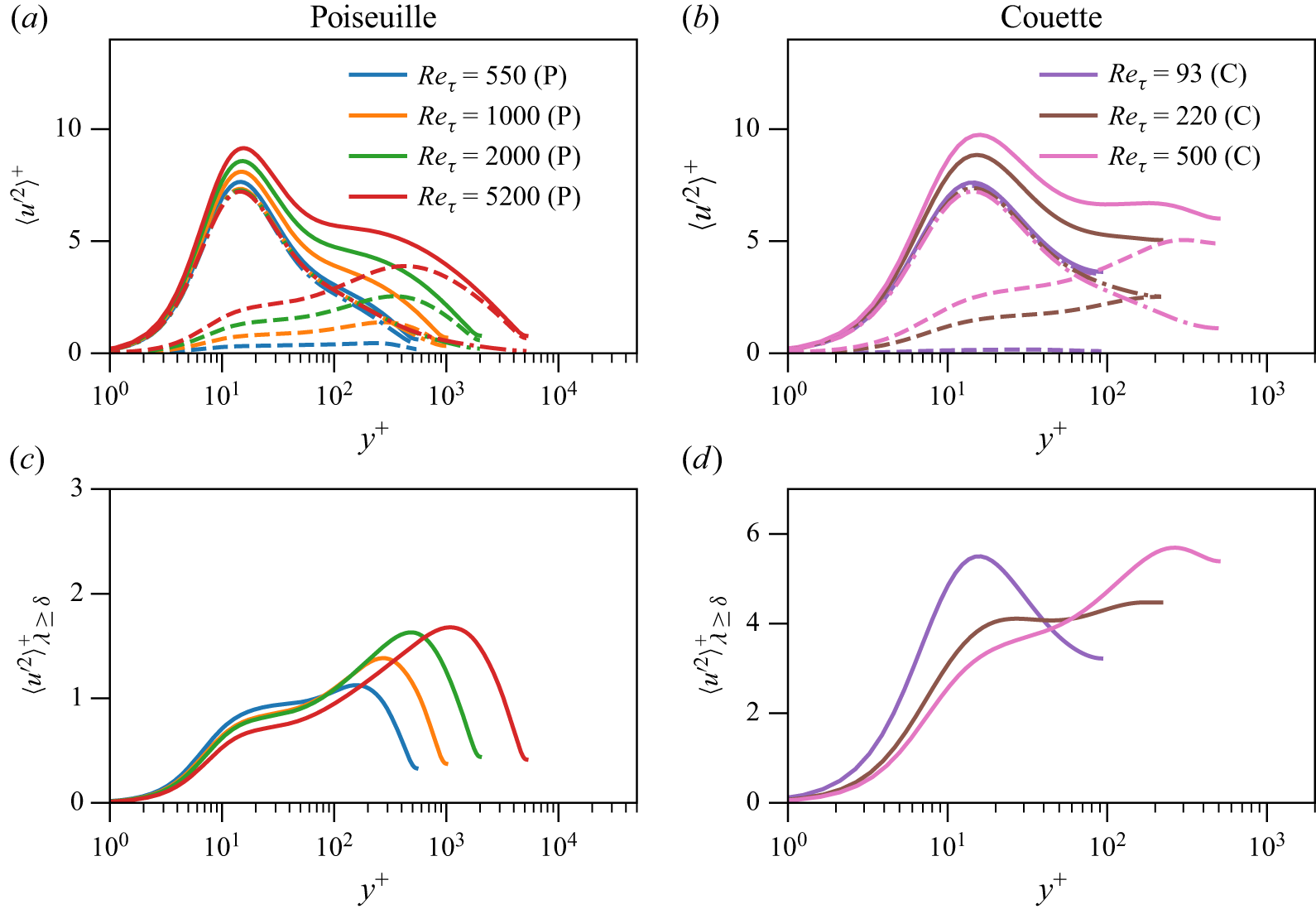


 Open access

