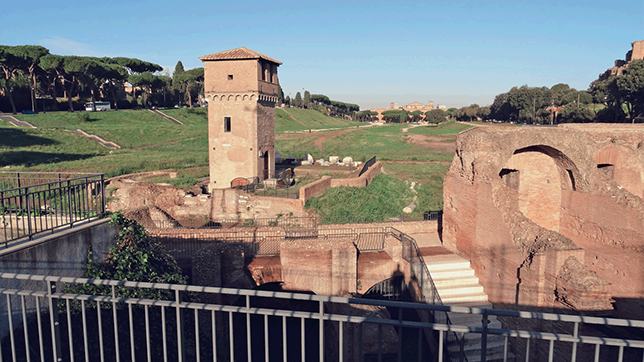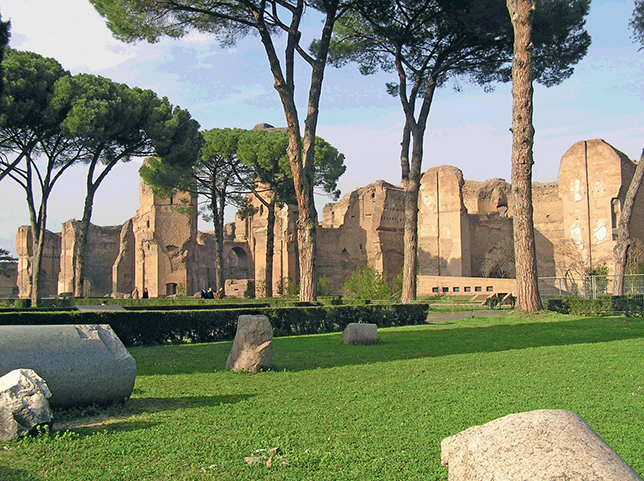


Rome was not ruined in a day. This is hardly surprising, since it had for centuries been the largest and most populous city in the Mediterranean basin. Over time it had been adorned with hundreds of temples and other monumental public structures built of dressed stone: racetracks, theatres, public bathing complexes (thermae), porticos, libraries. The extant regionary catalogues of the city, works of uncertain purpose originally composed in the fourth century,1 calculate the number of these impressive buildings and their capacity throughout the fourteen regions into which the emperor Augustus had divided Rome. Even the residential apartment blocks (insulae, ‘islands’) are included, a scarcely credible 46,602 in all. And yet for all that accumulated mass of brick and stone and marble, most of the structures still standing in late antiquity were gone by the Renaissance. Tourists nowadays are bound to be disappointed therefore if they visit the site of ancient Rome’s largest racetrack, the Circus Maximus, since all that is left to see of a structure that held 250,000 spectators is a small section of seating2 (Figure 2.1). But this was not the only venue for such spectacles. The footprint of the track of the stadium of Domitian is still clearly visible as the Piazza Navona; it held 30,000, but what little is visible of the curved substructure at the northern end is now embedded within later structures.3 The racetrack of Caligula and Nero has completely disappeared beneath St Peter’s Basilica in the Vatican City and the parvise in front of it. The fate of that most characteristic of Roman institutions, the public bathing complex (thermae), is equally telling. There were seven associated with their imperial builders, but only the ruins of the Baths of Caracalla and of Domitian are left to give us some notion of their gigantic scale (Figure 2.2). This chapter will give an account of how and why Rome became a site of such impressive ruination.
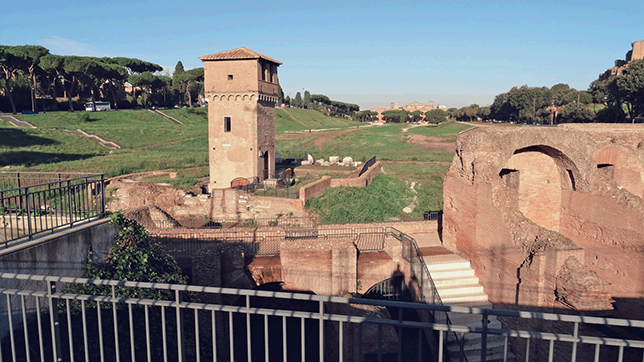
Figure 2.1 Remains of the Circus Maximus.
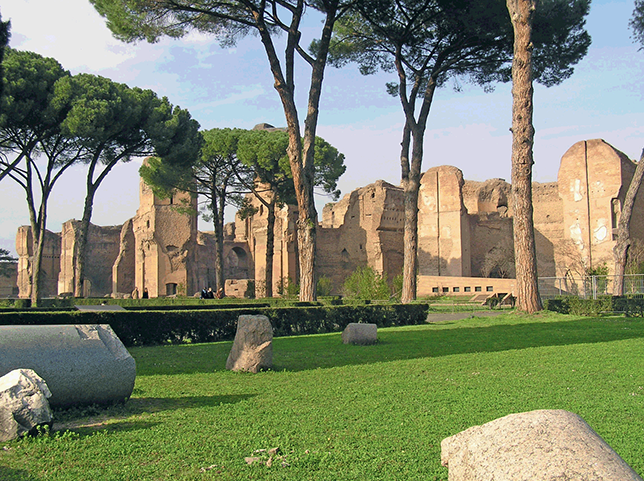
Figure 2.2 Panorama of the Baths of Caracalla.
The recurrent and persistent causes of damage to the built environment of Rome were three: fire, flood and earthquake. But in the early fourth century two particular events, the legal sanction of Christianity and the emperor Constantine’s removal of the seat of imperial government from Rome to the city he founded on the Bosporus, Constantinople, contributed a good deal over time to the decay of the material fabric of Rome.
Fire has always been the chief agent of any city’s destruction, and Rome had its fair share of disastrous conflagrations.4 The roofs of temples were made of timber, and the upper storeys of theatres and amphitheatres had wooden seating, thus providing fire with ample fuel to feed upon. For example, in 217 a lightning strike seriously damaged the wooden upper tier of the Colosseum; repairs took about five years. The building suffered more fires in the early 250s and in 320.5 The Theatre of Pompey was repeatedly undergoing repairs after fires;6 extensive repairs were undertaken by the emperor Honorius (395–402). Fires in the jerry-built apartment blocks were ‘an all too common accident in the city’, according to the late first-century poet Martial (nimium casus in urbe frequens, Epigrams 3.52.2), among other writers.
In addition to fire, Rome had to put up with a local agent of destruction, the river Tiber, which repeatedly flooded the low-lying regions of the city, chiefly the Campus Martius and the marketplaces (fora).7 (Such flooding was not checked until the river was embanked in the late nineteenth century.) The Janiculum Hill formed something of a barrier to flooding on the west bank of the river but it repelled flood waters towards the east bank, as the poet Horace memorably described in Odes 1.2.13–16: ‘We have seen the yellow Tiber, its waves hurled back from the Tuscan bank, proceed to wreck the king’s monuments including Vesta’s shrine’ (Loeb translation by Niall Rudd). The effects of flooding on the foundations of buildings cannot be exaggerated.8 The historian Tacitus described how after a particularly severe flood in ad 69 ‘the apartment houses had their foundations undermined by the standing water and then collapsed when the flood withdrew’ (Histories 1.86, Loeb translation by C. H. Moore), and in ad 15 ‘the Tiber, rising under the incessant rains, had flooded the lower levels of the city, and its subsidence was attended by much destruction of buildings and life’ (Annals 1.76, Loeb translation by J. Jackson). Ruina (‘collapse’) was one of the peculiar threats to life in the city of Rome, singled out by the satirist Juvenal (Satire 3.7–8 and 190–222, where flood and fire are combined as uniquely urban plagues). Rodolfo Lanciani reckoned that the flood of ad 589 brought Rome to the extremity of misfortune: temples, monuments and private dwellings were damaged, and as usual in late antiquity, when resources were severely diminished, in the wake of flood came famine and pestilence.9
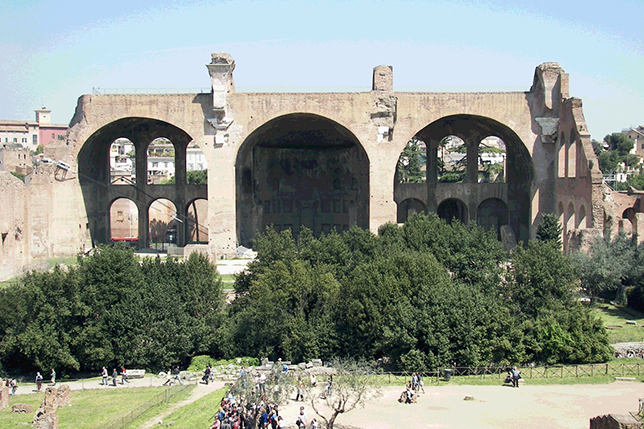
The Italian peninsula is subject to earthquakes, though Rome itself apparently enjoys a fairly low level of seismicity.10 If we focus on just one building, the Colosseum, there are records of its repair after earthquakes throughout the fifth and perhaps just into the sixth century.11 The last inscriptional record of repair is found on a reused statue-base set up by the Prefect of the City (praefectus urbi) Decius Marius Venantius Basilius, consul in ad 486, who paid for the work ‘out of his own pocket’ (sumptu proprio).12 Thereafter the records are meagre. There was a major quake in 847, when damage may have been done to the structure, as many believe; serious damage was certainly done in 1231 by the protracted earthquake recorded by the notary Riccardo of San Germano.13 The Italian poet Petrarch mentioned in a letter, Familiares xi.7, the earthquake of 9 September 1349, now recognised as ‘the strongest seismic shaking Rome ever felt’.14 Even though there is no record of which ancient buildings were damaged, it is likely that it was this quake (rather than that of 847) which brought down the southern perimeter wall of the Flavian amphitheatre, the debris forming its so-called haunch (coxa or coscia Colisei). This immense pile of ready-dressed stone served for centuries as a handy quarry for new buildings or for repairs to older ones.15 Finally, in 1703 an earthquake brought down one of the arcades of the Colosseum, and its stone too was recycled.16 Other structures were also seriously damaged by earthquakes. In the ninth century the much-admired Basilica Ulpia was so severely damaged that the building was in due course despoiled.17 The great quake of 847 devastated a substantial structure at the end of the Basilica Aemilia, and probably destroyed most of the Basilica of Maxentius, leaving only the three arcades with coffered vaults we see today18 (Figure 2.3).
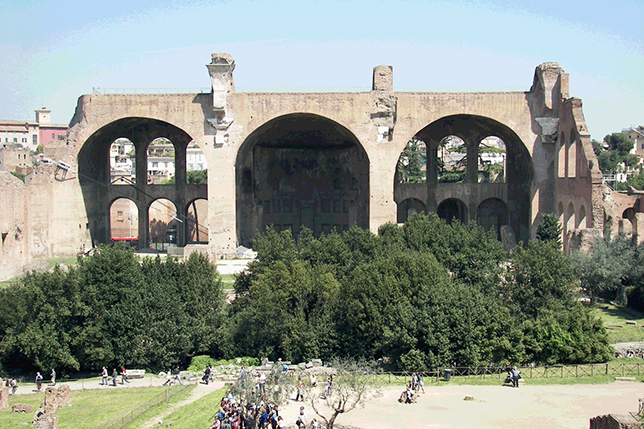
Figure 2.3 Basilica of Maxentius.
The product of all this damage was rubble. Rubble could be cleared away; Tacitus recorded in his Annals 15.43.3 that Nero had the rubble produced by the great fire of 64 transported in barges down to Ostia to be dumped in the marshes. But it was always easier to spread the rubble either within the damaged structure, as happened in the Basilica Aemilia,19 or in open spaces, thus raising the ground level, a practice which had its advantages in the low-lying Campus Martius, which was always liable to flooding (intentional deposition in fact became common in the twelfth century).20 The result of raising the paving level is best detected in the area sacra of the Largo Argentina site.21 After a fire probably in 111 bc the level was raised about 1.40 metres and paved in tufa. In ad 80 a second disastrous fire destroyed numerous buildings in the Campus. In consequence, the travertine pavement we now see in front of the Republican victory-temple A (so designated because the god to whom it was dedicated is not known) was laid over a metre above the older tufa paving below it.22 Likewise, the ground around the Ara Pacis Augustae (Altar of Augustan Peace), which had of course originally been built at ground level on the Campus Martius, was raised over 1 metre in 80,23 and by the early second century the complex sat in a pit and needed protection by a brick revetment, since the ground level had risen almost 3 metres.24 In this way over the centuries, as building after building collapsed as a result of fire or flood or earthquake, the rubble rose higher and higher. In addition, flood waters left a deposit of mud, and alluviation contributed well into the Middle Ages to the rise in the ground level. By late antiquity the level was in places raised by 3–4 or even to 5 metres above the surface of the Augustan period.25 (By way of comparison, the Mithraeum in London, recently relocated to its original position, now lies 7 metres below street level.) In fact, so elevated had the ground’s surface become that even the location of the Roman Forum itself was long unknown, since it had been submerged under rubble and alluvial soil; it became a meadow, called the Cowplain (Campo Vaccino). In the tenth century the Forum of Trajan was covered with crushed pottery, on top of which was spread agricultural soil; streets and houses with gardens were built on top of it.26 The hillock called Montecitorio, where the Italian Chamber of Deputies now stands, is actually a pile of accumulated rubble.27
If Rome’s religious life had persisted in paganism or if it had remained the metropolis of the empire, the chances of its buildings surviving would have been stronger. But once the emperor favoured Christianity and settled in distant Constantinople, Rome was marginalised into hardly more than the chief city of Italy. Members of the elite who wished to remain elite adopted the emperor’s religion and moved to the new capital. Rome itself was still occupied by wealthy pagans, who were reluctant to renounce the traditional religion of the state, but the tide was set against them. Throughout the fourth century a series of enactments or edicts aimed to reduce the role of paganism. This had an effect on the public structures in which the old gods had been worshipped (the temples) and honoured (the theatres, amphitheatres and racetracks). It must be understood that in Greece and Rome the sort of entertainments we enjoy as secular – going to the races or watching a play – were part of religious festivals, held at fixed times in the course of a year in honour of particular gods. In the Circus Maximus, for instance, the gods had their own box, the pulvinar, from which their statues could share in the excitement. So strictly speaking a Christian who was a private citizen ought not to attend the shows – a point driven home in a treatise, De spectaculis, by the second-century Christian polemicist Tertullian. A Christian who held public office would find it very hard to bankroll the entertainments of the stage or the racetrack, which in their way did honour to the pagan gods of Rome. (It should also be understood that Christians did not deny the existence of these gods; they held them to be the angels who fell with Lucifer and subsequently set themselves up as divinities on earth to mislead humankind.) Thus the progress of Christianity in due course proved fatal not only to paganism but also to the buildings strongly associated with it. The temples obviously ceased to have any function in a Christian community, and the entertainment venues too suffered when they lost their purpose. It is time to describe the fate of these structures in more detail.
The fate of all the buildings associated with pagan gods was ultimately determined by the policies of the emperors with regard to pagan cult from the fourth century to the sixth.28 In the course of these two centuries, Christians at last came to outnumber pagans. But the immediate successors of Constantine had had to accommodate a pagan majority, so their attempts to curb pagan practice, for instance by closing temples or banning blood sacrifice, were tentative and often ineffectual.29 The pace of suppression gradually accelerated, however, as Christianity became ever more dominant. By the late fourth century, Theodosius (Augustus from 379 to 395) and Gratian (reigned in the West 367–83) took more decisive measures against the apparatus of paganism. In 382 Gratian, firmly under the thumb of Bishop Ambrose of Milan, confiscated the endowments of pagan sacrifices and ceremonies.30 The cult of the Vestal Virgins was abandoned in 394. In 391 the emperors reiterated the ban on blood sacrifice and forbade access to temples (Theodosian Code 16.10.10–12). A repetition of the sacrificial ban in the fifth century shows, however, that earlier bans were ignored, but the trend is clear: efforts to eradicate paganism would not cease until success was achieved. During the reign of Justinian, a law of 527, Codex Iustiniani 1.5.12, aimed to secure that success by banning pagans from imperial, administrative or judicial employment and by privileging the Christian upbringing of their children. Recalcitrance was punished with a heavy fine or worse. Intolerance had won the day.
Official attempts at repressing the pagan cult did not, however, have as great an impact on the temples and shrines of the gods as might be expected.31 In 408 the buildings were effectively ‘secularised’ with the removal of their cult images. Temples lost their religious function. But their destruction was never imperial policy, and as we will see, efforts were made to maintain them, even after they had lost their purpose. Some temples were converted into churches, but Rome was stuffed with them, as we can still see in the area sacra of the Largo Argentina. There were far too many temples to be recycled; most of those now visible in the Largo Argentina were absorbed into later secular structures.
The buildings constructed for secular entertainment, on the other hand, fared rather better.32 Tertullian might attack spectacles generally and deplore the money lavished upon them, but they posed only a moral, not an existential, threat to Christianity. Pagan magistrates, patrons and spectators of all religious persuasions combined to ensure continued support for the shows, especially at the racetrack (circus). So long as the shows were popular, their venues were maintained. But mounting the shows was expensive, and by late antiquity lavish outlay no longer helped to secure the sort of rewards that had induced men in the old republic or early empire to spend fortunes on amusing Rome’s voters. The Roman Senate of late antiquity was but a shadow of its former self,33 and the city’s grandees preferred to spend their money on themselves rather than on entertaining a much-reduced population. The year 549 is the last-known date at which races, courtesy of the Ostrogothic king Totila, or indeed any other form of shows, were provided in Rome.34
Rome exceptionally had three permanent stone theatres: Pompey’s, inaugurated in 55 bc; one commissioned to celebrate a victory by Lucius Cornelius Balbus in 13 bc; and the one dedicated to Marcellus of about the same date. They were built chiefly for the performance of ‘regular’ dramas; that is to say, scripted plays. But in the imperial period the popular forms of staged entertainment were mimes, farces and pantomimes (this last a precursor of ballet). Unfortunately, we have very little information about stage performances in Rome in later antiquity, but it must be assumed that at some point they were given up, and the theatre buildings will have suffered once the ludi scaenici, which had traditionally been mounted at the cost of the elite, were abandoned or suppressed.35 The fine museum of the Crypta Balbi, itself hardly more than a courtyard of Balbus’ theatre, has on display instructive models of the changes to that theatre-complex over the centuries; they vividly depict the decay and repurposing of the buildings from the fifth century to the modern period.36 The porticus of the Theatre of Marcellus was being demolished in 365–70 to provide material with which to repair the nearby Bridge of Cestius, though the stage building was still adorned with statues as late as 421.37
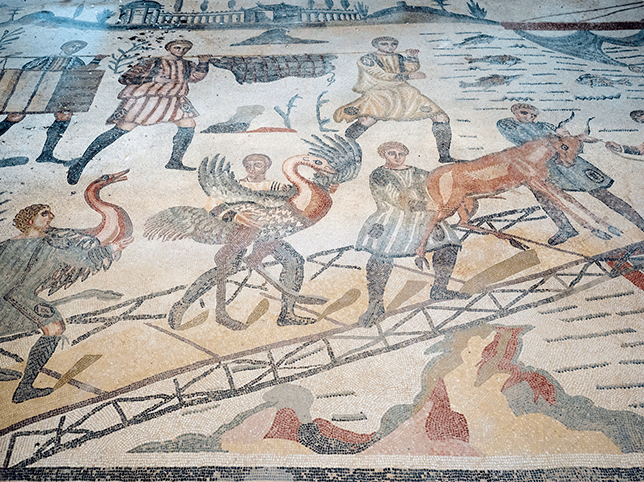
Rome’s amphitheatres were primarily the venues for two forms of entertainment, gladiatorial combat and beast hunts (venationes). These were not part of religious festivals, but in Rome they were closely associated with imperial cult, since only the emperor was entitled to provide them. Both were vastly expensive to mount: gladiators were trained professional fighters and beasts (which only lived to fight once) had to be shipped from remote places (Figure 2.4).
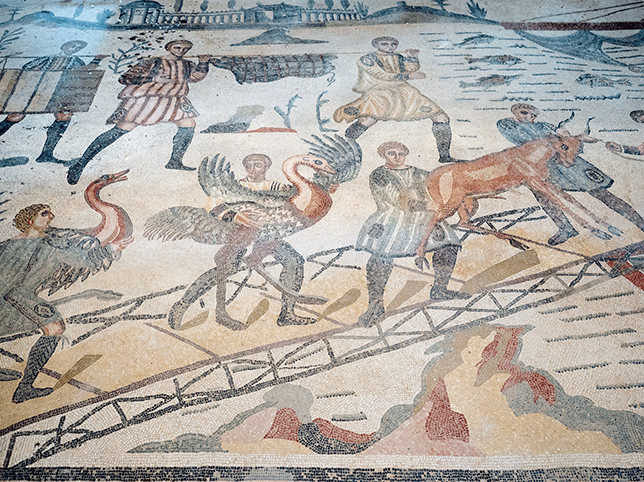
Figure 2.4 Loading animals for Venatio, Villa Romana del Casale, Sicily.
The butchery of the gladiatorial games was obviously anathema to Christians, and there were repeated imperial edicts banning them from the time of Constantine; the last combats were held ca. 400 (not in the Colosseum, oddly enough). The last-known beast hunt was held ca. 500.38 The upshot was that the huge buildings designed to accommodate vast audiences lost their primary use and function. There was therefore no point in maintaining them any longer. In the sixth century the Colosseum was sealed off to prevent access.39
Finally, the most popular of all Rome’s public entertainments were the exciting chariot races, mainly held in the Circus Maximus. As Rome’s oldest and largest racetrack, it was always kept in repair, and even in the fourth century senatorial wealth was used to fund races.40 But after the last-known races held there, king Totila’s, of what use was it?41
Maintenance of the numerous and huge public structures was the crucial problem. It was noted in Chapter 1 (p. 7) that Augustus recorded with pride the restoration of eighty-two temples, proof that neglect of public structures had a long history. His successors took it upon themselves to ensure the maintenance of public buildings in Rome itself (private citizens could and did build in urban centres beyond Rome). So long as the emperor lived in Rome and saw it daily, the upkeep of the public buildings was his personal concern. But once the emperor had moved away from Rome, maintenance was placed in the hands of an official whose title has already been mentioned, the Prefect of the City (praefectus urbi). He was appointed by the emperor and had under him other administrators (also praefecti) in charge of different departments, such as the corn and the water supplies; all these posts continued to exist into the sixth century and beyond. One had charge of buildings, the maintenance of which was funded by the arca vinaria, a wine tax.42 The chief obstacle to providing adequate maintenance in the Rome of late antiquity was that its buildings were larger and more numerous than had ever been necessary for its population, and yet building on a colossal scale persisted through the fourth and early fifth centuries.43 The emperors wanted to leave their personal mark on the city, and a new building served that purpose better than the maintenance of what was already there in abundance.
There was legislation aimed at maintenance, for instance the laws of Valentinian and Valens.44 One law of 364, Theodosian Code 15.1.11, ordered Symmachus, Prefect of the City, to ensure that ‘none of the judges shall construct any new building within the Eternal City of Rome if the order therefore of Our Serenity shall be lacking. However, we grant permission to all to restore those buildings which are said to have fallen into unsightly ruins’.45 This law strongly suggests that finding anyone to undertake maintenance was difficult, since permission given ‘to all and sundry’ (universis) hints that the urban authorities could no longer be required to repair from their own meagre resources. That law was followed up in the next year, 365, by Theodosian Code 15.1.14, with one ordering that ‘no new structures are to be begun before the old ones are restored’.46 This only goes to show that maintenance, always less prestigious than building anew, was being neglected. A law of 376, Theodosian Code 15.1.19, ordered that
no one of the prefects of the City or other judges whom power has placed in a high position shall undertake any new structure in the renowned City of Rome, but he shall direct his attention to improving the old. If any person should wish to undertake any new building in the City, he must complete it with his own money and labor, without bringing together old buildings, without digging up the foundations of noble buildings, without obtaining renovated stones from the public, without tearing away pieces of marble of despoiled buildings.47
Clearly the now prohibited acts are exactly what was going on. Finally a law of 397, Theodosian Code 15.1.36, conceded the destruction of temples, perhaps already ruinous ones, to supply material for repairs:
Since you have signified that roads and bridges over which journeys are regularly taken and that aqueducts as well as walls ought to be aided by properly provided expenditures, we direct that all material which is said to be thus destined from the demolition of temples shall be assigned to the aforesaid needs, whereby all such constructions may be brought to completion.48
That last law, with its focus on roads, bridges, aqueducts and walls, points up the difficulty of maintaining even the city’s basic infrastructure in the late fourth century. It cannot be surprising then that maintenance of the vast structures erected for popular amusement proved insupportable. An additional factor which increased the difficulties of the urban authorities tasked with maintenance of the built environment was steady depopulation.49 Estimations of Rome’s population vary, of course, given the lack of reliable data, but no one doubts that it decreased steeply in late antiquity. Conventional wisdom has it that Rome’s population was nearing a million by the end of the republic and probably in excess of that in the city’s first-/second-century heyday.50 By the late fourth century, however, it may have been reduced to 500,000. Over the course of the fifth century the population may have dropped by 90 per cent, from 500,000 to 60,000,51 and by the mid-sixth perhaps it had dwindled to as few as 50,000. By the eighth century there may have been not many more than 10,000 inhabitants.52
A significant driver of depopulation was the cost and depletion of the grain supply.53 The state’s provision of free grain (and later on, of free bread) to urban householders and the market sale of it at controlled prices, the annona, were seriously compromised after the Vandals occupied the province of Africa from 429 to 534. This deprived the empire of the tax revenue of the province, and so the crucial shipments of grain to Rome were no longer subsidised.54 Not surprisingly, Rome’s population shrank for lack of sustenance.
This shrunken population had no need for buildings designed to accommodate a much larger community, especially the more extravagant ones, like the imperial bathing complexes, the thermae, to which we may now turn. Strictly speaking, these well-appointed leisure centres had never been a necessity, since Rome had long had numerous private commercial bathhouses (balnea). A citizen who simply wanted to keep themself clean needed no more than that. The imperial structures, with their sculpture gardens, gymnasia and libraries, were therefore a luxury which the city of late antiquity could neither make adequate use of nor financially support. To operate at all, the thermae needed constant supplies of water and of wood for heating the water, the floors and the chambers of the complex.
The sources and cost of wood for fuel have been most recently set out by Douglas Underwood, who concluded that it was not all that costly or scarce.55 In the good times, wood had been supplied from Terracina, down the Latian coast, in exchange for wine,56 but once the Vandals controlled the sea, shipments in both directions must have become risky. The artificial harbour installations at the mouth of the Tiber at Portus were also no longer well maintained, and so shipment and transport became prohibitively costly. The functioning of the thermae was also hampered by the dwindling water supply to the upper reaches of the city. It is arguable that on balance even the aqueducts were something of a luxury, rather than a necessity, since water for everyday use was readily available in the low-lying parts of the city and near the river.57 Maintenance of the aqueducts had to be incessant, since the flowing water left a deposit on the interior surfaces of the channel which had to be removed regularly. If the deposit was allowed to build up, the flow of water was reduced to a trickle.58 The official in charge of the aqueducts, the comes formarum, is last mentioned in 602,59 and it is during Pope Gregory I’s reign (590–604) that we last hear of a functioning public bath. The thermae were soon repurposed as Christian cemeteries, along with other abandoned public areas.60
The diminished supply of water by aqueduct also had an impact on settlement within the city. If you lived up on the hills, the aqueducts supplied your water. Once that supply was seriously reduced, tanks, fountains and reservoirs were unfilled, and the hills had to be abandoned for the lower-lying areas of the city. By the time of Theoderic, huge tracts of land within the Aurelian walls were thus gradually disinhabited (disabitato).61 After his reign, warfare and plague caused further depopulation. The many huge structures in the disabitato, well outside the now restricted urban centre, were easily ignored and neglected or pillaged.
Money for maintenance became scarcer over time. There is no record of any imperial grant of money for repairs in Rome during the fifth century.62 An inscription of perhaps 443 attests the scarcity of public funds:63 the City Prefect, Petronius Perpenna Magnus Quadratianus,64 recorded that he had repaired the Baths of Constantine ‘with the small outlay that the shortage of public money allowed’ (parvo sumptu quantum publicae patiebantur angustiae).
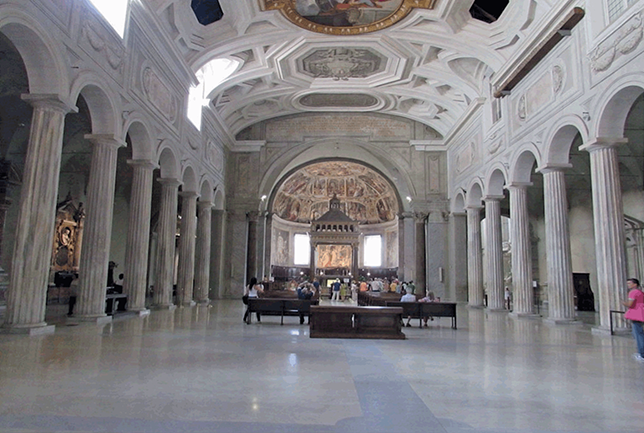
Although money was scarce for public works, Rome’s wealthy Christian elite were happy to spend their fortunes on new churches. Some of the building materials, brick and marble columns, for these often sumptuous structures were taken from older buildings, possibly decayed temples. This brings us to the practice of spoliation.65 Spoliation is not necessarily destruction. The material, nowadays called spolia, may have been removed from unwanted or dangerous structures deemed past repair or restoration. Since public buildings belonged to the state, they were a fiscal asset and the brick and stone of decayed or disused structures could be profitably sold. As an example of this practice, indeed as a justification of it, one need only visit the serene interior of the basilica of S. Sabina, constructed on the Aventine Hill by Peter of Illyria in the period 422–32. The eight columns in its atrium and the twenty-four elegant Corinthian columns of the interior are all clearly recycled from some older, but now unknown, structures.66 Who would deny the beauty and fitness of this reuse of classical materials? Mrs Charlotte Eaton who stayed in Rome between 1816 and 1818 made a point of visiting the church just to see its columns, not in fact an uncommon draw for tourists of the day, as Rosemary Sweet has demonstrated.67 Likewise, the twenty uniform Doric columns in cipollino marble in the basilica of S. Pietro in Vincoli, consecrated in 439, contribute much to the harmony of its nave. They too were repurposed from some pagan structure, evidently of considerable status (perhaps the porticus Liviae)68 (Figure 2.5). This practice of recycling continued well into the Middle Ages. In 1140 Pope Innocent II removed Ionic columns probably from the Baths of Caracalla to rebuild the nave of the church of S. Maria in Trastevere.
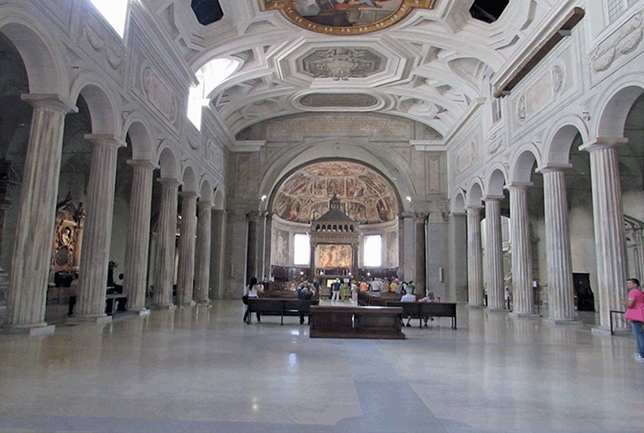
Figure 2.5 The nave of San Pietro in Vincoli.
So far, focus has been concentrated upon the factors which produced deterioration of the city’s material fabric in spite of legislation aimed at keeping up appearances. But there were a few concerted attempts to arrest the decay and repair damage. The emperor Septimius Severus, who reigned from 193 to 211, is credited with a considerable number of restorations: the Temple of Vespasian, the Porticus of Octavia gateway and the Pantheon.69 The Temple of Peace, which had been damaged in the serious fire of 192, was almost a new construction.70 The Temple of Vesta was restored by Julia Domna, Severus’ wife.71 The city had been much neglected in the disturbed period before Severus took control of the state. As a military usurper, he was eager to establish his legitimacy, and restoring the splendour of Rome’s public buildings was part of his programme to secure popular support.72 But after the murder of his son and successor Caracalla, Rome descended into a chaos from which it only began to emerge in the later third century under Diocletian.
During this unsettled period the long-standing practice of recycling building material, spolia, became more usual.73 Thanks to the recent archaeological investigations of Simon Barker, it has become clear that the recycling of bricks and especially of costly marbles was a fairly common practice as early as the first century.74 It made sense thanks to the logistical and economic advantages over production of new building materials.75 But there were abuses, and legislation in the reign of Claudius, the Senatus Consultum Hosidianum, was passed to prevent purchase of buildings for demolition solely with a view to profit from selling the material.76 Olivia Robinson plausibly urged that one motive for the Claudian legislation was protection of ‘the urban display of the glories of Rome’.77 But by the third century logistical and economic considerations made demolition and recycling not only more attractive but also necessary. One factor contributing to this practice was the unavailability of the fine white marble of Carrara in Tuscany; the harbour of Luna from which it was shipped had silted up, making its transport prohibitively expensive. By the late third century, exotic coloured marbles too could no longer be imported from remote provinces.78 A rescript of the emperor Alexander Severus in 222 forbade the removal of marble (marmora detrahere, Codex Iustiniani 8.10.2), which shows only that the practice was causing concern, not that anyone could stop it. As an example of this practice, the portico of the highest stage (summa cavea) of the Colosseum still shows its third-century repair with stone taken from different sources.79
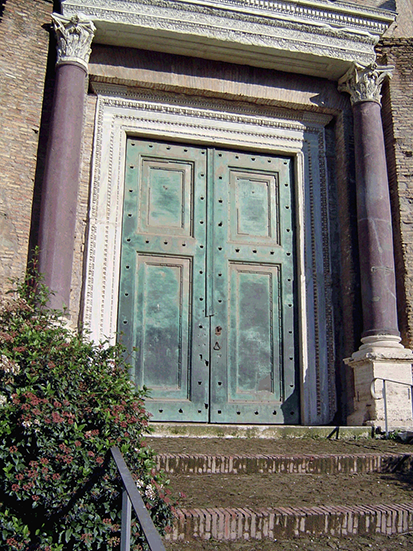
The practice continued in the fourth century. For instance, the emperor Maxentius built a round temple on the upper Sacra via in the Forum, the so-called Temple of Deified Romulus (perhaps Maxentius’ son); it became part of the church of Saints Cosmas and Damian in 526 in the reign of Theoderic.80 The majority of the architectural marbles used in the temple’s decoration and even its bronze doors with their marble frame were spolia from unknown structures of the Flavian and Severan period81 (Figure 2.6). Recycling persisted under Maxentius’ successor, Constantine. His arch, dedicated in 315, is decorated with statues of Dacians dating back to the time of Trajan. Indeed, most of the arch’s recycled decorative material was carved in the reigns of Trajan, Hadrian and Marcus Aurelius.82 The new Christian churches benefited too from the use of spolia; the Lateran baptistery, for instance, and the basilica of St John (built in the period 312/13–20) show a wholesale reuse of fine older material.83 Later in the fourth century, between 360 and 380, the Temple of Saturn in the Forum was restored by the Senate after its destruction by fire. Very little new material was provided, all the rest being recycled, some from the destroyed temple, but a good deal from other sources.84
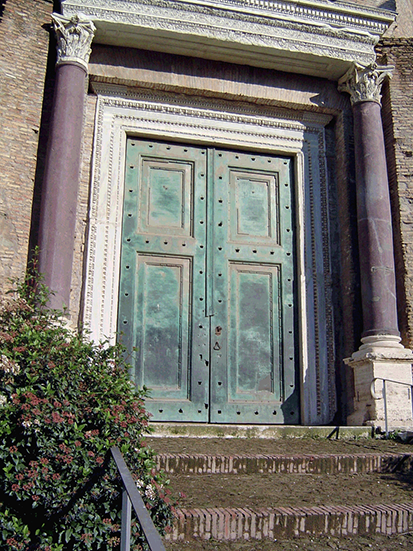
Figure 2.6 Ancient doors of the Temple of Romulus.
That the appearance of Rome’s monumental centre remained nonetheless impressive well into the fourth century is confirmed by the account of the historian Ammianus Marcellinus of the visit, his only one, to the city by the emperor Constantius II (reigned 337–61) in 357:
So then he entered Rome, the home of empire and of every virtue, and when he had come to the Rostra, the most renowned forum of ancient dominion, he stood amazed; and on every side on which his eyes rested he was dazzled by the array of marvellous sights … he thought that whatever first met his gaze towered above all the rest: the Sanctuaries of Tarpeian Jove [= Temple of Jupiter Optimus Maximus] so far surpassing as things divine excel those of earth; the baths built up in the manner of provinces; the huge bulk of the Amphitheatre [= Colosseum], strengthened by its framework of Tiburtine stone, to whose top human eyesight barely ascends; the Pantheon like a rounded city-district, vaulted over in lofty beauty; and the exalted columns which rise with platforms to which one may mount, and bear the likenesses of former emperors; the Temple of the City [= Temple of Venus and Roma], the Forum of Peace [= Temple of Peace, dedicated by Vespasian in 75], the Theatre of Pompey, the Odeum, the Stadium [both built by Domitian], and in their midst the other adornments of the Eternal City. But when he came to the Forum of Trajan [dedicated in part by Trajan in 113], a construction unique under the heavens, as we believe, and admirable even in the unanimous opinion of the gods, he stood fast in amazement, turning his attention to the gigantic complex about him, beggaring description and never again to be imitated by mortal men.
Some fifty years after this formal imperial visit, an adventus in Latin, Rome suffered the first of the non-Roman occupations which did much to reduce its prestige. The Visigoths did not, however, deliberately damage the built environment; it is generally agreed that little physical harm was done, since pillage rather than destruction was the price of defeat. Most damage was done by the Romans themselves, not by foreign invaders, who were after portable wealth. The destruction of buildings was just ‘collateral damage’, not the object of their attack. In 410 the Visigoth Alaric did only limited damage to buildings.85 It may be that this was when a fierce fire destroyed much of the Basilica Aemilia. It had been one of the grandest buildings on the Roman Forum, but it was only modestly repaired, proof of the declining resources of the city at the time and perhaps of local engineering skills too.86
On 11 July 458 the western Roman emperor Julius Valerius Majorian (reigned 457–61) issued a well-known edict, which provides the clearest proof that it was the Romans themselves who did the greatest damage to the city’s fabric by stripping or demolishing buildings to get material either for repairs or for new structures. Its terms are clear:
While we rule the state, it is our will to correct the practice whose commission we have long detested, whereby the appearance of the venerable City is marred. Indeed, it is manifest that the public buildings, in which the adornment [ornatus] of the entire City of Rome consists are being destroyed everywhere by the punishable recommendation of the office of the Prefect of the City. While it is pretended that the stones are necessary for public works, the beautiful structures of the ancient buildings are being scattered, and in order that something small may be repaired, great things are being destroyed.87
The edict went on to complain that with the connivance of the judges, private persons were removing material from public structures for their own building. The edict therefore orders that ancient temples and other monuments constructed for public use and pleasure must not be destroyed, nor must any material be removed from them. But the third section of the edict hedges by admitting that some public buildings were beyond repair, and that material really was needed for the repair of other structures. The Senate is therefore to consider a claim, and if it is upheld, it is to be referred to the emperor for a decision. Material can be supplied from a public building beyond repair for the repair and adornment of another public work. The despoliation of already ruinous public buildings can thus provide material with which to repair other structures.88 Two features of the edict deserve particular note. First, the beauty of the old buildings is stressed, and secondly the pagan temples are not to be damaged if at all possible, but conserved.
Despite the spoliation, there was nonetheless some restoration, thanks to the ruler who, after Severus, showed most concern for the care of Rome’s buildings, Theoderic the Ostrogoth (454–526).89 Rome and Italy had slipped from imperial hands, and Theoderic’s rule in the West was recognised by Constantinople. His capital was Ravenna, where his splendid tomb monument is still visible. He made his adventus to Rome in 500. Rather like Severus’, his programme of restoration of public works was a bid for legitimacy and popularity.90 Theoderic was in effect insinuating himself into the imperial tradition of maintenance of Rome’s infrastructure and built environment. He also saw to the restitution of the corn dole, annona, a move which ought to have stabilised the population. A valuable record of his works is to be found in the extant diplomatic correspondence of his minister, the Variae (‘Miscellanies’) of Flavius Magnus Aurelius Cassiodorus Senator. Cassiodorus’ letters disclose Theoderic’s broad aims and reveal what was actually happening in Rome.91 Aqueducts, thermae (tile stamps confirm the restoration of Caracalla’s), walls and palaces92 were all taken in hand. In Variae i.25 Theoderic writes to Sabinianus about the annual supply of tiles with which to restore and beautify the city.93 In Variae iii.30, he informs the City Prefect that he is sending to Rome one John to ensure the proper working of Rome’s amazing sewer system.94 In Variae iii.31, he expresses his irritation that water is being taken from aqueducts, that the slaves who have care of them have passed into private ownership, that metal is being removed from public buildings and finally that temples marked for restoration are being demolished instead; after all, he is ‘striving to bring everything back to its former condition’ (ad statum studeamus pristinum cuncta revocare).95 In iv.51, Theoderic encourages Symmachus to repair the Theatre of Pompey.96 It is surely significant that the king admitted that he ‘might have chanced to neglect the matter’ (haec potuissemus forte neglegere) had he not personally seen the building and been deeply impressed with its scale, hence his concern to have it repaired. He even promised to provide money from his treasury for the works, which were carried out between 507 and 512. He claimed that he wanted ‘antiquity to be seen to be more beautifully restored in his times’ (nostris temporibus videatur antiquitas decentius innovata) – that final appeal to ‘beauty’ (decentius) is rightly stressed by Valérie Fauvinet-Ranson in her translation.97 But Theoderic’s methods nonetheless betray something of the poverty of the times: columns and material were removed from the Temple of Mars Ultor for reuse, as was a pillar from the Colosseum.98
At the time of King Theoderic’s adventus in 500, another visitor had recently arrived in Rome, the north African monk Fulgentius, who was later to be the Catholic bishop of Ruspe in Tunisia. The life of Fulgentius, once attributed to Ferrandus of Carthage, records in § ix.27 that the monk was present at the king’s address to the assembled senators and people.99 The ascetic Fulgentius had put worldly things behind him, but he nonetheless found the spectacle of Rome so dazzling that he exclaimed to his brethren: ‘how beautiful can the heavenly Jerusalem be, when earthly Rome is so glittering!’ (quam speciosa potest esse Hierusalem caelestis si sic fulget Roma terrestris). Even in its reduced condition, the physical aspect of the city still evoked wonder.
The eastern Roman emperor Justinian, after recovering Africa from the Vandals, retrieved Italy as well from the Goths. His successful general Belisarius entered Rome on 9 December 536, and prepared for a siege by the Gothic general Vitigis. This siege, only a part of the wider Graeco-Gothic wars, lasted until March 538. The city was retaken in December 546 by Totila, who was in turn ousted by Belisarius in 547; but Totila then recovered Rome in 550. The wars only drew to a close with the defeat of Totila by the Byzantine general Narses in 552. This prolonged period of warfare naturally had an adverse impact on Rome’s built environment. For instance, the Goth Vitigis had cut or at any rate blocked the water supply from the aqueducts (he is unlikely to have done permanent damage, assuming that he intended to keep Rome). Justinian’s Pragmatic Sanction of 13 August 554, at the end of the Gothic Wars, regulated Italy’s affairs and insisted upon the repair of Rome’s public buildings, specifically the infrastructure, the market, the port and the aqueducts.100 But the fighting up and down the peninsula had devastated communities and agricultural estates, and thus it effectively ‘destroyed the very structures it had sought to rescue’.101 Justinian’s measures did little to check Rome’s social and physical decline.
The Greek historian of this protracted conflict, Procopius, in his Gothic Wars 4.21, noted the abandonment of the Forum of Peace and its temple, which had not been repaired after serious damage by lightning. It had already effectively lost monumental status when utilitarian shops or warehouses were built within it in the early fourth century. And yet Procopius praised the Romans for their love of their buildings:
The Romans love their city above all the men we know, and they are eager to protect all their ancestral treasures and to preserve them, so that nothing of the ancient glory of Rome may be obliterated. For even though for a long period they were under barbarian sway, they preserved the buildings of the city and most of its adornments, such as could through the excellence of their workmanship withstand so long a lapse of time and such neglect.
Recent stratigraphic research indicates that decay in the monumental imperial complexes of Rome was pronounced, thus correcting the rosy picture of the literary sources.102
A century after Justinian’s official but ineffective attempts to maintain Rome’s buildings, the Byzantine emperor, Constans II, visited the city in July 663. It must have presented a fairly shabby appearance by this date, and that appearance was not enhanced after Constans had pillaged much of the city’s bronze.103 He is notorious for having stripped the gilt bronze tiles from the roof of the Pantheon (though it was by now a church), and he took away many bronze statues, leaving at least that of Marcus Aurelius, which was thought to be of Constantine.104 All to no purpose, since he shipped the loot to Syracuse, where in due course he was murdered by a slave. The city fell to the ‘Saracens’, north African Muslims, who bagged the plunder, which included, it is recorded, the Menorah, brought to Rome in triumph from the Jewish temple in Jerusalem by Vespasian’s son Titus in 70.
In 751 the western exarchate of Ravenna was conquered by the Lombards, thus ending Byzantine power in Italy and leaving the papacy as the only institution in a position to exercise some control of Rome’s government and civil administration. Under Pope Adrian I (reigned 772–95), necessary repairs were made to infrastructure, such as the walls and aqueducts.105 Adrian’s successor, Leo III (reigned 795–816), required military protection from local insurgents, protection provided by the king of the Franks, Charlemagne, who was in due course crowned in St Peter’s basilica as Roman emperor in 800. During the next two centuries, Rome and the papal territories were subjected to repeated raids by ‘Saracens’, who had established themselves in Sicily and Sardinia. In 1084 the city was sacked by Robert Guiscard, the Norman duke of Apulia, an event made worse by a fire of terrible extent: the once populous Caelian hill, next to the Colosseum, was rendered largely uninhabited by it for centuries.106 The long-lasting desolation of the city resulting from the fire is described at length by Ferdinand Gregorovius, who noted that much ancient marble was removed from the city after the sack to build or adorn churches in Pisa, Lucca and Salerno.107 Finally, in the thirteenth century Brancaleone degli Andalò, a Bolognese elected in August 1252 to be the senator in charge of the Roman commune and then restored to power in 1257, ordered the destruction of more than 140 of the fortified towers of the city’s restive nobility. Gregorovius recognised that many of the towers and fortified residences were embedded within or built upon ancient structures, as confirmed by modern studies.108 So Brancaleone’s systematic slighting of the recent fortifications must also have destroyed a good number of Roman remains, such as the Temple of Quirinus.109
At this point, we may leave Rome’s pagan structures to moulder on. The city’s social and economic decline continues through the following centuries, and its older buildings suffer from the usual physical assaults of fire, flood and earthquake, as well as from lack of maintenance. But poverty is paradoxically a great preservative, as we can see from the almost miraculous condition of imperial Prague. The next serious assault upon the classical remains of Rome would not occur until the city was resurgent in the fifteenth century. But before we turn to an account of the ruins of Rome in the Renaissance, we should first see the extent to which, far from being forgotten, they became the subject of legend and wonder in the city’s bleaker ages.