


Introduction
The increased salience of environmental concerns marks one of the key developments in contemporary Western European politics. More specifically, it is global warming which has become one of the defining subjects of public debate in the twenty‐first century. It is no surprise then that environmental issues have increasingly shaped competition among political parties (Carter, Reference Carter2013; Spoon et al., Reference Spoon, Hobolt and De Vries2014). For them, global warming has not been a valence issue, but a controversial topic, where significant ideological differences come into play (Farstad, Reference Farstad2018). Still, despite the rise of environmentalism, political scientists long neglected its general impact on party politics (Carter, Reference Carter2006, p. 747). Initially, they were primarily interested in studying the breakthrough and development of the Green party family (e.g., Kitschelt, Reference Kitschelt1989; Müller‐Rommel & Poguntke, Reference Müller‐Rommel and Poguntke2002; van Haute, Reference Haute2016). By now, however, this picture has changed: A key insight of recent research is that political parties and their political entrepreneurs matter for environmental politics (Carter & Jacobs, Reference Carter and Jacobs2014; Jensen & Spoon, Reference Jensen and Spoon2011). This article studies two crucial recent developments concerning the party politics of the environment in Western Europe. First, so‐called populist radical right parties (Mudde, Reference Mudde2007) have increasingly mobilized against policies that tackle global warming, becoming another party family that strategically competes over environmental issues (Forchtner, Reference Forchtner2019b). Second, these issues have recently been salient in electoral campaigns (especially at the European Parliament elections 2019, see Pearson & Rüdig, Reference Pearson and Rüdig2020) and have started to indirectly (Rootes, Reference Rootes2008) or directly (Stokes, Reference Stokes2016) influence electoral outcomes. Focusing on these two crucial developments, this article shows how the salience of the environment does not only boost the electoral success of the Greens, but also of populist radical right parties strongly mobilizing against environmental measures. Therefore, global warming contributes to the general divide between these two party families, which is not only reflected in their opposing stances on cultural liberalism and especially immigration (e.g., Bornschier, Reference Bornschier2010, Reference Bornschier2015) but also on environmental politics (Guber, Reference Guber2013). Contention over the issue reinforces polarization and the new central divide between them (Hooghe & Marks, Reference Hooghe and Marks2018; Kriesi et al., Reference Kriesi, Grande, Dolezal, Helbling, Höglinger, Hutter and Wüst2012; Oesch & Rennwald, Reference Oesch and Rennwald2018; Roberts, Reference Roberts2021).
We show this by studying the electoral impact of the construction of wind turbines in municipalities. Local developments in environmental politics – such as the construction of wind turbines, the closure of coal pits or fracking operations – have regularly provoked strong political controversy. Since decades, wind power has been key in the production of renewable energy, as alternative to carbon‐based energy sources. Politically, Green parties have typically been most vocal about the promotion of wind energy. At the same time, the construction of wind turbines has often led to political opposition at the local level (e.g., Bell et al., Reference Bell, Gray and Haggett2005; Ogilvie & Rootes, Reference Ogilvie and Rootes2015; Toke, Reference Toke2005), with criticism targeting the alleged or real negative impact on birdlife, the landscape, shadow and noise, real estate prices, among others. Recently, many populist radical right parties have taken up these concerns, propagating sceptical positions towards wind power (Hatakka & Välimäki, Reference Hatakka, Välimäki and Forchtner2019).
Our article seeks to analyze the impact of the establishment of wind turbines on voting behaviour and asks the following questions: What is the relationship between the construction of wind turbines and voting behaviour? Specifically, how does the construction of wind turbines affect the electoral success of their biggest opponents, the populist radical right? And do the Greens benefit from the spread of wind turbines or does the (Green) revolution eat its own children? In answering these questions, we study the case of Germany. With its strong and early focus on the expansion of renewable energy, Germany has been in the vanguard of Europe – with important implications for understanding the political conflict over global warming more broadly. Strong investment in renewables, such as propagated by the European Commission's (2019) European Green Deal, which aims for carbon neutrality until 2050, can be expected to sharpen conflicts over global warming policies across the continent.
In Germany, both global warming in general and wind energy more specifically have been particularly salient issues. The expansion of wind power production is a key measure of the country's ‘energy transition’ (Energiewende) towards renewable energy. As we will outline in more detail later, the German Green party has been a major force in promoting the spread of wind turbines, while the Alternative für Deutschland (AfD, Alternative for Germany) has developed into a vocal opponent, strongly mobilizing against such infrastructure.
Our empirical strategy to assess the impact of the construction of wind turbines on electoral outcomes consists of two steps. First, we use individual‐level survey data to establish the link between attitudes towards the energy transition in general as well as towards onshore wind energy production more specifically and party identification. To do so, we employ logistic regression models. Second, we use novel municipality‐level data, linking the construction of wind turbines to voting results. The dataset covers national and regional elections in all 16 German Bundesländer, spanning from 2013, the year of the foundation of AfD, to 2019. Methodologically, we employ panel models with municipality and time fixed effects, allowing us to focus on changes within municipalities induced by the construction of wind turbines while controlling for unobserved factors.
First, our results show that while positive attitudes towards energy transition and wind turbines are strongly associated with support for the Greens, negative attitudes are strongly correlated with the likelihood to identify with AfD. Second, at the municipality level, we find that the construction of wind turbines contributes to the electoral success not only of their strongest proponents, the Greens, but also of their sharpest opponents, the populist radical right. We argue that the construction of wind turbines increases the local salience of the political conflict over global warming, therefore benefiting those party families with the most radical and opposite stances on the issue. In other words, we find that both NIMBY (not in my backyard) and IMBY (in my backyard) voting are important responses to local infrastructure projects that tackle global warming. Our results have important implications for understanding key developments in contemporary Western European politics such as the electoral rise of the Greens and the populist radical right, the importance of issue salience and the polarization of party systems.
The article proceeds as follows: In the next section, we link the literature on the electoral success of Green and populist radical right parties with research on the politics of environmentalism. Then we introduce the political conflict over wind turbines in German politics, with a special focus on the role of AfD and the Greens. Afterwards, we present our empirical strategy and our findings. The conclusion discusses the broader implications of our findings for understanding political conflict in contemporary Western Europe and suggests avenues for further research.
Environmentalism and the electoral success of green and populist radical right parties
In recent decades, Western European politics have seen the emergence and rise of two‐party families: The electoral breakthrough of the ‘populist radical right’ has become one of the key subjects of political science in recent decades (e.g., Caiani & Graziano, Reference Caiani and Graziano2019; Mudde, Reference Mudde2007). From its very beginning, the establishment of Green parties has also attracted considerable academic attention (e.g., Kitschelt, Reference Kitschelt1989; Müller‐Rommel & Poguntke, Reference Müller‐Rommel and Poguntke2002; van Haute, Reference Haute2016). The rise of both parties reflects the increasing polarization of Western European political systems (e.g., Dalton, Reference Dalton2008; Bornschier, Reference Bornschier2010, Reference Bornschier2015). Scholars have often highlighted that the electoral success of both party families share similar origins. Among these are macro trends such as cultural change through the ‘silent revolution’ (Inglehart, Reference Inglehart1977), followed by a ‘silent counter‐revolution’ (Ignazi, Reference Ignazi1992) and the increasing salience of a new cultural cleavage (e.g., Kriesi et al., Reference Kriesi, Grande, Dolezal, Helbling, Höglinger, Hutter and Wüst2012; Hooghe et al., Reference Hooghe, Marks and Wilson2002; Hutter & Kriesi, Reference Hutter and Kriesi2019). The emergence of this new cleavage was largely driven by ‘new’ social movements, including environmentalists (Kriesi et al., Reference Kriesi, Koopmans, Duyvendak and Giugni1995). In this context, the most important ‘new’ issue was immigration (Green‐Pedersen & Otjes, Reference Green‐Pedersen and Otjes2019), which is also the core issue of the populist radical right (Art, Reference Art2011; Mudde, Reference Mudde2007). Importantly, immigration has not only found to be of utmost relevance for explaining electoral support for this party family (e.g., Arzheimer, Reference Arzheimer2009; Billiet & de Witte, Reference Billiet and Witte1995). Also, the voters of the Greens are driven by their attitudes on immigration, in their case very positive ones – apart from further key drivers, which are, support for European integration and, ‘naturally’, environmental concerns (Dolezal, Reference Dolezal2010).
Furthermore, it is not only Green parties that compete over environmental issues – many mainstream parties also try to appear ‘greener’ than they were in the past (Carter, Reference Carter2013). Populist radical right parties have a long history of dealing with environmental concerns, too (Forchtner, Reference Forchtner2019b). Research has long established that populist radical right parties regularly show sympathy to a wide array of environmental causes, also in their legislative activities (Voss, Reference Voss2014). Recently, however, populist radical right political players have focused on global warming, many of them putting forward sceptical stances (Forchtner et al., Reference Forchtner, Kroneder and Wetzel2018). While populist radical right players continue to highlight the need to protect the national landscape, many of them doubt or even deny transnational environmental risks such as anthropogenic global warming (Forchtner & Kølvraa, Reference Forchtner and Kølvraa2015). So far, their scepticism towards the climate agenda has usually been not directly related to socio‐economic concerns, but more to the ‘populist’ rejection of elite opinion, including cosmopolitans and scientists (see also Huber, Reference Huber2020; Huber et al., Reference Huber, Greussing and Eberl2021; Lockwood, Reference Lockwood2018). Most studies on populist radical right parties analyze how they communicate about global warming, that is, to what extent they are sceptical about anthropogenic climate change and the measures against it (Forchtner, Reference Forchtner2019a). Research has not focused on whether these parties electorally benefit from focusing on environmental concerns.
We assume that when populist radical right parties focus intensively on the environment, they (also) do so to mobilize voters. If effective, it should be regarded as a factor that may contribute to the electoral success of the party – and that is usually neglected by explanations that either highlight cultural or socio‐economic factors (Arzheimer, Reference Arzheimer2009). Moreover, recently, the salience of immigration greatly contributed to the peak of the populist radical right's electoral success during the ‘refugee crisis’ in the mid‐2010s (Dennison & Geddes, Reference Dennison and Geddes2019). This observation is in line with theories of issue salience, which emphasize that political parties benefit at a given election when the issue they ‘own’ is salient (Budge & Farlie, Reference Budge and Farlie1983). Issue‐voting depends on how the individual voter perceives the salience of an issue (Bélanger & Meguid, Reference Bélanger and Meguid2008).
In the study of environmental politics, the salience of environmentalism has been found to influence the emphasis that political parties put on it (Spoon et al., Reference Spoon, Hobolt and De Vries2014). Moreover, in general, parties do not only focus on their core issues alone, such as immigration in the case of the populist radical right, but also use more confrontational strategies when issues that they do not ‘own’ are publicly salient (Dolezal et al., Reference Dolezal, Ennser‐Jedenastik, Müller and Winkler2014). This, we argue, may be the case for the issue of global warming, for example in the political contestation over the construction of wind turbines. Such infrastructure projects may be a salient issue at the local level, and may, in line with the above‐mentioned findings on salience and party competition, not only electorally mobilize staunch supporters, but also vocal opponents of such measures.
Indeed, it is well‐established in the literature that local infrastructure projects may cause huge political controversy (Thurner et al., Reference Thurner, Brouard, Guineaudau, Dolezal, Hutter, Müller, Müller, Wolfgang and Thurner2017). When it comes to environmental protest, opposition against nuclear power plants are probably the best‐known case in point. Protests against them have, like many other environmental protests, first started as NIMBY protests that only later scaled up into broader social movement mobilization (Jasper, Reference Jasper1990). Similarly, wind turbine projects have faced significant local opposition in many countries (e.g., Bell et al., Reference Bell, Gray and Haggett2005; Ogilvie & Rootes, Reference Ogilvie and Rootes2015; Toke, Reference Toke2005). Importantly, NIMBY infrastructure may not only lead to countermobilization in the protest arena but may also affect the electoral arena. Research has regularly established the importance of NIMBY voting (Ahlfeldt & Maennig, Reference Ahlfeldt and Maennig2012), even though the label is sometimes criticized as mainly pointing to egoistic incentives (Hunter & Leyden, Reference Hunter and Leyden1995). In the case of wind energy projects more specifically, incumbent governments have been found to be punished on election day (Stokes, Reference Stokes2016). In short, scholarship on NIMBY indicates that local infrastructure projects can not only become salient political issues, but that controversies over them may also affect voting behaviour.Footnote 1
Therefore, we expect local infrastructure projects such as wind turbines to boost the local salience of environmental politics, benefiting those parties that have the most radical stances on the issue. On the one hand, we expect the Greens to benefit electorally, given how the party's rise and its voters main concern relates to environmental issues. Moreover, and innovatively, we also expect a populist radical right party to benefit when it follows a strategy of mobilizing against global warming policies and the expansion of renewable energies, such as the construction of wind turbines. To empirically assess these expectations, we now turn to the case of Germany.
Wind energy in Germany, the Greens, and AfD
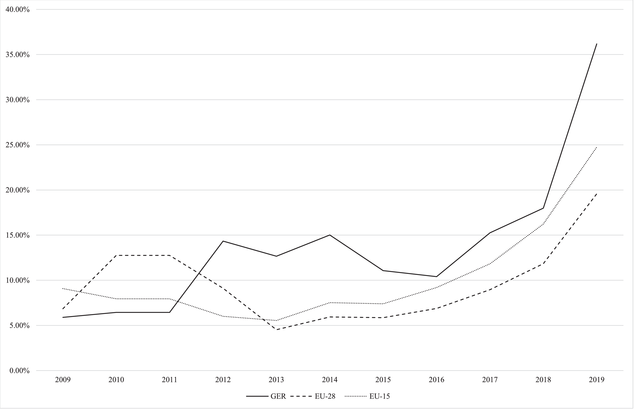
With its Energiewende, Germany is spearheading international efforts to move towards renewable energy production: According to the Global Status Report, among the major global economies, Germany has the highest per‐capita capacity in renewable energy (REN21, 2020, p. 205). In line with these developments, the issue of environmental politics has become a particularly salient topic in German politics. In the first half of the 2010s, 5–15 per cent of all Germans referred to it as one of ‘the two most important issues facing Germany at the moment’. Since 2017, a sharply increasing share of Germans has thought so: Figure 1 shows the development of the salience of environmentalism since 2010. While the issue has been particularly important in Germany, it has become more salient in all European Union countries, especially in the EU‐15.Footnote 2

Figure 1. The salience of ‘the environment, climate and energy issues' in Germany, the EU‐15 and the EU‐28 over time (Source: Eurobarometer item Q3a_12).
Wind energy production has become a particularly important aspect in German environmental politics. After an enormous expansion of wind turbines in recent years, wind energy rivals coal as the main energy source in the country. About 30,000 onshore wind turbines (and less than 1,500 offshore ones) exist in Germany. However, since the mid‐2010s, the expansion of wind power has slowed down (Fachagentur Windenergie an Land, 2021). Their construction has long been a matter of political controversy: Already in 1998, an SPD politician and then member of the German Bundestag, felt the need to publish a book on ‘windy protests’ (Scheer, Reference Scheer1998). Ever since then, projects over wind turbines have been a constant bone of contention, especially at the local level (Bues, Reference Bues2020; Marg et al., Reference Marg, Zilles, Schwarz, Hoeft, Messinger‐Zimmer and Zilles2017). Instruments of participation aimed at including the local population in the planning process have so far been unable to ease legitimacy concerns (Fraune & Knodt, Reference Fraune and Knodt2017). Even in favourable settings that involve local supporter groups, transparent planning and citizen participation, a small number of well‐organized opponents have been able to stop individual projects (Reusswig et al., Reference Reusswig, Braun, Heger, Ludewig, Eichenauer and Lass2016).
The Greens have long been the key proponent of renewable energy sources. Already in its very first national manifesto in 1980, the party called for an ‘immediate use of wind energy in particular for electricity supply. This technology has been mature for a long time and can be used economically’ (Die Grünen, 1980, p. 11). The Greens’ impact on the expansion of renewable energy during their participation in national government (1998–2005) is considered to be significant (Stefes, Reference Stefes2010). There, the Greens proved to be more influential than their governing French counterparts – and it is wind power that is often regarded as a particular success of the party (Evrard, Reference Evrard2012, p. 286). In the manifesto for the 2017 federal election, the Greens call for a move to 100 per cent renewal energy production by 2030, including the use of wind energy, emphasizing that in Schleswig‐Holstein, where the party is in regional government, this is already the case (Die Grünen, 2017; p. 49, 50). There is no doubt that the Greens have long been the major proponents of the expansion of wind power in German party politics.
For the standards of a contemporary populist radical right party, AfD has quite strongly focused on environmental concerns, especially when vocally rejecting anthropogenic global warming (Alternative für Deutschland, 2019). The topic is of particular importance in their stronghold of eastern Germany (Weisskircher, Reference Weisskircher2020), where the closure of ever‐more coal pits has become a bone of contention. Its opposition to the construction of wind turbines is stark. Already in its early days, key party figures usually not associated with environmental politics sharply criticized the expansion of wind power as a key element of an ‘ideological energy transition’ (Alternative für Deutschland, 2014). Its national manifesto of 2016 calls to
‘reject the further expansion of wind energy in Germany. It involves more harm than benefits. Wind turbines should only be permitted in exceptional cases, where they do not impair humans, animals, or landscape. When choosing locations, the local population needs to participate through referendums’ (Alternative für Deutschland, 2016, p. 86).
Similarly, a common declaration of all AfD regional environmental spokespersons is highly critical of wind energy (Alternative für Deutschland, 2019). In regional campaigns, AfD branches have strongly mobilized against wind turbines, even attempting to co‐opt local protest initiatives. In 2019, Stefan Möller, regional MP in the eastern German state of Thuringia and his party groups’ spokesperson for energy politics, describes AfD as the ‘legislative arm of the anti‐wind‐energy movement’, referring to the construction of wind turbines as ‘factor determining the [regional] election’ (Zeit.de, 2019). Other regional branches, also in western Germany, have shared a similar focus. Moreover, public statements against wind power are also followed by legislative action. In February 2020, for example, AfD proposed a motion in the regional parliament of Saxony titled, ‘Suspend the expansion targets for wind energy in the renewal of the energy‐ and climate program – protect nature, secure supply and wealth’ (Alternative für Deutschland, 2020). Clearly, opposition to the expansion of wind power has become a key element of AfD mobilization against global warming policies.
Other parties have positioned themselves between the two opposite poles of the Greens and AfD: On the federal level, the two ‘grand coalitions’ between CDU/CSU and SPD since 2013 have both supported an expansion of wind power (CDU et al., 2013, p. 42; CDU et al., 2018, p. 71–72). While the liberal FDP proposed the expansion of renewable energy sources in its 2013 electoral manifesto, it did not refer to domestic wind power production explicitly (FDP, 2013, p. 16). In 2017, the party sceptically highlighted the need for ‘public acceptance’ and supported rules for the minimum distance of wind turbines from municipalities and bird breeding grounds, without generally rejecting the technology (FDP, 2017, p. 136). Die Linke approved of the expansion of renewable energy both in 2013 and 2017, criticizing the influence of big business in wind power production (Die Linke, 2013, p. 64, 2017, p. 81). Most importantly, however, Greens and AfD have been not only most clear, but also most vocal about their stances.
Empirical strategy
Our strategy of assessing the impact of the construction of wind turbines on electoral outcomes consists of two steps. First, we use individual‐level survey data to establish a link between attitudes towards renewable energy in general, as well as wind turbines more specifically and party identification. We show that sympathizers of AfD and the Greens are indeed those with the most radical, and opposite, positions on these issues. Second, we use novel data on the construction of wind turbines to assess their influence on the electoral success of these parties. In other words, first, we establish the link between (anti‐)environmentalism and party preference on the individual level, and second, we show the impact of (anti‐)environmentalism on electoral outcomes at the aggregate‐level.
The individual level: Attitudes towards renewable energy and party identification
First, we establish the link that shows why the construction of wind turbines contributes to explaining voting behaviour at the individual level. In doing so, we rely on data from the Social Sustainability Barometer (Setton et al., Reference Setton, Matuschke and Renn2017, Reference Setton2019; Wolf, Reference Wolf2020), which is a representative panel study that focuses on attitudes and behaviour concerning the energy transition in Germany. For the analysis, we use the most recent wave, fielded in 2019, with about 6,000 responses in total. Using data from the Social Sustainability Barometer has the key benefit of being the only representative study in Germany that includes questions on party identification and detailed questions on attitudes on energy politics.
We use three items on renewable energy and wind turbines. The first item concerns approval or rejection of the expansion of renewable energy in general. The second concerns the spread of wind turbines more specifically. The third asks about the willingness to protest against the construction of wind turbines. The items read as follows:
‐ Item 1: Energy transition [Energiewende] involves a number of energy policy objectives. Please indicate your personal views on [the development of renewable energy sources].
‐ Item 2: Amongst others, the energy transition [Energiewende] involves the expansion of renewable energies. Please indicate your personal views on [the expansion of onshore wind turbines].
‐ Item 3: Can you envisage participating in the collection of signatures, protest action or citizens’ initiatives against planned wind turbines in your area?
All items are measured on a five‐point scale. We combine the second and the third item to an additive index to measure general support for wind energy.Footnote 3 Higher scores refer to more support for renewable energy in general (item 1) or wind energy in particular (combined items 2 and 3). We use the resulting two scales as independent variables.
The dependent variable is party identification:
‐ Many people lean towards one party for a long time, even though they sometimes also vote for another one. How about you: Generally speaking, do you lean towards any party in particular?
This is followed by a list of all relevant parties in Germany: Christian Democrats (CDU/CSU), Social Democrats (SPD), AfD, the Greens, the Left and the Liberals (FDP), as well as an option for ‘other parties’ and ‘no party’. We recoded the item into eight dummy variables, each indicating whether respondents picked the respective answer.
Figure 2 shows the mean values per year, that is, the aggregated trend for the three items. While there is high and stable support for the development of renewable energy in general (with a mean ranging between 4.3 and 4.36 on a five‐point scale), average support for onshore wind energy production is significantly lower. Highest in 2017 (3.89), it drops down to 3.31 in 2018 and again slightly increases to 3.44 in 2019. The data also shows that there is significant potential for protest against wind energy at the local level: The average values in 2017 (2.19), 2018 (2.54) and 2019 (2.38) always lie between ‘rather not willing’ and ‘rather willing’ to protest.

Figure 2. Developement of attitudes towards renewable energy and wind energy in Germany from 2017 to 2019.
Due to the binary nature of the dependent variables, we run multivariate logistic regressions to link these energy‐related attitudes to party identification.Footnote 4 In order to improve the predictions of our estimates, all our regression models include standard socio‐demographic controls (gender, age, level of education, vocational training and employment), a dummy variable for whether the respondent lives in eastern or western Germany and the (natural logarithm of the) population size of the respondents’ place of residence. Additionally, region fixed effects are included to account for heterogeneity at this level. Standard errors are clustered at the individual level (Supporting Information Appendix Table A1).
The results of the multivariate analysis strongly indicate that attitudes towards renewable energy indeed relate to varying party identification.Footnote 5 Favouring the transition to renewable energy decreases the probability of identifying with AfD and FDP, but increases the probability of sympathizing with Greens, SPD and the Left. For the CDU, the relationship is statistically insignificant. Comparing the average marginal effects underlines that the link is strongest for AfD and Greens. An increase of one point on the five‐point scale measuring support for renewable energy decreases the probability to identify with the AfD by 3.7 per cent, while it increases the probability to support the Greens by 10 per cent. These two values mark the extremes: For all other parties, support for renewable energy is much less associated with party identification (Figure 3; Supporting Information Appendix Table A2). Respondents who are strictly against the expansion of renewable energy have a predicted probability of 0.26 to identify with AfD and only a probability of 0.01 to be close to the Greens. On the other end, strong approval for the expansion of renewable energy lowers the predicted probability of support for AfD to 0.03 but increases the value to 0.2 in case of the Greens (Figure 4, panel 1).

Figure 3. The relationship between attitudes towards renewable energy and wind energy and party identification (notes: the figure is based on Supporting Information Appendix Table A2, models 1‐6; horizontal lines are 95% confidence intervals).

Figure 4. Predicated probabilities for identifying with different German parties across varying degrees of support for renewable energy and wind energy (notes: the figure is based on Supporting Information Appendix Table A2, models 1–6; vertical lines are 95% confidence intervals).
A similar pattern becomes visible when looking at the relationship between stances towards wind energy and party identification. Stronger support for wind energy, measured as the approval of the expansion of wind turbines and a refusal to protest against planned wind turbines, increases support for the Greens, SPD and the Left party, while it decreases the likelihood of identification with AfD, CDU and FDP (Figure 3; Supporting Information Appendix Table A2). The average marginal effects show that a one‐point increase for wind energy support decreases the probability of AfD support by 2.6 per cent, while it increases the likelihood to identify with the Greens by 4.9 per cent. Again, the relationship is strongest for these two parties. Holding everything constant to its mean and shifting from strong opposition (1) to strong support (5) on the five‐point‐scale, decreases the predicted probability of identifying with AfD from 0.11 to 0.02, while it increases the probability of identifying with the Greens from 0.06 to 0.21 (Figure 4, panel 2).
Overall, as expected, individual‐level data show that the general approval of renewable energy, as well as the specific support for the expansion of onshore wind energy production and a refusal to protest against wind turbines, are positively linked to the support of the Greens. Crucially, however, the data also underline that respondents favouring the opposite stances strongly tend to support the AfD.
The aggregate level: The construction of wind turbines and electoral outcomes
After showing how environmental attitudes link to party identification at the individual level we now, as a second step, analyze how the construction of wind turbines relates to electoral outcomes. This second analysis allows us to make claims about the impact of the construction of wind turbines on the electoral arena. In doing so, we draw on an original dataset spanning from 2013 (the year of the foundation of AfD) to 2019, with German municipalities serving as the unit of analysis. The longitudinal dataset compiles electoral data with economic and demographic data (DESTATIS, 2020) as well as data on wind turbines in Germany. We collected data on the location of wind turbines and their year of construction in the 16 federal states of Germany. We gained data either through requests from the regional authorities or by web scraping via the GIS‐implemented overviews on the webpages of the regional ministries of energy. The data include information on height, rotor‐length, energy production, the exact location and the year of construction.
The data points correspond to up to four election years during that period, namely two national (2013 and 2017) and up to two regional elections. In some regions, the regional election was in the same year as the national election. In these cases, we only included national election results in order not to inflate the analysis with additional time points (Table A4, Supporting Information Appendix).Footnote 6 The study focuses on national and regional elections for several reasons. First, for the process of planning and constructing a wind turbine, these two administrative levels are of utmost relevance: National politics decides climate goals and the general direction concerning environmental and energy policies. Regional governments declare areas where wind turbines might be built. Moreover, regional policies may also impede the construction of new wind turbines (for example the restrictive 10H regulation in Bavaria) (Fachagentur Windenergie, 2020). Ultimately, regional administrations decide whether specific wind energy projects will be implemented. The power of local authorities to prevent projects is only limited. Second, national and regional parties also strongly mobilize with respect to wind power, reflecting that the Energiewende has become a key issue of contemporary German politics (see above). This observation also corresponds to research on federalism, underscoring that party branches campaign on issues that reflect the functional responsibility of the respective political level (Atkesoncc & Partin, Reference Atkesoncc and Partin2001). Third, research also indicates that voters are able to distinguish between the different levels of federalism (e.g., Johns, Reference Johns2011), and, under certain conditions, may even vote accordingly (e.g., Arceneaux, Reference Arceneaux2006). The high importance of the national level not only for environmental policy, but also for voting behaviour in general – even in federal systems (e.g., Carsey & Wright, Reference Carsey and Wright1998) – is another reason why we included both the regional and the national level in our analysis.
Our dependent variables are the election results of AfD and the Greens, since we previously showed that the relationship between attitudes towards renewable energy and party support is strongest among them. Therefore, we assume that they are most likely to be affected by the construction of new wind turbines. As a robustness check, we also run our analyses for the other German parties (Table A6, Supporting Information Appendix). We log‐transformed our dependent variables to reduce the skewedness of the data and the effect of outliers.Footnote 7
The main independent variable is the number of wind turbines in a municipality in a given year. Research on the acceptance of renewable energy projects has shown that the number of (visible) wind turbines is a key factor explaining residents’ acceptance or non‐acceptance (e.g., Janhunen et al., Reference Janhunen, Hujala and Pätäri2014). For this reason, we argue that a greater number of wind turbines leads to more opposition or support and ultimately to an increased probability to vote in line with these preferences.
Since the analysis focuses on the impact of the construction of new turbines, the variable is coded as a count‐variable. When a new turbine is built, it adds to the existing number. According to our data, about 7,000 new turbines were built from 2013 to 2019: 1,410 German municipalities, which is about every eighth (12.78 per cent), experienced the construction of at least one wind turbine in this period. Most wind turbines are located in the middle to northern parts of the country (especially in Lower Saxony and in Brandenburg) (Figure 5). The construction of a wind turbine is the result of an often year‐long planning process. We decided to use the year of construction not only because of data limitations (for example, we could not gain systematic information on the length of the planning process). In addition, the construction is the point in time where the wind turbine becomes most visible, beyond potentially organized supporter and opponents, corresponding to our focus on explaining the electoral choices of all voters. Systematic data on planned turbines that were ultimately not built, for example due to local opposition, was also not available. We expect that protest against turbines more strongly influences electoral outcomes. Yet, this does not pose a problem in the context of our article: As we only include those wind turbines actually constructed, our estimates remain conservative. If anything, the inclusion of planned but prevented turbines in the analysis would likely increase the size of the effects under study.

Figure 5. German municipalities that built at least one wind turbine between 2013 to 2019.
We control for other factors that have a potential influence on electoral outcomes, are time‐variant and change within a municipality. In the given time period, a key event was the high number of asylum‐seekers coming to Germany in 2015 and 2016, of particular relevance to both AfD and the Greens, which also had opposite stances concerning immigration. Hence, the analysis controls for the share of foreigners within a municipality and the share of asylum‐seekers within a district.Footnote 8 Additionally, we also control for unemployment as well as the size of population (transformed as natural logarithm). At the district level, we include the average household income, the share of university graduates, the share of women and the average age of the population (Table A5, Supporting Information Appendix).
Overall, the dataset includes around 11,100 municipalities, which are observed at least at two, at most at four election‐years, averaging to 2.9 election‐years, leading to about 32,000 total observations. We use ordinary least square regression models and cluster‐robust standard errors at the municipality level to account for regional spatial dependence and heteroscedasticity. We estimate two‐way fixed effects models with municipality and time fixed effects. Municipality fixed effects adjust for all time‐invariant differences across municipalities that could explain both the construction of wind turbines and the electoral outcome (such as the level of urbanization or regional government participation of the Greens). Time fixed effects control for temporal variations common to all municipalities under study (e.g., changes in national policy or public opinion on immigration).
Table 1 shows the results of the fixed effects specifications. Model 1 contains the baseline results of regressing electoral outcomes of the AfD against the number of wind turbines. They show a positive and statistically significant coefficient: The construction of one additional wind turbine is associated with an increase of 0.67 per centFootnote 9 in electoral support for AfD. When including the control variables unemployment, share of foreigners, and population size in model 2, the link between wind turbines and AfD support remains substantial and statistically significant. Each new turbine results in an increase of 0.5 per cent of AfD vote shares.
Table 1. Wind turbine construction and voting outcomes of AfD and Green party

Notes: Models 1–4: Two‐way fixed effects regressions (OLS) (year dummies not shown).
Dependent variables: natural logarithm of vote shares of AfD and Green party, respectively. Standard errors (in parentheses) clustered at municipality level.
***p < 0.001; **p < 0.01; *p < 0.05.
In the case of the Green party, the baseline model (3) shows a positive and significant coefficient: For each new wind turbine, the Green Party results increase by 0.24 per cent. With the inclusion of the control variables (Model 4), the coefficient for wind turbines stays significant and has roughly the same explanatory power (0.28 per cent increase).
Summing up, the results strongly support our expectations. The construction of new wind turbines leads to increases in electoral support for both AfD and the Greens. The effect is not only significant, but also substantively strong: While the coefficients for one wind turbine may appear small, it is important to consider that municipalities that built new wind turbines in the period from 2013 to 2019 built not only one, but five turbines on average, making the effect on electoral outcomes sizable. When comparing the effects in strength, AfD profits more of novel wind turbines (Figure 6).

Figure 6. Average marginal effects of wind turbine construction on electoral outcomes of Greens and AfD (notes: the figure is based on model 2 & 4 in Table 1, horizontal lines are 95% confidence intervals).
Although the two‐way fixed effect specification employed is already quite demanding as it holds constant all factors that are either constant over time within a municipality or that are common shocks to all municipalities in a given year, we run a series of robustness checks to increase the confidence in our results even further. First, we test for several factors potentially inducing heterogeneity in treatment effects: We test whether the effect of the construction of wind turbines on electoral outcomes is mitigated by municipalities located in eastern Germany (Supporting Information Appendix Table A7), municipalities which already built wind turbines before 2013 (Supporting Information Appendix Table A8), municipalities in regions with Greens in regional government (Supporting Information Appendix Table A9) and urban municipalities (Supporting Information Appendix Table A10). Finally, we use an alternative specification of our main dependent variables, that is, using the electoral outcome in levels rather than in logs (Supporting Information Appendix Table A11). As explained in greater detail in the Supporting Information Appendix, the general patterns are confirmed by the wide range of robustness checks.
Conclusion
This article has shown how the transnational problem of global warming materializes locally. The case of Germany, vanguard concerning the expansion of renewable energy and the salience of global warming, has important implications for political developments across Western Europe. We show that the construction of local environmental infrastructure boosts support for both Green and radical right parties, that is, that electorates reward both pro‐environment and anti‐environment mobilization. In the case of the Greens, the most interesting aspect of our result is that local infrastructure projects tackling global warming may have a direct impact on support for the party. Even more striking, our findings underline that populist radical right parties do not draw from the issue of immigration alone. Instead, they are able to effectively make use of other salient issues, even global warming, which they are usually not associated with. In a setting where environmental politics is salient, populist radical right parties may electorally benefit from opposing measures against global warming, such as renewable energy projects.
Beyond general lessons for understanding the electoral success of these party families, our findings contribute to debates on polarization and the political conflict over environmental politics. Global warming has often been found to be an increasingly polarized issue (Guber, Reference Guber2013). From one perspective, our findings may add to arguments that the increasing polarization of party systems has contributed to a better representation of citizens’ views (Bornschier, Reference Bornschier2010, Reference Bornschier2015), with populist radical right parties channelling opposition against global warming policies. However, the increasing polarization across party lines also hampers effective communication on global warming, which makes it even more difficult to build broad coalitions in favour of environmentalist responses (Zhou, Reference Zhou2016). Therefore, the electoral strength of populist radical right parties may further increase the difficulties of finding effective responses to global warming, with the development of a strong veto‐player in many contemporary party systems. As with other issues, it will be crucial to see whether populist radical right parties will influence centre‐right parties in their positioning towards global warming (Bale & Kaltwasser, Reference Bale and Kaltwasser2021, see also Abou‐Chadi & Krause, Reference Abou‐Chadi and Krause2020).
Moreover, our results imply that contention over global warming reinforces the new central divide between opposing sides of a new cleavage that shapes political conflict in Western Europe (Hooghe & Marks, Reference Hooghe and Marks2018; Kriesi et al., Reference Kriesi, Grande, Dolezal, Helbling, Höglinger, Hutter and Wüst2012; Oesch & Rennwald, Reference Oesch and Rennwald2018; Roberts, Reference Roberts2021). Scholarship has often kept silent on specifying how the issue of global warming relates to the new structure of political competition: However, Lockwood (Reference Lockwood2018) has maintained that populist radical right opposition to global warming is less related to socio‐economic concerns, but to cultural opposition towards elites. While our research cannot provide an answer to the still open question to what extent material or cultural factors drive opposition to policies against global warming, it shows that the issue, similar to immigration (Aichholzer et al., Reference Aichholzer, Kritzinger, Wagner and Zeglovits2014), most strongly divides Green and radical right parties. Crucially, the political actors that benefit mostly are those which are usually interpreted as opposing sides on a new cultural cleavage.
The study of the political conflict over global warming offers important avenues for further research. This is particular urgent concerning the role of party interactions with social movements (Hutter et al., Reference Hutter, Kriesi, Lorenzini, Snow, Soule, Kriesi and McCammon2018, for the radical right see also Caiani & Cisar, Reference Caiani and Cisar2019; Heinze & Weisskircher, Reference Heinze and Weisskircher2021) – which are not only important for political players in favour, but also those against global warming policies. Since decades, environmental activists have been a crucial element of the Western European protest arena, with Fridays for Future protests recently constituting a new peak of environmental protest. How have these protests shaped the electoral success of Green parties – and their positions on global warming policies? At the same time, we need to learn more on how radical right parties organize and cooperate with both NIMBY groups as well as global warming sceptics in ‘think tanks’ and extractive industries. Research on these issues would improve our understanding of the politics of global warming as an issue reaching beyond the arena of party politics. As party interactions with radical non‐party players may further increase political polarization (McAdam & Kloos Reference McAdam and Kloos2014), party‐movement interaction may contribute to the ever‐more contested nature of policy intervention against global warming. In all likelihood, the political conflict around the issue will remain relevant for decades to come.
Acknowledgements
We are grateful to Denis Cohen, Swen Hutter, Fred Paxton, Nikolas Schoell, and the anonymous reviewers for their valuable comments.
Open Access funding enabled and organized by Projekt DEAL.
Online Appendix
Additional supporting information may be found in the Online Appendix section at the end of the article:
Supplementary material


 Open access

