

Introduction
Much peace research takes the view that peace agreements should not mark the end of conflict but rather enable its continuation through non-violent, political means.Footnote 1 For this to be realised, former adversaries should have platforms to engage through political rather than violent means.Footnote 2 One way to achieve this is in a democratic framework implies integrating ex-combatants into the political system as a political party.Footnote 3 However, if political participation is coupled with a framework for justice, it can create a paradoxical situation: how can ex-combatants exercise political authority while simultaneously confessing their crimes in court and potentially facing sanctions? To address this conundrum, we introduce the concept of the justice/participation paradox. It relates to the peace/justice dilemma – one of the core dilemmas, if not the core dilemma, in peace processes.Footnote 4 But rather than focusing on amnesties in peace agreements, the justice/participation paradox highlights the apparent dilemma of ex-combatants participating in politics while confessing to their crimes in court. Whereas this dual mode is a crucial element in settling peace agreements, it is paradoxical because justice in the form of trials can obscure political participation either very directly by imprisonment or more indirectly through damaging a political project.
Most literature treats the question of justice and participation as two separate problematics in peace processes. The ‘rebel-to-party’ literatureFootnote 5 is seldom bridged with literature on transitional justice and international law.Footnote 6 This article attempts to do so by investigating the friction and synergies between political participation and justice mechanisms.
We focus specifically on the political participation of the Revolutionary Armed Forces of Colombia (FARC) as ensured by the 2016 Colombian peace agreement. The Colombian peace agreement offers a unique solution to the dilemma of enabling political participation on the one hand and ensuring justice on the other. Following disarmament, the agreement includes provisions that allocate seats in Congress to FARC and provide security guarantees, coupled with the establishment of a Special Jurisdiction for Peace (JEP) to ensure legal accountability.
Under the JEP, individuals are subject to alternative sanctions to imprisonment, provided that they fully disclose the truth about their past actions – thus allowing them to engage in politics without hindrance. This novel approach seeks to navigate the delicate balance between peace, participation, and justice. However, a critical question remains unexplored: how does FARC’s engagement in the JEP interact with its political activities in Congress? How can confessions coexist with political endeavours? Do transitional justice mechanisms obscure political participation in practice, or can the two work in tandem? Could the combination of the two dimensions contribute to novel experiences, potentially helping to fulfil the promises of restorative justice? Or is there too much at stake in both ‘stages’ to live up to the intentions? Approaching these questions, this paper contributes not only to academic deliberations on these issues but also informs practical discussions on how best to ensure both political participation and justice.
Drawing insights from participant observation, 38 interviews, video recordings, and news articles, the paper investigates how former FARC combatants perform confession and accountability in the JEP while attempting to assert political authority in party politics. Based on our analysis, we argue that former FARC who appear before the JEP as comparecientes Footnote 7 navigate the paradox of public confession and political participation through a performative ‘doubling’ in the JEP and in Congress, simultaneously enacting roles as remorseful perpetrators and aspiring political actors. While this dual performance may foster a provisional synergy between justice and participation, it remains an inherently precarious negotiation – one that reflects the tensions and ambiguities of post-conflict democratisation without guaranteeing its consolidation.
Taking into account the temporal constraints of a fixed period of state-guaranteed political participation, we highlight the challenges faced by former combatants navigating transitional justice. Despite efforts to create synergies, the conflicting scripts of confession and political authority may ultimately result in the erosion of both participation and justice, offering important lessons about this novel approach to peacebuilding.
The article proceeds as follows. First, we position our work within the existing literature and present our theoretical framework of performative practices. Having unfolded the Colombian case and the methodological basis of the research, we proceed to analyse the scripts and stages of transitional justice and political participation in practice, focusing on performances in the JEP and in the Congress. Based on this analysis, we discuss the frictions and synergies between political participation and accountability mechanisms, highlighting contemporary developments that may put at risk the political participation of FARC and the importance of temporality. Finally, we discuss the potential of what we call restorative participation and the broader implications for other peace processes.
State of the art: Peace, justice, and participation
The peace versus justice dilemma concerns whether to prioritise ending hostilities or ensuring accountability for atrocities. This dilemma is extensively discussed in the literature on conflict resolution and international law. For example, MinowFootnote 8 explores the complexities of achieving lasting peace without sacrificing justice. The debate is further enriched by Gissel,Footnote 9 who scrutinises the impact of the International Criminal Court on peace negotiations, arguing that, while the court’s interventions aim to promote justice, they can complicate peace efforts. These works highlight the intricate balancing act required to address both the immediate and long-term needs of societies emerging from conflict, illustrating the multifaceted nature of achieving sustainable peace and justice. The debate over peace versus justice is becoming increasingly nuanced, with scholars pointing to alternative measures of accountability and hybrid approaches, such as ‘restorative–transitional justice frameworks’.Footnote 10 Our contribution to this strand of literature lies in the connection between the peace/justice dilemma and political participation – that is, how post-war justice can be ensured while including insurgent movements in politics.
Several scholars have emphasised the importance of inclusive peace agreements that provide clear pathways for former rebels to engage in the political process. For example, Hartzell and Hoddie’sFootnote 11 work shows that peace agreements incorporating political, territorial, and military power-sharing provisions tend to have more durable peace outcomes. Other studies on power-sharing have examined specific cases to understand how insurgent groups can be integrated into politics. For instance, Martín Álvarez et al.Footnote 12 show how former rebels in El Salvador successfully formed political parties and participated in elections, highlighting the importance of adaptability and gaining popular support. Raffoul’s recent study of power-sharing practices in Burundi and Northern Ireland underscores how power-sharing is consistently marked by disequilibrium between political adversaries. Raffoul finds that peace-through-power-sharing is ‘the always-contingent outcome of a never-ending process where joint decision-making has to be achieved recurringly’.Footnote 13 Drawing on Raffoul’s insights, we similarly view justice and participation as ongoing, dynamic processes that unfold within a perpetual state of disequilibrium. Colombia’s historical experiences with power-sharing between Liberals and Conservatives, as well as several peace agreements with leftist insurgencies prior to the 2016 accord with FARC, have all informed the current design of transitional justice and political participation.Footnote 14
Despite some success stories, the transition from armed group to political participant is fraught with challenges. Some rebels succeed in leveraging their wartime legitimacy and organisational structures to dominate post-conflict politics.Footnote 15 However, rebels often face significant obstacles, including the mistrust of the population, a lack of political experience, and continued competition from other political actors.Footnote 16 These challenges can impede their ability to function effectively within the political arena and risk triggering a resurgence of violence.
It is common practice to include provisions for political participation in peace agreements. As shown in a 2022 study, ‘almost half (48.9 per cent) of the armed groups that later transformed into political parties signed at least one peace agreement that included specific so-called “rebel-to-party” provisions’.Footnote 17 Rather than justice mechanisms, however, these provisions for political participation were often coupled with provisions for an amnesty (53.2%). Also, the general framework for including rebel groups in politics is either to allow them to transform themselves into an ordinary political party, or to include them in the government through a power-sharing agreement.
Hence, the Colombian model with seats in the congress coupled with transitional mechanisms of justice that do not grant amnesty for serious crimes but requires truth-telling is quite unique. There is an abundance of literature on the Colombian peace process, not least due to the historical nature of the peace agreement, as it is one of the most comprehensive and inclusive agreement in history.Footnote 18 Regarding FARC’s political participation, several articles investigate the grounds for public support for FARC. For example, scholars have shown that this element of the peace agreement formed part of the basis for resistance to the agreement itself, arguing that widespread support for the integration of ex-FARC guerrillas into democratic politics diminished broader support for a negotiated peace.Footnote 19 Other studies have examined the foundations of public support for FARC’s political involvement, showing that attitudes towards FARC’s participation are shaped by individuals’ experiences of the conflict and their partisan identities.Footnote 20 Findings from earlier evaluations of the 2016 peace agreement vary. One study suggests that the agreement ‘positively impacts FARC’s political strategy’.Footnote 21 However, this argument relies more on the anticipated implications of the peace agreement than on current realities. Another study finds that the agreement has not provided sufficient guarantees for political participation and the exercise of democracy.Footnote 22 Before conducting our own analysis of the Colombian case, the next section lays out the conceptual framework.
Theory: Performing confessions and political authority
We apply a performative lens to analyse the various scripts and practices that form the justice mechanisms and political participation respectively. Here, we draw on literature that frames social action as performativeFootnote 23 and political and courtroom activities as theatrical practices.Footnote 24 The performative element of social interaction does not imply that actors necessarily adopt a particular role deliberately or conceal ‘real’ aspects of their persona.Footnote 25 Rather, it implies that bodily actions and interactions in politics and transitional justice activities are viewed as ritualistic practices, following particular scripts that are enacted with the intention of impressing an audience. Studying performativity offers a lens through which to view actions and interactions as socially staged performances, wherein individuals cite and reiterate normative scripts – often unconsciously – thus constituting identities, power relations, and social realities that appear natural but are, in fact, contingent and contestable.
The performative nature of politics is increasingly recognised in both international relations and peace research.Footnote 26 Likewise, national politics has often been described using the metaphor of the theatre,Footnote 27 and the performative quality of parliaments is evident in many contexts.Footnote 28 From a performative perspective, sovereignty, authority, and power do not rely solely on the capacities of a given actor but are understood as something to be performed.Footnote 29 Hence, the challenge for politicians is to perform political authority as a legitimate, authoritative party.Footnote 30
Likewise, the courtroom is increasingly recognised as a stage, in which the various actors within the judicial process enact the determination of culpability or innocence on the part of the accused, to be evaluated by the jury.Footnote 31 Notably, PayneFootnote 32 theorises ‘confessional performances’ in terms of: 1) the script, 2) the stage, 3) the actor, 4) the timing, and 5) the audience.
In analysing performances in the JEP and Congress, we take inspiration from this framework, focusing on the ‘stage’, the ‘script’, and ‘time’. The ‘actors’ here are high-ranked FARC ex-combatants. In studying the transformation of ‘the perpetrator’ in confessional settings, Payne highlights how perpetrators can engage in what she calls ‘doubling’ – that is, when performing confessions, they seek to foreground more favourable elements of their identity, such as their political project, in order to downplay ‘the negative characteristics associated with perpetrators’.Footnote 33 The narratives provided by perpetrators may be partially fabricated – either consciously or unconsciously – to align with a specific political moment or personal interest.Footnote 34 Payne emphasises the public nature of confessions, which is particularly relevant given that JEP hearings are streamed and summarised in media broadcasts. The media thus becomes a stage for debating the political implications of these confessions.Footnote 35 The ‘audience’ includes victims, survivors, and the wider public. Payne notes that the audience can take control of the narrative during confessions, potentially undermining the perpetrators’ intended political objectives.Footnote 36 This is crucial for former FARC members, whose participation in the JEP is judged not only for its potential in healing and reconciliation, but also for its impact on their political aspirations. For Payne, ‘time’ indicates the temporal context in which acts of confession takes place. In the last section of the analysis, we discuss the JEP and congress performances considering the political temporal context, and additionally, we highlight how sequence and simultaneity are other important aspects of ‘time’ for how the justice-paradox unfolds.
Case: Colombia
While the justice–participation paradox is not unique to Colombia,Footnote 37 the implementation of the 2016 peace agreement offers a particularly compelling case for studying this paradox, as the agreement formalised the promise of delivering justice, truth, and political participation through nationally and internationally recognised institutions. Colombia’s earlier efforts to integrate armed opposition into non-armed formal politics resulted in the ‘political genocide’ of the Unión Patriótica, with 5,000 of its members killed between 1985 and 2002.Footnote 38 Providing crucial lessons for the Havana peace negotiations, this experience was instrumental in shaping the comprehensive ‘Final Agreement to End the Armed Conflict and Build a Stable and Lasting Peace’.Footnote 39 The 2016 peace agreement consists of several issue-by-issue accords, including chapters on political participation and transitional justice. Chapter 2 of the agreement is dedicated to political participation, enabling new political forces – including the FARC – to engage in politics. This addresses a key FARC demand, reflecting their grievance over limited political and democratic space. The agreement stipulates that, following its demobilisation as a guerrilla group, FARC would transition into a legal political party, with a guaranteed minimum of five seats in both the Senate and the House of Representatives for two legislative terms starting on 20 July 2018. Chapter 5 outlines the JEP, a key element of the transitional justice system, which is founded on four essential pillars: justice, truth, reparations, and guarantees of non-recurrence. The JEP focuses on serious human rights violations and breaches of international law, employing a restorative justice approach that emphasises truth-telling, reparations, and non-repetition. It operates independently of the traditional judicial system and promotes reconciliation, local agency, intersectionality, and inclusivity.Footnote 40 Those appearing before the JEP are still permitted to participate in politics. This complicates the enforcement of sanctions due to ongoing uncertainties over how to reconcile them with political engagement.
There is little doubt that support for FARC as a political party remains limited in Colombian society, as reflected, for instance, in the significantly low number of votes it received in the 2022 elections.Footnote 41 Despite the peace agreement being a historic achievement in Colombia, intense confrontations over competing political imaginaries of peace persist.Footnote 42 Current critiques of the JEP for deviating from the peace agreement, alongside the legal insecurity experienced by the FARC, highlight the challenge of safeguarding political participation and accountability simultaneously. How Colombia addresses the political participation–justice paradox will be critical for future peace processes. Even more importantly, how this plays out in practice will shape the prospects of future peace negotiations.
Methods
The article is based on four months of fieldwork in Colombia, including interviews with ex-FARC commanders, JEP judges, and national and international representatives of peace and transitional justice. ‘Former FARC combatants’ is a broad term encompassing a heterogeneous group with internal divisions. We primarily focus on members of the former Secretariat and Central High Command of the FARC as they are the ones appearing in the JEP and in Congress, representing the public face of the FARC, now transitioned into the political party Comunes (‘commons’ in English). We acknowledge that these higher-ranking members are distinct from the lower-level ex-FARC combatants. While we do not pursue a structured analysis of individual differences, we shift the lens from high to lower-level ex-FARC members at the grass roots level in the final part of the analysis.
In total, we conducted 38 in-depth interviews, the great majority in Spanish. Besides FARC and JEP representatives, we interviewed UN and EU officials, Norwegian peace diplomats, and representatives from the International Centre for Transitional Justice (ICTJ) and the Institute for Integrated Transitions (IFIT). Moreover, direct observation of a congressional session was conducted during a visit to the national Congress. We also carried out participant observations at a demonstration in Bogotá, in a peace village on the outskirts of Bogotá, and in a FARC reintegration camp in the north of the country. The fieldwork was primarily conducted from February to May 2023, with a brief follow-up in June 2024 and a later follow-up interview in November 2024. Anonymity was granted to participants upon request, with JEP judges identified by letters. Video recordings from JEP hearings and congressional debates, which are publicly available, form another key empirical basis of the study. Due to the extensive volume of footage (hundreds of hours), we deliberately selected recordings for further analysis: for the JEP, we focused on hearings related to truth recognition and fact determination; for Congress, we concentrated on early and more recent sessions in which Comunes representatives appear. To support this selection, we reviewed 50–60 hours of footage. For the JEP analysis, we selected material from Macrocaso 01, which investigates FARC-EP’s illegal detentions and is the most advanced case before the JEP, being the only case that has resulted in final convictions (issued in September 2025, just before publication of this article). The analysis of JEP interventions draws on approximately 21 hours of recordings. For Congress, we analysed the first plenary session featuring FARC as a political party (July 2018) and the latest plenary before the annual closure (June 2024) to trace performative transformations, amounting to approximately 14 hours of recordings. While we reviewed several additional plenary sessions and JEP hearings during that period (up to 30 hours) to ensure representativeness, this article focuses on examples drawn from these selected key sessions. To contextualise the events we analyse, we also rely on extensive readings of news articles, press releases, and recorded interviews with ex-FARC members, JEP judges, and political observers in Colombia.
Analysis: The dual performance of confession and political authority
The post-agreement process to reintegrate the FARC has been marred by escalating violence against ex-combatants, a notable failure by the government to uphold the terms outlined in the peace accord, and prevailing public contempt towards former FARC members.Footnote 43 This animosity towards the FARC stems from the group’s history of violence and brutality, which alienated civil society despite its origins as a peasant force advocating for marginalised rural communities. Public discourse remains deeply polarised regarding the FARC’s role in governance and the perceived leniency shown towards its leadership.Footnote 44
Against this backdrop, we analyse how the JEP provides a ‘stage’ on which actors may confess to past crimes, with the assurance that the more extensively they narrate, the less likely they are to receive a prison sentence. We hold this up against another central post-accord ‘stage’, namely the Colombian congress where the FARC is assigned seats to promote their political project as part of the peace agreement.
Performing confession
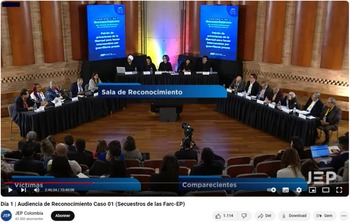
In line with performative theorisations of confessions, the JEP provides a ‘stage’, and the entire justice process follows a predefined ‘script’. The set-up, or staging, of a JEP session typically features two or three judges seated at the centre, moderating and guiding the hearing. The panel of victims is positioned to the left, and the accused sit to the right (as shown in Figure 1).

Figure 1. A hearing in the acknowledgement chamber, JEP. Source: Screenshot from YouTube, JEP Colombia.
In addition to the audience present in the room, JEP hearings can be followed remotely by an online audience. Most hearings are broadcasted live via the JEP’s YouTube channel. Although there are no official viewership figures, it is visible from the YouTube channel that recordings of the opening hearings in Macrocaso 01 had between 44,611 views (first day) and 24,699 views (third day) by August 2024. Moreover, various other outlets and media platforms also broadcast the hearings, or selected segments of them. The fact that these proceedings are videorecorded enhances their function as a performance space in which much is at stake – not only for the perpetrators appearing before the JEP, the so-called comparecientes, but also for victims and survivors, who may ‘subvert or derail the political project’ of the compareciente.Footnote 45
The ‘script’ comprises several components. The restorative justice process of the JEP draws on the British ‘PEACE’ model of criminal investigation: planning and preparation, engagement and explanation, account, closure, and evaluation.Footnote 46 Particular emphasis in the hearings is placed on the ‘E’ component, where trust is established through ‘active listening’ – a practice considered essential for eliciting an extensive and detailed account. Each hearing requires at least three months of preparation.Footnote 47 During this period, ‘the team’ – comprising sociologists, psychologists, criminologists, and other professionals assigned to each judge – visits ‘the field’ (where the victims and accused are located) to clarify the aims and steps of the process.Footnote 48 The entire structure and logic of the JEP requires former FARC combatants to tell the truth in the interest of what is termed ‘closure and evaluation’. It is then the responsibility of the judges to assess whether this has been done in a sufficiently sincere, comprehensive, and authentic manner for the individual confessing to avoid a prison sentence.
Following the PEACE model, after the preparation phase, the stages of ‘engagement and explanation’, ‘account’, and ‘closure’ take place publicly in the JEP hearings. The JEP instructs both victims and comparecientes in the script and the ‘dos and don’ts’ prior to engaging in a hearing. Comparecientes are also informed of their rights and responsibilities, based on a set of guiding principles and rules, which are documented in a procedural manual.Footnote 49 The conditionality regime is a guiding principle for comparecientes, requiring that the provision of ‘the full truth’ in confessions serves as a prerequisite for accessing the transitional benefits of the JEP. From the outset, the restorative paradigm underpinning the JEP demands that the appearing party – as implied by the verb comparecer (to appear) – ‘puts their face’ before their victims in order to receive benefits, such as reduced sentences or alternative sanctions.Footnote 50 From the outset of each hearing, the performative nature of the event becomes apparent, as the judge enters the stage and the room collectively rises. Upon arrival, the judge announces the date and time, and invites the participants to be seated. The judge then opens the session by outlining the agenda and main procedural rules, and ensures that victims are heard first – setting the stage for the accused to respond.
The scripted nature and procedural rules of the JEP hearings become especially apparent when they are not adhered to. For instance, during the first day of hearings in Macrocaso 01, ex-FARC commander Milton Redondo discussed the group’s kidnapping of former politician Ingrid Betancourt. He was repeatedly corrected by officials for deviating from the established script of the proceedings.Footnote 51 First, he directly addressed the victim while she was still in the audience and not yet seated in the ‘victims’ chair on the stage. Second, in recounting the kidnapping, he described how the FARC constructed a house for Ingrid Betancourt and her fellow captives to accommodate their wishes. The judges sternly redirected him, insisting that he focus on the torture and harm inflicted, and emphasised that referencing purportedly ‘benevolent’ acts during captivity was both inappropriate and damaging. They made it clear that, as comparecientes, individuals are expected to account for the crimes they committed, thereby maintaining their identity as perpetrators.
Moreover, JEP judges interviewed for this study affirmed that the tribunal does not allow perpetrators to portray themselves explicitly as victims – an example of the performative ‘doubling’ that Payne identifies in confession practices.Footnote 52 FARC comparecientes often subtly weave their own past hardships into their testimonies, portraying themselves as children of illiterate and impoverished farmers with limited opportunities prior to their recruitment into the FARC. This narrative strategy is commonly employed to explain or excuse their involvement in violence, while remaining just within the boundaries set by the JEP’s guidelines.
The judges’ corrections, in line with the JEP script, reflect an imperative central to the raison d’être of this form of justice: as the accused, one is not only expected to acknowledge responsibility and provide detailed accounts of crimes and harm inflicted, but also stands to benefit from such disclosures. In this sense, the judges function as a control mechanism over what Payne terms ‘salvage operations’ in perpetrator confessions.Footnote 53 Such performative operations transform memory fragments and ‘filter and select facts, seeing only what is convenient to see’. Within the JEP, the accused are not expected to demonstrate their innocence – rather, quite the opposite. They enter the courtroom to contribute new elements to the broader truth of their crimes. As one JEP judge bluntly stated: ‘In transitional justice, we find that non-self-incrimination does not serve as a guide. Because those who go to the JEP say, “It was me”’.Footnote 54 Another JEP judge remarked that the JEP’s model of restorative justice ‘breaks denialism’ as it is understood within traditional justice procedures.Footnote 55 The core principle is that those who offer ‘full truth and reparation’ are subject to restorative sanctions aimed at fostering political and social reintegration – standing in contrast to the retributive punishments characteristic of ordinary justice systems.Footnote 56 The scripting of JEP hearings and the judges’ strict enforcement of it should be understood in light of the early and sustained criticism levelled against the tribunal for its allegedly overly sympathetic stance toward the FARC. It must also be seen within the broader mandate of Colombia’s transitional justice framework, which emphasises a victim-centred approach.Footnote 57
The confession stage as a stage of politics?
Analysing recordings from the Chamber of Recognition, where FARC commanders acknowledge responsibility, it becomes evident that their performances serve a dual purpose – despite judges’ efforts to steer them toward emphasising their past roles as torturers and murderers. Alongside explicit acknowledgements of responsibility and the pardons issued during these hearings, several FARC commanders frequently reference the peace agreement negotiated in Havana and frame their current community work as an early form of sanction. One notable example is ex-FARC commander Julián Gallo’s conduct during the first day of hearings in Macrocaso 01 on 21 June 2022. After listening to victim testimonies, he reflected on how the stories of kidnapped civilians had affected him. Gallo remarked that such testimonies help add nuance to wartime actions, which are too often perceived in binary terms where ‘everything is black and white’. He stated: ‘facing the public, the state and the victims, sitting here and contributing to peace, we get a certain feeling of “patria” [homeland], also taking into account that we achieved an agreement that is comprehensive’.Footnote 58 Gallo underscored the ex-FARC’s involvement in community work, reparatory initiatives, infrastructure development, and environmental protection. This enactment of a dual subject position – or ‘doubling’ – aligns with the anticipated futures of perpetrators in political life, where they ‘display patriotism, a sense of duty, and a willingness to make personal sacrifices’.Footnote 59 Gallo frames the FARC as actors who assume responsibility and speak the truth, while simultaneously positioning themselves as demobilised peacebuilders actively contributing to nation-building.
However, such duality is fraught, and the JEP does not allow space for overt political declarations. Instead, its format compels perpetrators to continuously display remorse and guilt. Pastor Alape, for instance, closely adhered to the restorative confessional script of the JEP throughout the three days of public hearings in Macrocaso 01. Frequently noting how victim testimonies had moved him – often in a tremulous voice – he described an episode on the second day that affected him deeply. Referring to the poet Carranza and her family, Alape began to cry, stating that ‘getting involved with the arts, with culture’ had been especially troubling for him, concluding: ‘that’s why this is so hard’.Footnote 60 There is a performative dimension to the expression of emotion, and in this context, the act of crying functions as a visible display of remorse and regret. As discussed below, Pastor Alape stood as a mayoral candidate in his hometown of Puerto Berrío in 2023. Although his political success was limited, he is widely regarded as ‘one of the signatories of the Peace Agreement who has expressed the greatest willingness to clarify the truth of what happened’.Footnote 61
Alongside the JEP proceedings – where former FARC combatants confess to past crimes – many ex-combatants continue their political struggle through formal democratic channels. In the following section, we examine the practices of former FARC members within the Colombian Congress and at the local political level, before drawing these analyses together to explore the synergies and tensions between these dual modes of performative engagement.
Performing political authority
The academic literature on ‘rebel-to-party’ transformations suggests that integrating former insurgents into mainstream politics is a crucial, yet challenging, aspect of peacebuilding efforts globally.Footnote 62 The core platform for the official political participation of the FARC is Congress, where the peace agreement guaranteed them ten seats starting on 20 July 2018. The transition from guerrilla group to political party is complex and paradoxical. Sandra Ramírez, a Senator from Comunes, stated in a national news channel interview that entering party politics elicited ‘mixed emotions’ because, ‘before, when we were in the guerrilla or conflict and war, we thought that Congress had to be eliminated (…) now we are beginning to be part of this institution’.Footnote 63
The Congress serves as a ‘stage’ for political performances, where members express their political positions. The Colombian Congress (Figure 2), housed in the neoclassical National Capitol, consists of two chambers: the 108-seat Senate and the 188-seat Chamber of Representatives. The Comunes party holds five seats in each chamber.

Figure 2. The Colombian Congress. Source: AFP/CP.
Observing in person parts of a congressional session in 2023 and reviewing video recordings, it is evident that interactions in Congress are highly scripted, though occasionally chaotic. Generally, political authority is performed through passionate, engaging, and articulate expressions of views, while adhering to designated speaking times.
For the FARC, the main challenge in Congress is to shift its narrative from rebellion and insurgence to political authority. Initially, the FARC retained its original name as a political party, but in January 2021, it changed it to Comunes to signal a ‘past’ and a ‘present and future’ for ex-FARC members.Footnote 64 Political authority involves not just rhetoric but also performance directed toward both fellow members and the public and voters.
Our interviews reveal that initially, Comunes faced difficulties in asserting its authority due to stigmatisation. For example, Jairo Cala, a Comunes member of the House of Representatives, described in an office interview that ‘for the first year and a half, almost two years, we faced daily tirades, insults, and accusations within Congress. There was stigmatization’.Footnote 65 To address this, they ‘designed a strategy’ to avoid responding unless absolutely necessary. Cala noted that this approach helped them gain respect and recognition in Congress, even among ‘some sectors of the right-wing parties, to the degree that today they actually recognise us, with respect’.Footnote 66 This shift implied that Comunes representatives would adopt a more reactive role on specific issues and open space for new collaborations.
In the recorded congressional plenaries, the change in performance from their initial engagements in Congress to more recent debates is notable. Comunes Senator Julián Gallo exemplifies this evolution through a comparison of his earliest and latest appearances. On 20 July 2018, Gallo’s first Senate intervention appeared significantly out of place and misaligned with the established script.Footnote 67 He faced technical issues with his microphone, causing a minute of confusion. Forced to use the central pulpit instead, he delivered his speech in a stiff, steady tone, rarely looking up from his notes, which contrasted sharply with previous and more experienced Congress members who spoke powerfully and without a crib. In his prepared speech, Gallo outlined his party’s priorities, emphasising the need for judicial security and halting the hatred against peace signatories. Having highlighted the importance of the transitional justice system for uncovering the truth in respect of the victims, he referred explicitly to his own and his colleagues’ new roles as members of Congress.
After eight minutes, Gallo was interrupted by the congressional leader, who reminded him that the space was designated for shorter interventions to nominate the new Congress leader. Despite the usual five-minute limit, Gallo was granted additional time to finish, during which he criticised the incoming right-wing government of Iván Duque and thanked Colombia’s allies for supporting the peace agreement. Following Gallo, his opponent Álvaro Uribe from Centro Democrático spoke, expressing his party’s opposition to the peace agreement with the FARC. This plenary reflects minimal consolidation between the FARC party and other members, with Gallo’s speech positioning his party as a radical ideological alternative to the established order. At the level of performance, Gallo does not follow the formal congressional script – neither in respecting the technical and time limits, nor in speaking the ‘language’ of a member of Congress by promoting the FARC’s political project.
Comunes’ strategy to perform political authority has since involved toning down its ideological elements. Comunes Chamber Representative Jairo Cala explained in our interview: ‘For many people, it may seem as though we are perhaps half-hearted [tibios], or not as confrontational as other members of Congress from the democratic parties. We believe that ideology should be presented, but in settings where it does not provoke hostility’.Footnote 68 Cala’s remarks illustrate the transformation perceived as necessary for ex-FARC members to adapt to the ‘political theatre’ of Congress. For Comunes, it has been crucial to confront their public image as confrontational and conflictual. According to Cala, the current government of the leftist Gustavo Petro has eased the conditions for democratic dialogue, partly because Petro sees himself as part of a broader governmental project in which Comunes plays a role. Gustavo Petro is himself, in one sense, a compelling example of the possibility of transforming from guerrilla insurgent to established politician, given his past as a member of the insurgent group M-19.Footnote 69
During one of the most recent FARC performances in Congress (19 June 2024), Julián Gallo intervened in a style markedly different from his first appearance six years earlier. In the plenary session in the Senate, held one day before the annual closure of Congress, the topic of state control over security was debated.Footnote 70 Following several senators from different parties across the political spectrum addressing the lack of ‘territorial control’, Gallo took the floor, beginning by praising Senator Andrés Felipe Guerra Hoyos. Guerra Hoyos, from Centro Democrático and a leading figure in opposing the peace agreement with FARC, normally contrasts sharply with Comunes’ positions. Suddenly, however, Gallo acted as his ally. Sitting engaged and leaning forward in his seat, clearly content with his role as Senator, Gallo spoke directly and articulately without any crib. Thanking Guerra Hoyos for emphasising that rural reform (the first point in the peace agreement) is essential for regaining territorial control, Gallo called for ‘all sectors of society’ to unite and meet ‘in the middle of disagreement’. He proposed the creation of a shared plan for building a ‘classical nation-state’ with a monopoly on the use of force, territorial control, and justice institutions.Footnote 71 After speaking for four minutes, he thanked Guerra Hoyos for his intervention, and the Congress leader thanked Gallo for his effective use of speaking time. Much indicates that Julián Gallo, over the course of six years, has blended in as a regular member of the national Congress, performing according to the script and advocating unification and compromise across ideological disagreements.
However, the move to formal politics has caused frictions within the FARC movement. One part continues to operate within congressional politics and defend this platform, while other parts of the movement have found alternative ways to participate politically.Footnote 72 In some cases, the alternatives have emerged as a natural extension into other formal platforms, while others have created new political alliances, such as Agrupar para Avanzar, out of dissatisfaction with the Comunes leadership.Footnote 73
Likewise, former FARC combatants engage in local politics at the municipal level without the benefit of guaranteed seats. To date, the most prominent example of a successful former FARC rebel in local formal politics is Guillermo Torres (alias Julián Conrado), who, in 2019, was elected mayor of the town of Turbaco in the department of Bolívar. In 2019, this was a historic victory. A recent study analyses how Torres succeeded in performing political authority and in presenting himself as a ‘credible political figure’ who had moved from insurgent to mayor.Footnote 74 Torres used his popular attitude and role as a musician as key factors in his success, along with his emphasis on being an alternative to the established corrupt politicians. He ran for mayor without the support of the FARC party due to differences with its leadership and instead received the endorsement of the Colombia Humana – Unión Patriótica (CH-UP) coalition of leftist movements.Footnote 75 Following in the footsteps of Torres, 114 ex-FARC members contested popularly elected positions across the country during the subsequent local elections in October 2023.Footnote 76 One FARC candidate won the mayor’s post: Armel Caracas Viveros, who ran for the Historical Pact (the incumbent national government coalition), rather than FARC’s own political party, Comunes. Interestingly, Caracas secured victory in the municipality where FARC carried out its last massacre in 2011.Footnote 77 Nonetheless, the remaining ex-FARC candidates for mayoral positions ended up among the last-placed contenders. For example, the former FARC commander Pastor Alape received 1,572 votes (9.25% of the vote) in Puerto Berrío, his hometown, where he had aspired to become mayor.Footnote 78 In contrast to the two ‘success stories’ mentioned earlier, Alape’s candidacy was for the Comunes Party but also had the endorsement of the Historical Pact. In an interview with the authors prior to the election, Alape explicitly sought to distance himself from his past as a fighter: ‘Already starting to use the word “combatant”, I’m telling you that […] I’m entering a different tone. It is not [opening] the dialogue’.Footnote 79 Pastor Alape appeared intent on shifting public perception of his political project away from any associations with the armed struggle, seeking instead the status of a peaceful, democratic advocate for justice. While various factors may account for Alape’s limited political success, his remorseful confessions before the JEP are especially noteworthy in contrast to his efforts to portray himself as a legitimate political figure. Nonetheless, he continues to serve as Comunes’ official coordinator for the implementation of the peace agreement.
Although the overall number of Comunes candidates has declined, there has been a rise in the number of aspiring ex-combatants standing for election compared to previous cycles. While this suggests a degree of democratic pluralism, it also underscores the enduring stigma surrounding the FARC and its political party, Comunes, despite concerted efforts to overcome it.
Discussion: The justice/participation paradox
Having analysed the ‘actors’ performances on the ‘stage’, the following sections now turn to discuss the friction and synergies of justice and participation post accord, the political context in which these dynamics unfold, and the sequence of events – highlighting the ‘time’ dimension of Payne’s framework.
Dual performativity: Frictions and synergies
Several interviewees emphasised the combination of justice and political participation as a cornerstone of the peace agreement. A truth commissioner and close observer of the agreement’s implementation remarked: ‘these points were perhaps the most discussed points in Havana, let’s say the most neuralgic’.Footnote 80 According to our interviewees, the combination of justice mechanisms and political participation was critical to securing FARC’s agreement to sign the peace accord. As Pastor Alape put it: ‘The peace agreement is not an agreement to surrender, it is a pact in which political action is guaranteed to some citizens who were confronting [others] with weapons or conducting politics with weapons in order to […] enter a scenario, in a new field of battle’.Footnote 81
However, as we have shown, combining political participation with accountability in the JEP is not straightforward. The restorative nature of transitional justice, as practised by the JEP, requires ex-FARC members to fully disclose their harmful acts, plead guilty, take responsibility, and apologise to victims. On paper, this process is not expected to impede their political endeavours. In fact, this restorative approach includes mechanisms that facilitate their political participation in the first place.
However, the confessional script in the JEP contrasts with the script of authority in political arenas, particularly in Congress. Here, the challenge is to present Comunes as a legitimate political party with sincere and politically sound aims. As a JEP judge rightly stated in an interview when asked about the justice-participation paradox, ‘a person is never unidimensional’. This complexity, she noted, must be acknowledged to achieve the goal of the FARC’s reincorporation into economic, social, and political civilian life.Footnote 82 Despite the judge’s openness, our analysis does not find that the scripts of the two stages align well when it comes to acknowledging the ex-FARC’s complex subjectivities. Moreover, the audience – at least when considered as voters – has thus far shown insufficient openness and confidence in Comunes’ political authority for the party to remain sustainable beyond its safeguarded period.
There are, however, also potential synergies between ensuring justice by holding ex-combatants accountable and enabling their political participation. Essentially, justice and accountability measures can pave the way for some form of forgiveness, which can increase acceptance of political participation. Moreover, possibilities for synergy emerge as former FARC combatants on both stages refer to themselves as ‘peace signatories’ willing to make sacrifices for the country, frequently citing the 2016 peace agreement as a shared achievement symbolising their ability to engage in political compromise. This transformation from ‘peace-breaker’ to ‘peacemaker’Footnote 83 is what travels across the two otherwise very diverse platforms. Comunes also leveraged this subject position during the 2019/2020 demonstrations, promoting the peace agreement and framing themselves as non-violent political participants in the streets.Footnote 84
Despite attempts at synergies, the possibility for forgiveness and reconciliation is linked to a time element, whereby justice provisions need to conclude in due time to allow this potential forgiveness to develop into endorsement of ex-combatant political participation. Specifically in the case of Colombia, a video and survey experiment has shown that apologies by the FARC in fact induce negative effects on attitudes towards reintegration among people who already did not support the peace agreement.Footnote 85 The limited support for former FARC combatants, as evidenced by the number of votes for Comunes, suggests that attempts at synergies are not sufficient to overcome the justice/participation paradox.
We do not claim that their involvement in the JEP alone accounts for Comunes’ limited support, instead, multiple factors contribute to this. We do, however, wish to highlight the challenge of ‘selling’ one’s political project in one arena while performing concession and remorse in another. Added to this are the more recent disputes regarding the JEP’s slowness and FARC’s concerns about their judicial security and future in politics.
Controversies between the JEP and comunes
During 2024 and 2025, the contradictions between justice and political participation deepened, with FARC members publicly criticising the JEP. In early 2024, Comunes’ leadership condemned what they saw as the JEP’s ‘deviation’ from the peace agreement’s principles. The ex-FARC members argued that the JEP’s ‘derailment’ from recognising the political nature of the agreement undermines its role as a peace jurisdiction grounded in restorative and non-punitive elements. In response, Comunes proposed an alternative to the JEP – a ‘closing tribunal’ – claiming the JEP had rendered itself ‘meaningless’ as a guarantor of the conflict’s end.Footnote 86 At a press conference on 16 April 2024, Julián Gallo, speaking for the 13,000 former FARC insurgents and their leadership, reaffirmed the peace agreement’s legitimacy and the congressional roles it granted to him and five others. Emphasising their status as legitimate politicians rather than mere participants in justice processes, he declared: ‘we are not just comparacientes’.Footnote 87 He further argued that, unlike other parties to the conflict, ex-FARC members have fully engaged with charges and allegations under the JEP process. Emphasising this, in November 2024, the FARC publicly renounced their presumption of innocence in all charges already issued against them. To advance to the final phase of resolution, they requested that the JEP consolidate all macro-cases and consider the FARC leadership maximally responsible in all. This petition aimed to expedite the process by avoiding a case-by-case approach and defining sanctions promptly. This request was rejected by the JEP.Footnote 88 Comunes’ proclamation reflects the tension between their desire to appear as legitimate politicians in Congress and the JEP’s expectation that they assume responsibility as perpetrators. At the same time, this move sought to navigate the justice-participation paradox by securing judicial security alongside continued political engagement.
When asked why developments have drifted so far from the agreement and its intended spirit, a FARC lawyer suggested several factors: first, a growing distance between JEP judges and the public from recognising the agreement as a source of law; second, the JEP’s movement towards alignment with the ICC and away from restorative justice principles; and third, what he termed ‘mediatised justice’, whereby decisions are shaped to appease public opinion. With most JEP proceedings streamed and rulings shared instantly on social media, justice outcomes tend to reflect what is least controversial in the public eye.Footnote 89 Recent criticisms of the JEP by the FARC reflect Colombia’s fragile political context and underscore the ongoing challenge of reconciling justice and participation in practice. At the same time, ‘mediatising’ their critique may be understood as an attempt to build synergies across the various platforms underpinning their long-term political project.
On 16 September 2025, the JEP handed down its first restorative sentence, nine years after the signing of the peace agreement. Seven former members of the FARC Secretariat, including Pastor Alape interviewed in this article, was convicted for kidnappings and other war crimes and crimes against humanity committed against individuals held captive. Rather than imprisonment they were sanctioned with eight years (which is the maximum penalty under the Final Peace Agreement) of community service. While the ex-FARC members sanctioned retain their political rights and may campaign for Comunes, the JEP has affirmed that completing their sanctions takes precedence over any political activities. This first decision by the JEP is likely to unleash some of the uncertainties about when the sanctions would come and what they would be, which have caused severe doubts about the prospects for peace.
Temporal dichotomies and the justice/participation paradox
Where does this leave the participation/justice paradox? The Colombian example confirms the theoretical challenge of successfully performing political authority on one ‘stage’ while enacting remorse and confession on another. Both participation and justice are crucial for the sustainability of peace agreements and essential for the successful implementation of the Colombian accord. In this context, timing becomes significant. As time is ‘intensely political’,Footnote 90 one central challenge in Colombia lies in the simultaneous unfolding of confessional and political authority processes.
A central debate in the peace versus justice literature concerns whether one should precede the other, or whether both can unfold simultaneously.Footnote 91 Recent literature in transitional justice underscores the importance of accommodating the complexity and indeterminacy inherent in such processes, shifting away from linear, outcome-focused thinking towards an understanding of transitional justice as an ongoing process.Footnote 92 This perspective is also beginning to emerge in the power-sharing literature, which recognises that peace, when pursued through power-sharing processes, is dynamic and continuously evolving within a perpetual state of disequilibrium.Footnote 93
Nonetheless, the justice/participation paradox introduces an additional layer of complexity to this reckoning, often generating friction. According to several actors interviewed in Colombia, accountability processes and legal proceedings should ideally be concluded before political participation commences, thereby allowing for a clean slate. Comunes and various observers have criticised the JEP for its protracted procedures, citing the adverse effects on their ability to participate politically.Footnote 94 Julián Gallo, for example, expressed concern about the prospect of JEP proceedings continuing ‘for the next twenty years’.Footnote 95 A JEP judge noted that the process was never ‘imagined to be that lengthy’, and that in Havana, the FARC had especially envisioned completing their accountability duties more swiftly in order to focus on their political project.Footnote 96 Concretely, the period of state-guaranteed congressional seats ends in 2026, meaning that thereafter Comunes must secure its own votes to remain in Congress. If this coincides too closely with a potential extension of the JEP’s mandate to deliver sanctions, political participation becomes increasingly complicated. Adding to this uncertainty, the current JEP president, Alejandro Ramelli, publicly stated in response to delays, that unresolved cases by the tribunal’s closure in 2032 – extendable by five years – would be transferred to the ordinary justice system. This declaration caused renewed critique by the FARC and was denounced as unconstitutional by several legal experts and senators.Footnote 97 Reflecting the mediatised stage on which peace and transitional justice are negotiated, this reveals the growing rift between the FARC and the JEP, and underscores how temporality is deeply political.
These discrepancies, or ‘temporal dichotomies’,Footnote 98 also hinge on whether confessional performances are accepted as sincere and somehow healing of the past or as mere displays of past wrongdoings that are ‘instrumental and insincere, manipulative’.Footnote 99 Furthermore, during confessions ‘[p]erpetrators learn new languages for expressing their views […] through interaction with victims and survivors who challenge them’.Footnote 100 Potential healing in society may need to proceed society’s acceptance of perpetrators’ political participation. Just as the political context is transitional, actors involved in confessions also undergo transitions and may be willing to confess crimes that they would initially not admit to.Footnote 101 The ‘audience’ may also be willing to pardon unforgivable crimes as time passes. On the other hand, experiencing ex-FARC combatants performing legitimate political authority and compensating victims rightfully may also assist in this healing process. Hence, the complex indeterminacy of such processes, along with the plural temporalities at play, must be acknowledged.Footnote 102
Another key aspect of the time dynamic is the expiration of Comunes’ guaranteed parliamentary seats, set to end this year (end of 2025). If the party fails to maintain its presence in Congress, there is a risk that its activities could shift from political engagement to violent action, potentially leading more former FARC members to return to armed struggle. One way to mitigate this risk might be to extend their congressional mandate beyond the current eight-year term. The government did attempt to prolong the guarantees, but as presidential elections are approaching and the political climate intensifies, the president issued a decree in August 2025 declaring the seats ‘transitional’ and therefore ineligible for extension.
Hence, future peace processes could benefit from considering this complex time-dynamic. It might be difficult to create more efficient processes of transitional justice in very complex cases, but maybe political participation can be contingent on decisions in the transitional justice system, so that political participation is secured beyond the period of investigation, to provide ex-combatants with a fair chance to build a political project post-conviction.
Towards restorative participation
As we have discussed, combining political participation and justice mechanisms comes with a set of challenges. However, we should avoid being caught in too narrow a view on participation as seats in formal decision-making bodies. Instead, we should consider participation more broadly, to also include grass-roots engagement. With this in mind, we point towards the potential of what we could call restorative participation. That is, participation in grass-roots activities with a restorative focus, of engaging with victims and rebuilding societal and environmental facilities destroyed in the war.
The first JEP conviction against the seven former FARC combatants involves eight years of alternative sanctions requiring them to carry out humanitarian demining, missing-person searches, environmental restoration, and memory work. Memory work includes installing commemorative tiles, producing radio and digital content, and hosting forgiveness and dialogue sessions with victims. The sanctioned individuals must relocate near the intervention zones, and the UN Mission will verify compliance via georeferencing and periodic reports.
While some victims have voiced criticism that the alternative sanctions are too weak, there is a potential that the social activities imposed upon former FARC combatants can have a healing, restorative power in and of themselves.Footnote 103 These activities of repairing aspects of the Colombian society destroyed by the war and engaging with victims, can be considered a form of restorative participation.
While we are yet to see the full restorative potential of victim-perpetrator activities, we have seen several such engagements since the Havana Agreement, facilitating a form of political involvement of former FARC combatants at the community level.Footnote 104 For example, we visited a peace village just outside Bogotá, where ex-combatants and victims live side by side and engage in various community-building activities, including agriculture. In the village, we interviewed alias ‘El Cura’, a former mid- to lower-ranked FARC insurgent and coordinator at La Granja [the farm] in Tibares, Usme, on the rural outskirts of Bogotá. El Cura views La Granja as a grass-roots platform for ‘preparing for restorative justice’, with the aim of gaining state recognition and transitional justice for their community work by seeking certification of their activities as early JEP sanctions.Footnote 105 We observed several activities in this peace village, for example a performative reading of a children’s book, an LGBTQ festival, as well as joint farming by victims and perpetrators.
This form of restorative participation holds great potential, both as part of direct sanctions in the JEP as well as more broad peacebuilding activities aimed at restoring material as well as relational aspects of the Colombian post-accord society. However, this form of participation lacks protections and guarantees associated with the formal electoral politics of Comunes. While the JEP has recognised the need for enhanced protection, actual improvements in security are still pending.Footnote 106 We therefore propose that future peace agreements following a similar model of simultaneous justice and participation should consider extending political protections to non-parliamentary initiatives.
Conclusion
Exploring the justice/participation paradox in peace processes we have analysed the dual performativity of political authority and justice confessions in post-accord Colombia. We show how former FARC combatants need to balance their political participation with engagement in justice mechanisms. On one platform, the JEP, the script requires former FARC combatants to display regret and remorse – tears, for instance. On the contrary, at the political stage in Congress, they are expected to promote their political project with passion and credibility.
We show that former FARC comparecientes try to balance this challenge by using the stages they are offered to engage in ‘doubling’: on the one hand, they largely adhere to the restorative and transitional spirit by confessing in JEP, showing remorse, and providing additional truths and apologies. They performatively position themselves as perpetrators willing to assume responsibility for their past crimes. On the other hand, former FARC commanders attempt to use the same stage to project political authority, signalling their transformation into peaceful, democratic citizens and contributors to the new nation-state capable of forging political agreements and engaging in community work. In Congress, we observe that Congress members employ strategies such as downplaying ideology and avoiding hostility towards political opponents as ways of demonstrating their willingness to compromise.
Given the continuing assassinations of peace signatories and the FARC’s growing criticism of the JEP’s failure to uphold the agreement, balancing justice and political participation remains a challenge. By identifying the justice/participation paradox and examining its practical manifestations – including the creative strategies actors deploy to generate synergies – we contribute to and build bridges across ongoing debates on peacebuilding, transitional justice, and power-sharing.
For future peace processes, it is essential to recognise the centrality of time in transitional contexts. A key lesson from Colombia highlights the importance of setting realistic time frames for both justice and political participation. One possible approach is to make political participation contingent upon demonstrable progress in judicial mechanisms – such that access to decision-making bodies like Congress is postponed until the courts have reached substantive rulings.
We also acknowledge the potential of broadening the concept of participation to include restorative participation – grass-roots engagement by former combatants through community work with victims and direct efforts to rebuild the societal and environmental foundations of the post-accord society. These alternative forms of engagement are integral to the Colombian peace process, both as direct outcomes of the JEP proceedings and as part of broader peacebuilding initiatives. Future peace processes can draw valuable lessons from Colombia’s experience with restorative participation, while also recognising the critical importance of ensuring security for both victims and perpetrators involved in these activities.
As for research, there is a need to investigate the healing effects of restorative participation activities as well as a need for investigating public responses to the JEP confessions, and trace whether and how these are linked to Comunes’ conduct in Congress. Such work would offer a broader picture of the implications of the rebel-to-party transition in relation to transitional justice mechanisms – insights highly relevant to future peace processes.
Acknowledgments
We thank all interviewees in Colombia for their participation, and the anonymous reviewers who provided constructive comments. We are grateful for the feedback we have received from the research groups Global Political Sociology at Roskilde University and the Peace and International Politics at Lund University, in particular, Line Engbo Gissel and Lisa Strömbom.


 Open access

