

Introduction
In December 2018, demonstrations broke out in multiple cities and rural areas in Sudan, echoing calls for “Freedom, Peace, and Justice.” The 2018/19 Sudanese uprising intensified and caught the world’s attention as we saw women at the forefront (Figure 1). The world was fascinated by the role of Sudanese women (Bearak Reference Bearak2019; Read Reference Read2019), but very little was said about how Sudanese working peoples collectively overthrew Omar al-Bashir and subverted the militarized Islamist state. How did the Sudanese working peoples overthrow Omar al-Bashir’s regime and challenge the state? This paper argues that the nonhierarchical coordination of numerous self-organized autonomous groups, representing different sections of the working peoples of Sudan, created bottom-up participatory processes that shifted the balance toward the overthrow of al-Bashir and challenging the state.

Figure 1. Alaa Salah leading revolutionary chants. Photo taken by @lana_hago.
To substantiate this argument, the paper begins by situating the uprising in a theoretical approach that allows us to recognize the political role of working peoples and the utility of self-organization, in addition to the inextricability of class from race and gender. The second section of the paper discusses two organizations, the Neighborhood Resistance Committees and the Tea Sellers Association, that facilitated the participation of working peoples, while the last section chronologically evaluates three types of political activities (street demonstrations, sit-ins, and strikes) that were populated by working peoples. Between December 2018 and August 2019, the tenor and protracted nature of the protests slowly changed the character from demonstrations to that of an insurrection that subverted the state as working peoples controlled the streets, stagnated economic life, and coordinated their capabilities. Four months after the initial protests, al-Bashir was removed, and within eight months the state’s security apparatus (military and paramilitaries) was unable to consolidate power. The mass refusal to have the Transitional Military Council (TMC) hold power led to the TMC agreeing to a shared governing structure between 2019 and 2022, composed of the security apparatus (represented by the TMC) and civilians represented by the Forces of Freedom and Change (FFC).Footnote 1
By analyzing the processes that led to pivotal turning points in the uprising between December 2018 and August 2019 (Figure 2), this analysis highlights how working peoples’ autonomous and coordinated activities enabled the most oppressed sections of society to organize around their demands. The wide participation of different sections of working peoples challenged not only the ideological (gender and racial) oppressions of the state, but also the legitimacy and functionality of the state, including the ability to repress and accumulate, due to the simultaneous and coordinated actions. By highlighting the self-organization of NRCs and the TSA, this analysis shows how they enabled wide participation and allowed for bottom-up democratic processes where working peoples represented themselves and created collective power to hold more powerful groups (like political parties) accountable. Grounded in theories of liberation and working peoples’ struggles, this analysis leverages a range of data sources—books, peer-reviewed articles, blogs, organizational websites, and reports—that allow us to interrogate the nature of the organizations that participated in the uprising and how they mobilized to achieve state and security apparatus concessions. The intergenerational ability of some of the most exploited and oppressed groups, such as women and other unwaged workers, to politically organize and form alliances in a multi-ethnic, multi-racial, multi-religious, and regionally diverse social formation is a central feature of this work. In a country that has been referred to as the “microcosm of Africa,”Footnote 2 we have witnessed a bottom-up political process that leveraged the differences among working peoples and challenged the state’s security apparatus and ideological position.

Figure 2. Timeline of uprising.

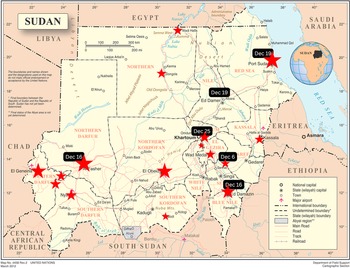
Figure 3. Locations and dates of initial protests mapped by author. United Nations. (2012). Sudan [Map]. UN Geospatial Information Section. https://www.un.org/geospatial/content/sudan
Theoretical approach
As an African educated in institutions rooted in Western neoliberal hegemony (Campbell Reference Campbell2008), I considered “identities, locations, and institutional affiliations, as well as the epistemological and methodological constraints and choices” when conceptualizing the theoretical framework for this work (Mama Reference Mama2007, 7). Sudan, which has been studied under academic disciplines with Eurocentric and patriarchal limitations, has suffered the reproduction of ahistorical categorizations (Sharkey, Vezzadini, and Seri-Hersch Reference Sharkey, Elena and Iris2015). Further, Western and Eurocentric narratives have often framed uprisings in Africa as the antithesis to modern democratic processes, marred by riots, warlords, child soldiers and other violent depictions that eventually require humanitarian assistance (Branch and Mampilly Reference Branch and Mampilly2015). In contrast, this paper seeks to use frameworks that situate the Sudanese uprising (December 2018–April 2019) within the literature of emancipatory struggles of African working peoples. In addition to the bottom-up participatory political processes that characterized the 2018/19 uprising, “chants carried a strong anti-military, anti-imperialist sentiment, particularly in advocating for economic rights and justice” (Hassanain and Sidig Reference Hassanain and Sidig2024, 100). The uprising is, therefore, situated in the literature on liberation movements in Africa (James Reference James1995; Maloba Reference Maloba2007; Bianchini, Sylla, and Zeilig Reference Bianchini, Ndongo and Zeilig2023) and working peoples’ struggles (Kelley Reference Kelley1990; Rodney Reference Rodney1981), both of which have contributed immensely to our understanding of the organizing of Global AfricansFootnote 3 for political change.
Outside of attempting to ensure a contextually accurate analysis, there are at least three reasons why this paper frames the 2018/19 uprising within the literature of liberation movements. First, situating the Sudanese uprising among liberation movements means adopting a framework that is explicit about the necessary role of working peoples in social and political change benefitting the majority. Global African revolutionary thinkers not only recognized the impact of geography and structural factors outside the control of human agency on politics (i.e., avoiding a structural-agency binary approach in the place of a dialectical or interconnected relation), but they also emphasized that social and political change intended to benefit most of society would require the self-organization, political participation, and coordination of different sections of working peoples. Unlike arguments of mass participation that tie effectiveness to mere numerical presence, for thinkers like Amílcar Cabral, social reality “can only be transformed by detailed knowledge of it [reality], by our own efforts, [and] by our own sacrifices” (Reference Cabral1966, 3). In this sense, it follows that the effectiveness of a movement is tied with its ability to reflect and take advantage of the cultural and material realities of working peoples (Cabral Reference Cabral1974).
For Ella Baker, the autonomous self-organization of working peoples was first, “simply the democratic idea that an oppressed group, class, or community had the right to determine the nature of the fight to end its oppression” (Ransby Reference Ransby2003, 300). Baker believed the masses have an instinctive ability to speak and act for themselves, which Kwame Ture called her “unfailing confidence in the democratic political instincts in the grassroots” (Carmichael and Thelwell Reference Carmichael and Michael2003, 393). In having different sections of society self-organize, Baker explains that “[her] theory is, strong people don’t need strong leaders” (as cited in Moye Reference Moye2013). Baker advocated for the self-organization and autonomy of grassroots communities and youth groups like the Student’s Non-violent Coordinating Committee (SNCC) in the context of larger and more established organizations like the Southern Christian Leadership Conference (SCLC). She further encouraged organizations like SNCC to learn from and directly engage working peoples in the communities they were organizing because ultimately “[w]e can only create a new world out of a commonness of purpose and a decent respect for all the people who are helping to contribute to it” (Baker Reference Baker1963).
Many of Sudan’s Neighborhood Resistance Committees (NRCs), mainly because of their geographic and relational basis, became conducive to popular participation based on strong relationships, trust, and political engagement within the community. For both Andaiye (Reference Alissa2020) and Baker (Ransby Reference Ransby2003), self-organization, particularly autonomous organizing, serves a dual purpose: challenging hierarchies of power and building political capacity for self-advocacy. The self-organized labor, spatial, and demand-based organizations that participated and coordinated in the uprising not only allowed different sections of working peoples to determine the nature of their fight and articulate their specific demands, but also limited the impact of repression and lobbying of select groups to stifle the movement.
Second, theories on [Global] African liberation movements provide concepts and classifications that do not obscure the complexity and dynamism of what is happening on the ground. Despite emphasizing the necessity of understanding material conditions to make sense of sociopolitical realities, Cabral (Reference Cabral1966) explains how class as a fixed category cannot explain the dynamism of African workers in underdeveloped economies. Moreover, Franz Fanon (Reference Fanon1968) and Andaiye (Reference Alissa2020) allow us to understand how the nature of imperialism and capitalism position race and gender as inextricable from class and, thus, central to understanding liberation movements and effective political organizing. Therefore, I use the concept of working peoples to account for the various groups that participated to remove the Sudanese regime, with a classification that accounts for the fluidity of classes.Footnote 4 Walter Rodney’s (Reference Rodney1981) concept and classification of working peoples allows him to discuss formerly enslaved Black laborers, indentured Indian servants, landed workers, and women and children under one category not only because the basis of the classification is the exploitation of labor and the lack of clear delineation between subsistence and wage labor, but also because these different forces have tended to act in unison and create alliances in order to have better control over their lives and destiny.
In the Sudanese context where intersecting classes (from professionals to precarious workers) and social groups (racial, ethnic, and religious) participated in the uprising, the term working peoples allows us to avoid conflation of different groups despite their collective rejection of the regime.Footnote 5 By paying attention to the specific patterns of oppression and exploitation of different groups, the term also prevents universalizing experiences. After the Islamist military coup in 1989, the National Islamic Front (NIF), later the National Congress Party, wasted no time entrenching and establishing systems and structures of control and extraction with the support of global capital.Footnote 6 The regime created unlivable conditions for the working peoples of Sudan under which women remained super-exploited,Footnote 7 hence the interchangeable use of working peoples and women in this work when discussing tea sellers. With most available job opportunities in Sudan being concentrated in the “informal” sector, studies show the considerable dependence on women: “some families subsist on only one meal a day, cooked, and served by women in the evening after they are done with work” (Assal Reference Assal, Ryle, Willis, Baldo and Jok2011, 126). Negative perceptions of womanhood and women’s subordinated role (Najjar, Abdella, and Alma Reference Najjar, Abdalla and Alma2017), legalized through the state’s political Islam (Ali Reference Ali2015), not only renders invisible women’s labor and their centrality to social processes (Ibnouf Reference Ibnouf2011), but it also positions them as a central force in any liberation movement (Andaiye Reference Alissa2020). The racial, ethnic, and religious diversity of women who are forced to migrate to urban areas to earn a living further necessitates a fluid understanding of class.
At the analytical level, paying attention to the inextricability of class, race, and gender means taking seriously the solidarities that emerge across working peoples and social groups. In the history of Sudan, and particularly under the Inqaz regime (1989–2019), religion, gender, and race were manipulated to fragment and suppress the political capacity of organized labor and social movements (Ali Reference Ali2015). The fact that Sudanese working peoples were able to confront and overcome such manipulations by the regime, which has essentially served as “a comprador for regional regimes, which in turn serve as compradors of Western capitalism” (El-Battahani Reference El-Battahani2023), was an important political-ideological victory necessary for the overthrow of al-Bashir and challenge to the state. Cabral (Reference Cabral1974) emphasizes how the ability of different social groups to bring diverse interests into harmony and attempt to resolve internal contradictions is a form of political victory necessary for the development of the liberation movement: “The taking to heart of its objectives by large strata in the population, reflected in their determination in the face of difficulties and sacrifices, is a great political and moral victory” (Cabral Reference Cabral1974, 48).
In 2019, the practice of solidarity in the face of repression and divisive rhetoric served as the moral and political basis necessary to withstand and subvert the state. This solidarity was demonstrated through several key moments: solidarity protests held in Khartoum in February 2019 as a teacher protesting in Kassala was tortured to death (Radio Dabanga Reference Dabanga2019a); the August 2019 vigil held by demonstrators in El-Obeid to commemorate four demonstrators shot dead in Omdurman (Radio Dabanga Reference Dabanga2019g); the chanting of “Kullu al bilad Darfur” (We are Darfur) in Khartoum when the regime attempted to blame protests on Darfurians (Elmahadi Reference Elmahadi2020); and the nature of the Khartoum sit-in itself. Further, chants, which included references to Sudan’s matriarchal and African histories, opposed patriarchal ideologies and binary impositions of Sudan as Arab or African: “the discourse of this generation is generally embracing diversity, equal citizenship, anti-racism, and the other demands of the revolution” (Arman Reference Arman and Zambakari2019, 1).
Third, situating the Sudanese Uprising within the literature of African liberation movements allows us to understand the forms of organization and the demands of the movement, not only in its interaction with the world at large, but also based on historical and contemporary realities of and lessons among the Sudanese working peoples. To understand its emergence and effectiveness, we must historicize the autonomous and loose nonhierarchical coordination of different organizations of working peoples in Sudan, beyond the shared aversion to leader-based hierarchical movements witnessed across the world over the last few decades (Bevins Reference Bevins2023). First, even one of the most horizontally organized groups in the uprising, the NRCs, had structures that were as dynamic and adaptive as the revolutionary process that unfolded between 2018 and 2023 (Mustafa and Albahi Reference Mustafa and Albahi2024). It is then important to underscore that not only did the working peoples of Sudan successfully challenge the state in 1964 and 1985 (Berridge Reference Berridge2015), but also the 2018/19 uprising was a culmination of revolts, rebellions, and political organizing that intensified over the last decade. The horizontal/nonhierarchical, autonomous, and coordinated nature of the uprising is, therefore, not assumed to be solely a reflection of regional trends, or the “prefigurative politics” of the New Left in Europe, or the influence of libertarian trends in the North Atlantic (Bevins Reference Bevins2023). Rather, it is a reflection of the experiences and historical lessons of the Sudanese working peoples. In this case, the effectiveness of an organization is not tied to an ideal form (horizontal or vertical) but instead its ability and flexibility to reflect and acquiesce to the reality and demands of those self-organizing.
Ahmad Sikainga’s (Reference Sikainga2010) work demonstrates how early forms of resistance among railway workers in the city of Atbara in Sudan emerged from the social process of workers during a specific period and under a particular environment. The institutional hierarchies, “chains of command, strict rules, and a high level of discipline” embedded in railway employment manifested in the form and discipline of political organizing adopted by railway workers (Reference Sikainga2010, 37). In the same vein, the Tea Sellers Association (TSA) and the NRCs active in the 2018/19 uprising emerged from the unique nature of precarious work, violence from the state, and the struggles for social reproduction, which have generated similar self-organizations in other parts of Africa (Ngwane Reference Ngwane2021; Al-Bulushi Reference Al-Bulushi2024). Unlike hierarchical (“Stalinist”) forms of organizing that were adopted by the Communist Party of Sudan (CPS) and the Sudanese Women’s Union (SWU) (Anis Reference Anis2001)—both of which were instrumental in the 1964 and 1985 popular movements—the 2018/19 uprising harbored varied modes of organizing best understood through Sudan’s historical process and concrete labor (social) processes that distinguish industry work from precarious labor and housework.
Loosely coordinated autonomous organizations
Outside of the remarkable history of popular mobilization in Sudan (Kurita Reference Kurita, Vezzadini, Iris, Lucie, Anael and Mahassin Abdul2023), throughout the period of the Inqaz regime (1989–2019), there were massive demonstrations and protests, especially by youth (Deshayes, Etienne, and Medani Reference Deshayes, Margaux and Khadidja2019). Magdi el-Gizouli (Reference El-Gizouli2020, 2) referred to the 2013 protests as “a rehearsal for the December 2018 showdown.” There is overwhelming consensus among academics, journalists, and activists that youth and women populated most of the demonstrations against the regime. Youth have been estimated to make up 80 percent of the protestors overall (Elmahadi Reference Elmahadi2020), and 70 percent of protestors in Khartoum were estimated to be women (Engeler, Braghieri, and Manzur Reference Engeler, Braghieri and Manzur2020). In the early period of the uprising, “the mass of protesters were drawn from poor town dwellers and from people who have lost out in the reworking of land relations in rural Sudan to the benefit of commercial agriculture” (El-Gizouli Reference El-Gizouli2019b). Updated accounts claim that protests first broke out in Mayrno (Sennar State) on December 6, 2018, then spread to El-Fashir (North Darfur State) and Ad-Damazin (Blue Nile State) before reaching the historic city of Atbara (River Nile State) on December 19, and finally spread to other cities including Khartoum by December 25 (Kadoda and Hale Reference Kadoda and Hale2020). Within a few days, the Sudanese abroad echoed the calls of the people in cities across the world (Franck Reference Franck2019; Radio Dabanga Reference Dabanga2019).
Qualitative research on the uprising indicates the dynamic and adaptive nature of the movement over time (Hassan Reference Hassan2023; Hassanain and Sidig Reference Hassanain and Sidig2024). Interviews with NRC members demonstrate that the organizational structure of each NRC was neither unitary nor static—that is, each NRC emerged in relation to and continued to change based on their geographic location. Although most committees eventually came under an umbrella body organized for social and political change, each local iteration remained autonomous and responsible for reflecting and building towards the specific changes sought in their respective neighborhood and locality. In an interview with Marya Hannun, labor organizer Rabab Elnaiem (Elnaiem and Hannun Reference Elnaiem and Maya2024) notes:
it’s [not] accurate or even beneficial to study neighborhood resistance committees as a unifying structure. A resistance committee is a reflection of the political and social class behind it. So, a neighborhood resistance committee in a poor neighborhood in Khartoum might have a lot more in common with a resistance committee somewhere in the periphery than another neighborhood in Khartoum.
Such localization ensured that working peoples were able to bring their various demands to the fore and in discussion with professionals and elites. From rural communities to urban peripheries to upscale neighborhoods, the structure and function of the NRCs were replicated once the uprising was underway (El-Gizouli Reference El-Gizouli2020), but the committees first emerged as early as the popular demonstrations of 2013 (Abbas Reference Abbas2019).
As local committees proliferated across all eighteen states in Sudan, the NRCs created “an elected leadership council and branches in many towns across the country” (Abbas Reference Abbas2019). The Resistance Committee, which signed the Declaration of Freedom and Change, became an informal, widely and loosely organized residents network that collectively represented the committees at the national level. In many cities like Khartoum, Nyala, and Wad Medani, NRCs in the same residential neighborhoods created Coordinating Committees (made up of representatives from each NRC) to coordinate information and their political activities. Internally, however, even NRCs in the same neighborhood may have had different structures. NRC structures ranged from those consisting of presidents and secretaries, such as in Al Gedaref, to those without Coordinating Committees such as Kosti NRCs (Mustafa and Albahi Reference Mustafa and Albahi2024). Research conducted by the Carter Center in 2021 attempted to map out youth-led organizations in Sudan and shows how “[a]mong the groups mapped, 5,289 (73 percent) were resistance committees, while 1,949 (27 percent) were other kinds of youth-led organizations” (Carter Center Reference Center2021, 12).
Personal interviews reveal that many of the forms of organization adopted during the uprising were in response to past struggles: “Instead of organizing easily controlled and repressed central demonstrations [as before], they [NRC members] innovated the idea of popular resistance at the grassroots level. This involved creating small groups within neighborhoods to organize and lead small-scale protests in Khartoum State” (Mustafa and Albahi Reference Mustafa and Albahi2024, 7). During the uprising, Coordinating Committees launched “guerrilla-style urban protests,” which meant daily organized, sporadic protests in multiple regions (Hassan and Kodouda Reference Hassan and Kodouda2019). Xavier Houdoy and Nicolas Ressler’s (Reference Houdoy and Ressler2019) rich visual mapping of the protests (see Figure 4) encapsulates the high frequency and geographical dispersal of these guerilla-style demonstrations in Greater Khartoum alone. Mai Hassan’s (Reference Hassan2023) qualitative work reveals, even at times where dis-coordination and spontaneity seemed to characterize the demonstrations in Sudan, demonstrators were tactically deploying “coordinated discoordination” as a response to repression. In the neighborhoods of Khartoum, different NRCs coordinated:
Their plan was simple. If Wad Nobawi was out on the streets and came under the grip of the police and security, they relied on the committee in the other two neighborhoods to hit the streets and take the pressure off them. “We called Wad Nobawi, Beit Al-Mall and Abu Rouf the ‘terror triangle’ because we were organized and had each other’s back,” said Abdulhafeez. (Abbas Reference Abbas2019)

Figure 4. Mapping protests, by Xavier Houdoy and Nicolas Ressler (Reference Houdoy and Ressler2019).
Such organizing ensured that the uprising was not vested in a few organizations or groups, rather in the working peoples more broadly. Unlike in 2013 and 2014, persecuting key figures in the Sudanese Professional Association (SPA) would not stall the revolutionary process. This time, it would not be enough to dissolve the unions and the political parties, or kill and exile opposition leaders, to stifle the voices of opposition and resistance.
In addition to making demonstrations more sustainable and manipulation by the regime more difficult (Alneel Reference Alneel2021), the neighborhood-scale organization and national coordination meant that NRC members and “protestors knew their physical and social geography well, and they created a new cityscape as they took control of the streets, built their barricades and redirected traffic, used private spaces for public mobilisation, slipped in and out of alleyways to escape and outflank the security forces, and redecorated the walls and bridges of Khartoum [and beyond]” (Berridge, de Waal, and Lynch Reference Berridge, de Waal and Lynch2022, 17–18). The sheer amount of self-organized autonomous organizations and the loose structure of coordinating also meant that even if demonstrators were not coordinating to dis-coordinate, different political actions were happening in a manner that caught the state and its security apparatus off-guard. Muzan Alneel (Reference Alneel2021) reflects on how the decentralized nature of demonstrations inhibited the state from launching multiple effective attacks of repression. Furthermore, Abdulhafeez’s statement, “we … had each other’s back,” shows how (like the Baker model suggests) the trust built through local organizing was necessary to execute nationally coordinated actions.
Despite various techniques used to vet new members, the autonomous geography-based organization of the NRCs meant that people with different social, political, and economic backgrounds and affiliations made up each local NRC. The committees were generally established and populated by young men and women (Abbas Reference Abbas2019; Lewis Reference Lewis2020). The committees brought together many people, but were generally established and populated by young men and women (Abbas Reference Abbas2019; Lewis Reference Lewis2020). In the resistance committee of Haj-Yusef district in Khartoum, some members “have jobs, others don’t; [but] everyone is committed to improving the daily life of their community” (Debuyser Reference Debuyser2020). Bahri (North Khartoum), a historically middle-class neighborhood and an active site of resistance during the uprising (Rowsome and Provan Reference Rowsome and Provan2020), had several hundred members in about eighty resistance committees by 2020 (Achcar Reference Achcar2020). By 2022, autonomous NRCs would proliferate in the thousands and create the conditions for working peoples to organize based on their shared localized concerns. The relation of the NRCs to the community was based on the recognition and need to redress fundamental economic and sociopolitical issues at the local and national level.
From their inception, the committees worked on different fronts—street cleaning campaigns, road works, school repairs, equitable distribution of resources (Lewis Reference Lewis2020)—that increased their embeddedness in the community. In many places, locals even depended on the NRC to manage day-to-day matters or settle neighborhood disputes (Debuyser Reference Debuyser2020). An NRC in Ombada, Omdurman organized a solidarity market once a week where products, many of them necessities such as oil and rice, were sold at-cost instead of the inflated market prices (Debuyser Reference Debuyser2020). Other volunteers from the NRCs in Arkawit, another neighborhood in Khartoum, mobilized to monitor the distribution and use of flour by the bakeries in order to control inflated prices of bread that resulted from wheat or bread smuggling (Lewis Reference Lewis2020). Contrary to this bottom-up political process, the NIF regime installed “popular committees” to mobilize political support (Sidahmend Reference Sidahmed, Ryle, Willis, Baldo and Jok2011) and legitimize its rule by giving the impression of wide popular participation in governance (Ali Reference Ali2016). In reality, these committees, run by “retired army officers, merchants, land brokers, the mosque imam and the in-service security eye” (El-Gizouli Reference El-Gizouli2020, 2), had become tools of surveillance and control (Ali Reference Ali2016; Assal Reference Assal, Ryle, Willis, Baldo and Jok2011, 125). The NRCs were able to build trust in each other and within the community and thus, challenge the legitimacy of the state.
Considering the historical role of professional and workers unions in Sudan, and their alliances in the popular uprisings of 1964 and 1985, it is not surprising that one of the leading forces of the uprising was the Sudanese Professional Association (SPA). In August 2018, the SPA announced its existence and held a conference on minimum wage, where it was revealed, from a study finding, that the professional class (including doctors and lawyers) were living below the poverty line. The SPA played a central role in 1) organizing different professional sectors, including teachers, accountants, veterinarians, pharmacists, plastic artists, and so on; 2) nationally coordinating different unions and their regional members under an umbrella organization; and 3) coordinating national schedules for revolution and utilizing international networks. The organization was able to effectively collect and distribute information, such as daily schedules and routes for demonstrations, through its local networks and social media platforms. The SPA’s strength, however, lay in its ability to coordinate with networks of autonomous self-organized organizations.
The NRCs particularly functioned as a grassroots extension of the SPA as they distributed the national schedules for revolution and organized people in their neighborhoods to respond accordingly. Considering their effectiveness, the FFC had called on people to create more committees and further coordinate nationwide demonstrations (Hassan and Kodouda Reference Hassan and Kodouda2019). Many NRCs built trust and transparency with community members as they held regular neighborhood meetings where they would announce plans related to the uprising while providing an opportunity for neighborhood residents to respond. Organizations such as the TSA, on the other hand, not only served as a powerful network with reach to more than 20,000 people, but its members also participated in, provided necessary care work, and even raised funds for the uprising (Hassanain and Sidig Reference Hassanain and Sidig2024; Lavrilleux Reference Lavrilleux2019; York Reference York2019). The TSA and NRCs are two organizations that show how varied yet self-organized groups emerging from lived realities coalesced to create a country-wide horizontal network of organizations working autonomously, separately, and in coordination in different capacities and across different scales. Such a structure of political organizing created an interdependent political process that did not exclude the most oppressed and exploited populations but benefited from their self-organization and political participation.
Unlike the NRCs, the TSA is not a geography-based organization but a sector-based organization catering to women street vendors. Women, mostly from Southern and Western regions, facing conflict or climatic strains move to urban areas like Khartoum, which offer very limited employment opportunities for impoverished, under-educated, and racially differentiated women not represented by the “Riverain Arab-Muslim Power Bloc” (Ali Reference Ali2015). These women are compelled to professions like tea selling because they not only make more money than their male counterparts, but because it is often the only means to secure a livelihood without much capital (Assal Reference Assal, Ryle, Willis, Baldo and Jok2011). Similarly, alcohol brewing is another one of the limited options for income generation for displaced women from Western and Southern Sudan. Women in precarious work such as street vending are not only harassed by state police forces in Khartoum, but they also make up a disproportionate number of the women in prison (SIHA Network 2015, 2020).
Demonstrating the value and need for self-articulation and self-organization, Awadeya Koko, founder of the Tea and Food Sellers Cooperative Union that predated the TSA, describes how the cooperative emerged from the needs of street vendors, who lacked substantive representation despite the existence of worker unions (Lavrilleux Reference Lavrilleux2019). Koko explains how the TSA emerged as a historical necessity based on the realities of women like herself, who was born in the Nuba Mountains in South Kordofan but fled to Khartoum with her family to avoid conflict. Along with women like herself, Koko self-organized the first Women’s Food and Tea Sellers Cooperative in Khartoum in 1990 (Lavrilleux Reference Lavrilleux2019). By 2019, the union had twenty associations within it and an outstanding 15,000–27,000 members, with at least 10,000 being tea sellers (Hendawi Reference Hendawi2019). Among other necessities, the association offered help in securing vendor permits and providing legal and financial aid to confront local police authorities who are known to consistently harass street vendors. It also provided assistance to educate family members and conduct funeral processions (Hendawi Reference Hendawi2019). The autonomous self-organization of the TSA also meant that tea sellers could negotiate their future alongside women with different class positions in coalitions such as MANSAMFootnote 8 (Hassanain and Sidig Reference Hassanain and Sidig2024).
For Andaiye (Reference Alissa2020), in contrast to a top-down hierarchical (vertical) format for organizing and building networks, a horizontal collective made up of autonomous organizations across different sectors can reduce the possibility that organizing different sections of the working peoples (with different levels of power) reproduces the very social relations being challenged:
It is only possible to confront hierarchies from a base that recognizes that hierarchies exist, and reflects this by having sectors with different levels of power organize autonomously. In this way each sector, particularly those with the least power, can independently analyze its experience, work out strategies, and bring all of this to the common table. Increasing the power of the least powerful sectors is essential to ensuring accountability from the more powerful sectors and essential to ensuring that women who rise in the power structure stay accountable. (Andaiye Reference Alissa2020, 12)
Therefore, it is no small feat that some of the core organizations in the 2018/19 uprising were the NRCs and TSA, which organized autonomously and within horizontal networks and within coalitions. In fact, another important distinction from past mobilizations of women in Sudan is that many groups that formed over the last few years and contributed to the ousting of Bashir were autonomous and self-organized (Elradi Reference Elradi2018; Kadoda and Hale Reference Kadoda and Hale2020).
As protests continued, women endured public beatings, rape, and abuse from security officers, which “set off a ripple-effect of abuse—husbands began to divorce their wives out of shame, and fathers beat their daughters into submission, in an attempt to keep them at home” (Elbagir et al. Reference Elbagir, McKenzie, Bashir, Nasiir and Abdalaziz2019). The manifestations of Sudanese women’s oppressions—by the state apparatuses and within the family structure—in the uprising did not deter the militancy of Sudanese women. Many young women did not receive a blessing from their families to participate in the demonstrations; nonetheless, they did participate (Tønnessen and al-Nagar Reference Tønnessen and al-Nagar2019). During a protest in Khartoum, men attempted to encircle women to protect them from security forces, but women “insisted on standing in the front lines” (Elbagir et al. Reference Elbagir, McKenzie, Bashir, Nasiir and Abdalaziz2019). Testimonies from women demonstrators (Elbagir et al. Reference Elbagir, McKenzie, Bashir, Nasiir and Abdalaziz2019) show that women, even those who were repeatedly detained, continued to mobilize and demonstrate on the streets and at the sit-ins (Tønnessen and al-Nagar Reference Tønnessen and al-Nagar2019). The visible and varied roles of women during the uprising not only provided a social battle against the state’s conception of womanhood (Ali Reference Ali2015), but it also “reinstates women from all walks of life onto the map of Sudanese public life” (Aziz Reference Aziz2019). Similarly, demonstrations held in solidarity with sexual violence survivors and to denounce the dehumanizing retaliation on women have been referred to as nothing short of a social revolution (Tønnessen and al-Nagar Reference Tønnessen and al-Nagar2019).
As the FFC and SPA called for further mobilization, on January 18, 2019 an elderly man, Muawiya Bashir, was shot and died inside his home when officers raided his house searching for harbored revolutionaries. The funeral procession in the Burri neighborhood of Khartoum became a march with thousands of people chanting for the fall of the regime and the death penalty for al-Bashir and his security forces (Suleiman Reference Suleiman2019). By February, Bashir had declared a state of emergency, which resulted in increased violence from security forces on demonstrators and the indefinite closure of schools and colleges. As doctors in a hospital in El Obeid called for his downfall and youth were controlling the streets of Omdurman, Khartoum protestors were getting teargassed as they called for the release of women detained at previous demonstrations (Reuters 2019). Each regional state experienced different demonstrations calling for local redress in addition to the collective goal of the regime removal.
The repression and mobilization cycles continued for months. By April, gruesome reports compiled and reported by the Central Committee of Sudan Doctors were coming out from different regions. One of the first people killed on April 6 was Badrya Ishaq, a new mother living in a displacement camp in Zalingei, Central Darfur (Awad Reference Awad2019). Ishaq was shot by security forces during a protest in a camp for internally displaced people. The Central Committee of Sudan Doctors also released a statement that a lab technician was killed in Omdurman (Human Rights Watch [HRW] 2019). According to HRW, at least eight people were killed in the days between April 6 and April 8 alone. Instead of deterring political organizers, the violence unleashed by the security apparatus were humanizing moments that spurred mobilization.
Subverting the State: Insurrection
On April 6, 2019, as protest schedules were disseminated, the SPA called for a march commemorating the fall of Gaafar Nimeiry’s regime, and one of the largest sit-ins of the uprising was erected in front of the military headquarters in Khartoum. The sit-ins, which have been referred to as “tent-cities” (Kadoda and Hale Reference Kadoda and Hale2020, 85), took place in fourteen cities across Sudan (Alneel Reference Alneel2021), including El-Obeid, Gedaref, Wad Medani, and Port Sudan. In 2020, the sit-in in Nertiti, Central Darfur had attracted demonstrators from cities across Darfur (Amin Reference Amin2020). The 2019 sit-in in Khartoum, which also attracted many working peoples and youth from different parts of the country, lasted fifty-eight days and sealed Bashir’s fate.
According to Engeler, Braghierhi, and Manzur (Reference Engeler, Braghieri and Manzur2020), the sit-in was visited by tens of thousands of people daily, and “was maintained by hundreds of volunteers who erected makeshift health stations, classrooms, pharmacies, food distribution stations, and security checkpoints on the territory.” The area where the main activities took place measured about 27.5 hectares, whereas the whole sit-in covered an estimated 108 hectares (Bahreldin Reference Bahreldin2020). From at least nine cities across Sudan, street vendors, doctors, dock workers, artists, engineers, elders, religious groups, unemployed youth, and so on, with different religions, races, ages, ethnic groups, and genders, came together to form the sit-in (Bahreldin Reference Bahreldin2020). From Atbara and Port Sudan alone, hundreds of workers from cities and villages took a convoy of trains to join the sit-in (Amin Reference Amin2019). The sit-in drew so many people from other regions that security forces barricaded roads and bridges entering Khartoum. With women’s roles “remarkably unchallenged,” volunteer teams created elaborate systems that addressed concerns of food, security, social services, and gendered violence (Bahreldin Reference Bahreldin2020, 13). Arising from the realities of state repression and the experiences of many Sudanese women, the Maydanik,Footnote 9 “a safe zone for women,” was also established inside the sit-in. The space provided legal and psychological support for women and became a space to discuss the gendered nature of the uprising (Nugdalla Reference Nugdalla and Okech2020). The sit-in also became a place to disseminate information and negotiate “diplomatic” relations. The SPA and FFC used the sit-in space to disseminate information and update the people with intended actions and ongoing negotiations between the FFC and the TMC (Elmahadi Reference Elmahadi2020). In April, when the TMC attempted to hold more power, Saudi Arabia and the United Arab Emirates (UAE) pledged to provide $3 billion to improve Sudan’s economic situation (Voice of America Reference America2019). In response, the sit-in space echoed with anti-imperialist chants to “keep their money,” “we don’t want Saudi support” (Radio Dabanga Reference Dabanga2019c), and “we do not want Saudi aid even if we have to eat beans and falafel!” (Bearak and Fahim Reference Bearak and Fahim2019).
What emerged in the Khartoum sit-in has been described as “a microcosm of the future Sudan that the protesters envision” (Osman Reference Osman2019), a “fully-functioning micro society” (Elhassan Reference Elhassan2019), and a “mini-state” (Hassan and Kadouda Reference Hassan and Kodouda2019, 100). Mohammed Elnaiem used the phrase “governing without a government,” to describe the sit-in, and I would restate the phrase as, self-governing with an alternate mode of politics (Reference Elnaiem2019, 7). Organizers have expressed how the collective organizing, dwelling, and producing developed a strong sense of solidarity across region, race, class, and gender (Elmahadi Reference Elmahadi2020). The sit-in not only exemplified the insurrection and a more organized microcosm of the broader movement, but it also became one of the spaces that institutionalized popular participation and exhibited a form of political organizing based on the needs and capacities of the working peoples. In other words, the sit-in displayed what self-organization and making use of the capacities of different sections of society, for collective liberation, can look like in Sudan.
After four months of nationally coordinated street protests, workers strikes, a few days of the sit-in in Khartoum, and the deaths and injuries of hundreds of people, the power of the Sudanese working peoples was realized on April 11, when Bashir’s vice president and [then] defense minister, General Awad Ibn Auf, announced that the security forces had removed Bashir as per the people’s demands (Hassan and Kadouda Reference Hassan and Kodouda2019). The army also announced it would hold power until democratic elections could be held in two years. The TMC was supported by external powers, such as Egypt, Saudi Arabia, and the UAE (Jacinto Reference Jacinto2019). After Bashir’s removal, two general trends emerged with one side demanding civilian rule and adherence to the initial demands of the uprising, and another side willing to make compromises and make strategic arrangements with the TMC.
Magdi el-Gizouli (Reference El-Gizouli2020) contrasts the responses in Riyadh and Kalakla, two neighborhoods in Khartoum, with the former being upscale and comprised of mostly middle/upper-class and the petty bourgeoise (including graduates of elite universities abroad), and the latter being a densely populated neighborhood with mostly unemployed youth, hustlers, and other precarious workers. Those from Riyadh were willing to consider negotiations with the TMC, whereas those “younger and disenfranchised” in Kalakla were overrepresented on the side unwilling to accept a role in politics by the security apparatus (El-Gizouli Reference El-Gizouli2020, 5). Part of the demands raised by the residents of Kalakla were for the removal of rainwater from the streets (Radio Dabanga Reference Dabanga2019g). Unlike those in Riyadh, the inhabitants of Kalakla not only faced daily struggles in their living and working conditions, but they also had been confronted by the violent state systems and structures of appropriation and control more frequently than the inhabitants of Riyadh (El-Gizouli Reference El-Gizouli2020). A member of the NRCs explained how the horizontal and autonomous structure was intended to represent “the voiceless and a broad spectrum of Sudanese people” (Mustafa and Albahi Reference Mustafa and Albahi2024, 13). In practice, the nationwide self-organized participation of various classes through the NRCs brought different interests to the fore and challenged the disregard of less powerful sections of society.
The decision to stay in the streets and demand the removal of the security apparatus from political power was therefore reinforced by the thoughts and decisions of autonomous organizations, such as the Al Kalala NRCs, and workers like Yousef Mohamed, a banker from Omdurman, who asserted, “we tried a military government, but it didn’t work for us in Sudan” (France 24 2019). After the 1985 popular uprising, the TMC that took power “stole the victory of the people” (Khalid Reference Khalid2012, 167), but the same mistakes were not to be repeated in 2019. As working peoples from organizations like the Al-Kalakla NRCs and the TSA expanded the social and political demands of the movement, committees in middle-class neighborhoods like Burri were some of the most well-organized and effective, and NRCs in Al Riyadh and professionals in the SPA leveraged their resources and international networks (Mustafa and Albahi Reference Mustafa and Albahi2024).
The professionals, industrial workers, public sector employees, and small property/business owners are neither the majority social classes in Sudan nor the most exploited, but they are central to social processes in Sudan as they generate revenue for the masculinized Islamist dependent-capitalists controlling the militarized state. The coordination of these groups among each other (via groups like the SPA) and with the grassroots (via networks and media) added pressure on the regime and military. Depending on the expertise and the issue at hand, groups under the SPA functioned separately and as a collective. Each of the bodies under the SPA staged independent strikes across their respective sectors and exchanged information based on expertise. For instance, on December 25, 2018, the Sudan Pharmacists Central Committee, in cooperation with the Community Pharmacists Committee and the Department of Pharmacy Owners, called for a strike and closure of all pharmacies in Khartoum state (Radio Dabanga Reference Dabanga2018). A day before, the SPA had coordinated an open-ended national doctors strike. El-Gizouli (Reference El-Gizouli2019a) credits the response to the SPA’s calls, among young men and women, to their usage of popular language and general ideas of freedom and equality. As youth and precarious laborers governed the streets and refused the curfew set by the TMC, professional and working-class organizations coordinated to withhold their labor or use it to aid the uprising until the security apparatus agreed to include civilian leadership in the transitional government.
Responding during the May 2019 strikes, Siddiq Farukh, a protest leader from Khartoum, told a reporter that “the two-day strike aims to deliver a message to the whole world that the Sudanese people want a real change and they don’t want the power to be with the military” (Amin Reference Amin2019). Thousands of Sudanese workers (factory workers, lab technicians, doctors, accountants, bankers, railway workers, dock workers, etc.) in private and public sectors joined the May 28 and 29 national strikes. Despite threats and repression (Radio Dabanga Reference Dabanga2019e), civil servants in the Labor Ministry, the Electrical Distribution Company in Khartoum, and the Thermal Power Station in Khartoum North, as well as workers in the telecommunications sector and bankers at the Central Bank of Sudan, joined the strike (Amin Reference Amin2019; 500 Words Magazine 2019).
Even more workers joined the strikes on the second day (Radio Dabanga Reference Dabanga2019f). A strike organizer and employee of the Bank of Sudan, Muez Ahmen, told reporters, “I can confirm that the 110 branches of the Bank of Khartoum are striking, also the banks of Faisal, Farmers, Animal resources, Alnilain, Exports development, Sudanese-French bank, Albaraka and others are all striking” (Amin Reference Amin2019). The commonly reported impact of the strike is the paralysis it caused as airport staff in Khartoum International Airport refused to show up to work. One flight after the other got cancelled (Shaban Reference Shaban2019) as Sudanese airlines Badr, Tarco and Nova and EgyptAir were forced to cancel flights (France 24 2019). Reflecting the general and specific demands of each section of the working peoples, Osman Tahir, a worker at the dock in the Port of Sudan expressed that for him, the strike was meant to ensure civilian rule and “get rid of the corruption in Port Sudan” (France 24, 2019). In downtown Khartoum, markets, restaurants, shops, and public transportation were at a standstill (Amin Reference Amin2019). The working peoples of Sudan had demonstrated that the people run the country, and collectively, they could stop it, again.Footnote 10
In this sense, we can understand why a few days after the incapacitating general strike of May 28 and 29, and the relentless continuation of daily demonstrations including protests and sit-ins, we witnessed one of the most violent attacks by security forces. On June 3, 2019—what is now remembered as the Khartoum or Ramadan Massacre—the Rapid Support Forces (RSF), the Sudan Armed Forces (SAF), and the riot police raided the sit-in outside the military headquarters in Khartoum (El-Gizouli and Thomas Reference El-Gizouli and Thomas2020). More than a hundred people were killed and hundreds injured. More than seventy women were raped, and at least three committed suicide after the incident (Hassan and Kadouda Reference Hassan and Kodouda2019; Ali Reference Ali2019; Salih and Burke Reference Salih and Burke2019). The large number of deaths during one event garnered international and regional condemnation, including the suspension of Sudan from the African Union.
By June 4, the military transition was scrapped, and the military announced elections would be held in nine months. Following the June 3 raid, the FFC announced preparations for the “March of Millions,” followed by another effective general strike on June 9. After weeks of mobilization through the NRCs, tens of thousands of people came out to the streets on June 30, 2019. Simultaneously, protests were staged in several major cities, including Atbara, El-Obeid, and El-Gedaref, and others in Darfur, and in smaller towns such as Sennar. According to a report from Radio Dabanga (Reference Dabanga2019b), “Red Sea, El Gedaref and Kassala witnessed the largest demonstrations ever seen.” By July 5, the TMC and FFC reached an agreement, which continued to be negotiated among different forces within the FFC and would become part of the Constitutional Declaration (signed in August) that set up a shared governing structure for the thirty-nine-month transitional period. Despite the explicit and implicit support from external forces, the TMC was forced to reckon with the working peoples’ power and make immediate and promised concessions. The insurrection—in the form of sit-ins, strikes, and street demonstrations—that continued after the fall of a 30-year incumbent military regime led to the establishment of a transitional government and the repeal of repressive gendered laws.
Conclusion
In October 2021, the inability of the security apparatus to subdue the popular movement and its sharpening demands resulted in a military coup. The coup, conducted jointly by the Rapid Support Forces (RSF) and the Sudanese Armed Forces (SAF), removed civilians from the Transitional Sovereign Council and attempted to stifle the politics from below. The SAF and RSF, which are united in their repression of revolutionaries and in conducting the 2021 coup, have been in an all-out war since April 2023. Despite this counterrevolutionary moment, the resilient political struggle in Sudan makes it even more pertinent to identify and analyze the elements that drove political change in 2019. Which social forces were central to the removal of the old regime? How did they challenge an entrenched militarized state? What forms of organization and participation were unleashed and conducive to challenging the state? This work has sought to provide answers to these questions by providing an account of the 2018/19 uprising that takes seriously the role of working peoples.
In creating alternate forms and structures of political organizing, women, unwaged workers, and other working peoples have provided the Sudanese people with models for transforming from the dominant mode of politics in Sudan. They have not only coordinated to remove an oppressive regime (political change), but they also have developed a mode of politics that does not exclude or relegate women and the most exploited groups, but instead benefits from their self-organization and political agency. Challenging the state and political change was, therefore, not limited to changes in state leadership, but included changes in the material and ideological oppressions that characterized the state. The progressives and professionals depended on women’s groups, cooperatives, and the NRCs for subversion and insurrection, whereas the grassroots depended on the professionals and working class to disrupt the power structure and effectively coordinate the uprising. In the process, women and youth leadership developed alongside grassroots networks that held powerful groups more accountable. The grassroots represented themselves at the local level and joined networks that would represent working peoples at the national and state level. Through each coordinated strike and street demonstration, working peoples power and capacity were realized. Furthermore, the popular participation of working peoples through self-organized autonomous bodies, the horizontally structured nonhierarchical networks, and equitable resource distribution coordinated by groups like the NRCs and the TSA exemplified the value, sustainability, and possibility of bottom-up processes for political change.




 Open access

