

Theatre was at the vanguard of modernism. Indeed, it saw an explosion of different aesthetic forms, from naturalism and dialectical drama to symbolism, expressionism, futurism, Dadaism, surrealism, absurdism, and epic theatre. While several of these movements were spread across genres, many of their most important works and events were theatrical. These include the ‘riots’ that greeted Alfred Jarry’s Ubu Roi (1896), J. M. Synge’s The Playboy of the Western World (1907), and Sean O’Casey’s The Plough and the Stars (1926); the raucous, fisticuff-inducing futurist serate (evening performances); and the provocations of Dadaist cabaret. Attesting to the challenges that the modernist theatre posed to political and social structures, censorship was employed across the ideological spectrum to restrain its more radical impulses, from liberal democratic Britain to fascist Germany and communist Russia. In part stemming from this subversive threat, the roll-call of those who contributed to modernist theatre has long had significant global standing, including amongst their ranks Kōbō Abe, Adolphe Appia, Antonin Artaud, Samuel Beckett, Bertolt Brecht, André Breton, Anton Chekhov, Edward Gordon Craig, Isadora Duncan, Hallie Flanagan, Susan Glaspell, Tawfiq al-Hakim, Langston Hughes, Henrik Ibsen, Eugène Ionesco, Wassily Kandinsky, Aurélien Lugné-Poe, Maurice Maeterlinck, Filippo Marinetti, Vsevolod Meyerhold, Eugene O’Neill, Luigi Pirandello, Erwin Piscator, Max Reinhardt, Bernard Shaw, Lee Simonson, Konstantin Stanislavsky, August Strindberg, Rabindranath Tagore, Sophie Treadwell, Tristan Tzara, and W. B. Yeats. The plays of these theatre-makers, the innovative acting and staging techniques that they developed, and their engagement with foreign cultures and cutting-edge scientific and philosophical developments continue to pose substantial challenges to our understanding of theatre and our views of the world.
The Case for Theatre
It is thus perplexing that theatre remains ignored by or tends to be found at the extreme margins of canonical accounts of modernism. This tendency can be seen, for example, in Hugh Kenner’s The Pound Era, a work that posits poetry as the modernist genre par excellence while completely sidelining the theatre, despite the fact that, as some of the essays in this volume attest, Ezra Pound and his close collaborators were invested in and contributed to drama throughout their careers.1 In this way, a scholarly phenomenon of two solitudes has long existed, leaving those who focus on theatre to bemoan how the genre has been inexplicably disregarded and thus providing incomplete or lopsided notions of modernism with regards to how it developed, functioned, and circulated.2
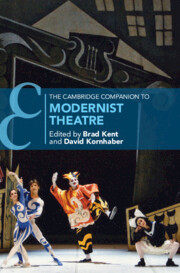
Perhaps the main cause of the relative invisibility of theatre within scholarly accounts of modernism was the sway that New Criticism had on literary studies in the mid to late twentieth century, a period that coincided with the advent of modernist studies. With its close readings of texts, its particular focus on poetic form and narrative technique, and its wilful refusal to consider the broader forces, ideologies, contexts, and material conditions that impinged upon the writing and production of literature, New Criticism tended to be contemptuous of theatre. Likewise, given to a cult of authorial style that lionises the solitary genius, New Criticism could not account for the collaborative nature of stage production, with the playwright forging the script; the director, a position that came to prominence with the advent of modernism, imposing their own vision; scenographers and other designers crafting the visual look of the stage; and actors continuing to experiment during the run of a production.3 In this respect, one might consider the ballet Parade (1917), which was written by Jean Cocteau, was choreographed by Léonide Massine, had music composed by Erik Satie, and featured a set designed by Pablo Picasso.
As it has developed in the United Kingdom and the United States, modernist studies has also long been the focus of narrowly Anglo-American concerns. Much of this might have stemmed from the emphasis on text and language that has dominated the field, with scholars wary of undertaking close readings of works that are translated. In contradistinction, modernist theatre has, since its origins, been a decidedly transnational and multinational affair, with networks of directors, actors, translators, stage designers, and playwrights contributing to productions in different polities. Moreover, theatre companies toured other countries, allowing for greater exposure to currents and advances from elsewhere for both audiences and performers. Following these circuits, modernist theatre studies has more readily incorporated that which occurred on the continent as well as in the British Isles and the United States, seeing theatrical cultures as fluidly integrated. This could, in part, be explained by the fact that while language might form a barrier to undertaking close readings of poetic and prose modernisms in other tongues, because of its visual and performative aspects, theatre has long offered even stringently monolinguistic practitioners windows into other cultures. One need only think of Yeats’s account of attending the premiere of Ubu Roi, with his companion providing commentary on both contemporary tendencies in the French theatre and the action in the play; in the end, Yeats was left bowled over by the audience’s diversely passionate responses and the estranging, outlandish acting.4
Even at times when modernist studies has looked beyond the text to consider context, theatre is rarely taken into account. In studies of modernist institutions, for instance, while periodicals and little magazines have attracted significant attention, there is little regard for the fact that some significant plays were first translated in such publications alongside prose and poetry.5 Moreover, theatres are considerable institutions themselves, yet these, too, are overlooked. Finding it difficult to stage works in the larger commercial venues, modernists created new theatres, including the Théâtre-Libre in Paris, the Freie Bühne in Berlin, the repertory theatres in Birmingham, Manchester, and Glasgow, the Abbey Theatre in Dublin, the Moscow Art Theatre, and the Intimate Theatre in Stockholm. Such companies as the Independent Theatre Society, the Stage Society, the Théâtre Mixte, the Théâtre d’Art, the Pioneer Players, the Theatre Guild, and the Provincetown Players were likewise founded to produce challenging plays; although they often lacked brick-and-mortar homes and relied upon rented or donated spaces, these groups represented major ‘soft’ institutions. Similarly, modernists took to unconventional places, such as the Café Voltaire and the Kaufleuten nightclub in Zurich, where Dadaists plied their trade during and just after the First World War. These were part of a reconceptualisation of the physical relationship between performer and observer, with many modernists seeking to dissolve the boundaries not only through the metatheatrical breaking of the fourth wall but by rejecting the proscenium arch in favour of thrust and arena stages and even performing in the street.6 Over the years, national and local governments came to accept the importance of theatre to the cultural, political, and social life of their people, slowly establishing subsidised theatres that were not dependent upon the whims of commercial forces. Similarly, theatre schools were founded, including the Royal Academy of Dramatic Art in 1904 and the Yale School of Drama in 1924. Without incorporating such institutions, there is a significant lacuna in our understanding of modernism.
By attending to the theatre, modernist studies would also open itself to different geographies and temporalities. Studies of the visual arts, prose, and poetry are comfortable in situating the advent of modernism in France – with the rise of impressionism and cubism in the visual arts, Flaubert and Proust in prose, and Baudelaire and Rimbaud in poetry – before pivoting to the British Isles and the United States. In theatre, many scholars would rather begin with Scandinavia, looking to the Norwegian Ibsen and the Swedish Strindberg. While prose might focus on dates like Virginia Woolf’s notion of a change in human character occurring on or about December 1910, modernist theatre reaches further into the past, with the final decades of the nineteenth century witnessing the advent of the Ibsen revolution that shook much of Europe, the expressionism of Strindberg and Frank Wedekind, the symbolism of Maeterlinck and Wilde, and the dialectical modernism of Shaw. Were we still to insist on the primacy of Woolf’s essay, we would do well to consider that although she separates the more aesthetically conservative Edwardians, including John Galsworthy, Arnold Bennett, and H. G. Wells, from the more aesthetically radical Georgians, including James Joyce, D. H. Lawrence, and T. S. Eliot, it is in the plays of Shaw that she notes the change in human character has been recorded.7 Similarly, if we choose to keep 1922 as an annus mirabilis that saw the publication of Joyce’s Ulysses and Eliot’s The Wasteland, theatre likewise saw several major events that year that should be considered alongside these more usual suspects of modernism, including the Moscow production of Fernand Crommelynck’s The Magnanimous Cuckold (1921) that was directed by Vsevolod Meyerhold and employed constructivist and biomechanical acting styles, the Paris production of Jean Cocteau’s Antigone (1922) that featured sets by Picasso and costumes by Coco Chanel, the West End premiere of Pirandello’s Six Characters in Search of an Author (1921) and his writing of Henry IV, the New York Theatre Guild’s production of Shaw’s Back to Methuselah (1920), and the premiere of O’Neill’s The Hairy Ape (1922).8
Nomenclature
Despite such bona fides, many theatre scholars have contributed to marginalising theatre from larger considerations of modernism by employing the more popular term ‘modern drama’. At times, they seem to be of two minds, not quite able to decide as to whether they are speaking of modernist theatre or modern drama.9 In fact, in theatre, there are three terms that vie for what in prose and poetry are more readily labelled modernist: ‘modern’, ‘avant-garde’, and ‘modernist’, with the latter the least common but, as the title of this volume suggests, in many ways the most apt.
Although it shares a root with ‘modernism’, ‘modern’ has tended to be employed differently. As the Oxford English Dictionary notes, ‘modern’ is derived from the classical Latin modo, meaning ‘just now’, and the post-classical Latin modernus, meaning ‘of the present time’. The problem with ‘modern’ is thus that it englobes not a movement or a series of movements, however loosely affiliated and contradictory they might be, but rather subsumes everything that is produced in an era. In literary terms, the modern tends to be defined as that which comes after or slightly overlaps with the Victorian and extends to the beginning of the contemporary or post-modern period in the latter half of the twentieth century. As a result, not only the New Drama and the experimental spectacles of the Dadaists, futurists, and surrealists could be included by the ‘modern’, but also a popular, run-of-the-mill farce like Brandon Thomas’s Charley’s Aunt (1892) and a patriotic extravaganza like Noël Coward’s Cavalcade (1931). The radical now-ism of the modern is therefore curtailed by certain manifestations of the culture that do nothing to overturn current structures or ideologies or call into being new aesthetics or politics.
In this sense, ‘avant-garde’ would seem to be a more appropriate term to apply to the innovative and experimental elements that existed within modern culture.10 Referring to the foremost part of an army, the militaristic etymology of ‘avant-garde’ signifies confrontational advancement. In many respects, this is a fitting description of modernism’s aesthetics and politics of rupture. Yet ‘avant-garde’ also jars as it implies coherence, discipline, and conformity.11 While the proliferation of manifestoes in modernist movements suggests that adherents had to follow dictates, there was a large degree of heresy and breaks between members of various groups, which was often the result of the revolutionary nature of the artists and their anarchic desire to continue to explore and create new forms.
By the late eighteenth century, ‘avant-garde’ had shifted and become more readily applied to the radical politics of the left. These roots are also considerably problematic as movements that represent the artistic avant-garde have been affiliated with both the left and the right, from the communism of Dadaists and practitioners of epic theatre to the fascism of futurists, imagists, and vorticists. Indeed, artists stood with workers at the barricades of the Paris Commune in 1871, actively contributed to the operations of the Fabian Society from the time of its formation in 1884, participated in the Easter Rising of 1916, agitated in favour of the vote for women, were aggressive misogynists, led the Munich Soviet in 1919, broadcast propaganda for Mussolini and Hitler, downplayed the horrors of the Stalinist purges, joined the French Resistance, insisted on the importance of racial hierarchies and empires to protecting civilisation, supported revolts against colonial regimes, and aligned themselves with various nationalist movements. In many ways, there was a theatricality of politics to which artists were drawn and they in turn responded with a politicisation of theatre. Meanwhile, others remained aloof by holding to the mantra of art for art’s sake. Although modernists might share a loose form of aesthetic progressivism, they thus differ significantly with regards to their implication in and the directionality of their politics.
From shortly after 1870, ‘avant-garde’ began to be applied to the arts. Like the militaristic avant-garde, the aesthetic avant-garde was imagined to be leading the charge, impelling culture into the future without looking back to see what it had left in its wake. Yet this sense of the word also fails to grasp the complexity of modernism. Indeed, while Dadaism, surrealism, and futurism all suggest incessant advancement and the determined rejection, destruction, or ignorance of antecedents, many modernists readily drew upon the past and their precursors as they created a forward-looking art. In the realm of narrative, even the most extreme examples of stream-of-consciousness are undergirded by realism and its conventions, while in poetry imagism borrowed from traditional Japanese haiku and drew upon the best of simplified, non-abstract diction in British literature. Similarly, in theatre, there were modernist experiments with comedy and tragedy, the two oldest of genres, and playwrights, like poets and prose stylists, sometimes adopted primitivist elements (often problematically), engaged with religious subjects, and frequently drew upon history and ancient myths for their material. Traditionalism and the past are therefore considerable aspects of many modernist projects.
The other major drawback to applying the term ‘avant-garde’ to modernism is that while modernism is somewhat temporalised, the avant-garde is a largely ahistorical concept. Indeed, works that are often categorised as post-modern, but not modernist, such as Heiner Müller’s Hamletmachine (1977), could be considered avant-garde. Moreover, while the avant-garde is defined by its forward movement, it eventually becomes fossilised and dépassé as it is overcome and usurped by the next wave, thus making the avant-garde an oxymoron of sorts.
The term ‘modernism’, however, is not without its own problems; it is, as even its most ardent promoters have admitted, ‘far easier to exemplify than to define’.12 Experts in the field who have set out to explain it have concluded that ‘there is no such thing as modernism – no singular definition capable of bringing order to the diverse multitude of creators, manifestos, practices, and politics that have been variously constellated around this enigmatic term’, acknowledging that even for those artists who are most associated with it, ‘modernism was a mobile, expansive, and ultimately unsettled concept’.13 Failing to come to an understanding of what modernism is, some scholars have instead proposed the plural ‘modernisms’, but this simply suggests that there are more than one strain of an undefinable concept that, nevertheless, can somehow be considered a whole.14 For this reason, others have insisted on preserving the singular, despite the fact that it does not produce a satisfactorily coherent notion: ‘Weakly defined, fluid, internally differentiated’, modernism ‘corresponds to a set of historical circumstances that have not happened exactly this way before and that have carried in their wake a variety of social changes (capitalism, secularization, modernity) that, for now, seem to define a period and a state of affairs’.15 In general, modernism is the art of crisis and disruption, signalling that something within the prevailing social order has cracked or been deemed insufficient, and that that which has emerged both responds to the altered and still-changing circumstances and provokes the further fissuring of certainties. Such breaks manifest themselves principally in the advent of new formal modes and often, although not always, a push against the world, whether it be regressive or progressive in nature. This is the sense of movement that modernism encapsulates and that is referred to more directly, if also problematically, in the notion of the avant-garde.
Yet many theatre-making modernists were prevented from constantly moving forward by forces with which they had to compromise: the dominance of the commercial theatre; the economic, time, and personnel constraints of mounting productions; the practicability of performing and staging the new ideas and concepts that they developed; and the threat of censorship. Thus, many influential modernists purposefully infused ‘a Modernist spirit into standard theatrical forms’ by introducing innovative elements.16 The result was that comedy, tragedy, melodrama, farce, and realism were not wholly or uniformly rebelled against. Instead, as a collective, as loose and contradictory as that collective might be, modernists sought to inject into their art that sense of the new that the modern demands.
A Theatre of Antagonism
Perhaps the definitive hallmarks of modernist theatre are antagonism, provocation, opposition, and hostility.17 This is the rupture that it sought to impose on the wider culture. In effect, modernist theatre-makers jostled for supremacy with theatre culture as they found it, rebelling against dominant genres, conventions, institutions, reviewers, and audiences alike. Importantly, they also competed with their fellow modernists, both within and beyond theatre, vying for relevance, attention, and primacy. This inter- and intra-competition is essential to keep in mind with regards to the various splits that occurred in both the wider and the more marginal cultures. But the prevailing antagonism paradoxically holds the various strands of modernist theatre together, attesting to the fact that, despite their differences and rivalries, theatre-makers shared an adversarial spirit and an indomitable drive for change and innovation.18
In many respects, this antagonism is encapsulated in another paradoxical concept: the anti-theatricality of modernist theatre. While Jonas Barish has shown that anti-theatricality was a prejudice that many people, including some playwrights, have long had against theatre as an institution and a practice, Martin Puchner has extended Barish’s thinking to suggest that modernist anti-theatricality was a productive, internal reaction to the day’s foremost theatrical trends and tendencies.19 Indeed, as Puchner has argued,
Even the most adamant forms of modernist anti-theatricalism feed off the theater and keep it close at hand. The resistance registered in the prefix anti thus does not describe a place outside the horizon of the theater, but a variety of attitudes through which the theater is being kept at arm’s length and, in the process of resistance, utterly transformed.20
Tragi-comedy, perhaps the modernist theatre’s most enduring formal innovation, addresses the inadequacies of both comedy and tragedy to speak to the lived experiences of modern life. Naturalism likewise reacted against the inability of melodrama to represent real life and added to realism the scientific regard for economic and social conditions that shape peoples’ lives and tend to curtail the agency of both individuals and groups. Naturalism also competed with symbolism and expressionism, adherents of the former considering the latter two as being too spiritual, romantic, and ignorant of materiality, and practitioners of the latter two claiming that adherents of the former were too engrossed in the material world and thus unable to grasp interiority, subjectivity, and the metaphysical. For its part, futurism rejected all of it, whether traditional or modernist, its theorists condemning ‘the whole of contemporary theater because it is too prolix, analytic, pedantically psychological, explanatory, diluted, finicking, static, as full of prohibitions as a police station, as cut up into cells as a monastery, as moss-grown as an old abandoned house’. They further charged that even the ‘writers who wanted to renew the theater (Ibsen, Maeterlinck, Andreyev, Claudel, Shaw) never thought of arriving at a true synthesis, of freeing themselves from a technique that involves prolixity, meticulous analysis, drawn-out preparation’.21 Meanwhile, advances in metatheatre and epic theatre forced theatregoers to question the very nature of theatre as well as their own place in the spectacle and life in general.22
As it was in many ways a rebellion against established forms, modernist anti-theatricality was also aligned with a rebellion against the techniques that supported those forms. Staging became ever-more suggestive and minimalist, employing visual artists and scenographers to reconceptualise both outer and inner realities as well as the more abstract and spiritual. Acting then had to translate such concerns for the audience, with methods ranging from hyper-realist embodiment to highly expressive anguish, dreamy disengagement, and intentionally wooden delivery. As Olga Taxidou has argued, modernist theatre’s ‘quest for theories of acting, the most systematic and inspired in theatre history, provides the main context for the agon between the word and the flesh. This battle between the word and the body is primarily fought through and on the body of the modernist performer.’23 Not satisfied with the results, some practitioners replaced actors with puppets and marionettes, while, in the spirit of envisioning a stage for the future, others floated the idea of incorporating robots and mechanised humans. Such experiments would further estrange the audience and enhance the theatricality of modernist anti-theatre.
This antagonism and anti-theatricality went beyond formal experiments to include challenging content. Incest, heightened sexuality, sexually transmitted diseases, the New Woman, abortion, birth control, nationalist demands, and class politics became the focus for significant strands of modernist theatre. As a result, many plays were banned or shut down by government censorship or rejected by the commercial theatres who feared both audience backlash and legal intervention. Authorities often labelled such works ‘obscene’, with the Latin prefix ‘ob-’ meaning ‘against’ and the Latin term ‘scene’ meaning the backdrop for a play; thus, the ‘obscene’ could be considered that which is ‘against theatre’ or that which should not be publicly performed. So much of modernist theatre questions moral and ethical orthodoxies, which, traditionally, were upheld by a conservative theatre that granted closure. Indeed, whereas death and destruction lead to the catharsis of tragedy and the reconciliation and marriage of comedy result in social harmony and the reproduction of hierarchies, the obscene confronts and is generally not resolved. Yet even were it to be resolved, a destabilising of norms and mores occurs that likewise unsettles the audience, which further emphasises the antagonism of modernist theatre. This type of antagonism also betrays an activism, a promotion of other forms and values that could supplant current modes and social norms. Many strands of modernist theatre therefore run against the detachment and irony that are often considered to be hallmarks of modernism, instead encapsulating a devoted commitment.
Theatre and the New Modernist Studies
The arrival of the new modernist studies around the turn of the twenty-first century offered the possibility for theatre to finally find its place in the fold. From the outset, the new modernist studies has been dedicated to questioning and expanding the generic, formal, geographical, temporal, gendered, racial, political, and material boundaries that had long defined modernism. This shift was motivated by broader movements within academia. While literary studies in the second half of the twentieth century had been dominated by New Criticism and deconstructionism, both of which gave primacy to the text and formal concerns, overtly historicised and politicised approaches began to hold sway, most notably amongst them postcolonial studies, critical race theory, queer theory, and feminist studies. Additionally, sociological approaches, inspired by Immanuel Wallerstein’s world systems theory that underpins a considerable amount of the work undertaken in the recent boom around the study of world literature, have emboldened critics to consider how conceptions of modernism are undergirded by relationships that have resulted in asymmetric histories of cultural, economic, and political development, and thus how and when regions have experienced modernity differently. The result has been a significant broadening of the concept of modernism and a concomitant broadening of the canon. For some people, this has come at the price of modernism becoming an umbrella term that is too capacious, lacking its former harder definition and coherence.24
One of the results of this openness in the new modernist studies is a greater inclusion of other disciplines, with more recent research focusing on literary modernism’s relationship to sound technology, radio broadcasting, cinema, the visual arts, religion, and science.25 One of the gains of this incorporation of other disciplines is that there is now a greater understanding that modernism in the different arts did not originate at the same time or develop at the same pace. A further element that theatre offers to the new modernist studies is that theatre is by definition interdisciplinary, depending upon the work of playwrights, scenographers and visual artists, sound technicians and lighting experts, carpenters and electricians, choreographers, actors, and directors. Moreover, theatre received significant attention from many of modernism’s leading philosophers, including Friedrich Nietzsche, Walter Benjamin, Jean-Paul Sartre, and Simone de Beauvoir, which suggests that to better understand these thinkers’ contributions to modernism, their writings on theatre must also be considered.26
As already noted, although theatre studies were not as cloistered as modernist studies were throughout the twentieth century, both have tended to work on a Euro-American axis. More recently, the new modernist studies has begun to look at how modernism was transported to, developed within, and emitted from polities in Oceania, Asia, Africa, and Latin America. The result has in part been to break from a Eurocentric model in which modernism began in Europe and was only incorporated by American artists. The Cambridge Companion to Modernist Theatre continues to tease out the geographies of modernism, including artists from Japan, China, India, Latin America and the Caribbean, Africa, and the Middle East. The result is that modernism is understood as not simply a European or a Euro-American affair, but very much a global phenomenon or a series of global phenomena.27
Broader and more rigorous geographical perspectives reveal that modernism is insistently not unidirectional, with its European forms being simply adopted by artists in other polities; it is, rather, multidirectional. While modernist theatre might have begun earlier in Europe and North America because of the earlier advent of modernity in those places, it has strong roots elsewhere. Several modernist theatre practitioners from Africa, the Middle East, Latin America, and Asia travelled to and studied in Europe and North America, where they came under the influence of an emerging or dominant theatrical modernism and then imported their ideas upon their return. Yet they did so productively, at times grafting elements of the discussion play, expressionism, or absurdism onto local stories and myths to overturn tired conventional theatrical forms, creating, for example, huaju, or spoken drama, in China.28 Others, including Efua Sutherland and Ama Ata Aidoo in Ghana, borrowed European forms while integrating indigenous dance, music, and rituals. In some polities, conventional forms were simply updated by infusing them with more contemporary concerns, as was the case of the ‘new kabuki’ in Japan.29 In turn, European modernists drew upon forms from elsewhere, including noh drama, Balinese dance, Chinese acting, and African music, to create theatrical hybrids that challenged long-established concepts of theatre; they also took classical genres like Greek tragedy and invigorated them with innovative acting and scenography to fashion new modernist art forms. As Jahan Ramazani argues, ‘Although postcolonial “hybridity” is often criticized, it and related ideas of creolization, vernacularization, indigenization, and interculturation are more capable of registering the intricate meldings of transnational forms than is the foreign form-local content model of diffusion.’30 At times, the modernisms in these other places were, like their Euro-American brethren, strikingly antagonistic to their local forms, cultures, and societies, but they could also be oppositional in their relationship to Euro-American modernism through their experiments. In this sense, such art, defined by its multidirectional antagonism, could be considered a more evolved or sophisticated modernism.
Such a repositioning of the where of modernism entails a similar rethinking of the when of modernism. Traditionally, modernism has been stringently dated. While Woolf’s aforementioned invocation of 1910 offers one possibility, Wyndham Lewis proposed the ‘men of 1914’, arguing that Pound, Eliot, Joyce, and of course himself were those who instigated and nurtured modernism.31 Studies followed that largely echoed such claims, with scholars periodising modernism as occurring, variously, between 1908 and 1922, 1890 and 1930, 1899 and 1939, and 1880 and 1922.32 All of these ranges are similarly limiting of the when of modernism, their narrow chronologies eliminating certain writers, movements, art forms, and works. More recently, scholars have adopted the term ‘late modernism’ to expand the timeline past the onset of the Second World War and to include people like Samuel Beckett, Elizabeth Bowen, and Doris Lessing as well as works by Woolf, Eliot, Joyce, and Lewis that were written well into their older age.33 As Morag Shiach notes, ‘To say that modernism is a cultural moment or period, as well as an artistic movement, is thus a retrospective judgement that also embodies a set of assumptions about the nature of modernism. Deciding when modernism began or ended is connected to a view of what modernism was, or could have been.’34
Increasingly, scholars suggest that these past periodisations are insufficient. Susan Stanford Friedman, for example, refuses to consider modernism as representing the culture of a fixed, brief period, preferring to see it as part of a longue durée that stretches centuries into the past to account for different forms of modernity across time.35 Moreover, once polities beyond Europe and North America are considered, traditional periodisations fail to reflect their reality. In much of the formerly colonial world, while the first contact with modernity might very well have coincided with the appearance of Europeans, their exploitation and plundering of natural resources, and their imposition of the slave trade, anti-colonial movements both coincided with and occurred after most of the classic timelines presented in modernist studies. So, too, did national liberation and the establishment of post-independence institutions and economies, which allowed for the fruition of new literatures that experienced, engaged with, and fashioned modernism in their own discrete manners.
The catalogue of major modernist theatre-makers in the opening paragraph of this introduction is therefore provocative in multiple ways. It includes the names of many recognisable modernists who are rarely mentioned in studies of modernism, although that has started to change.36 It also includes women and those from beyond the typical Euro-American contexts. Having been influenced by feminist theory and practice, the new modernist studies has opened the canon to previously neglected figures. In many respects, this was one of the first areas in which the modernist canon was redressed, with Woolf and H. D., for example, receiving considerably more attention as modernists in the waning years of the twentieth century. More recently, the canon has been further expanded with the inclusion of women of colour, such as Zora Neale Hurston, and women playwrights, like Sophie Treadwell.37 Intersectionality should lead to a further reconsideration of the how and where of modernism; indeed, just as including the Harlem Renaissance has slightly decentred modernist studies, recognition of the role of female playwrights of colour would relocate Black modernism from Harlem to Washington, DC, where many women studied at Howard University and taught in local schools before going on to write several plays of import.38
As this volume embraces the ethos of the new modernist studies, it includes women theatre-makers throughout its chapters. Rather than separating them in an individual essay or including a chapter on feminism, it incorporates these writers and feminist issues in the discussions of the various movements with which they were aligned and to which they made significant contributions. The same can be said for diverse polities: rather than treat nations or regions individually, the volume adopts a transnational approach that focuses on how and when different forms emerged in certain polities and moved across the globe, and how and when certain issues gained traction and were variously engaged with by theatre-makers around the world.
The Cambridge Companion to Modernist Theatre does not seek or pretend to be exhaustive. Instead, it points to the diversity and paradoxicality of modernist theatre as a rich and illuminating global phenomenon that has genuinely and deeply impacted playwriting, modes of production, and audiences well into the present day. It is hoped that students, researchers, and theatre-makers will use it as a resource to better understand the what, who, where, when, why, and how of modernist theatre, but also as an invitation to continue the investigation of the variety, aggravation, and excitement that this genre has to offer.
