


1. Introduction
Gender is a socially constructed concept shaped by biological traits and societal beliefs, which influence perceptions of gender behavior. These beliefs often associate assertiveness with men and warmth with women, reinforcing established gender roles (Reference Priyashantha, De Alwis and WelmillaPriyashantha et al., 2023). As societal norms evolve, some gender stereotypes fade while new ones emerge (Reference Martínez-Palma, Rabanal-Gatica, Valenzuela-Rettig and Fernández-DarrazMartínez-Palma et al., 2023). Advertising plays a significant role in reinforcing these norms, shaping perceptions of gender identity through both verbal and non-verbal symbols. Advertisements guide consumer behavior, influence decision-making, and serve as powerful tools for social messaging, making it difficult for individuals to question established norms (Reference Chu, Lee and KimChu et al., 2016; Reference Setyaningsih and PalupiSetyaningsih & Palupi, 2022; Reference Zayer, McGrath and Castro-GonzálezZayer et al., 2019; Reference Nandi, Bhat and WolfsNandi et al., 2019; Reference SitanggangSitanggang, 2020). As advertising has transitioned from traditional media like television to digital platforms like YouTube, it has continued to shape societal narratives (Reference Setyaningsih and PalupiSetyaningsih & Palupi, 2022; Reference SitanggangSitanggang, 2020).
India, with a population exceeding 1.4 billion, is experiencing rapid growth and is projected to have one-fifth of the world’s working-age population by 2025 (UN DESA Policy Brief, n.d.; Reference VargheseVarghese, 2018). Despite this, India grapples with a patriarchal society that shapes gender expectations, often portraying women in passive roles and men as the primary breadwinners in media, limiting societal potential and perpetuating inequality (Reference Adalı, Yardibi, Aydın, Güdekli, Aksoy and HoştutAdalı et al., 2024; Reference Das and SharmaDas & Sharma, 2021). Cultural practices, like arranged marriages, have historically defined gender roles, but the younger generation, especially in urban areas, is increasingly challenging these norms. Many young people now turn to online dating apps like Tinder and Bumble to initiate relationships independently, signaling a shift towards greater acceptance of love marriages as India becomes more globally connected (Reference Chandrasekaran, Wilson and RoyChandrasekaran et al., 2022; Reference Chakravarty, Jagota and SahooChakravarty et al., 2023).
Online dating platforms have seen significant growth, with 83% of users expressing interest and 82.4 million users in India, indicating a growing acceptance (Reference Chakravarty, Jagota and SahooChakravarty et al., 2023; Reference GuptaGupta, 2023). Apps like Bumble and Tinder facilitate real-time connections, enabling faster transitions from online to offline interactions (Reference Wu and TrottierWu & Trottier, 2022; Reference Abramova, Baumann, Krasnova and BuxmannAbramova et al., 2016). Research indicates these platforms shape gender identity through design, influencing users’ interactions with gender norms while challenging cultural norms surrounding masculinity and femininity (Reference Bivens and HoqueBivens & Hoque, 2018; Reference PruchniewskaPruchniewska, 2020). Bumble, marketed as “100% feminist,” challenges conventional dating roles by allowing women to initiate conversations, promoting gender equality, and addressing harassment concerns, earning it the nickname “anti-Tinder” (Reference Bivens and HoqueBivens & Hoque, 2018).
Previous research has examined the portrayal of women in Indian advertisements, focusing on the shift from traditional to non-traditional roles through thematic, content, and semiotic analysis (Reference Das and SharmaDas & Sharma, 2021; Reference Kumari and ShivaniKumari & Shivani, 2015). Other studies have explored the role of signs and symbols in shaping consumer behavior, particularly in reinforcing brand messaging and influencing purchasing decisions within sociocultural contexts (Reference ShyamShyam, 2024; Reference Sharma and GuptaSharma & Gupta, 2015). Additionally, research has investigated the evolution of gender roles across various product categories, such as cosmetics and household goods (Reference Agrawal and DeyAgrawal & Dey, 2023; Reference SahuSahu, 2022; Reference Jha, Raj and GangwarJha et al., 2017). However, limited attention has been given to other categories, particularly online dating platforms. Moreover, most studies have concentrated on traditional media formats, such as print and television advertisements, leaving a gap in understanding how gender roles are constructed in digital advertising.
While much of the research on dating apps such as Tinder and Bumble has focused on design features and biases (Reference MacLeod and McArthurMacLeod & McArthur, 2018; Reference Chen and LiuChen & Liu, 2019), limited studies (Reference Chakravarty, Jagota and SahooChakravarty et al., 2023) have specifically explored the Indian context, particularly the impact of easy access to dating platforms on adolescent romantic relationships in India. This gap highlights the need to understand how these platforms address cultural and societal challenges and shape perceptions of gender dynamics in contemporary India. This leads to our research question: How do Indian social media campaigns address gender dynamics and cultural narratives, and what common themes emerge in their portrayal?
This study aims to examine how dating app advertisements, like Bumble’s, address cultural and societal challenges and shape perceptions of gender dynamics in contemporary India. Using Barthes’ Semiotic theory, we analyzed a popular Bumble ad on YouTube to explore how its visual elements communicate gender roles and challenge societal norms within the Indian context. The analysis decodes the denotative, connotative, and underlying myths in the advertisement, focusing on how Bumble’s feminist branding and design are conveyed through its marketing strategy.
The study enhances our understanding of how advertisements address cultural and societal challenges by shaping perceptions of gender dynamics in contemporary India. It highlights how digital advertising, like Bumble’s, challenges traditional gender roles and contributes to evolving social norms. By demonstrating how advertising reshapes cultural narratives around gender equality, this research provides valuable insights for researchers and a framework for examining the intersection of design, culture, and social impact. For advertising designers, this study serves as a reference for creating campaigns that are both commercially effective and socially responsible, encouraging them to consider the cultural and societal implications of their work.
The subsequent sections of the study are as follows: Section 2 introduces the Bumble brand. Section 3 outlines the research methodology used to select and analyze the advertisement. Section 4 presents the results and discussion, providing a detailed analysis of each scene in the advertisement. Section 5 addresses the limitations of the study, while Section 6 offers the concluding remarks.
2. About Bumble
Launched in 2014, Bumble entered the male-dominated dating app market with a “female-focused” approach to counter sexism and offer an alternative to “shallow” environments (Bumble, n.d.). Its key feature, “ladies ask first,” allows women to initiate conversations within 24 hours of matching, promoting a more respectful and balanced dating experience. This feature directly addresses gender inequality and challenges the aggression often seen on apps like Tinder. Positioned as a feminist platform, Bumble opposes gendered harassment in both the dating and the tech industries (Reference Bivens and HoqueBivens & Hoque, 2018). By emphasizing individual choice, Bumble aligns with neoliberal feminism, empowering women with greater control over their dating lives (Reference PruchniewskaPruchniewska, 2020).
3. Research methodology
To achieve the objective of the study, we applied Barthes’s Semiotic theory (Reference BarthesBarthes, 1972), focusing on denotation, connotation, and myth, to analyze the Bumble India advertisement. Barthes’ multi-layered approach helps understand how images and signs convey meaning within society by connecting them to cultural myths, revealing deeper layers of meaning. He refers to “signifiers” as denotation, which is the literal meaning of an image, and “signified” as the connotation, which encompasses the implied meanings shaped by emotional and social contexts. Connotation, arising from emotional responses, creates myths that reflect societal beliefs and values (Reference SitanggangSitanggang, 2020; Reference Nurnisya and FitriNurnisya & Fitri, 2023). Barthes’ theory was selected for its ability to analyze how advertisements use signs, symbols, and myths to shape societal ideologies (Reference SitanggangSitanggang, 2020). It uncovers both denotative and connotative meanings, revealing deeper cultural and ideological messages. Barthes’ focus on connotation explains how visual elements in advertising evoke cultural meanings that influence consumer behavior (Reference BouzidaBouzida, 2014). His dual-layered analysis is ideal for examining modern ads, especially on platforms like YouTube. Overall, Barthes’ framework provides a comprehensive understanding of how advertisements shape cultural narratives, consumer perceptions, and societal norms, making it the ideal approach for this study.
We identified nine online dating platforms currently operating in India—Aisle, Bharat Matrimony, Bumble, Community Matrimony, Happn, Jeevansaathi.com, OkCupid India, Shaadi.com, and Tinder—using the GenderNext report (Advertising Standards Council of India, 2021). We then focused on identifying the most viewed advertisements from these platforms on YouTube, selecting Bumble’s ad for analysis due to its high view count. Released on May 19, 2023, the ad has since garnered 19 million views. The 30-second advertisement was divided into six scenes based on changes in characters and actions. Each scene was analyzed through a structured approach, starting with visual depiction, followed by denotative and connotative analysis, and concluding with an exploration of the underlying myths. This methodology provided insights into how the advertisement reflects and shapes cultural narratives and gender roles in contemporary society while conveying Bumble’s feminist branding and design.
4. Results and discussion
For this analysis, we focused on the Bumble India advertisement titled “India, find them on Bumble!” (Bumble, 2023). The advertisement is divided into six distinct scenes, each playing a crucial role in conveying the ad’s overall narrative and themes.
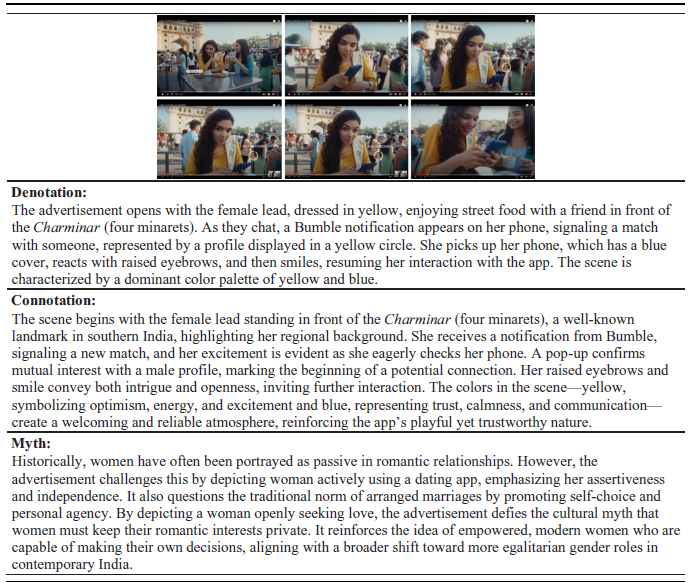
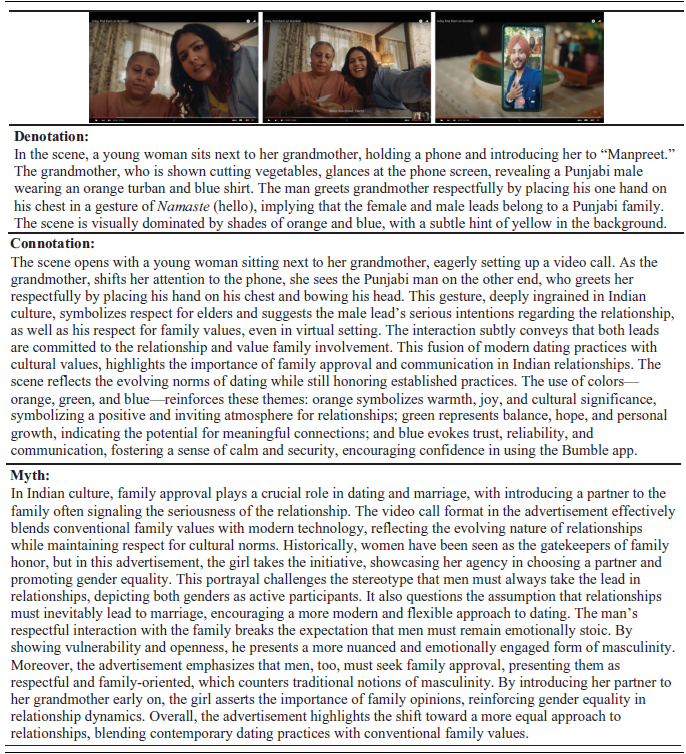
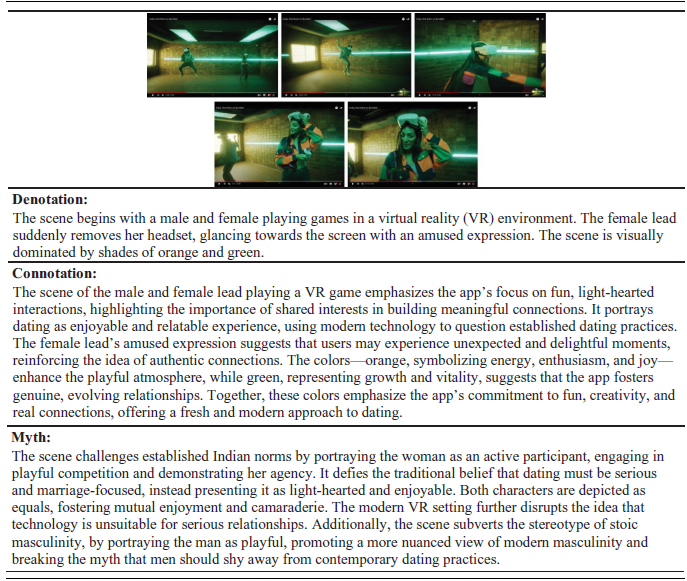
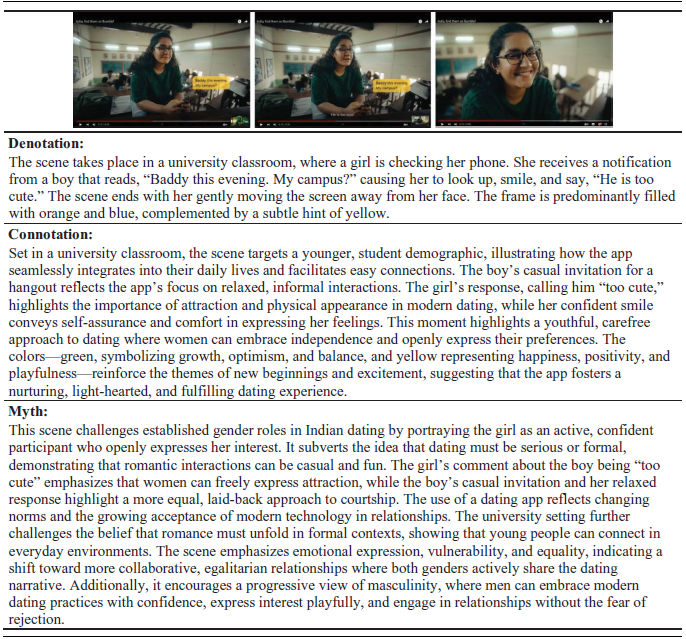
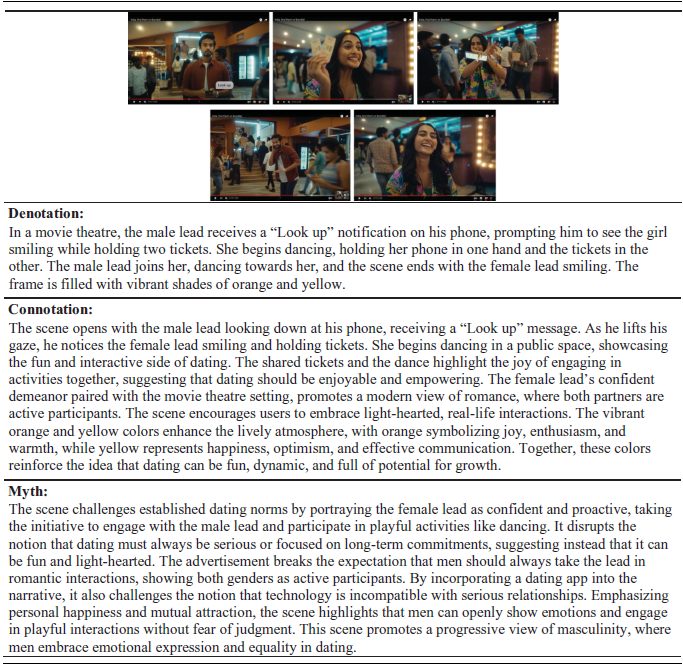
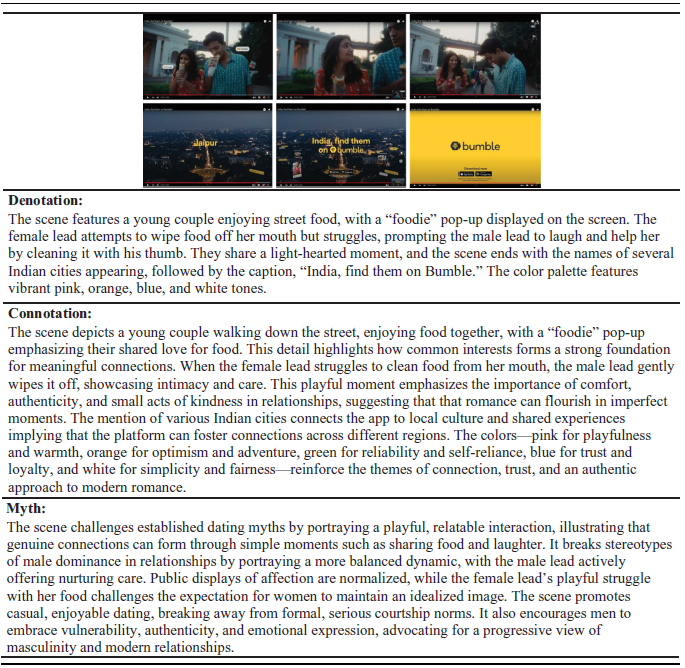
The advertisement highlights how Bumble empowers women to take control of dating through relatable and real-life scenarios. It opens with a female lead receiving a match notification in front of the Charminar (four minarets), emphasizing the app’s role in initiating connections. The next scene shows the woman confidently introducing a potential match to her grandmother, reflecting women’s growing agency in partner selection. Subsequent scenes showcase playful interactions and casual moments in settings such as college campuses, movie theatres, and food dates, reinforcing the idea that dating can be fun and approachable. These moments emphasize authentic connections and mutual respect, aligning with Bumble’s message of fostering meaningful relationships. The advertisement concludes with the tagline “India, find them on Bumble,” positioning the app as an inclusive platform for empowered dating in a modern, multicultural society.
A detailed breakdown of each scene and its analysis based on Barthes’s Semiotic theory can be found in Tables 1, 2, 3, 4, 5, and 6.
Table 1. India, find them on Bumble! Scene 1: 0:00 - 0:03

Table 2. India, find them on Bumble! Scene 2: 0:04 - 0:07

Table 3. India, find them on Bumble! Scene 3: 0:08 - 0:11

Table 4. India, find them on Bumble! Scene 4: 0:12 - 0:14

Table 5. India, find them on Bumble! Scene 5: 0:15 - 0:19

Table 6. India, find them on Bumble! Scene 6: 0:20 - 0:30

The semiotic analysis of the Bumble India advertisement effectively challenges established gender roles, societal myths, and dating practices. The ad portrays women as active, self-reliant participants in romantic pursuits, breaking the stereotype of passively waiting for men to lead. By promoting self-choice in relationships, the ad shifts away from the conventional notion of arranged marriages in India, reflecting the growing influence of feminist movements on societal narratives. As noted by Reference Das and SharmaDas & Sharma (2021), this shift toward depicting women as “freewheelers” emphasizes independence and challenges societal expectations regarding physical appearance. This change reflects the advertisers’ intention to push women beyond traditional boundaries, fostering a more progressive narrative.
The Bumble ad also redefines masculinity by depicting men as emotionally expressive and vulnerable, which contrasts with the traditional portrayal of men as stoic and dominant. This shift aligns with the growing trend identified by Reference Walker and GangadharbatlaWalker & Gangadharbatla (2019), which highlights the increasing portrayal of men as more emotionally open. Similarly, Reference Setyaningsih and PalupiSetyaningsih & Palupi (2022) observe this shift in men’s grooming product ads, where previously taboo notions of masculinity are now linked to the concept of soft masculinity. The portrayal of emotionally open, caring men in the Bumble ad reflects broader societal changes toward masculinity, emphasizing qualities like empathy and sensitivity, challenging rigid stereotypes. This shift, as noted by Reference Bui, Gottfried, Katz, Serazio, Smulyan, Thomas, Weston, O’Barr and TimkeBui et al. (2019), indicates that older forms of masculinity based on aggression coexist with newer models that value emotional intelligence and vulnerability.
Additionally, the advertisement effectively integrates Bumble’s modern dating features, such as video calls with family values, suggesting that dating can take place within the comfort of one’s home and alongside family members. This approach emphasizes the coexistence of technology and family in contemporary dating. It aligns with the research (Reference Tsai, Shata and TianTsai et al., 2019) on the evolving portrayal of both men and women in advertising, where they are increasingly depicted in nurturing, family-oriented roles. The Bumble ad’s use of vibrant colors—yellow, blue, orange, green, and pink—reinforces themes of optimism, trust, and warmth, creating a welcoming atmosphere for genuine connections. By emphasizing casual, fun interactions over rigid, marriage-focused relationships, the advertisement portrays modern romance as dynamic, playful, and rooted in mutual respect. This shift towards inclusivity and egalitarianism aligns with Bumble’s feminist branding, reflecting the evolving dating dynamics in India.
5. Limitations
The study has several limitations. It focuses solely on Bumble India’s advertisement, potentially overlooking broader trends across different platforms in India. Additionally, the study does not consider regional, linguistic, or cultural variations within India that may influence gender role portrayal in advertising. By focusing solely only on YouTube, the study excludes other major digital platforms such as Instagram and Facebook. While providing a semiotic analysis of the advertisement, it does not assess advertisements’ direct impact on consumer attitudes or behaviors regarding gender roles. Furthermore, while Bumble’s feminist branding is explored, the study does not evaluate whether this branding aims to promote social change or serves merely as a marketing tactic. These limitations highlight the need for future research that includes multiple platforms, regions, and advertisements and examines the real-world impact of such campaigns on societal perceptions and behaviors.
6. Conclusion
The study examines the role of advertisements, especially dating apps like Bumble, in reshaping societal perceptions of gender dynamics. By applying Barthes’ Semiotic theory to the Bumble India ad, our analysis reveals how the advertisement challenges established gender roles and promotes progressive views on gender equality in contemporary India. Through strategic use of visual and textual elements, the advertisement empowers women by positioning them as active participants in dating, breaking away from the passive roles historically assigned to them. Additionally, it redefines masculinity by portraying men as emotionally expressive, promoting a more inclusive and fluid understanding of gender.
The advertisement also bridges modern dating practices, facilitated by Bumble’s app and video calls, with established family values. This creates a harmonious blend of technology and culture, emphasizing casual, enjoyable interactions over rigid, marriage-focused norms. The portrayal of modern romance as dynamic, respectful, and based on mutual consent reinforces Bumble’s feminist branding and highlights its commitment to empowering individuals, particularly women, in their romantic pursuits.
The study contributes to a deeper understanding of how digital advertising can drive social change by challenging established gender norms and promoting inclusivity. For researchers, it provides an approach to examine the intersection of design, culture, and social impact. For advertising designers, the study offers valuable insights into creating commercially successful and socially responsible campaigns. It encourages designers to consider the broader cultural and societal implications of their work and to design with awareness and sensitivity to issues like gender equality.
While the study provides valuable insights into how advertising reshapes gender roles, further research could explore the long-term impact of such campaigns on consumer behavior and societal attitudes. Examining regional variations in India’s response to similar feminist branding could offer deeper insights into the diverse effects of digital campaigns. Additionally, future studies could investigate the role of emerging digital platforms in shaping gender dynamics and explore how other industries and media address gender representation in advertising. This will further expand the scope of this research and strengthen the connection between design, culture, and social impact.

 Open access

