


Introduction
The latter years of the 2010s witnessed an increased prominence of environmental concern among European publics (Kenny, Reference Kenny, Franzen and Mader2021a). Eurobarometer data record an increase in those considering the environment to be one of the two most important issues facing their country from just 4 per cent in May 2013, to 10 per cent by the end of 2017 and to 20 per cent by June 2019 (European Commission, 2019). In electoral contests, Green Parties also performed very competitively. A record 55 Green Party representatives were elected in 2019 to the European Parliament, up from the previous high of 47 in 2009 (Pearson & Rüdig, Reference Pearson and Rüdig2020, p. 336). At the national level, cases of particular note are Austria where the country elected Western Europe's first Green Party President in 2016 (Gavenda & Umit, Reference Gavenda and Umit2016) followed by the Greens going from 0 to 26 parliamentary seats in 2019 and entering government for the first time (Eberl et al., Reference Eberl, Huber and Plescia2020); Switzerland where at the 2019 federal election the two Green Parties polled over 20 per cent in a result that has ‘fundamentally shaken the Swiss Party System’ (Ladner, Reference Ladner2020, p. 557); and Ireland where the Green Party capitalized on their over fourfold increase at the 2019 local elections (Quinlivan, Reference Quinlivan2020) by increasing their parliamentary representation from 2 to 12 seats in 2020 (Field, Reference Field2020).
These trends have substantial policy implications given the evidence that both higher environmental concern among the publics and the presence of Green parties in government are associated with the increased implementation of environmental legislation (Anderson et al., Reference Anderson, Böhmelt and Ward2017; Jensen & Spoon, Reference Jensen and Spoon2011). And yet, there is disagreement within political science as to how environmentalism should be conceived which hinders furthering our understanding of the role it may play. Is it merely a component of broader liberal values or separable and deserving of attention in its own right? Part of this problem arises from the way in which the study of environmental politics has not traditionally been integrated into the discipline. As recently as 2014, Keohane (Reference Keohane2015, p. 19) remarked that ‘in view of the magnitude of climate change, it is distressing to observe the slow response from political science as a discipline’. While this is changing in recent years, there exists a legacy whereby intersections between environmental research and other research agendas within the discipline may be overlooked (Iskander & Lowe, Reference Iskander and Lowe2020).
Our paper focuses on one of these: the intersection between environmental attitudes and dimensions of electoral competition. The latter literature predominantly subsumes it into a broad second ‘cultural’ dimension whose associated issues are argued to relate to the dual concepts of tolerance and hierarchy. While it may be the case that a two-dimensional solution is satisfactory at the party level, we focus on the citizen level. That the attitudinal and belief systems of political elites are structured by far fewer underlying factors than those of the mass public is long-established. The rather narrow belief systems among political representatives that coherently organize large amounts of specific information tend not to be mirrored among mass publics whose attitudes are rarely so neatly structured into so few dimensions (Converse, Reference Converse2006; Layman & Carsey, Reference Layman and Carsey2002). Thus, it is important to empirically test whether environmentalism – which we theoretically argue does not derive from concepts of tolerance and hierarchy but is commonly bundled with such issues in the literature – should be considered a separate dimension among individuals. Furthermore, citizen-level divisions may exist without being expressed in the party system if the parties choose not to compete on them, but become politically relevant if activated as shown for instance in the literature on class voting (Evans & Tilley, Reference Evans and Tilley2017; McKenzie, Reference McKenzie2017). Our research question, therefore, has substantial implications for the functioning of the political system and the potential structure of party competition. If environmental attitudes were to constitute a separate dimension among citizens but not in party policy offerings, this could imply the presence of representation gaps not hitherto considered.
We begin by providing an overview of the literature on dimensionality, how the environment has (or has not) featured in this and why there are reasons to consider the environment as separable. Having set out the data we use, we then provide empirical evidence for environmentalism forming a separate dimension of its own across Western Europe. It loads onto a separate factor in factor analysis and has somewhat different social predictors from the other second dimension issues. Furthermore, environmentalism has important and distinctive electoral consequences given its differing associations with support for the various party families. Our findings imply that not including environmentalism in studies of party politics and electoral behaviour comes with a risk of missing an important piece of the puzzle. Equally as important, subsuming environmentalism into the cultural dimension may distort conclusions about the social predictors of key political attitudes as well as their electoral consequences. Finally, our results have important implications for the study of political representation and the social antecedents of political preferences which are discussed in the conclusion.
The dimensionality of the political space
The question of the dimensionality of political space has been at the core of political behaviour and political party research for decades (Downs, Reference Downs1957; Kitschelt, Reference Kitschelt1994; Kriesi et al., Reference Kriesi, Grande, Lachat, Dolezal, Bornschier and Frey2008). Following Wheatley and Mendez (Reference Wheatley and Mendez2021, p. 56), we consider a political dimension to consist of a ‘bundle of issues that are deemed to be associated with one another in such a way that to know the position of a party or voter on one issue allows a reasonable degree of confidence in predicting her/his/its position on another issue from the same bundle’.
The most parsimonious idea of political dimensionality is that all issues can be sorted into a single left-right bundle (Downs, Reference Downs1957). In the decades after the Second World War, politics was largely dominated by issues related to redistribution and the role of the state in the economy. Such attitudes were naturally associated with a single left-right dimension.
However, new issues arrived on the political agenda from the late 1960s onwards such as gender equality, homosexual rights, immigration, EU attitudes, and the environment, often collectively referred to as ‘New Politics’ issues (Flanagan & Lee, Reference Flanagan and Lee2003). These have mostly been considered to constitute a second, ‘cultural’ or non-economic dimension of Western political space, under various labels such as libertarian versus authoritarian (Flanagan, Reference Flanagan1987; Kitschelt, Reference Kitschelt1994; Stubager, Reference Stubager2008), GAL-TAN (Green-Alternative-Liberal Traditional-Authoritarian-Nationalist) (Hooghe et al., Reference Hooghe, Marks and Wilson2002); integration versus demarcation (Kriesi et al., Reference Kriesi, Grande, Lachat, Dolezal, Bornschier and Frey2008), materialist versus postmaterialist (Inglehart, Reference Inglehart1977) or libertarian-universalistic versus traditionalist-communitarian values (Bornschier, Reference Bornschier2010). A review of political cleavages in Western Europe notes that the materialist versus postmaterialist and the GAL-TAN accounts have been particularly influential (Ford & Jennings, Reference Ford and Jennings2020).
The idea of such a two-dimensional political space is very common in contemporary political science, both for parties and citizens (see, for instance, Krause, Reference Krause2020; Norris & Inglehart, Reference Norris and Inglehart2019). There is much variety in the choice of measures, and many studies do not explicitly discuss why the measures they use are chosen. Most studies tend to include some variety of issues related to immigration, authoritarianism, law-and-order and moral traditionalism, for example abortion or homosexuality (Flanagan & Lee, Reference Flanagan and Lee2003; Heath et al., Reference Heath, Evans and Martin1994; Oskarson & Demker, Reference Oskarson and Demker2015; Stubager, Reference Stubager2008, Reference Stubager2010; Tilley, Reference Tilley2005).Footnote 1 Some also include European integration (Hillen & Steiner, Reference Hillen and Steiner2020; Kriesi et al., Reference Kriesi, Grande, Lachat, Dolezal, Bornschier and Frey2008; Oesch & Rennwald, Reference Oesch and Rennwald2018), while others argue that this is a separate dimension (Bakker et al., Reference Bakker, Jolly and Polk2012; Rohrschneider & Whitefield, Reference Rohrschneider and Whitefield2012, p. 69). Importantly for our purposes, many of the referenced studies leave out environmentalism, while others include it in the second dimension (Flanagan & Lee, Reference Flanagan and Lee2003; Hooghe et al., Reference Hooghe, Marks and Wilson2002; Stubager, Reference Stubager2010).
Despite the somewhat omnipresent tendency to consider a single libertarian-authoritarian dimension, even at the citizen level (Knutsen, Reference Knutsen2018, p. 83), there are grounds for questioning its theoretical basis. For one, as Green-Pedersen (Reference Green-Pedersen2019, p. 171) remarks, ‘in terms of issue content, the notion of the new, second dimension or ‘new politics’ is typically rather vaguely described’. The primary commonality amongst its issues is that they are supposedly not about economic redistribution and the role of the state in the economy. While this may be true of moral liberalism issues, environmental policies – and issues such as EU integration and immigration – certainly can have differential economic effects both on individuals and labour markets. Moreover, party competition on the environment, European integration and immigration have developed differently (Green-Pedersen, Reference Green-Pedersen2019, p. 23), pointing to potential internal divergence in the coherence of its components. The GAL/TAN index for instance – combining issues on ‘personal lifestyle (such as gay marriage, abortion, euthanasia), law and order, the role of religion, immigration, multiculturalism and environmentalism’ (Wheatley & Mendez, Reference Wheatley and Mendez2021, p. 41) – may be orientated more towards different components in different countries (Marks et al., Reference Marks, Hooghe, Nelson and Edwards2006).
One theoretical justification for bringing these together has been the claim that they are all related to the two dual concepts of hierarchy and tolerance. In this view, authoritarians favour social hierarchy and dislike deviant behaviour leading them to favour compliance with social norms, while libertarians oppose hierarchies, are highly tolerant of non-conformity and value tolerance of deviance (Bengtsson et al., Reference Bengtsson, Berglund and Oskarson2013; Flanagan & Lee, Reference Flanagan and Lee2003; Kitschelt, Reference Kitschelt1994; Stubager, Reference Stubager2008). This can then take on different forms across countries, reflected for instance in the culture wars on moral issues in the United States and immigration in Northern Europe (Stubager, Reference Stubager2008). This is theoretically meaningful for issues related to moral traditionalism, immigration and law and order.
It is less clear how the other issues fit into this theoretical framework. As Dalton (Reference Dalton2019, p. 153) remarks, many of these are potentially contradictory which generates considerable complexity for contemporary electoral politics. A few scholars have already argued that we need to distinguish between three dimensions of political space, whether they separate out EU integration (Bakker et al., Reference Bakker, Jolly and Polk2012; Rohrschneider & Whitefield, Reference Rohrschneider and Whitefield2012, p. 69) or issues of group identity or immigration (Caughey et al., Reference Caughey, O'Grady and Warshaw2019; Kitschelt, Reference Kitschelt and Rydgren2013). However, both the one-, two- and three-dimensional solutions proposed so far suffer from the same potential problem: They do not allow for a separate environmental dimension despite the possibility that ‘it might be considered questionable whether environmental issues belong in the social/postmaterial category’ (O'Grady & Abou-Chadi, Reference O'Grady and Abou-Chadi2019, p. 5). For though environmental concern may be positively correlated with these other components – and indeed Green parties and their supporters tend to be more ‘progressive’ across the range of values (Dalton, Reference Dalton2009) – that is not to say that such values are indistinct from each other.
Indeed, research investigating the role of environmental values specifically is not well-developed in the comparative party literature. Green-Pedersen (Reference Green-Pedersen2019, p. 118) comments that ‘party competition for the environment has … never been a central theme in the literature on the politics of the environment’ and Farstad (Reference Farstad2018, p. 698/699) that, ‘Analysis of how the environment impacts on mainstream … parties and party competition is surprisingly scarce, particularly in countries without an electorally successful green party’. This extends to the extent of the match between voters’ environmental preferences and those of the parties they vote for, and how this relates to party competition. Thus, in this paper, we investigate whether the environment is separable from other ‘new politics’ issues and the implications for electoral research.
At this point, it is worth elaborating on what we mean by an environmental dimension. While environmentalism has been traditionally seen as a unidimensional construct ranging from being unconcerned to concerned about the environment – with environmental concern ‘often defined as the insight or awareness that humans endanger the natural state of the environment combined with the willingness to contribute to solving environmental problems’ (Franzen & Mader, Reference Franzen, Mader, Franzen and Mader2021, p. 64) – there is growing evidence demonstrating that it is multifaceted (Milfont, Reference Milfont2012, p. 270). The effects of these individual facets may differ empirically (Daniels et al., Reference Daniels, Krosnick, Tichy, Tompson, Kraft and Kamieniecki2012; Klineberg et al., Reference Klineberg, McKeever and Rothenbach1998). Furthermore, response patterns can differ with alternative environmental topics (Dunlap & Jones Reference Dunlap, Jones, Dunlap and Michelson2002), such as whether one is being asked about air pollution or climate change.
Thus, we recognize that environmentalism is too complex to be fully captured in any single summative scale, which is of course also true for moral liberalism or immigration attitudes. However, that is not our aim. Even with the differences among different environmental measures, there is theoretically more that binds them together than that which connects them with economic, libertarian or ‘cultural’ values and this is what we examine empirically. And, following a review of the environmental attitudes and behaviour literature, Gifford and Nilsson (Reference Gifford and Nilsson2014, p. 151) remark that ‘in broad strokes a person with a particular personal and social profile will be more likely to be concerned about the environment and to act on its behalf’, which gives credence to our plight.
There is already scattered evidence that environmentalism is separable from other dimensions among individuals. In Britain, it has been shown that environmental trade-off questions load onto a separate factor to both redistribution and libertarian/immigration values (Kenny, Reference Kenny2021b). Factor analyses of a large number of political attitude items in the Norwegian Election Study have consistently found a separate dimension for environmentalism versus economic growth (Bergh & Aardal, Reference Bergh and Aardal2019). While in a 12-country study Flanagan and Lee (Reference Flanagan and Lee2003) find the correlations between their environmental and libertarian value indices to be consistently positive, the magnitudes – with Pearson's r of as low as 0.14 in Belgium and 0.15 in France – are too low to regard them as tapping into the same construct. In even earlier analyses, Kitschelt (Reference Kitschelt1995, p. 178) finds the ecology preferences of voters in both Austria and Germany to be distinct from their authoritarian-libertarian ones. On the GAL-TAN index, while originally designed to measure the supply-side of parties’ positions, a comparative study using Voter Advice Application data finds that their environmental item does not load onto the same dimension as the other GAL-TAN items for voters in any of the countries they included it in (Wheatley & Mendez, Reference Wheatley and Mendez2021). And recent analysis using 2016/2017 European Social Survey data finds that neither first- nor second-dimension values can fully account for the differences in climate change attitudes recorded among voters of different party families in Western Europe (Fisher et al., Reference Fisher, Kenny, Poortinga, Böhm and Steg2022).
There are thus both theoretical and empirical reasons to expect environmentalism to be an independent dimension. And yet, these findings have not had a widespread impact on the literature on political dimensionality. In this study, we provide an up-to-date assessment using high-quality representative data across 14 West European democracies. We move beyond factor analysis of political attitudes to also inquire into their social predictors and political consequences.
We derive hypotheses from the two-dimensional framework as well as from our own. If environmentalism can be subsumed into the second dimension, then factor analysis should yield two-dimensional solutions of the political attitudes where environmentalism loads on the second dimension along with other second dimension issues such as immigration or abortion (H1a); environmentalism should have similar social predictors as the other second dimension issues (H1b); and environmentalism should have similar electoral consequences as the other second dimension issues (H1c).
However, if environmentalism is best understood as a separate dimension that needs to be examined in its own right, attitudes related to the environment will load onto a unique dimension (H2a); environmentalism should have somewhat different social predictors than the other second dimension issues (H2b); and environmentalism should have different electoral consequences from the other second dimension issues (H2c).
In the following, we first demonstrate using factor analysis of a large number of political attitudes across 14 Western democracies that environmental attitudes do not load on the same factor as attitudes to immigration, EU integration, moral traditionalism or gender equality. Secondly, we show that environmentalism to some extent has different social predictors than other second dimension issues. We finally reveal the important implications of this in the electoral arena given that environmentalism is related to party preferences in a different way than the other issues. This strengthens our conclusion that environmentalism does not belong conceptually to the second dimension and also demonstrates empirically that analysis merging environmentalism and other second dimension issues may conceal relationships between the social predictors as well as the political consequences of these attitudes. In the coming section, we explain how we test these propositions in more detail.
Data and methodology
We rely on the most recent wave of the European Values Study collected between 2017 and 2020 (EVS, 2020). This dataset covers most of Western Europe,Footnote 2 with sample sizes ranging from 1122 individuals in Norway to 3362 individuals in Denmark.Footnote 3 We do not include Central and Eastern Europe for reasons of validity and comparability given the well-documented differences in the structure of ideological and environmental values there (Chaisty & Whitefield, Reference Chaisty and Whitefield2015). In addition to its geographic coverage, the EVS contains high-quality, representative data and a large variety of measures of political attitudes, both related to the economic left-right and second dimensions, that have been standardized across countries thus enabling us to test our hypotheses. This is much less the case for other datasets. The timing is also important given that it covers a period when environmental issues were witnessing increased prominence in public discourse, and before the onset of the COVID-19 crisis which subsequently dominated.
In all analyses, we use a range of political attitudes variables. Our environment items ask whether respondents would give up part of their income to prevent pollution, whether it is too difficult for someone like the respondent to do much about the environment, whether there are more important things to do than protect the environment, whether there is no point in taking action for the environment unless others do too, whether many claims about environmental threats are exaggerated and whether one would prioritize environmental protection over economic growth/jobs. Thus, these capture willingness to take personal action, environmental beliefs, environmental efficacy and societal priorities.
Our immigration variables ask whether immigrants take jobs away from nationals, increase crime problems and are a strain on the welfare system as well as whether it would be better for them to maintain their own customs or not. Our moral-traditionalism items ask whether respondents justify homosexuality, abortion, euthanasia and divorce. Our gender variables ask whether a child suffers with a working mother, whether women really want a home and children over employment, whether the family suffers when a woman has a full-time job, whether a woman's job is to look after the home, whether university education is more important for boys, whether men make better political leaders, whether men make better business executives and whether men have more of a right to employment when jobs are scarce. We have a single question for attitudes towards the European Union, measuring respondents’ confidence in it.
Finally, we use questions tapping into economic left-right values on individual versus state responsibility, the right of the unemployed to refuse a job, whether competition is good or harmful, whether incomes should be made more equal and whether government ownership should be increased.
In all cases, respondents with ‘Don't Know’ or missing answers have been treated as missing. Moreover, variables are coded so that the more ‘progressive’ or ‘left’ respondents are positive and question scales have been adjusted to a common 10-point scale for comparability across items.Footnote 4
Our first analysis is exploratory factor analysis – inputting the just-described attitude variables – to test whether the environmental items load onto a distinct factor. Much of the initial analyses for testing issue dimensionality used this method, though the environment was often maintained as part of a second-dimension even when the empirical evidence pointed to the contrary (see Dunlap & Mertig Reference Dunlap and Mertig1997). Deciding how many factors to retain is particularly important. We use Cattell's scree test in which the factors retained correspond to those before the last large drop on the scree plot. This has shown a high level of accuracy and reliability in previous studies (Cattell & Vogelmann, Reference Cattell and Vogelmann1977; Preacher & MacCallum, Reference Preacher and MacCallum2003).Footnote 5
For our second analysis, we first generate summative scales for each of our values, and then analyse their social determinants. We concentrate on the most common social background variables – age, gender, education, class and religiosity. Respondents with lower secondary education or less are categorized as having low education. Respondents with medium education have upper secondary education or post-secondary education below the bachelor's degree level. Finally, highly educated respondents are those with tertiary education. We measure class by a modified version of the traditional EGP (Erikson-Goldthorpe-Portocarero) class schema (Erikson & Goldthorpe, Reference Erikson and Goldthorpe1992). The schema distinguishes between five classes: the higher service class, lower service class, routine non-manual employees, the self-employed and the working class (cf. Langsæther, Reference Langsæther2019a). We measure religiosity by attendance at religious services, splitting respondents into three categories: Those who attend less than yearly (non-attenders), those who go yearly or on specific holidays (irregular attenders) and those that go at least monthly (regular attenders) (Langsæther, Reference Langsæther2019b).
We then estimate Ordinary Least Squares (OLS) regressions models for each of the four ‘non-economic’ political attitude indices on a pooled dataset with country fixed effects and country-clustered standard errors. $\begin{equation*}{\rm{\ PolAtt}}_i = {\beta }_0\ + {\beta }_1AG{E}_i + {\beta }_2ED{U}_i + \ {\beta }_3EG{P}_i + {\beta }_4RE{L}_i + \ {\varepsilon }_i,\end{equation*}$
where PolAtt is a vector of the different attitude indices, AGE is a vector of the dummies for the age categories and β1 is a vector of their coefficients; similarly for EDU, EGP and REL. These are our main models and results are reported in detail. To check that the results hold up, we replicate the models in each individual country. Results are reported in the online Appendix but discussed where relevant in the text.
Finally, we turn our attention towards the electoral implications of the aforementioned analysis by examining whether support for different party families is differentially associated with the different values. As a measure of party support, we use responses to the question ‘Which political party appeals to you most?’ Responses were coded into seven dominant party families: Radical Left, Green, Social Democratic, Christian Democratic, Liberal, Conservative, and Radical Right (for details, see online Appendix B). To avoid random noise, parties were coded into a family if they were named by at least 2 per cent of respondents in each country/30 individuals. If they did not meet this threshold, such parties were collectively merged into an ‘other’ category. (See online Appendix B for details.)
One methodological issue is that not every party family is present in each country. Thus, country fixed effects will not compute in multinomial models on the pooled dataset. To overcome this, we carry out a series of logit regressions in which the dependent variable is whether a respondent supports a particular party family, with each of the values indices as explanatory variables and country fixed effects. Using these, within support for each family, we then compute predicted probabilities for each of the values indices while keeping all other variables at their mean values. Like in the previous analyses, we carry this out on a country-by-country basis in addition to country-pooled models.
Results
Part 1: Factor analysis
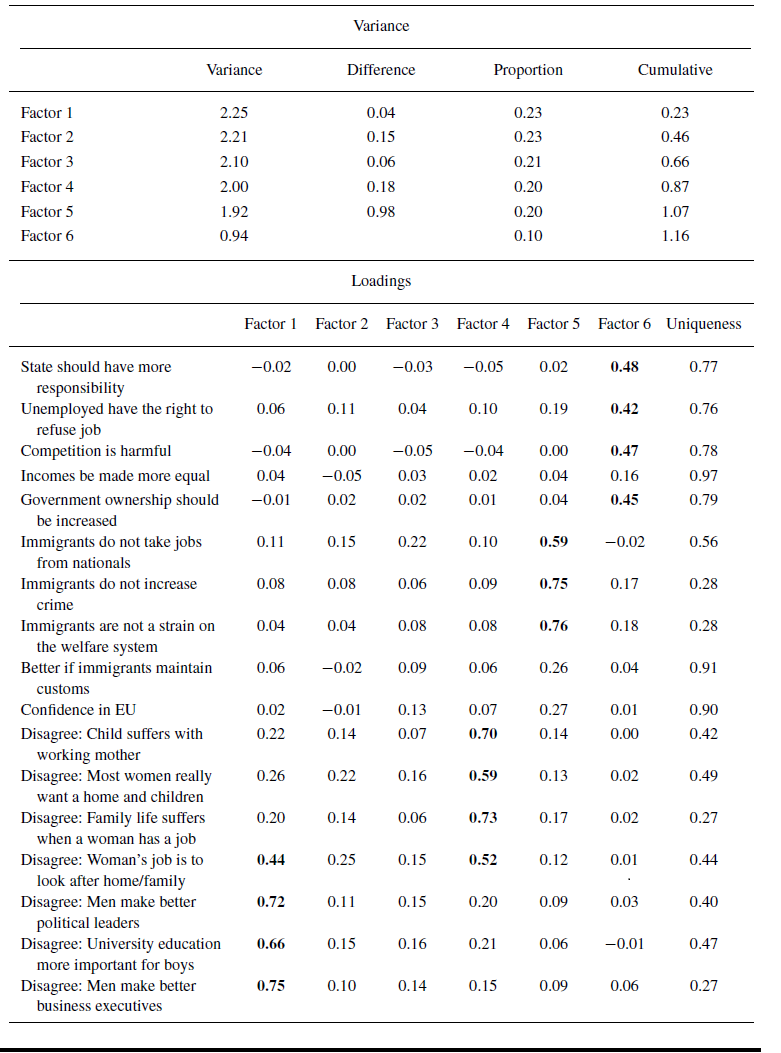
To begin, we discuss the results from our factor analysis. For the pooled analyses, using Cattell's scree plot led to the retention of six factors (see online Appendix C for the scree plots). The results of the rotated factor analysis with a Kaiser normalization specification are contained in Table 1 and largely correspond to our pre-defined categories. All the environmental items load solely on an environmental factor (factor 3), though the item dealing with being willing to sacrifice one's income for pollution has a lower loading than the others. The moral liberalism items also all load onto a single factor (factor 2) at a magnitude of 0.61 or higher. The gender items divide into two categories – one that concerns the role of women at home (factor 1) and one that concerns broader gender roles in society. One item – that a woman's job is to look after the home and family – is associated with both. The immigration factor (factor 5) contains all the prespecified immigration items, apart from the question tapping into the desirably of maintaining immigrants’ customs. The confidence in the EU question does not load substantially onto any factor, which supports previous research pointing to the question tapping into a separate dimension (Bakker et al., Reference Bakker, Jolly and Polk2012). Finally, the battery of economic left-right orientations come together (factor 6), with the exception of the item on whether incomes should be made equal or there should be greater incentives for individual effort.Footnote 6 It does, however, have much lower loadings than for the other factors as well as accounting for a smaller proportion of the variance.
Table 1. Pooled rotated factor analysis

Note: Factor loadings of 0.3 and above are displayed in bold; sample size 18,605.
The results in Table 1 are based on a pooled analysis, and one weighted towards larger populations. Do we also see such a coherent picture in country-by-country analyses? Online Appendix D contains exploratory factor analysis within each country which shows broad similarities, but also some differences. Environmentalism shows remarkable consistency – in 11 out of 14 countries, the six constituent indicators all come together to load at 0.30 or higher only on an ‘environmental’ factor. The exceptions are Spain and Italy where the indicator of being willing to give up some of one's income for pollution loads instead onto the immigration factor, and Portugal where the same item does not load onto any factor at the specified threshold level. Even in these countries, the other five environmental items do show coherence as a unique factor (see online Appendix D for a description of differences found with the other items).
Two further robustness tests can be undertaken. Firstly, one charge may be that the results are biased by having different numbers of items relating to each construct. To address this, further exploratory analyses are undertaken with just four items per construct (plus the single EU item). As shown in online Appendix E, the results remain robust. The only substantive difference is that the gender items load onto one factor instead of two. Secondly, while the exploratory factor analysis suggests that these second-dimension items are distinct, would a more parsimonious solution be acceptable whereby we combine all of these together? This can be tested using confirmatory factor analysis. What this shows is that, if all the ‘second dimension’ items are pre-specified as belonging to one factor, the model fit is poor with an SRMR (Standardised Root Mean Squared Residual) of 0.103 and thus above the acceptable threshold of 0.08. If the environmental items are separated out and specified as a second factor, the model fit improves to 0.090 and the fit improves further to acceptable levels as all of the components are also separated out.
In sum, both pooled and country-specific factor analyses confirm that the environmental questions fit together into a coherent dimension of their own, while they do not belong in a combined ‘second’ dimension.
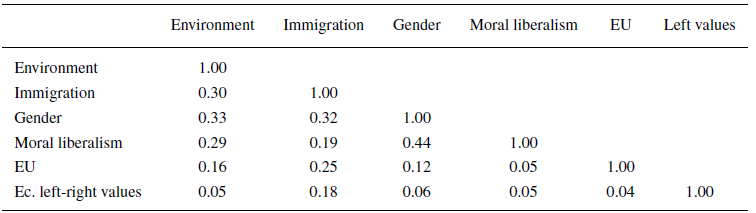
Having established this, we construct one political attitudes index for each dimension found in the factor analysis: environmentalism, immigration orientations, moral liberalism, gender equality, EU attitudes and economic left-right values. High values again indicate left-wing or ‘progressive’ positions. Table 2 displays the correlation matrix among these. The environmental index is positively correlated with all other indices, though with a magnitude of only approximately 0.30 with immigration, gender and moral liberalism and 0.16 for EU confidence. Such magnitudes do not suggest that these can be regarded as interchangeable. Indeed, pointing to further divides within the ‘second dimension’, it is only the indices of gender and moral liberalism that correlate at a magnitude of more than 0.40, two items that are each very weakly correlated with EU confidence. Economic left-right values have low associations with all the others, though the correlation with immigration attitudes is higher than for the rest. In tandem with the factor analysis, Table 2 thus points to noticeable differences in what our indices are capturing and provide supportive evidence of separable dimensions.Footnote 7
Table 2. Correlation matrix among our six indices

n = 18,605.
Part 2: Social background
With the previous part establishing differences in the structure of the components commonly used to formulate a second dimension, we next test whether these differences have substantive implications through focusing on whether their social predictors are similar or different. As per Feldman and Johnston's (Reference Feldman and Johnston2014) study of issue dimensionality in the United States, dimensions may be somewhat rooted in bottom-up, socio-structural divisions. Thus, if two proposed dimensions have differing social bases, this would provide further support that they are distinct. The most conclusive evidence for this would be if the relationships differed in their directionality, or if certain socio-demographic characteristics were significantly associated with one of the values indices but not the other. The literature does point to many second dimension issues sharing common socio-demographics – especially education – and so we do not expect to find distinct relationships for each of these.
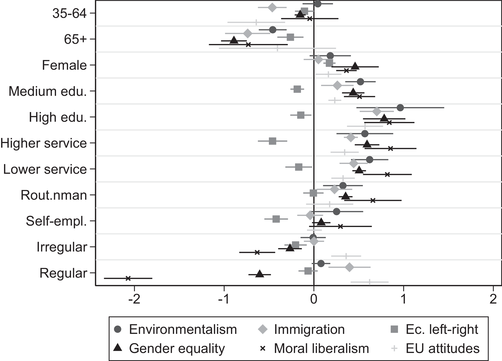
Figure 1 visualizes the relationships between social background and the various political attitude indices from six pooled models (one for each index), including country fixed effects and controls for the other social background variables. While young people (18–34) are more positive to immigration and to the EU than their middle-aged peers (35–64), they are not distinguishable in terms of environmental attitudes (nor economic left-right or EU attitudes).Footnote 8 On the contrary, older citizens (65+) differ from all others by being slightly more right-wing and, more importantly, less environmentalist – but the relationship is much weaker than for, say, moral traditionalism or gender equality attitudes. Analysing these as an index would distort the results: One would underestimate the association between age and both moral traditionalism and gender equality attitudes, while one would overestimate the association between age and environmentalism. This picture is supported in country-specific analyses (see online Appendix H).

Figure 1. Social background predictors of the different second dimension attitudes.
Note: The vertical line marks the level of the political attitudes (environmentalism, etc.) for the reference group for each variable. At the top, then, the vertical line indicates the environmentalism (and immigration orientations, etc.) for those younger than 35. The dots indicate the difference between those 35–64 and those younger than 35, and the horizontal line indicates the confidence interval around this estimate. For the remaining variables, the reference groups are men; people with low education; workers; and those who do not attend religious services. All dependent variables range from 0 to 10.
Moving to gender, there is no consistent pattern for environmentalism. However, women differ from men in terms of moral traditionalism and gender equality attitudes. These averages conceal some cross-national variation (see online Appendix H). In Austria, for instance, women are in fact substantially more environmentalist than men, but there is no difference in terms of EU attitudes and no statistically significant difference for moral liberalism. In Italy, women have similar levels of environmentalism as men but are less positive to immigration and more positive to gender equality. With only a handful of exceptions, associations between gender and a combined index of “cultural” attitudes would substantially misinterpret the real gender patterns in political attitudes.
Education has perhaps been considered the predictor of second dimension preferences at least since Lipset's (Reference Lipset1959) assertions about working-class authoritarianism (Kriesi et al., Reference Kriesi, Grande, Lachat, Dolezal, Bornschier and Frey2008; Norris & Inglehart, Reference Norris and Inglehart2019; Stubager, Reference Stubager2008). Unsurprisingly, then, we find that more education is associated with more environmentalism, pro-immigration attitudes, moral liberalism, gender equality attitudes and pro-EU positions, with the strongest patterns for environmentalism and weakest for EU attitudes (see online Appendix H for further discussion).
Moving on to class, we find a strong association with environmentalism, tying in with previous research that tends to find the middle class to be the most environmentalist (Gifford & Nilsson, Reference Gifford and Nilsson2014). The service classes are most environmentalist, while the self-employed and the working class are at the other pole. Interestingly, this occurs even after controlling for education levels, indicating that current objective circumstances affect these attitudes over and beyond any socialization or even self-selection effects of education. Like for education, the coefficients in the environmentalism model are in the same direction and of similar magnitude as for the other attitudes. It is not feasible to discuss in detail the class patterns in these five attitude orientations for six classes in 18 countries. The general picture is that in most countries, a second-dimension index would work reasonably well, although certainly not perfect, while in others it would not. In Finland, for instance, the lower service class is no different from the working class in terms of environmentalism, but they are substantially more pro-immigration, morally liberal, gender equal and pro-EU.
Religiosity is not associated with environmentalism – the coefficients are quite tightly estimated around zero. On the contrary, religiosity is associated with other political attitudes, but to various degrees. Religious people are somewhat more pro-immigration and pro-EU, but somewhat less in favour of gender equality. Most strikingly, they are less morally liberal, and the difference is very large. Any study of religion and “second dimension” preferences would be severely biased. The result would be a very strong underestimation of the extreme moral traditionalism of the religiously active compared to those who do not attend religious services. One could also believe that they are less environmentalist than secular people, when there is no difference. The country-specific analyses confirm this picture. Religious people do not differ in environmentalism from secular people in any country, but they are everywhere much less liberal and everywhere (except Iceland) are somewhat less in favour of gender equality. In about half of the countries, they are more pro-EU, while in the remaining countries there is no difference.
In summary, there is substantially more support for H2b than for H1b: Any scholars studying the relationship between age, gender or religiosity and second dimension attitudes would risk biased estimates of the statistical significance, magnitude or even direction of the associations if combining environmentalism with the other items. Indeed, for religiosity, the associations are nuanced and go in different directions for all of them. For education and class, the direction would be a reasonably close approximation.
Part 3: Party Preference
Finally, we examine the associations between our indices and party appeals by carrying out a series of logistic regressions models – including country fixed effects – in which support for a particular party family is regressed on our six value indices. Subsequently, we plot a series of predicted probabilities at the different values of each of our indices while keeping everything else at their mean value. As the entirety of these are too much to refer to in text, some pooled plots are contained in online Appendix I, with the appendix, also containing individual-country models, grouped either by party family (online Appendix J) or by country (online Appendix K).
Even if we have demonstrated that our variables largely load onto distinct factors and are differently associated to some extent with different demographic characteristics, if the environmental factor is associated with support for different party families in similar ways to the other value indices, then this may mean that – in practice – combining it into a single index with the other variables would have little impact on overall results in studies of electoral behaviour and would thus be a justifiable empirical strategy. However, if it behaves differently, then this would point to important consequences of not acknowledging it as such.
Our opposing hypotheses H1c and H2c were that environmentalism would have similar (different) electoral consequences from the other second dimension issues. If environmentalism has effects in the same direction and of similar magnitude as that of other dimensions, we consider this evidence in favour of H1c. If, on the other hand, environmentalism has an effect on support for a party family that differs substantially in magnitude or direction from the effect of other second dimension preferences, we consider this to be evidence in support of H1c. The strongest evidence in support of this would be for the associations to differ in the direction of their relationships, or if some have an effect while others do not. Furthermore, the difference in the magnitudes of the relationships is important for electoral scholars, as it is substantially meaningful if environmentalism is associated to a greater or lesser degree support for a particular party in comparison to the other values variables.
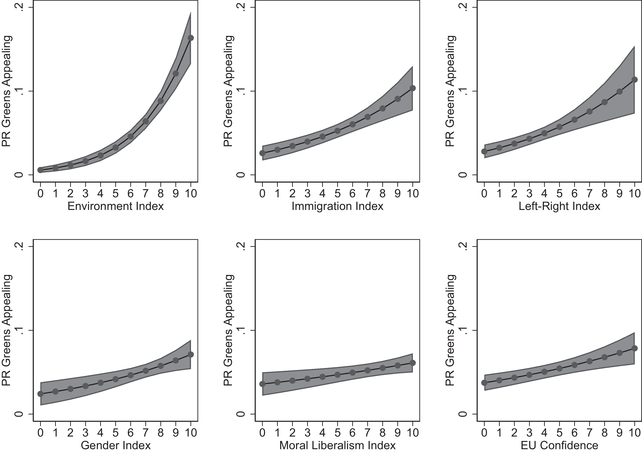
Looking initially at the predicted probabilities of supporting Green parties (Figure 2), we see that for all indices there is a positive slope between the ‘progressive’ ends of the indices and having a larger probability of supporting them, with the slope unsurprisingly steepest for environmentalism. While respondents who are less environmentally inclined have almost zero probability of supporting the Greens, the most environmental citizens have a 16 per cent probability of doing so. By comparison, moral liberalism or EU attitudes hardly matter. Within countries, this consistency for environmentalism among Green supporters remains in all cases except Austria where the relationship is flat. However, more within-country variation is experienced for the other values. While generally showing a positive relationship, there are a number of countries within each of the indices where there is no observable difference. For example, in Britain, France and Switzerland there are no differences in Green support according to immigration views.Footnote 9 Thus, overall, environmentalism is the key associate of Green appeal, with a tendency for the other values to lean positively.

Figure 2. Pooled predicted probabilities of Green support.
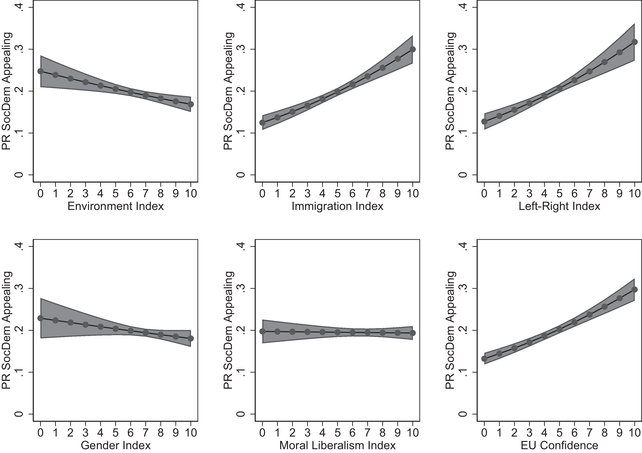
Examining the associations for other parties suggests that the generally positive associations across the indices for the Greens may be due to their tendencies to have progressive policies on all these fronts, rather than for these values to be necessarily intertwined with environmentalism. This is seen clearly when looking at the probabilities for Social Democratic party support (Figure 3), which is negatively associated with environmentalism, though positively associated with being pro-immigration and having confidence in the EU. This is replicated at the country level where Switzerland is the only country with a slight positive curve for environmentalism, pro-immigration only has a negative relationship in Portugal and Spain and there is no country where the association is negative for having confidence in the EU.Footnote 10

Figure 3. Pooled predicted probabilities of Social Democratic support.
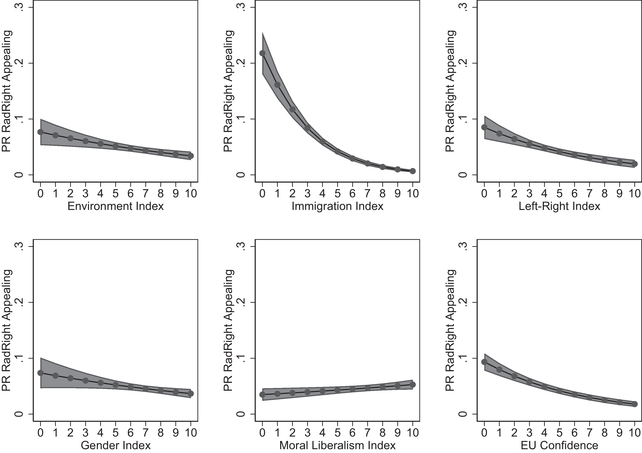
There is also the question of magnitudes to consider. For supporters of the Radical Right, even if the association with environmentalism is generally negative (Figure 4) it is only in Austria and Switzerland where this is significantly and substantially so. This is in contrast to immigration where pro-immigration views are negatively associated with Radical Right support in a substantive way across all countries as well as confidence in the EU which has a negative association in all countries except Finland and Norway. Our results are thus in line with recent research finding that Radical Right voters in Western Europe have opposition to immigration and European integration as their core values, but are increasingly less traditional on gender and sexuality (Lancaster, Reference Lancaster2020). If individuals considered these values similarly, one would not observe such variations in the size of the associations.

Figure 4. Pooled predicted probabilities of Radical Right support.
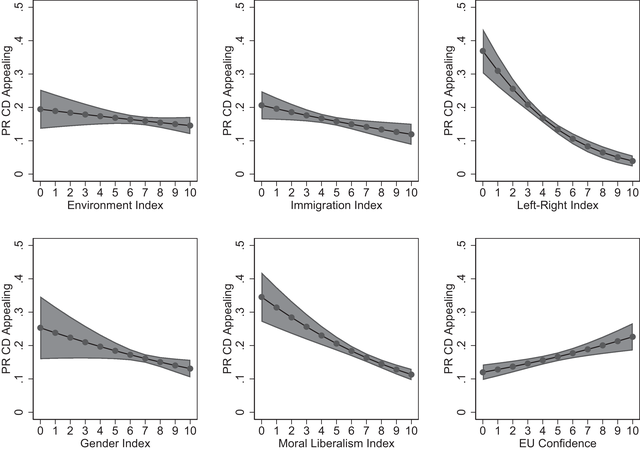
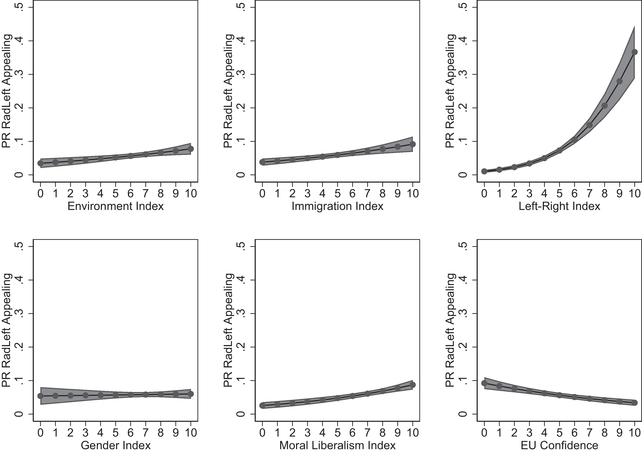
While this paper is primarily focused on environmentalism, there is also evidence that attitudes towards the EU should be considered separately. Christian Democratic support (Figure 5) is very strongly correlated with economic left-right values and moral liberalism. For the latter, the most traditionalist voters have a 35 per cent probability of supporting Christian Democratic parties, while the most liberal ones are closer to 10 per cent. For environmentalism, on the other hand, the association is close to zero and confidence intervals overlap. At the same time, attitudes to the EU are positively correlated with Christian Democratic support. Meanwhile, there is a positive relationship between Radical Left support (Figure 6) on the one hand and environmentalism, immigration and moral liberalism on the other, but a negative relationship with EU confidence. Thus, merging these indices would lead to wrong conclusions about the political consequences of political attitudes.

Figure 5. Pooled predicted probabilities of Christian Democratic support.

Figure 6. Pooled predicted probabilities of Radical Left support.
Finally, support for Conservative and Liberal parties is primarily related to economic left-right attitudes (results in online Appendix I). At the aggregate level, Conservative support is unrelated to environmentalism as well as moral liberalism and EU attitudes, while negatively associated with immigration. This is in line with conclusions from a recent edited volume on mainstream right parties in Western Europe that finds they adopt harsher stances on immigration without necessarily taking a negative position on other ‘second dimension’ issues (Bale & Rovira Kaltwasser, Reference Bale and Rovira Kaltwasser2021), thus pointing to a congruence between their voters’ positions and their own stances. Liberal party support displays a large degree of inconsistency given the diverging platforms of Liberal parties in different countries – while support for the Liberal Democrats in Britain is associated with greater environmentalism, support for the Liberals in Switzerland is associated with less environmentalism.Footnote 11
In summary, this last part of the analysis demonstrates that not only can environmentalism display different associations with support for party families to other values commonly included in a second-dimension index, but so too can immigration and attitudes towards the EU. Thus, by including these all together, one would mask key associations. Any such analysis of political representation or the attitudinal predictors of electoral behaviour would be at risk of making wrong conclusions, either about the magnitudes of the associations or, in the worst cases, even about the direction.
Conclusion and discussion
Environmentalism is an important aspect of electoral competition, party politics, and public policy. Yet in the literature on the dimensionality of Western political competition, it tends to be either not empirically included or subsumed into an index of so-called cultural attitudes. While this could have clear benefits in terms of parsimony and could be useful in some contexts, we agree with Feldman and Johnston (Reference Feldman and Johnston2014, p. 253) that the desirable goal of parsimony ‘must be balanced against the need for an accurate description of social phenomena’. Our findings show that environmentalism is an important dimension of its own among individuals and should not be subsumed into a dimension to which it does not belong. There is little theoretical reason to do so, and, using high-quality survey data on thousands of respondents from across Western Europe, we have demonstrated that environmentalism is better understood as a dimension of its own. Environmentalist attitudes load on a unique factor and partly different social predictors, as well as very different political consequences compared to other second dimension attitudes.
The implications for scholars of electoral behaviour and party competition are clear. Firstly, not accounting for environmentalism comes with the peril of missing an important explanatory factor, as we have shown it to be. While for the Green parties environmentalism is associated with support at far higher magnitudes than any other of the indices, it has also proven to have separable associations for the support of other party families too. Indeed, support for Social Democratic parties sees a difference in the direction of the relationship compared to the other second dimension items. Building on this, it is clear that assuming that it goes together with other second dimension attitudes can shroud important findings, whether one is investigating the social bases of political attitudes, or especially their electoral consequences. Recognizing that they are separable also allows for the possibility that one's pro-environmental values – and their importance for one's vote - may increase or decrease over time even if one's views on immigration or gender equality remain unchanged.
In fact, our findings may have even broader implications for the debate on the dimensionality of West European politics. While we have in this article focused on the difference between environmentalism and the other second dimension preferences, the results question the internal consistency of the other second dimension preferences. The measures only correlate weakly to moderately with each other, load on separate factors, have somewhat different social predictors and have widely different electoral consequences. The integrity of the second dimension has of course already been the subject of debate within the literature using different methodologies and data, with strong assertions by some authors that certain components – such as European integration attitudes - do not belong within it and constitute separate dimensions of their own (Bakker et al., Reference Bakker, Jolly and Polk2012; Rohrschneider & Whitefield, Reference Rohrschneider and Whitefield2012). At least on the demand side, our findings thus provide further supportive evidence that the political space in Western Europe is more accurately described with more than two dimensions. This has further implications for environmentalism, as it raises the possibility that the correlational trends between, for example, environmental and European integration values may differ from the correlational trends between environmental and moral-traditional values.
Our findings matter also for studies of political representation. Just like the left-right dimension and the cultural dimension may no longer be sufficient explanations by themselves for structuring party competition with evidence of further issue fragmentation to include Europe and immigration (Dalton, Reference Dalton2019, chapter 7; Rohrschneider & Whitefield, Reference Rohrschneider and Whitefield2012, p. 69), our article clearly shows that at the individual level the environment is a separable issue for citizens and thus needs to be considered as such in studies of representation. If it is dropped or subsumed into a broader second-dimension index, we are unable to discover potential representation gaps for this issue. For instance, Hillen and Steiner (Reference Hillen and Steiner2020) conclude that there is a left-authoritarian representation gap in Western Europe whereby, in a two-dimensional space, many voters are located in the left-authoritarian quadrant, while few parties offer this ideological profile. One could imagine similar representation gaps which could be discovered by studying environmentalism as a distinct phenomenon. Most parties who have environmental policies high on their agenda (primarily Green and some Radical Left parties) are economically left-wing and very morally liberal, pro-immigration and so on. As we have shown that individuals’ environmentalism is not equivocal to these other views, there is likely a substantial group of citizens who care about the environment but who are economically right-wing or socially conservative. These groups are not well-represented, and our findings suggest that there is room for parties representing these particular combinations of core political views.
Acknowledgements
We would like to thank David Attewell, Henning Finseraas and Sandra León as well as the anonymous reviewers for their constructive comments on previous drafts that greatly improved the paper. Previous versions have been presented at the December 2020 ECPR Environmental Politics Online Seminar Series (EPOSS) seminar, the internal seminar at the Department of Political Science at the University of Oslo, as well as the Political Behaviour Workshop at the Department of Sociology and Political Science at NTNU and we are grateful for the feedback received at these meetings. Kenny would like to acknowledge funding provided by the ERC (via the DeepDCarb Advanced Grant No. 882601).
Online Appendix
Additional supporting information may be found in the Online Appendix section at the end of the article:
Supplementary material


 Open access

