


Introduction
Globally, over 1.3 billion people – approximately one in six – live with some form of disability, and this number continues to grow, driven largely by population ageing and the rising burden of non-communicable diseases (NCDs) (Organization, Reference Organization2022). Although disability is closely linked to ageing, its prevalence is also markedly increasing among young adults. In the US, for example, the proportion of adults aged 18 to 44 reporting at least one disability or activity limitation rose by five percentage points between 2000 and 2018 (Zajacova and Margolis, Reference Zajacova and Margolis2024). Similarly, recent data from Canada show that disability prevalence among individuals increased most sharply among younger populations – by seven percentage points among those aged 15–24 years and by four percentage points among those aged 25–64 years – compared to a three-point increase among older adults (≥65 years) (Canada, December 1, Reference Canada2023).
There is substantial evidence linking disability to increased risk of mental health conditions, and mental health-related mortality, including dementia (Cho et al., Reference Cho, Jung, Jung, Yeo, Kim, Han, Shin and Min2023), anxiety, depression (Kwon et al., Reference Kwon, Han, Jung, Cho, Chung, Park, Choi, Jeon, Shin and Min2024) and suicide mortality (Lee et al., Reference Lee, Shin, Han and Kawachi2024). These studies have consistently reported that the impact of disability on mental comorbidities is more pronounced among younger age groups than older ones (Cho et al., Reference Cho, Jung, Jung, Yeo, Kim, Han, Shin and Min2023; Lee et al., Reference Lee, Shin, Han and Kawachi2024), underscoring the importance of early identification and prevention of these psychiatric conditions beginning in early adulthood.
Despite these implications, research and policy discussions have disproportionately focused on the elderly or children, leaving young adults relatively overlooked. Young adulthood in their 20s and 30s represents a pivotal life stage characterised by transition towards independence, decision-making responsibility, as well as the building of competencies and human capital, thereby setting the trajectory for career development, socioeconomic stability and family formation later in life (Pinquart, Reference Pinquart2014). The onset of disability during this formative period may mean substantial loss of opportunities, leading to cumulative disadvantage across the life course, and therefore, can lead to greater frustration and lower self-esteem, making young adults more vulnerable to mental health disorders, compared to the older population (Kalin, Reference Kalin2020).
Anxiety and depressive disorders are among the most common psychiatric illnesses linked to impaired quality of life (Hansson, Reference Hansson2002) and suicide (Kalin, Reference Kalin2021), and frequently co-occur (Kalin, Reference Kalin2020). Although several studies have examined the relationship between disability and these mental health conditions among non-elderly, most have focused on children and adolescents under 20 years or only in their early 20s (Botting et al., Reference Botting, Toseeb, Pickles, Durkin and Conti-Ramsden2016; Dykens et al., Reference Dykens, Shah, Davis, Baker, Fife and Fitzpatrick2015; Lal et al., Reference Lal, Tremblay, Starcevic, Mauger-Lavigne and Anaby2022; Maiano et al., Reference Maiano, Coutu, Tracey, Bouchard, Lepage, Morin and Moullec2018; Strang et al., Reference Strang, Kenworthy, Daniolos, Case, Wills, Martin and Wallace2012), or on specific types of disability such as intellectual (Bakken et al., Reference Bakken, Helverschou, Eilertsen, Heggelund, Myrbakk and Martinsen2010; Dykens et al., Reference Dykens, Shah, Davis, Baker, Fife and Fitzpatrick2015; lugnegård et al., Reference lugnegård, Hallerbäck and Gillberg2011; Strang et al., Reference Strang, Kenworthy, Daniolos, Case, Wills, Martin and Wallace2012), physical (Verhoof et al., Reference Verhoof, Maurice-Stam, Heymans and Grootenhuis2013), or language impairments (Botting et al., Reference Botting, Toseeb, Pickles, Durkin and Conti-Ramsden2016). In addition, many of these studies employed relatively small sample sizes, consisting of only 100 ∼ 200 participants (Bakken et al., Reference Bakken, Helverschou, Eilertsen, Heggelund, Myrbakk and Martinsen2010; Botting et al., Reference Botting, Toseeb, Pickles, Durkin and Conti-Ramsden2016; Dykens et al., Reference Dykens, Shah, Davis, Baker, Fife and Fitzpatrick2015; lugnegård et al., Reference lugnegård, Hallerbäck and Gillberg2011).
To our knowledge, no prior studies have comprehensively assessed the risk for depressive and anxiety disorders among young adults aged 20–39 years with disabilities in a large, representative sample. This study, therefore, aims to: 1) examine the association between disability – including its presence, severity and type – and the risk of anxiety and depressive disorder, and 2) explore the heterogeneity of this association across sociodemographic factors, health behaviours and comorbid conditions.
Methods
Data sources
This study utilised two population-based datasets from the Republic of Korea: the National Health Insurance (NHI) Database and the National Disability Registry (NDR). Korea operates a single-payer public health insurance system that covers approximately 97% of the population, funded through enrollees’ premium contributions. The remaining 3% – those living below the poverty line – are supported through the Medical Aid (MA) scheme, which is fully funded by general taxation. The NHI Database comprises several sub-datasets, of which we utilised the following three: (1) the NHI Enrollee Database, which provides basic sociodemographic information on enrollees; (2) the Claims Database, which includes detailed records of disease diagnoses and health service utilisation; and (3) the Health Check-up Database, which offers information on health-related behaviours (e.g., smoking status and alcohol consumption), anthropometric measurements (e.g., body mass index [BMI]) and laboratory biomarkers such as blood pressure, fasting glucose and lipid profiles (Shin et al., Reference Shin, Cho, Park and Cho2022). The NDR contains information on individuals with officially registered disabilities, including disability type and severity levels, as determined by standardised clinical assessment protocols. The National Health Insurance Service (NHIS) offers researchers access to a dataset that links the NHI data with selected information from NDR for research purposes. Further details on each data source are provided in the Supplementary Methods.
Study population and design
Our study population was derived from the Health Check-up Database, which includes individuals who participated in the biennial health check-up program provided by the NHI agency. The initial, nationally representative sample comprised 6,891,401 individuals aged 20–39 years, including both individuals with and without disabilities who completed the Health Check-up between 2009 and 2012. This sample represents approximately 40% of the population within the specified age group. Observations with missing values in any of the study variables were excluded, resulting in a refined sample of 6,328,087 individuals. Additionally, individuals with pre-existing diagnoses of depressive or anxiety disorders at baseline were excluded to ensure that only incident cases were analysed. A one-year lag was applied to the outcome variable to address potential temporal effects and avoid the risk of reverse causality. The final analytical cohort consisted of 6,058,290 individuals, including 5,970,401 without disabilities and 87,889 with disabilities.
Outcome variable and follow-up
The outcome variables were the incidence of depressive and anxiety disorders. These conditions were identified using the diagnostic codes from the Korean Classification of Diseases, 6th revision (KCD-6), within the NHI Claims Database. KCD-6 is an extended version of the ICD-10, incorporating disease classifications used in traditional Korean medicine (Ko et al., Reference Ko, Lee, Nam, Ahn, Bae, Ban, Yoo, Park and Han2020).
The incidence of depressive and anxiety disorders was defined as having either two or more outpatient visits or at least one hospitalisation with relevant diagnostic codes (F32.x and F33.x for depressive disorder, and F40.x and F41.x for anxiety disorder) (Kwon et al., Reference Kwon, Han, Jung, Cho, Chung, Park, Choi, Jeon, Shin and Min2024). Each individual was followed from the date of their health check-up until the occurrence of depressive or anxiety disorder, emigration, or December 31, 2022 – whichever occurred first.
Independent variables
The primary independent variables of interest were the presence of the disability, as well as its severity and types. Disability severity within the NDR is classified into six grades based on the degree of functional impairment, which is quantified as a percentage of functional loss relative to pre-impairment functionality. Specifically, Grade 1 (most severe) indicates a functional loss exceeding 85%; Grade 2, 75–84%; Grade 3, 60–74%; Grade 4, 45–59%; Grade 5, 35–44%; and Grade 6 (mildest), 25–34%. These were dichotomised into Grades 1–3 (severe) and Grades 4–6 (mild). The specific functional domains assessed for severity classification vary by disability type (Kim et al., Reference Kim, Jung, Kim, Park and Shin2023). To ensure objectivity and inter-rater consistency, the assessment process follows two-step procedures based on national criteria. First, a specialist at an approved medical institution conducts the initial assessment. The results are then submitted to the National Pension Service, where a medical advisory committee – comprising at least two specialists – reviews the case and renders the final decision (MoHW). Further details on the Korean NDR are available in Kim et al. (Reference Kim, Jung, Kim, Park and Shin2023). Disability types are classified into 15 categories within the NDR, in accordance with the classification framework defined by the Korean Welfare Act for Persons with Disabilities.
Covariates included sociodemographic characteristics (sex, age and income level), health-related behaviours (smoking status, alcohol consumption and regular physical activity) and comorbidities (obesity, metabolic syndrome, diabetes mellitus [DM], hypertension, dyslipidemia). As the NHI Database does not provide specific household income information, monthly health insurance premiums were used as a proxy for income. The NHI premiums are determined based on gross salary for employee-insured individuals and on a composite index of annual income and assets for self-employed enrollees. Low-income was defined as a combination of MA beneficiaries and the 1st quartile of NHI enrollees. More specific definitions and operational criteria for income and comorbidities are provided in Table S1.
Analyses
Descriptive statistics were presented for the study sample, stratified by disability status and severity. The cumulative incidence of depressive and anxiety disorders was illustrated using Kaplan–Meier survival curves, stratified by disability status and severity, to visualise differences in time-to-event distributions. To examine the association between disability and the incidence of depressive and anxiety disorders, Cox proportional hazards regression models were employed. Three primary models were constructed: Model 1 (M1) assessed the presence of disabilities; Model 2 (M2) examined the dichotomised categories of disability severity; and Model 3 (M3) investigated disability types. Hazard ratios (HRs) and corresponding 95% confidence intervals (CIs) were estimated, with statistical significance determined by a two-sided P-value of < 0.05. For each model, we sequentially adjusted for two blocks of covariates to examine the potential confounding effect: first adjusting for demographic variables (age and sex), and then additionally adjusting for economic status, health-related behaviours and comorbidities.
In addition, comprehensive subgroup analyses were conducted to explore potential heterogeneity in the associations between disability and the incidence of depressive and anxiety disorders, across strata defined by sociodemographic characteristics, health behaviours and comorbidity profiles.
Results
Characteristics of the study sample
A total of 87,889 individuals, accounting for 1.45% of the study population, were identified as having a disability (Table 1). Among them, approximately 33.8% were classified as having a severe disability, defined as Grades 1 to 3. The most prevalent type of disability was related to the extremities, comprising 53.8% of the disabled group, followed by visual (12.8%) and intellectual disabilities (12.3%). The mean age was higher in the disability group than in the non-disability group (32.3 years vs. 30.8 years). Additionally, the proportion of individuals classified as low-income was greater among those with disability compared to those without (Table 1).
Table 1. Sample characteristics by disability status: n (%)

Health-related behaviours and comorbidity profiles also differed by disability status. Compared to those without disabilities, individuals with disabilities had higher smoking rates but lower rates of alcohol consumption and higher rate of engagement in regular exercise. Comorbidities such as obesity and metabolic syndrome were more prevalent in the disability group. Overall, the incidence of depressive disorder was higher than that of anxiety disorder, with both conditions occurring more frequently among individuals with disability than those without (Table 1).
Within the disability group, those with severe disabilities were more likely to be younger, have low income, and less likely to smoke or consume alcohol or have comorbidities. Depression and anxiety disorders occurred at a higher rate among individuals with severe disabilities compared to those with mild disabilities (Table S2).
Risk of depressive and anxiety disorders by disability status
The cumulative incidence of both depressive and anxiety disorders was higher among individuals with disabilities (Fig. 1(a) and (c)), with those with severe disabilities exhibiting a higher cumulative incidence than those with mild disabilities (Fig. 1(b) and (d)). When fully adjusted for covariates, individuals with disabilities were 1.58 times (95% CI: 1.55–1.60) more likely to develop depressive disorders and 1.50 times (95% CI: 1.42–1.59) more likely to develop anxiety disorders compared to those without disabilities (Table 2). The increased risk was more pronounced for severe disabilities (adjusted HR [aHR] [95% CI]: 1.88 [1.84–1.93] for depressive disorder; 1.87 [1.71–2.04] for anxiety disorder) than mild disabilities (aHR [95% CI] = 1.42 [1.39–1.45] for depressive disorder; 1.32 [1.23–1.42] for anxiety disorder) (Table 2).

Figure 1. (a–d) Kaplan–Meier curves illustrating the cumulative incidence of depressive and anxiety disorders by disability status and severity over time.
Table 2. Association between disability and incidence of depressive and anxiety disorders
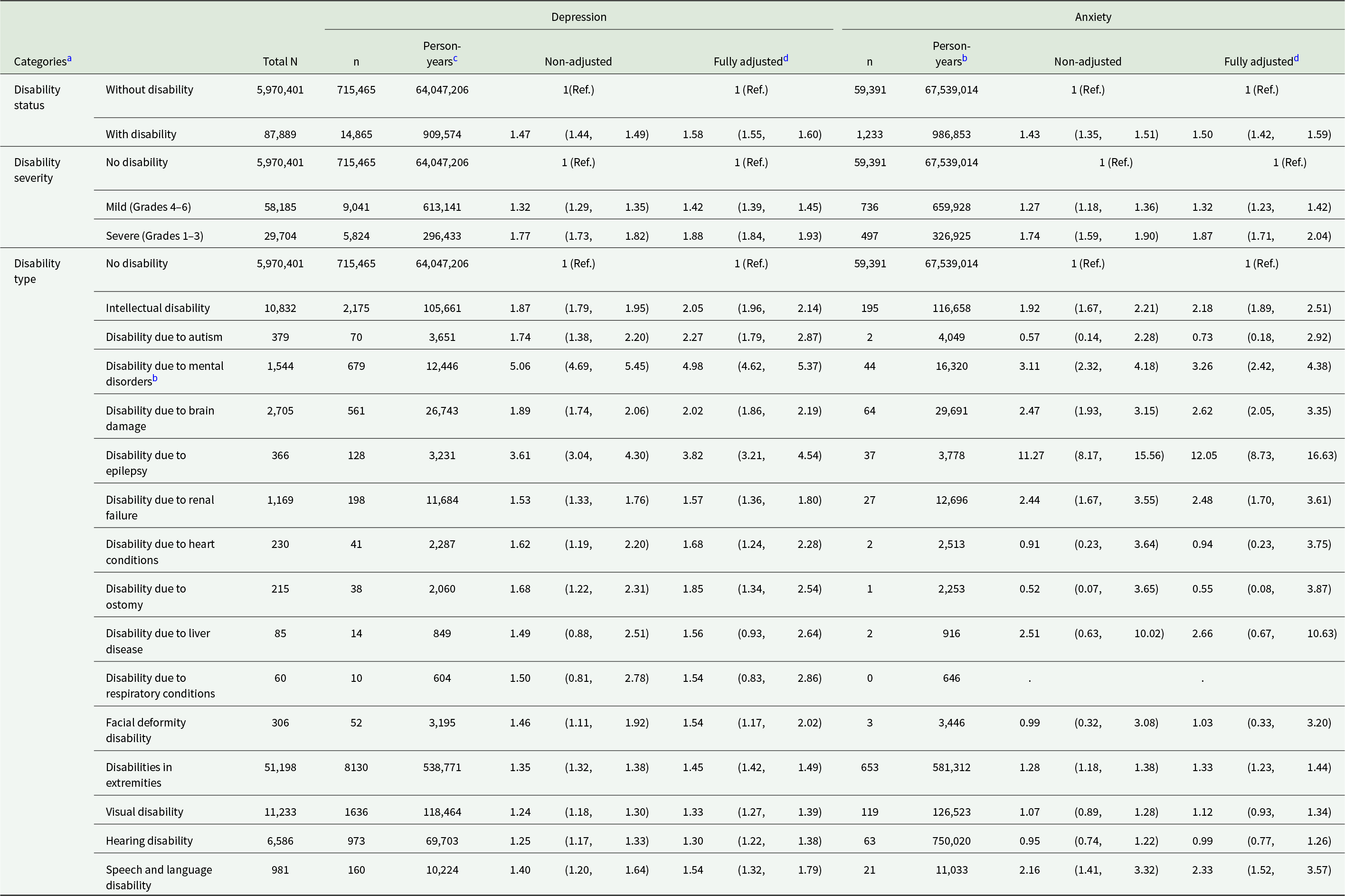
a Separate analyses were conducted for disability status severity and type.
b Mental disabilities other than those due to depressive or anxiety disorders
c Duration of follow-up
d Adjusted for sex, age, income level, smoking, drinking alcohol, physical activities, obesity, diabetes mellitus, hypertension, dyslipidemia
Patterns of association by disability type differed between the two mental health conditions. The greatest increase in risk for depressive disorder was observed among individuals with mental disorder-related disabilities (aHR [95% CI] = 4.98 [4.62–5.37]). On the other hand, epilepsy-related disability was associated with the highest risk for anxiety disorder, with an approximately 12.1-fold increase compared to individuals without disabilities, showing a substantial gap from the second-highest risk category (aHR [95% CI] = 3.26 [2.42–4.38] for disability due to mental disorders). Several disability types – such as those related to autism, ostomy and heart conditions, facial deformities and visual and hearing impairments – were associated with an increased risk of depressive disorder but not with anxiety disorder incidence (Table 2). Adjustment for demographic characteristics slightly increased the HRs, whereas additional adjustment of economic status, health-related behaviour and comorbidities had little influence on the observed associations (Table S2).
Stratified analyses by sociodemographic and health-related characteristics
Several factors were common effect modifiers of the association between disability and the incidence of both depressive and anxiety disorders (Table 3). The HRs for both mental health outcomes associated with disability were significantly higher among individuals aged 20–29 years compared to those aged 30–39 years (aHR [95% CI] = 1.64 [1.59–1.69] vs. 1.56 [1.35–1.59], p-interaction = 0.006 for depressive disorder) and in the low-income group compared to the higher-income group (aHR [95% CI] = 1.86 [1.81–1.91] vs. 1.44 [1.41–1.47], p-interaction < 0.001 for depressive disorder; 1.87 [1.70–2.05] vs. 1.33 [1.24–1.43], p-interaction < 0.001 for anxiety disorder). The association was also more pronounced among individuals who did not smoke (aHR [95% CI] = 1.67 [1.64–1.71] vs. 1.44 [1.40–1.47], p-interaction < 0.001 for depressive disorder; 1.71 [1.59–1.83] vs. 1.22 [1.11–1.34], p-interaction < 0.001 for anxiety disorder), did not drink alcohol (aHR [95% CI] = 1.77 [1.73–1.81] vs. 1.43 [1.40–1.46], p-interaction < 0.001 for depressive disorder; 1.78 [1.64–1.93] vs. 1.30 [1.20–1.40], p-interaction < 0.001 for anxiety disorder), compared to their respective counterparts.
Table 3. Association between disability and incidence of depressive and anxiety disorders: stratified analyses by sociodemographic and health-related factors

All stratified analyses were adjusted for all covariates except for the variable used for stratification.
a No hypertension: SBP ≤ 120 mmHg and DBP ≤ 80 mmHg without medication/ bNo dyslipidemia: TC < 200 mg/dL without medication.
On the other hand, sex and comorbidity with DM significantly interacted with disability only in relation to depressive disorder, while engagement in regular physical activity emerged as a significant effect modifier only for anxiety disorder. Specifically, a more distinct increase in the HR for depressive disorder associated with disabilities was observed among young adults who are females or have comorbid DM, compared to those who are male or without DM, respectively. The increase in the risk for anxiety disorders associated with disabilities was greater among individuals who did not engage in regular physical activity (Table 3).
Discussion
This study is the first to comprehensively investigate the association between disability and the risk of anxiety and depressive disorders among young adults aged 20 to 39. Disability was significantly associated with an increased risk of both conditions, and this association persisted even after adjusting for all covariates, including sociodemographic factors, health behaviours and comorbidities. An elevated risk of depressive disorders was consistently observed across most disability types with the highest increase observed in mental health-related disabilities. The risk of anxiety disorders also increased in approximately half of the disability types, with the greatest increase noted among those with epilepsy-related disabilities. Moreover, we found a more pronounced increase in the risk associated with disability among individuals who were younger, had lower income and did not smoke or drink alcohol. Several findings merit further attention.
First, previous studies that examined the entire population of individuals with disabilities across all age groups in Korea – among whom older adults constituted a substantial proportion – reported significantly lower likelihoods of depressive and anxiety disorder incidence in several disability types (e.g., brain injury-related disabilities, internal organ impairment-related disabilities) compared to individuals without disabilities (Lee et al., Reference Lee, Kim, Yeob, Kim and Park2023, Reference Lee, Yeob, Kim, Kim and Park2025), interpreting these findings as potentially reflecting under-diagnosis, likely attributable to limited access to healthcare services among individuals with disabilities rather than evidence of genuinely lower incidence. On the other hand, the present study observed a consistently positive association between disability and the incidence of depressive and anxiety disorders across all disability types among young adults. This may reflect a lower degree of under-diagnosis in this younger population relative to older adults, potentially indicating a greater capacity to actively seek healthcare services, facilitated by more readily available social support to assist their health visits or more stable financial assistance compared to older individuals.
Second, while disabilities due to mental disorders exhibited the highest risk of depressive disorders, epilepsy emerged as the strongest risk factor for anxiety disorders among the various types of disabilities. The category classified as ‘disabilities due to mental disorders’ encompasses functional impairments arising from a broad spectrum of psychiatric conditions, including schizophrenia, bipolar disorder, organic mental disorders secondary to neurological brain damage and recurrent depressive disorders. Because individuals with preexisting depressive or anxiety disorders were excluded from the baseline population – thereby including only those newly diagnosed with depressive or anxiety disorders after the onset of their existing mental disorders – concerns about circularity between exposure and outcome were effectively minimised.
Although bipolar disorder is often initially misdiagnosed as major depressive disorder – since depressive episodes typically precede the recognition of hypomanic or manic episodes – it is uncommon for individuals already diagnosed with bipolar affective disorder to subsequently receive an additional diagnosis of depressive disorders. Such instances usually occur only when patients change healthcare providers and the new clinician, unaware of the prior bipolar disorder diagnosis, records depression instead (Stensland et al., Reference Stensland, Schultz and Frytak2010). Therefore, it is highly unlikely that bipolar disorder substantially contributed to the elevated risk of depressive disorder observed among individuals with mental disability.
In contrast, other mental conditions causing disabilities, such as brain damage or schizophrenia, are well-documented risk factors for secondary depression. In schizophrenia, a depressive episode that develops after the remission or stabilisation of psychotic symptoms is clinically recognised as post-schizophrenic depression, clearly defined in the ICD-10 as F20.4 – ‘A depressive episode, which may be prolonged, arising in the aftermath of a schizophrenic illness’. (Guerrero-Jiménez et al., Reference Guerrero-Jiménez, Carrillo, Albornoz Calahorro, Girela-Serrano, Bodoano Sánchez and Gutiérrez-Rojas2022). Similarly, neurological brain damage, including traumatic brain injury and stroke, is frequently followed by the onset of depressive disorder, a phenomenon consistently reported as both common and clinically significant across psychiatric and neurological literature (Choi et al., Reference Choi, Kim, Sun, Kim, Lee, Oh, Park and Leigh2021; Conroy et al., Reference Conroy, Brownlowe and Mcallister2020; Dehbozorgi et al., Reference Dehbozorgi, Maghsoudi, Rajai, Mohammadi, Nejad, Rafiei, Soltani, Shafiee and Bakhtiyari2024).
Notably, the risk of anxiety disorder was most markedly elevated among individuals with epilepsy-related disabilities. Epilepsy, one of the most common chronic neurological conditions, is characterised by recurrent, unprovoked seizures resulting from transient disruptions in brain electrical activity (Batchelor and Taylor, Reference Batchelor and Taylor2021). Previous studies have highlighted the unique psychological challenges faced by young adults with epilepsy, including intense fear of seizure recurrence (Ryan and Räisänen, Reference Ryan and Räisänen2012) and threats to their sense of self, such as loss of self-esteem and sense of coherence (Gauffin et al., Reference Gauffin, Landtblom and Räty2010). These psychological burdens may contribute to the substantially elevated risk of anxiety disorders observed in this population. Pugh et al. (Reference Pugh, Copeland, Zeber, Cramer, Amuan, Cavazos and Kazis2005) demonstrated poorer mental health outcomes among young adults with epilepsy, compared to their middle-aged and older counterparts, despite relatively well-preserved physical function and activity levels, suggesting that older individuals generally cope better with epilepsy than middle-aged or younger adults do (Pugh et al., Reference Pugh, Copeland, Zeber, Cramer, Amuan, Cavazos and Kazis2005).
Intersectional subgroup analyses also revealed a few notable findings. First, it was found that females were more vulnerable to depressive disorders than males. It has been consistently reported that females are more prone to depression, despite higher suicide rate and greater prevalence of addictive behaviours in males (Ford and Erlinger, Reference Ford and Erlinger2004). This female preponderance in rates of depression begins as early as adolescence (Cyranowski et al., Reference Cyranowski, Frank, Young and Shear2000). A few studies comprehensively reviewed risk factors leading to gender differences in depressive disorders, which include different coping styles and higher dependence on social support among females (Piccinelli and Wilkinson, Reference Piccinelli and Wilkinson2000). Specifically, when stressful life events occur, males tend to distract themselves from their mood by engaging in physical or instrumental activities, whereas females more frequently employ self-consolatory strategies, such as ruminating over the possible causes and implications of their depression, thus prolonging the depressed mood (Hänninen and Aro, Reference Hänninen and Aro1996). Additionally, since females have a stronger affiliative style than males, requiring greater social support for their psychological health, they may be more vulnerable to events affecting their close emotional ties, such as disabilities (Bebbington, Reference Bebbington1998). How the gender disparities in disability-related depression can be translated into effective action needs to be given thoughtful consideration.
Second, within young adults, the risk of depressive and anxiety disorders associated with disability was higher among even younger individuals in their twenties compared to those in their thirties. The twenties represent a transitional stage during which individuals have recently emerged from adolescence and are in the process of establishing the foundations for adult life. Additionally, most individuals in their twenties are still engaged in educational pursuits (Settersten and Ray, Reference Settersten and Ray2010). Experiencing disabilities during this period may result in the loss of various opportunities for personal and professional development. Kwak et al. (Reference Kwak, Shin, Lee, Kim, Hyun and Park2024) reported that Korean young adults with disabilities in their twenties are less likely to complete a college degree or pursue post-secondary education (Kwak et al., Reference Kwak, Shin, Lee, Kim, Hyun and Park2024) and have significantly lower marriage rates compared to their non-disabled peers (Kwak et al., Reference Kwak, Shin, Lee, Kim, Hyun and Park2024). These disparities may lead to greater psychological distress among younger individuals, who often hold higher expectations and aspirations for their future, yet may lack the life experience and coping capacity to manage significant adversity, than older populations.
Third, although income did not serve as a major confounder in the association between disability and the incidence of depressive or anxiety disorders, it appeared to act as an effect modifier. The heightened risk for depressive and anxiety disorders associated with disabilities was more pronounced among individuals in the low-income group compared to those in higher-income groups. Higher income may indicate that an individual is economically active and remains engaged in the labour market, which can foster a sense of self-esteem and self-efficacy, thereby contributing to better mental health outcomes. Furthermore, income can serve as a financial buffer, enabling access to activities and services that help alleviate the psychological burden associated with disability, such as hiring a caregiver, engaging in leisure or recreational activities, or participating in social networks. A follow-up in-depth study incorporating additional variables, such as employment status, occupational type, or social capital, is warranted to further elucidate the mechanisms underlying these associations.
Notably, individuals who engaged in health-promoting behaviours, such as abstaining from smoking and alcohol consumption, showed a more substantial increase in risk for both conditions compared to those who smoked and consumed alcohol. A cautious interpretation is necessary to explain this counterintuitive finding. Smoking and alcohol use are often linked with social networks and interactions, facilitating interpersonal bonding (Borsari and Carey, Reference Borsari and Carey2001; Christakis and Fowler, Reference Christakis and Fowler2008). This is particularly relevant in the South Korean context, where smoking and drinking are not merely individual behaviours but are deeply embedded in social customs and cultural norms (Chun, Reference Chun2012; Hyeonjin, Reference Hyeonjin2012). These behaviours often serve as social lubricants in both professional and leisure settings, fostering intimacy and cohesion within communities, particularly among younger generations (Chun, Reference Chun2012; Hyeonjin, Reference Hyeonjin2012). As a result, not participating in smoking or drinking gatherings may compound feelings of exclusion or social isolation, which are already imposed by disabilities. Supporting this interpretation, one prior study conducted in Korea found that a slight increase in alcohol intake among individuals who were initially non-drinkers was associated with a reduced risk of depression, suggesting that, while heavy smoking and drinking are undoubtedly harmful, mild use during mentally challenging periods can serve as a coping mechanism or stress reliever (Cho et al., Reference Cho, Park, Lee, Oh, Kim, Ko and Park2024).
Finally, the risk of depressive symptoms associated with disabilities was higher among DM patients compared to those without DM. Diabetes in individuals in their 20s and 30s is more likely to be young-onset type 1 diabetes or maturity-onset diabetes of the young (MODY) (Song et al., Reference Song, Song, Nam, Park, Yoon, Son, Ko and Lim2016; Tanenbaum and Gonzalez, Reference Tanenbaum and Gonzalez2012). Since type 1 DM has a higher prevalence of severe diabetic complications and shorter life spans, insulin therapy must be started immediately after the onset and continued throughout the lifetime, causing a serious physical, psychological and economic burden (Liese et al., Reference Liese, D’agostino, Hamman, Kilgo, Lawrence, Liu, Loots, Linder, Marcovina and Rodriguez2006). In this context, having DM and disability may pose a double burden to young populations.
Although this study makes an important contribution to the discourse on disability and mental health, several limitations should be acknowledged. First, the proportion of individuals with disabilities in our cohort was 1.5%, which is lower than estimates reported in other countries and slightly below the national prevalence among individuals aged 20–39 years during the corresponding period (2.0% in 2009–2010 and 1.9% in 2011–2012) (KWDI, 2025). This discrepancy may be explained by two factors: the narrow scope of disability criteria in Korea and a potential selection bias. In Korea, registration in the NDR requires assessment and certification by a qualified specialist physician based primarily on medical condition. This differs from the International Classification of Functioning, Disability, and Health (ICF) framework, which encompasses broader dimensions such as body functions, activity limitations, participation restrictions and environmental factors. Consequently, the scope of disability recognition in Korea is narrower, likely resulting in lower prevalence estimates compared with other countries that use ICF-based definitions. Additionally, our study population was drawn from the NHI Health Check-up database, which includes only individuals who participated in the health screening program. Individuals with limited access to these health check-ups – such as those with disabilities or mental health conditions – were therefore likely underrepresented, which may have led to an underestimation of both the prevalence of disability and the true risk of depressive and anxiety disorders among people with disabilities.
Second, it cannot be ruled out that the incidence of anxiety disorders may have been under-ascertained, partly due to clinicians’ diagnostic coding practices in combination with structural characteristics of the NHI reimbursement system. In clinical settings where anxiety and depressive disorders coexist, physicians often enter depressive disorder as the primary diagnosis and anxiety as a secondary one. However, it is typical that only the primary diagnosis is submitted to the NHI for reimbursement, as the NHI requires diagnostic codes that justify billed medical services rather than the full spectrum of a patient’s clinical conditions (Park et al., Reference Park, Jang, Jun, Lee, Lee and Lee2017). Furthermore, since 2013, the reimbursement system has been revised to allow non-pharmacological consultations for mental health conditions to be reimbursed without requiring a psychiatric diagnosis code. Consequently, patients with mild or early-stage anxiety disorders – who frequently receive cognitive or counselling therapy – are less likely to have diagnostic codes recorded, whereas patients with depression, for whom pharmacological treatment remains the mainstay even in mild cases, are more frequently assigned diagnostic codes within the insurance database (Jang et al., Reference Jang, Bahk, Woo, Seo, Park, Kim, Jeong, Shim, Lee, Jon and Min2023; Ryu, Reference Ryu2013). Third, the presence of multiple disabilities could not be considered because the NHI service only retrieved information on the primary disability type from the NDR during data linkage. Additionally, information on the duration of disability was unavailable. These limitations may have resulted in either over-or under-estimation of the association observed across different disability types. Lastly, as the NHI database is originally designed for administrative and claims purposes, it provides limited information on socioeconomic characteristics. Consequently, only income level was included as a proxy for socioeconomic status, although mental health is likely influenced by a broader range of social determinants. Future studies incorporating a more comprehensive set of variables would offer a more in-depth understanding of the mental health challenges faced by young adults with disabilities.
Conclusions
Our findings highlight that young adults with disabilities, a population that has been relatively overlooked in policy discussions, warrant greater attention. Certain types of disabilities that may not constitute major risks among older adults with disabilities in relation to mental conditions – such as epilepsy – may require closer monitoring and targeted intervention in young adults with disabilities. Future studies addressing the current limitations should be conducted to inform and guide policy efforts.
Supplementary material
The supplementary material for this article can be found at https://doi.org/10.1017/S204579602510036X
Availability of data and materials
Data used in this study are available from the Korean National Health Insurance Service (http://nhiss.nhis.or.kr) under license and are not publicly accessible due to restrictions. However, they may be made available by the authors upon reasonable request and with permission from the KNHIS.
Acknowledgements
This work was supported by a generous grant provided by the Udeok Foundation.
Author contributions
DW Shin and K-D Han contributed equally to this work. Kyung-Do Han can also be contacted for correspondence, email: hkd@ssu.ac.kr.
Financial support
Not applicable.
Competing interests
The authors have no relevant financial or non-financial interests to disclose.
Ethical standards
Participant consent was not required as the study used previously held secondary data, which is de-identified at the point of access. The authors assert that this study was performed in accordance with the Helsinki Declaration of 1975, as revised in 2013.


 Open access

