


Copyright qua Proprietary Authorship
Where books and other textual forms are concerned, the terms ‘work’ and ‘literary work’ in particular are often used to designate the main subject matter of copyright protection, both nationally and internationally.Footnote 1 The Berne Convention 1886 not only foregrounds in the title its overarching interest in the ‘protection of literary and artistic works’ but further identifies ‘books, pamphlets, and other writings’Footnote 2 as some of the tangible forms that literary works may take. In copyright scholarship, it has been suggested that the Berne Convention’s adoption of ‘literary work’ as its final term of reference was substantially owed to the German delegation’s objection to the French delegation’s proposed use of ‘literary property’, which the former regarded as being at odds with the concept of Urheberrecht in German law.Footnote 3 The absence of reference to ‘property’ or ‘property right’ in the Convention might seem to support the suggestion that the treaty evinced, and continues to do so in its latest revision, a non-proprietary understanding of author’s rights.Footnote 4 Nonetheless, it is also apparent from the more recent copyright directives issued by the European Union that literary works are now understood as objects of ‘intellectual property’ in European and international copyright law.Footnote 5 In the United Kingdom, the Copyright, Designs and Patents Act 1988 (‘CDPA 1988’) expressly conceives of copyright as ‘a property right which subsists … in … original literary, dramatic, musical or artistic works’,Footnote 6 likewise reflecting the synonymity between ‘literary work’ and ‘literary property’ in contemporary copyright systems. Under the present legal orthodoxy, when books are nominated as literary works, they are at once understood to be objects of intellectual property, that is, so-called intangible objects created and owned by persons, referred to as ‘authors’.Footnote 7
The intangible nature of the literary work tends to be simply assumed in contemporary copyright law and scholarship.Footnote 8 The very differentiation between the fields of property law and intellectual property law is premised on a categorical distinction between ‘physical’ and ‘non-physical’ forms susceptible to ownership. Where an asset is non-physical, as in the instance of the literary work, the law provides that it has first to be embodied in some perceptible form so as to be disposed to regulation. For instance, under section 102 of Title 17 of the United States Code, copyright protection ‘subsists … in works of original authorship fixed in any tangible form of medium of expression … from which they can be perceived, reproduced or otherwise communicated’. Though distinguished from tangible forms, the copyright work nonetheless requires a material form to be protected as such. The printed book comprised of inked paper bound between covers is but one of the substantial forms in which the work appears. Effectively situated at the threshold of the physical and the non-physical, the concept of ‘work’ affords the law’s movement between the domains of the perceptible and the imperceptible so as to enforce a system of rights and obligations in which the ‘author’ stands as a key beneficiary.Footnote 9
The significance of authorship in copyright law has been much discussed in copyright scholarship, initially often in critical projects aimed at disclosing its contingency and limits,Footnote 10 but more recently also as part of proposed correctives to the utilitarian-proprietary paradigm of copyright.Footnote 11 To be sure, it is possible to identify modulations in the understanding of authorship adopted in different copyright regimes. A brief comparison between what are often accepted as the prevailing standards of originality in the United States and the United Kingdom, for instance, would suggest that there are multiple ways of conceiving the contribution to the literary work a person must make to be recognised as its author in copyright law. Simply put, whereas the US Supreme Court has clarified that authorship presupposes originality in the sense of ‘independent creation plus a modicum of creativity’Footnote 12 (Feist Publications Inc. v Rural Telephone Service Co. Inc. 111 S.Ct. 1282 (1991), p. 1288), the British courts still largely affirm the traditional view that origination simply entails some requisite amount of ‘skill, labour, and expense’.Footnote 13 Yet, as Jane Ginsburg has noted in a comparative study of seven contemporary copyright regimes,Footnote 14 the varying notions of authorship across jurisdictions do coincide in a shared understanding of the author as the personal creator of the work: ‘Despite these variations [in originality standards], I nonetheless conclude that in copyright law, an author is (or should be) a human creator who, notwithstanding the constraints of her task, succeeds in exercising minimal personal autonomy in her fashioning of the work’Footnote 15 (p. 1064). For Ginsburg, a proper understanding of copyright law necessitates our recognition of authors as the central subjects whose creative endeavours copyright law seeks to stimulate so as to advance public knowledge.Footnote 16 Such a claim about the centrality of authors to copyright law is backed by the Constitution of the United States, which recognises ‘securing for limited Times to Authors … the exclusive Right to their … Writings’Footnote 17 to be a means of promoting scientific progress. Though lacking equivalent constitutional support, the United Kingdom expressly defines in its copyright statute the author of the work as ‘the person who creates it’,Footnote 18 similarly stressing the notion of personal intellectual creation as the touchstone of authorship. Such continuities between common law and civil law systems, and across national and international copyright regimes, suggest a commonly ingrained approach to the work as an intellectual creation of its personal author. On this view, the book is regarded as embodying an intangible object created by an author, whose proprietary rights are granted and protected under the prevailing copyright system. The threshold requirement of ‘originality’ collaborates with the operative terms ‘work’ and ‘author’ to re-entrench the modern myth of the author as personal creator and owner of literature (and other cultural forms).
This chapter seeks to destabilise the central position of the proprietary author in copyright law. Following on from Chapter 1’s call to study the peripheral matters of Kant’s Von der Unrechtmäßigkeit des Büchernachdrucks (‘On the Wrongfulness of Reprinting’) (1785),Footnote 19 I now turn to a series of paratexts within and surrounding those printed pages as indices of their medial-material conditions of possibility. We consider not only the epitextual background of the German Enlightenment in which the Berlinische Monatsschrift was produced, but also the peritextual specimens of catchwords, signature marks, and various front matter of Kant’s periodical essay.Footnote 20 This medial reading suggests the periodical to be deeply involved in the operations of a print machinery preceding the authorial figure, the existence of which perturbs copyright law’s attachment to original authorship.
Place and Genre of the Berlinische Monatsschrift
In studies of the historical event and period that we now call the German Enlightenment, it is not unusual to note the suggestion that one of its defining practices was, precisely, that of defining what the practices of enlightenment were. As discussed in Chapter 1, the Berlinische Monatsschrift had published Kant’s perspective on the matter less than a year before his essay on author’s rights. In Beantwortung der Frage: Was Ist Aufklärung? (1784) (‘An Answer to the Question: What is Enlightenment?’), Kant conceived of enlightenment as the use of ‘one’s own understanding’,Footnote 21 which released oneself from an immature state of dependence on another. Though it might appear to bear the philosophical form of a universal proposition, Kant’s account of enlightenment was deeply political.Footnote 22 To valorise the use of one’s own reason as an emancipatory practice was to oppose the Prussian King Frederick II’s contemporaneous declaration, which forbade laypersons from passing judgements on the actions of public officials because the former purportedly lacked the requisite expertise.Footnote 23 The declaration had reproduced the commonplace understanding of ‘private reason’ as that which was exercised by persons in their personal capacity, and ‘public reason’ as that which extended to official actions. Kant inverted that basic distinction. Formerly debased as being beneath the expertise of officials, the individual’s critique of official actions was transfigured into a ‘public use of one’s reason’Footnote 24 that was infinitely freer and more valuable than the execution of bureaucratic and institutional duties. The latter became merely the ‘private use of reason’.Footnote 25 For Kant, it was the public use of reason, ‘an unrestricted freedom to make use of his own reason and to speak in his own person’,Footnote 26 that facilitated the human being’s emergence from immaturity.
Further, Kant clarified that it was principally in the media of writing and print that the public use of reason occurred. The ‘public’ element of enlightenment related not simply to the critique of state and institutional actions, but also to the broadcasting of such critique to the masses through textual publications: ‘But by the public use of one’s own reason I understand that use which someone makes of it as a scholar before the entire public of the world of readers.’Footnote 27 For Kant, the public use of reason involved the production, circulation, and reading of printed matter. Enlightenment, it would seem, was a thoroughly literate enterprise that surrounded the focal object of the eighteenth-century book.
This is also where a continuity between Kant’s essays on enlightenment and author’s rights becomes apparent. Published in less than a year apart from each other, the essays commonly apprehended the book as the communicative interface between the scholar-author and the reading public. The book afforded the practice of enlightenment, that is, the use of one’s own reason, because it relayed its author’s speech to the reader. Kant’s later account of the book as the optical medium that conveyed a speech necessarily spoken in the author’s name was consistent with his prior understanding of the use of public reason as a freedom to speak in one’s own person. ‘[The publisher] indeed provides in his own name the mute instrument for delivering the author’s speech to the public; [footnote inserted] but to bring his speech to the public by printing it, and so to show himself as the one through whom the author speaks to the public, is something he can do only in the name of another’.Footnote 28 As Anne Barron has also suggested, the regime of author’s rights was proposed by Kant as the legal arrangement to protect the freedom to speak publicly through print in eighteenth-century Germany, which he had situated at the heart of enlightenment practice.Footnote 29
The medium of the book was understood by Kant to be fundamental to the emancipatory practice of enlightenment. And yet, in the 1784 essay, the book was first figured as a threat to individual autonomy and the project of enlightenment that sought to secure it: ‘If I have a book that understands for me, a spiritual advisor who has a conscience for, a spiritual advisor who has a conscience for me, a doctor who decides upon a regimen for me, and so forth, I need not trouble myself at all.’Footnote 30 Grouped together with the commanding figures of theology and medicine, the epistemic object was recognised as one of the main adversaries of enlightenment: it inhibited the use of one’s own understanding. Appearing to be an authoritative record of knowledge, a book threatened to divest its reader of the will to participate in the production of other books that mediated the use of public reason. Thus, for Kant, the societal function of the book in eighteenth-century Germany was markedly ambivalent: it was, at once, the friend and enemy of enlightenment culture.
Kant’s suspicion of the book arose alongside the booming print trade of late eighteenth-century Germany. Like many other parts of eighteenth-century Europe, Germany saw the rapid proliferation of printed books and other literary forms such as pamphlets, newspapers, periodical journals, encyclopaedias, lexica, and bibliographies.Footnote 31 Especially in the latter half of the century, the German literary market was evidently flourishing. Let us consider some indicative statistics in the literature. As estimated by Eltjo Buringh and Jan Luiten van Zanden, the total number of printed books in Germany rose from 98 million in the seventeenth century to 195 million in the eighteenth century.Footnote 32 Relying on another dataset, Eckhart Hellmuth and Wolfgang Piereth suggest that more than two-thirds of the total production of German language books in that century were likely to have been published after 1760.Footnote 33 Similarly, Helga Brandes notes that the rapid market expansion was captured in the catalogues of the Leipzig and Frankfurt book fairs: ‘In 1763, the number of new titles listed in these catalogues had risen since 1721 by 265; during the next forty years from 1763 to 1805 the rate of new titles grew tenfold (2,821 more books appeared in 1805 than in 1763). Around 1740 about 750 new titles entered the market annually; during the 1780s and 1790s there were about 5,000 each year.’Footnote 34 Periodical publishing, too, expanded rapidly: Thomas Broman reminds us that more than 2,000 periodicals were launched between 1765 and 1800.Footnote 35 In the 1770s alone, Jeremy D. Popkin observes that there were 718 new periodicals.Footnote 36 These statistics on print proliferation reflect the rapidly growing demand for information, which correlated with the rising literacy rates of the German inhabitants and the expansion of the reading public.Footnote 37
From the distance of the twenty-first century, the phenomenon of print proliferation in eighteenth-century Germany and its associated increases in readership and literacy might seem to be of transparent advantage to individual growth and societal development. In its time, however, print proliferation was accompanied by much epistemological, cultural and ethical anxiety amongst scholars and writers.Footnote 38 Disease-related metaphors were used to describe, denounce and caution against print saturation and the excesses of reading. German historian Johann Gottfried Hoche compared the ‘reading addiction’Footnote 39 in Germany to the ‘infectious … yellow fever in Philadelphia’Footnote 40 of 1793, condemning it as ‘the source of moral degeneracy in children’Footnote 41 and of intellectual decline. ‘The mind is savaged instead of being ennobled. One reads without purpose, enjoys nothing and devours everything.’Footnote 42 It was suggested that the indiscriminate, excessive reading habits of the German literate public achieved nothing other than self-abasement and civilisational decline. Similarly, German scholar and publisher Johann George Heinzmann condemned the rampant circulation of printed matter (and the incessant chatter about them) as ‘the plague of German Literature’.Footnote 43 Print proliferation was adversely assessed as involving the virulent fetishisation of books as commodities serving no desirable end.
In so distrusting the book for having displaced its reader as the agent and subject of knowledge, Kant contributed to the growing suspicion amongst his contemporaries that knowledge had been reduced to fungible commodities. His more critical intervention, however, was to call for the reappropriation of print as an enlightenment technology. Rather than continuing to fetishise books and other textual forms as commodities whose indiscriminate consumption merely concealed one’s concomitant objectification, Kant argued that persons should reclaim their autonomy over and through the medial object.Footnote 44 Apprehended as an optical medium that relayed a speech necessarily spoken in the author’s name, the book materially afforded the public use of reason that served the proper telos of human emergence from immaturity. Print publishing was the mediated process by which one used one’s own reason, spoke in one’s own name, and released oneself from a captive state of reliance on another. The apparent surfeit of books and texts was to be addressed neither by condemning nor by abandoning print technology, but by purposefully redirecting it to these human-centred ends.
Recent and contemporary enlightenment scholars such as Franco Venturi have read Kant’s essay as advancing a ‘philosophical interpretation of the German Aufklärung’Footnote 45 that proceeded by tracing the idea of enlightenment to its origins in Roman antiquity. As the argument goes, it was from Horace’s Epistle II, Book I, Ad Lollium, that Kant retrieved the phrase sapere aude and transposed it to eighteenth-century Germany as the motto of enlightenment. According to Venturi, Kant’s bias towards the history of ideas led to the philosopher’s neglect of the political realities in which enlightenment was practised. However, as James Schmidt has rightly pointed out, such a treatment of Kant’s essay ironically suppressed those passages and dimensions of Kant’s essay that suggest it to be profoundly involved in the politics of its time.Footnote 46 For Kant’s concept of the public use of reason effectively conveyed the necessity for persons, civil servants included, to make use of their own reason – in their capacity as scholar-authors – to critically assess their socio-political situation. As we have further noted, Kant’s concept was premised on an inversion of the commonplace distinction between private and public reason that King Frederick II had used to justify limiting the freedom of laypersons to critique the actions of public figures. In so opposing the censorious sovereign edict, Kant’s essay critically engaged with late eighteenth-century German politics.
Whilst engaged with the political affairs of eighteenth-century Germany, Kant’s 1784 essay on enlightenment also responded to the rapidly evolving medial situation, particularly the troubling phenomenon of print proliferation in Germany and Europe at large. To address the glut of printed books and other textual forms, Kant proposed a rehabilitated understanding of the book as the medium of enlightenment. Not so much a fungible commodity, the book was a crucial technology that afforded the public use of reason and the human being’s emergence from immaturity. Similarly attentive to the rapidly evolving medial conditions of the European Enlightenment, contemporary media and literary scholars such as Clifford Siskin and William Warner have sought to rethink the Enlightenment as ‘an event in the history of mediation’.Footnote 47 The singularity of the Enlightenment was to be found in the communicative media, practices and institutions in which it occurred. ‘By apprehending Enlightenment as an event in the history of mediation, we are arguing that one cannot disentangle the phenomenon called Enlightenment from the particular forms and genres, the associational practices, and the protocols first developed in the long eighteenth century.’Footnote 48 As the scholars further noted, the booming book trade had been widely discussed in eighteenth-century Europe. For Kant, print proliferation was to be critically appropriated and understood as part of the mediated process of ‘enlightenment’, whose meaning Johann Friedrich Zöllner had – in a footnote – invited other readers of the Berlinische Monatsschrift to clarify.Footnote 49
Unlike his more monumental works, Kant’s successive interventions in the discourse surrounding print proliferation did not bear the form of a philosophical treatise. Rather, it was in the genre of the periodical essay – particularly essays published in the Berlinische Monatsschrift – that Kant advanced his concept of the public use of reason and the legal regime to protect it. For a long time, the fields of book history and print culture had largely focused on the medium of the book and its surrounding practices. But perhaps attesting to the recent emergence of ‘periodical studies’,Footnote 50 there are now multiple histories of the periodical that address the specificities of the genre. Often taken as a starting point in these accounts is a set of analytical differences between the two textual forms, one of which concerns their respective temporal structures. Whereas the modern book is broadly understood as a relatively self-contained publication that is more or less complete by the time of its appearance before the reader (subject, of course, to qualifications or complications, such as the possibility of new editions), the periodical is known to be published in ‘continuing serial form’.Footnote 51 Our contemporary understanding of the academic journal as consisting of regularly published issues of articles and other texts, such as letters and book reviews, substantially coheres with the German historian Joachim Kirchner’s definition of the modern periodical:
Seventeenth- and eighteenth-century periodicals were founded as publications, intended to continue for an unlimited period, to be published with more or less regular frequency, each publication meant for a generally limited group of readers, multiplied mechanically and in such a manner that the single issues are recognizable as (periodically) appearing parts of a uniformly edited entity, and striving after varied contents within their own specialized professional or scientific field.Footnote 52
These expectations and features – continuity and regularity in publication, the use of print technology for its mass reproduction and relay to subscribed readers, and the editing of issues that include a variety of contents even as they participate in some whole – typically define the periodical genre. In more recent scholarship, further distinctions have been made between the periodical and other textual forms in terms of authorship and topicality. Thomas Broman notes that while the authored monograph is often presented as dominated by ‘a single authorial voice’,Footnote 53 each periodical issue ‘contains a multiplicity of voices that sometimes speak to each other, sometimes to other writings, and sometimes to no one in particular’.Footnote 54 And while newspapers are seen as ‘wholly topical and transfer their attention to the next matter of interest with every issue’,Footnote 55 periodicals tend to evidence greater commitment to their selected topics, using each as ‘the occasion for more sustained discussion and reflection’.Footnote 56
Notwithstanding these apparent generic differences between books, newspapers and periodicals, a closer look at some critical studies would suggest the historical evolution of these textual forms to be deeply intertwined. Kirchner’s history of German periodicals from the late seventeenth century to the turn of the twentieth century privileged as its starting point the 1665 launch of the French Journal des Sçavans, which continues to be seen as the first learned journal in Europe.Footnote 57 But it is now also acknowledged that the periodical was anticipated by other handwritten and printed texts that similarly embodied its defining characteristics of seriality and periodicity. In pre-histories of the periodical, it is not the codex – and its gradual succession of the two-handed scroll from around the second century AD – that claims priority.Footnote 58 Rather, Jeremy Popkin notes that, as early as 1540, a rudimentary form of the periodical – a regularly printed list of commodities traded in the Antwerp market – had been in circulation.Footnote 59 Unlike the eighteenth-century periodical, that early price list was not fully printed: the current prices of the printed index of commodities were handwritten.Footnote 60 Nonetheless, it bore the salient features of periodicity and publicness in its dissemination of useful knowledge. These features would be re-embodied by the first political newspapers to appear in early seventeenth-century Europe – at least two of them appeared in Germany by 1609.Footnote 61 Those fully printed texts organised contemporary events in chronological sequences and were sold to the reading public. More so than the early price lists, the newspapers ‘systematized the collection and organization of data about the political world’,Footnote 62 turning apparently random flows of information into more coherent, more intelligible forms of knowledge about the world in which their readers inhabited. Their regular appearance probably helped to foster a greater sense of order in seventeenth-century Europe than did the sixteenth-century news sheets or broadsides, which appeared far more sporadically.Footnote 63 The sense-making enterprise would later be joined by learned journals, such as the Journal des Sçavans, the English Philosophical Transactions (also from 1666), the Italian Giornale de’ letterati (from 1668), the Latin Acta Eruditorum (from 1682) and the German Monats-Gespräche (from 1688), along with entertainment magazines, such as the French Mercure galant (from 1672). The periodical genre would continue to diversify in topics of interest and multiply, both in titles and individual output, across the eighteenth century and beyond. Some major categories of eighteenth-century journals include moral weeklies, women’s journals and review journals.Footnote 64 There were not only general magazines that dealt with a wide range of subjects but also specialist journals that focused on some, including ‘theology, philosophy, law, medicine, education, natural sciences, economics, music, architecture and military science’.Footnote 65 As Hellmuth and Piereth have noted, the Berlinische Monatsschrift was one of the late eighteenth-century ‘historico-political journals’Footnote 66 that, notwithstanding their varied contents, engaged closely with political topics such as the question of enlightenment.
Like the glut of books in the eighteenth century, the contemporaneous growth in periodicals evidenced a heightening demand for reading materials. Such an expansion of the literary market has been attributed to a coalescing nexus of historical changes. As we have previously noted, there was a clear rise in the literacy rates of eighteenth-century Germany and other parts of Europe, which translated into a widening of the reading public. ‘Around 1700 only 5 percent of the German population or approximately 80,000 to 85,000 people are estimated to have been literate, but by 1800 we count between 350,000 and 550,000 potential readers (or an increase of about 25 percent).’Footnote 67 Further, Germany might have experienced a sort of ‘reading revolution’Footnote 68 or fundamental alteration in reading habits that intensified the demand for a wider variety and larger quantity of materials. As Rolf Engelsing’s hypothesis went, the literate public shifted from an intensive reading of a relatively limited selection of texts to an extensive reading of a greater number of varied texts. Engelsing’s study has been criticised for exaggerating the extent of the shift.Footnote 69 But if such an alteration in reading habits did happen, it would probably have facilitated the popularisation and diversification of the periodical genre.
Though similarly riding on the rising demand for reading materials, the periodical genre has flourished under certain economic conditions that rendered periodical publishing more successful than book publishing in some ways. As commonly noted by Popkin, Broman and Adrian Johns, the successive launches of eighteenth-century journals, however short-lived, were perhaps partly owed to the market assessment that periodical publishing tended to be less risky an enterprise than book publishing. In contrast to the uncertainties surrounding the profitability of publishing a novel or monograph, the qualities of standardisation and repetition in content and format of consecutive issues in any periodical, and the promise of a steady flow of income from subscribers, provided greater assurance of its commercial viability.Footnote 70 For printing houses, subscription arrangements ensured a consistent stream of work and payment: unlike in the case of books, master-printers did not have to wait for payments from authors only at the end of long projects, but could rely on more frequent payments based on the periodicity of journal issues to keep the printing houses running.Footnote 71 Further, as Johns has suggested, periodicity could have helped to mitigate some consequences of unauthorised reprinting: for instance, the losses suffered by the reprinting of any particular issue could be recouped in later issues.Footnote 72 The temporal structure of the periodical genre suited the economic demands of eighteenth-century publishing and printing, making it a promising venture for the participants in the book trade. It might even have inspired the printing and selling of certain books in instalments or by subscription, such as multi-volume encyclopaedias.Footnote 73
In the light of Broman’s recent study of the financial records of the Thurn und Taxis Post, which was one of the main postal systems that distributed and sold periodicals to subscribers in eighteenth-century Germany, we can suggest that the expansion of the periodical trade was materially supported by the postal infrastructure that relayed communications across the Holy Roman Empire.Footnote 74 The very emergence of newspapers and periodicals depended on the prior establishment of postal routes in Europe during the early sixteenth century. The postal network allowed not only the exchange of personal, commercial and political correspondences but also the production and distribution of handwritten newsletters such as the Fugger newsletters (1568–1604) that anticipated the first fully printed political newspapers of the seventeenth century.Footnote 75 Following their invention, printed newspapers and periodicals could not only reach their reader-subscribers by post but also be sold and distributed at local post offices. By the late eighteenth century, German postmasters, such as those of the Thurn und Taxis Post, participated in the lucrative periodical business by contracting with publishers to distribute and sell them at local offices.Footnote 76 For example, with respect to the 1783 launch of a new periodical, Wöchentliche Nachrichten vom Handel (‘Weekly Trade News’), the post office in Gotha received about a quarter of the revenues for contributing towards the periodical’s subscription and distribution.Footnote 77 Hence, the expansion of the periodical trade could be traced to the postal systems that operated as the intermediaries and channels between publishers and readers.
Whereas eighteenth-century books substantially relied on the less mobile spaces of bookshops and book fairs for their trade, the Berlinische Monatsschrift and other periodicals could be more readily circulated through the same postal infrastructure that afforded the emergence of the preceding lightweight forms – the handwritten newsletters and printed newspapers. In so identifying this closer proximity of the periodical to the newspaper than the book, we move closer to seeing the periodical’s distinctive place in the German Enlightenment. Recall that, for Kant, it was based on printed matter that the public use of reason proceeded. Based on the prominence of the book in Kant’s writings on enlightenment and author’s rights, we suggested that he might have considered the book to be the privileged medium of enlightenment. And yet, it was in the form of the periodical essay – an essay in the Berlinische Monatsschrift – that Kant advanced his perspective on enlightenment. Given its continuous, regular appearance before the public – a periodic rhythm prescribed by its temporal structure, and materially enabled by the postal infrastructure of postal routes, local post offices and postmen – could the periodical not, in fact, be the ‘medium of the Enlightenment par excellence’?Footnote 78
There is much in the literature suggesting the critical contributions of periodicals, especially the Berlinische Monatsschrift, to Kant’s understanding of enlightenment. As Popkin has suggested, in its tendency to reach out to the broader reading public and beyond a narrow circle of intellectuals, the periodical genre suited the enlightenment ethos of subjecting knowledge to public scrutiny espoused by Kant (and, later, by Habermas): ‘Even more than the book, which might languish unread, the journal was the chosen vehicle for this public debate.’Footnote 79 The avoidance of philosophical jargon in Kant’s essay contributions to the Berlinische Monatsschrift, as prescribed by its format as a popular journal, would have facilitated its reading by scholars and non-scholars alike. From its inception, the Berlinische Monatsschrift was envisioned by its editors, Friedrich Gedike and Johann Erich Biester, as an enlightenment medium – that is, as the means by which ‘to spread useful enlightenment and to banish pernicious errors and enterprises of unmeritorious conviction’.Footnote 80 As observed by John Christian Laursen, Biester frequently reiterated the journal’s role in critical publicity: ‘“Candidness was ever its character; the spread of freedom of thought … was its goal; the undoing of the chains of untruth, the recovery of the right to one’s own investigations and one’s own thinking were often in different disguises, its object.”’Footnote 81 Further, as James Schmidt and others have demonstrated, the journal was closely affiliated with the Berliner Mittwochsgesellschaft (‘Berlin Wednesday Society’), a secret society committed to enlightening the public, in which the editors participated as members.Footnote 82 Though strategically concealing their weekly meetings from the public, the Society relied on the journal to broadcast their findings.Footnote 83 As noted by Brad Pasanek and Chad Wellmon, many of the lectures that opened those meetings were later published in the Berlinische Monatsschrift.Footnote 84 One of these reworked pieces was Moses Mendelssohn’s response to the question of enlightenment in the September 1784 issue, which was based on the lecture delivered at a meeting in May earlier that year.Footnote 85 Relayed to the subscribers across late eighteenth-century Germany, the monthly periodical based in Berlin worked to inform and structure ‘the entire public of the world of readers’,Footnote 86 directing them towards a print-based culture of public debate.
The postal infrastructure materially enabled periodicals to operationalise the principle of publicity, that is, the public use of reason that Kant theorised as the practice of enlightenment. Through the December 1784 issue of the Berlinische Monatsschrift, Kant could address the phenomenon of print proliferation – which arose amidst convergent historical changes such as the increase in literacy rates and shift in reading habits. The glut of books and other printed matter, which threatened to dispossess readers of their agency, was to be managed through the exercise of public use. The periodical essay and the Berlinische Monatsschrift at large were a technology by which to regulate what Chad Wellmon has called the ‘information overload’Footnote 87 of late eighteenth-century Germany. Enlightenment periodicals of the sort served to critique and control the saturation of books. Other types of periodicals, such as review journals, also acted as critical tools for readers to differentiate between books of varying qualities.Footnote 88 Yet these periodicals could have performed their regulatory functions only by adding to the vast quantity of printed matter and exacerbating the phenomenon of print proliferation. A version of this paradox was noted in the editors’ preface to the first issue of the Berlinische Monatsschrift: ‘Among the excellent, good, mediocre, and bad periodicals with which our fatherland is enriched, endowed, flooded, and afflicted, our Berlinische Monatsschrift now also appears.’Footnote 89 Nonetheless, as the editors recognised, the paradox did not necessarily announce the failure of their enlightenment goal. Rather, it pointed to the preceding historical conditions – political, economic and medial-material – in which the periodical arose, and which it sought to reconfigure.
How the Periodical Turned into Books
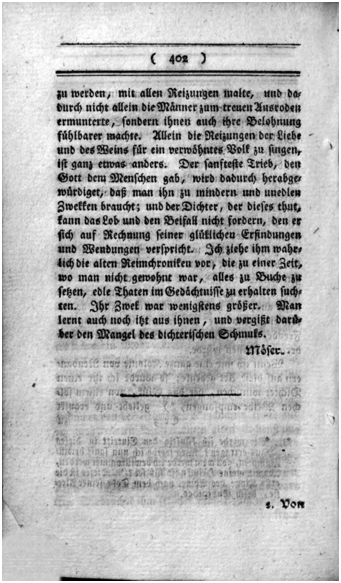
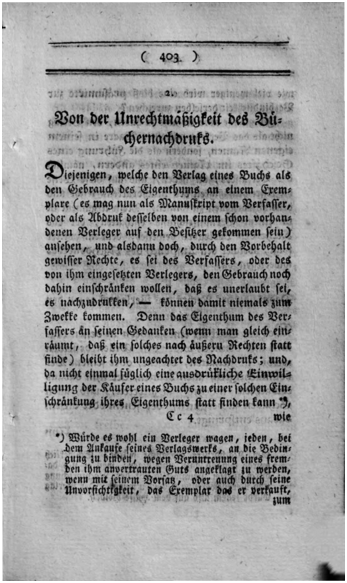
If we juxtapose the first pages of Kant’s original 1785 essay with those of its translation in The Cambridge Edition of the Works of Immanuel Kant, we shall see some of the past paratextual features that were not carried over into the contemporary English text (see Figure 2.1). In the German essay, between the main textual body and the footnote, we can identify a couple of apparently displaced markings along an invisible line that bibliographers call the ‘direction line’.Footnote 90 At the far-right of the direction line we find the last word of the page’s main text, wie (‘how’), which has been dropped to that corner from the line above it. If we turn to the next page, we shall find a repetition of the word wie, from which the main text continues. The pattern continues across all fifteen pages of Kant’s essay, with the solitary last word of each page in the direction line mirroring the first word of the subsequent page, as if anticipating the latter’s arrival. Indeed, Kant’s essay was, in this sense, foreseen in and by the periodical contribution before it: 1. An einen jungen Dichte (‘To a Young Poet’) by Justus Möser. In the May 1785 issue of the Berlinische Monatsschrift, Kant’s essay bore not only its German title, but also its assigned number within the ten publications in the issue: 2. Von der Unrechtmäßigkeit des Büchernachdrucks. On the last page of Möser’s letter, which is the verso of the leaf before the first of Kant’s, we find the marking 2. Von. In the same way, the last page of Kant’s essay is marked 3. Der, which is the first word and serial number of the following contribution: a poem entitled 3. Der Gefange (‘The Prisoner’). This series of paratexts, which point to and beyond Kant’s essay, are called ‘catchwords’.Footnote 91
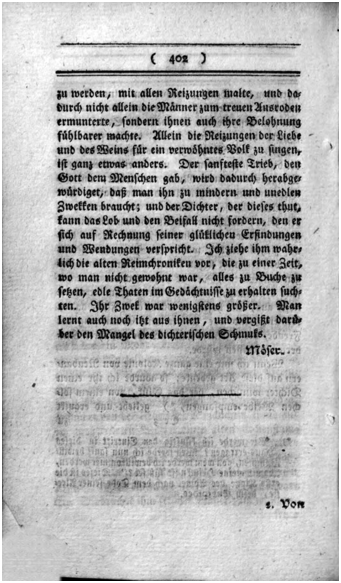
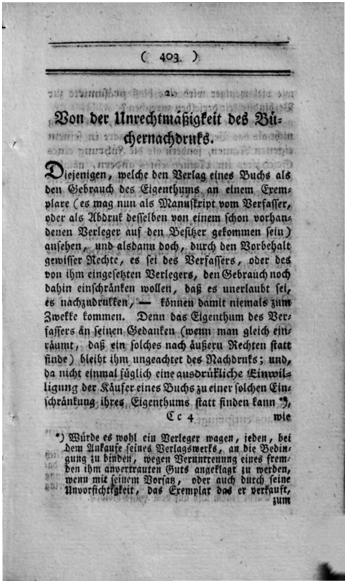
Figure 2.1 First page of Kant’s 1785 essay and the verso facing it.
‘Page-by-page catchwords’Footnote 92 of the sort used in the Berlinische Monatsschrift were one of the systems that had emerged in Western Europe during the early days of print for book producers to prescribe and track the physical structures of the books into which manuscripts were made. Books as codices, that is, ‘pairs of leaves folded into gatherings or quires’,Footnote 93 were produced pursuant to these types of functional systems. Even before Johann Gutenberg’s mid-fifteenth-century invention of the printing press, earlier practices of writing in the direction line of the verso of the final leaf of a gathering the first word of the recto of the first leaf of the subsequent gathering had been adopted in early medieval Latin books circa 1000.Footnote 94 Those early ‘gathering catchwords’Footnote 95 mostly worked to ensure the gatherings were bound in order. By the time that page-by-page catchwords became more or less standardised as a printing convention around the mid-sixteenth century, the system served at least two functions in addition to its contribution to bookbinding. Before book production arrived at the binding phase, the pages of the text had first to be arranged for printing in a particular sequence on large sheets of paper, after which the printed sheets could be cut and folded into gatherings. This activity of ‘imposition’Footnote 96 was undertaken by a workman in the printing house, the ‘compositor’,Footnote 97 whose responsibilities also included assembling the requisite printing types. Imposing catchwords helped the compositor to ensure the pages were in order. During bookbinding, the catchwords, assisted the binder also by ensuring the pages were correctly arranged. Further, as Daniel Sawyer has suggested, during the reading of the book, these catchwords, by virtue of their repetitive and anticipatory character, would have eased the reader’s transition from page to page, especially if the book was read aloud.Footnote 98
The catchword wie is hardly the only paratext that indexed the making of the Berlinische Monatsschrift, registering ‘how’ the manuscripts submitted by Kant and other authors to the editors became the printed pages enclosed between covers. To its left, centred within the same direction line, is another marking that reads ‘Cc4’. Unlike the catchword, this paratextual feature does not appear on every page of Kant’s essay, but only on the first two rectos and last three rectos of the leaves that comprise it. The recto of the leaf that comes after that of the first page is marked ‘Cc5’. In the following three leaves, each direction line simply contains a catchword. Only on the rectos of the sixth, seventh and eighth leaves do we find ‘Dd’, ‘Dd2’ and ‘Dd3’, respectively. But like catchwords, this series of markings both precede and succeed Kant’s essay. ‘Cc’, ‘Cc2’ and ‘Cc3’ appear in the opening and closing leaves of Möser’s letter, while ‘Dd4’ and ‘Dd5’ would appear in the third poem and the fourth essay. In the May 1785 periodical issue, catchwords begin from its first contributions and end with its last. There is no 1. An anticipating Möser’s letter, nor does final page of the issue include any catchword that heralds the June 1785 issue. Catchwords appear within individual issues of the Berlinische Monatsschrift, grouping them as relatively self-contained wholes. This second set of serial markings, however, cuts across the six issues that form the first volume of the Berlinische Monatsschrift in 1785. For instance, ‘Bb5’ is found in the last contribution to the April issue, and the June issue begins with ‘Ii’, continuing from the last markings of May’s. The volume begins with ‘A’– ‘A5’ in the first pieces in the January issue and ends with ‘Oo’–‘Oo5’ from the last few in the June issue. In bibliography, these markings are called ‘signatures’ or ‘signature marks’.Footnote 99
These signature marks in the German periodical were a hybrid system in which two older modes of sorting the leaves and gatherings of texts met. As Sawyer reminds us, the antecedents date back to well before print culture, the earliest evidence of which arose in late antiquity.Footnote 100 ‘Leaf signatures’,Footnote 101 usually comprised of numbers (e.g. 1–5), were used to mark every leaf of the first half of each gathering. On the other hand, ‘gathering signatures’Footnote 102 often appeared as a letter (e.g. A–O) or number marked on the recto of the first leaf of each gathering, or on the verso of the last leaf of the gathering. It was in late medieval times that leaf and gathering signatures became combined, marking not just the first and last leaves of a gathering but also the gathering as part of a codex. The combined form in the Berlinische Monatsschrift – identifying gatherings by serial letters from A to O, and from Aa to Oo, and marking leaves from 1 to 5 – dates back to others that were rapidly adopted by print producers during the incunable period. Like the system of catchwords, the signature series guided the work of binders by prescribing the text’s intended binding order. These systems were all the more significant at a time when texts, be they eighteenth-century novels or periodicals, were usually sent for binding only sometime after they had been purchased.Footnote 103 Eighteenth-century publishers, readers and binders could rely on these systems to have gatherings of leaves assembled into bound codices.
Like other periodicals, the Berlinische Monatsschrift did not reach its subscribers as bound volumes comprised of multiple issues. As its name indicates, the Berlinische Monatsschrift was published only once a month, each issue of which would usually have been delivered through the post as stitched gatherings of leaves. Though not yet enclosed in front and back paper boards, these issues would have, to some extent, resembled books in their printed matter. For instance, the May 1785 issue contained not just Kant’s essay and nine other contributions but also the front matter of a title page – including, in chronological sequence, the names of the periodical and editors, its month of issue, an imprint identifying the place of publication and the printing house, and a table of contents – followed by an advertising page. These opening paratexts, along with the internal serial markings of catchwords, signature marks and page numbers, would have lent some sense of unity to the periodical issue. Indeed, to collate these printed matter as a unit for sale already constitutes an act of binding, inasmuch as doing so defines the issue’s boundaries and ascribes value to it.Footnote 104 To assemble this issue and the other five from the first half of 1785 into a bound volume, then, is to engage in an act of rebinding: to unravel the ‘whole’ that it was and form another.
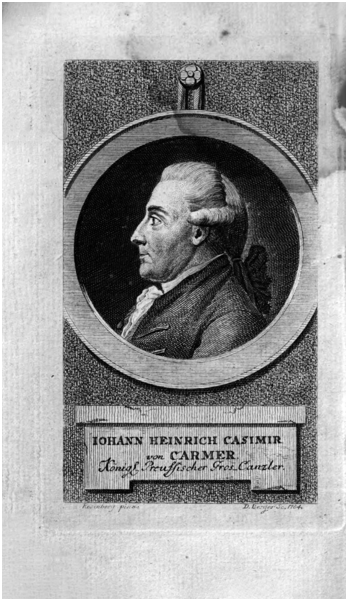
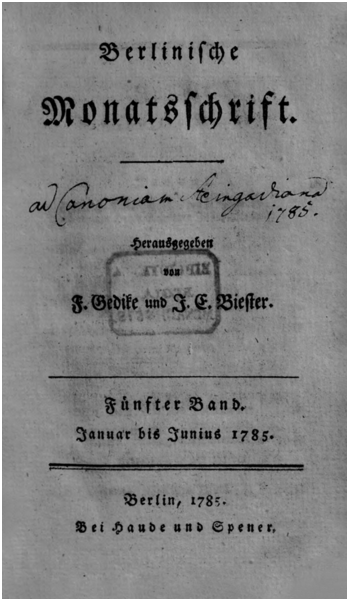
But if we return to the front matter of the volume comprised of the January–June 1785 issues of the periodical, it would seem that the subscribers needed more than the usual contents represented in the May issue to build the book as a whole (see Figure 2.2). After the flyleaf separating the front paper board from the printed pages, we find on the verso of the first leaf of the text block a portrait-style frontispiece of an eighteenth-century Prussian jurist, Johann Heinrich Casimir von Carmer. The copper-plate engraving consists of a circular frame affixed to a wall, which depicts a side profile of the head and upper torso of the jurist as if looking to the reader’s left and outside the book. Below the circular frame, engraved in Roman type, are his name and title as King Frederick II’s Grand Chancellor. Facing us, on the recto of the next leaf, we find the volume’s title page, again specifying the names of the periodical and its editors, the publishing house and place of publishing, and further identifying it as the fifth volume consisting of the six issues from January to June 1785. Thereafter, we find a consolidated table of contents, entitled Inhalt des fünften Bandes (Contents of the Fifth Volume), listing the full contributions of the six issues and their page numbers. Then, instead of the title page, table of contents and advertising page of the January issue, we see the first contribution to the month’s issue (another piece by Möser), followed by the others. To form the fifth volume, then, the subscriber-reader must have received the book’s own frontispiece, title page, and table of contents.
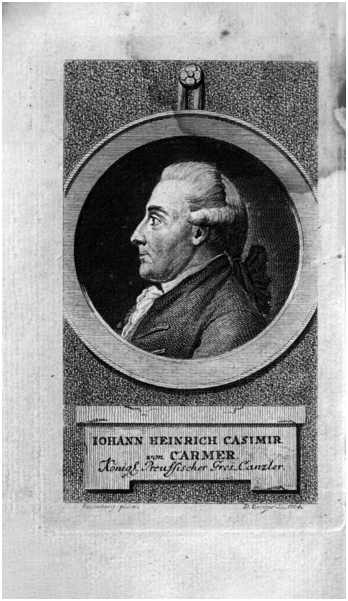
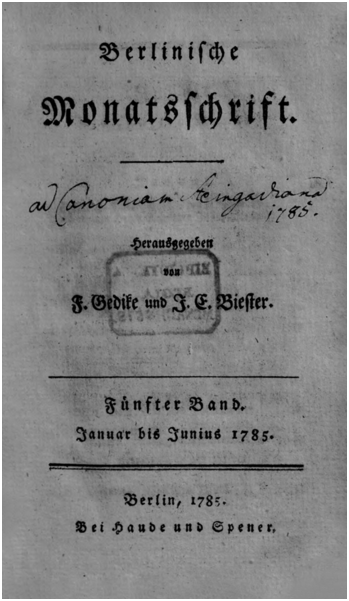
Figure 2.2 Frontispiece and title page of the fifth volume of the Berlinische Monatsschrift.
If we turn to the preface of the very first volume of the Berlinische Monatsschrift, we shall learn that these bookmaking materials had been purposefully given at selected times by Gedike and Biester:
Each month, an issue of six to seven sheets stitched together is published. Six issues make up one volume. With the sixth issue, the main title is given. Our idea as publishers is to occasionally (at least before the first issue of each volume) provide, at no additional price, a clean and faithful copper engraving of a special, deserving man whose image is not yet well known, which would delight us as much as the public.Footnote 105
Based on this key editors’ peritext, the frontispiece of Carmer would probably have been received by the January 1785 issue, while the main title and consolidated table of contents should have arrived with the June 1785 issue. From the very beginning of the Berlinische Monatsschrift, then, the editors had devised and carried out the plan of encouraging their readers to turn the individual issues into a bound volume by supplying them with these bookmaking materials every half year. The readers were, thereby, mobilised as participants in the making of each lasting volume of the Berlinische Monatsschrift. As well put by Pasanek and Wellmon, ‘The readers then participate in the Enlightenment not least by converting their periodicals into bound books; the serialised Monatsschrift providing a kind of kit that a reader could use (in cooperation with a book binder) to collect the individual pieces of the journal into a volume (ein Band) that would lend the journal the printed book’s greater sense of stability and heft.’Footnote 106
In so enlisting its reader-subscribers as bookmakers through these material means, the Berlinische Monatsschrift joined other eighteenth-century periodicals in promoting their own survival and longevity during the age of print proliferation. Rather than being a unique stratagem of Gedike and Biester, the distribution of those sorts of front matter was quite a common practice in periodical publishing. As Popkin has noted, ‘throughout the eighteenth century, journal publishers assumed that readers would bind and preserve the index numbers of their journals: subscribers regularly received title pages, indexes, and sometimes engraved illustrations that had not been included with the number of the journal when it was first sent out but which were intended to be bound with it in its definitive form’.Footnote 107 Becoming a book was one of the material methods by which the periodical sought to overcome its own ephemerality: an obsolescent condition where the value of its printed matter was ceded to, or equated with, that of the innumerable others constituting the ‘plague of German literature’.Footnote 108 To rebind every six issues of the Berlinische Monatsschrift into a hard-backed volume that could stand on the shelf for a long time and pulled out for re-reading at any future point was to value it as worthy of storage and retrieval. Gedike and Biester provided the instructions and materials for the individual reader’s revaluation of the received issues and, in so doing, improved its odds against the very phenomenon of print proliferation that the editors and Kant had identified as the medial-material conditions for their respective interventions.
Catchwords, signature marks, page numbers, title pages, imprints, tables of contents, advertising pages, frontispiece – none of these paratexts were inherited by the English translation of Kant’s essay in The Cambridge Edition of the Works of Immanuel Kant. Their excision reflects not so much editorial neglect as the loss of their historical functions. As Gérard Genette has noted, paratexts are developed to fulfil particular functions that allow them to present the text as a book. Thus, their lifespans are intimately related to how far they are needed to fulfil these functions: ‘a paratextual element may … disappear, definitively or not, by authorial decision or outside intervention or by virtue of the eroding effect of time’.Footnote 109 As books were increasingly sold in bound copies by publishers, and the processes of book production became more standardised and reliable (especially in the age of electronic publishing), catchwords and signature marks were no longer seen as necessary to guide the assembly of books. ‘Their disappearance is a marker of increasing predictability in the book and of the shift of the responsibility for binding from owners to producers.’Footnote 110 Having been transposed from the Berlinische Monatsschrift to an Anglophone edition comprising ‘all of Kant’s writings on moral and political philosophy’,Footnote 111 Kant’s essay now bears its own page numbers, title and intertitle pages, imprints and table of contents. Instead of the frontispiece of an unfamiliar but important jurist the editors sought to introduce to the public, we now find another portrait on the book cover – the illuminated head of Kant the author, peering at the dark grounds on which he stood. Following the nineteenth- and twentieth-century development of other mass media such as radio, television and the internet, print has long ceased to be the preferred medium for advertising. Many of the ‘prior’ and ‘original paratexts’Footnote 112 – those which had appeared before, within or alongside Kant’s essay at the time of its publication – were probably excluded from the contemporary edition because of their perceived obsolescence.
And yet, as I have suggested, these discarded paratexts are valuable in their continuing indexical functions: they point to the print machinery of the German Enlightenment that produced the Berlinische Monatsschrift, and which the enlightenment periodical sought to steer. As long recognised in the fields of book history and print culture, books are not the exclusive creations of their authors, but the effects of larger assemblages of technologies, techniques, objects, institutions and other persons. Robert Darnton has diagrammatised a ‘communications circuit’Footnote 113 through which printed books had tended to pass. In that circuit, authors were located within a series of other industry actors including publishers, printers, shippers, booksellers, readers and binders. The actions of those involved persons were, in turn, defined and delimited by particular historical conditions variously called ‘intellectual’, ‘economic’, ‘social’, ‘political’ and ‘legal’. This study of Kant’s essay in the fifth volume of the Berlinische Monatsschrift has similarly suggested a decentring of the figure of the author: instead of being simply the material embodiment of an author’s ‘own intellectual creation’, Kant’s essay was deeply involved in the historical processes that produced it and other printed matter in eighteenth-century Germany. Its material paratexts evidence the technologically mediated labour of compositors, printers, binders, advertisers, editors, readers, authors, etc. Together with the postal system, these text- and bookmaking processes participated in the gargantuan print apparatus that mediated the German Enlightenment. It was through the very medium of print that Kant, Gedike, Biester and others sought to clarify and advance public enlightenment and to intervene strategically in the phenomenon of print proliferation. Authorship in the German Enlightenment was intimately bound up with a broader medial-material assemblage without which essays, periodicals and books would not have been possible.
The Print Machinery of the German Enlightenment
In their history of modern intellectual property law, Brad Sherman and Lionel Bently suggested that the now trite treatment of literary works as forms of intangible property (in short, the ‘mentality of intangible property’Footnote 114) arose during the premodern debate over literary property leading up to the decision of Donaldson v Becket (1774).Footnote 115 Faced with the pressing issue of whether authors retained a perpetual property right in their labours at common law that surpassed the fourteen-year term of copyright protection conferred by the Statute of Anne 1710,Footnote 116 participants in the debate took opposing positions on the threshold question of the ontological status of literary property. For some who were against the very recognition of literary property, the supposedly incorporeal or intangible nature of authorial labour was cited as preventing any requisite occupancy or possession of the object amounting to the acquisition of title.Footnote 117 By contrast, those in favour of perpetual literary property claimed that the mental labour invested in authorial creation was, à la Locke’s notion of possessive individualism, sufficient to found the author’s property right. Occupancy was but an alternative to, if not a subsidiary of, labour as a category that justified the recognition of proprietary rights.Footnote 118 This question regarding the basis on which literary property could or could not be acquired, along with others pertaining to its identification and relation to the public,Footnote 119 dealt with the nature of the subject matter of literature and the (im)possibility of literary ownership. Despite their differing takes on whether and how far property may subsist in literature, both positions assume the distinction between mental and manual labour, between the exertions of the mind and body, which similarly defines their understanding of the pertinent subject matter.Footnote 120 In the premodern and modern phases of intellectual property law alike, literature tends to be understood as consisting in the intellectual efforts of the originating author, which are protected as forms of intangible property.
This study of Kant’s 1785 essay and some of its constitutive paratexts has suggested that literature need not be viewed in intangible or in proprietary terms. Despite the prevailing emphasis placed on the notion of the authorial speech act in Kantian copyright scholarship,Footnote 121 the essay also understood the book to be a printed artefact whose visible marks facilitated its reception by readers. Instead of viewing the book as a material embodiment of an intangible literary work created and owned by its author, Kant perceived it to be an optical medium that operated within a communicative situation, one that recognised authors as persons who relied on the technology to communicate with the public and perform the emancipatory practice of enlightenment. In line with his personal understanding of the author and medial account of the book, Kant’s proposed regulatory regime for book publishing eschewed the idiom of property rights and instead recognised legitimate publishers as agents contractually empowered by personal authors.Footnote 122 Kant’s prioritisation of authors and publishers as the main actors and controllers of book production is both deepened and problematised by this study of the essay’s paratexts. Both the epitextual background of the German Enlightenment and peritextual features of the periodical essay have directed us to the print machinery of eighteenth-century Germany. The indexed assemblage of print technologies, practices, infrastructures, and actors was the medial-material a priori that afforded the very production and circulation of Kant’s essay. Connecting but also preceding authors, publishers and books, this print machinery suggests the terms and doctrines of copyright law to be insufficient to deal with the complexities of the book’s emergence. As the myth of the proprietary author is reproduced through the triadic terms of ‘work, ‘author’ and ‘originality’, copyright law continues to suppress the deep historicity of literary production. Renewed attention to the medial-materialities of the print artefact is, arguably, necessary to counteract this.

 Open access