


Thinking is easy, acting is difficult, and to put one’s thoughts into action is the most difficult thing in the world. Knowing is not enough; we must apply. Willing is not enough; we must do. (Goethe)
Introduction
Sustained volunteering requires a long-term commitment to help and face challenges because of drop-outs, non-performance, and non-attendance of volunteers (Boezeman and Ellemers Reference Boezeman and Ellemers2007). People often discontinue volunteering because they feel that their efforts are not recognized, their skills and interests are not properly matched, and they are not given enough autonomy or freedom (Wilson Reference Wilson2000). There is mixed evidence as to what is behind sustained volunteering and which types of marketing efforts are effective to retain volunteers in the long term. Bennett and Barkensjo (Reference Bennett and Barkensjo2005) have found that volunteers’ commitment is positively affected by the charity’s internal marketing activities and negatively affected by the unpleasant client-contact experiences that they have to endure. Despite general satisfaction’s having been found positively to be associated with retention of volunteers (Dwiggins-Beeler et al. Reference Dwiggins-Beeler, Spizberg and Roesch2011), integration schemes on their own, such as regular meetings with staff, newsletters, mailings, and appreciation events, turned out to be insufficient to promote continued volunteering (Einolf and Chambré Reference Einolf and Chambré2011; Omoto and Snyder Reference Omoto and Snyder1995).
The purpose of this study is to test the extent to which an expanded theory of planned behavior (TPB) model can explain sustained volunteering. This study will explore a specific behavioral aspect of sustained volunteering by addressing what makes young people volunteer for a specific long-term project. Two types of behavior and behavioral intention will be approached: first, the act of volunteering itself and second, the commitment to the length of the project which the volunteers have decided to help with. The path towards long-term volunteering can start at a young age and this very group encompasses potential leaders able to drive volunteering forward (Francis Reference Francis2011; Janoski et al. Reference Janoski, Musick and Wilson1998). Furthermore, there is a serious research gap in the volunteering literature in relation to how this demographic group behaves (McDougle et al. Reference McDougle, Greenspan and Handy2011).
TPB: Brief Description and Critique
The theory of reasoned action (TRA) was created by Fishbein and Ajzen in the 1970s (Ajzen and Fishbein Reference Ajzen and Fishbein1980; Fishbein and Ajzen Reference Fishbein and Ajzen1975) as an attempt to predict human behavior from attitudes and norms. The TPB came to prominence in the following years to expand the TRA applicability to non-volitional behaviors (Ajzen Reference Ajzen, Kuhl and Beckman1985, Reference Ajzen1991, Reference Ajzen2005). The TRA proposes a mediator for the attitude-behavior relationship, the behavioral intention. Behavioral intention is a measure of the individual’s readiness to perform the behavior (Ajzen Reference Ajzen2006). The TPB proposes the addition of a new component to the TRA, named perceived behavioral control (PBC). PBC is a measure of the extent to which a person believes that the behavior is under their own control (Ajzen Reference Ajzen2002). The TRA elements include attitude toward the behavior, subjective norm, behavioral intention, and behavior (i.e., attitude → behavioral intention; subjective norm → behavioral intention; behavioral intention → behavior). The TPB includes the same elements as the TRA, plus PBC (PBC → behavioral intention; PBC → behavior). All these elements are supposed to be compatible with and correspond to the same specific components of Target, Action, Context, and Time frame (i.e., the TACT, see Ajzen and Fishbein Reference Ajzen and Fishbein1977, Reference Ajzen and Fishbein1980; Fishbein and Ajzen Reference Fishbein and Ajzen1975).
Empirical research has shown that the TPB supersedes the TRA (Armitage and Christian Reference Armitage and Christian2003; Hausenblas et al. Reference Hausenblas, Carron and Mack1997). PBC has been found to raise the amount of variance explained (∆R 2) in behavioral intentions and behavior in a variety of behavioral domains (Basen-Engquist and Parcel Reference Basen-Engquist and Parcel1992; Madden et al. Reference Madden, Ellen and Ajzen1992; Armitage and Conner Reference Armitage and Conner2001a). A major failure of these empirical investigations is that few have concentrated on measuring “actual” behavior; instead they have used self-reported measures of behavior or assumed that intention is a good predictor of behavior (Armitage and Christian Reference Armitage and Christian2003; Jackson Reference Jackson2005). Another criticism is that much research on the TPB has been undertaken by measuring behavior and cognitive variables at the same time, which weakens the internal validity of the resulting model.
Hypotheses
Previous TPB investigations which aimed to predict volunteering have been confined to the use of self-reported measures of behavior (Greenslade and White Reference Greenslade and White2005; Warburton and Terry Reference Warburton and Terry2000) or evaluations of intention (Okun and Sloane Reference Okun and Sloane2002). To the best of our knowledge, the TRA study by Harrison (Reference Harrison1995) on volunteering was the only one to undertake the measurement of actual behavior, but as the TRA supposes, it did not evaluate the role of PBC. In these investigations, the time elapsed between the measure of behavior and the measure of cognitive variables varied from 1 to 2 months only, thus implying that further lessons remain to be learned from volunteering for longer-term projects and the TPB. There is still scope for research addressing the role of additional variables in the TPB as only moral obligation and behavioral norm have been approached previously (Harrison Reference Harrison1995; Warburton and Terry Reference Warburton and Terry2000).
Based on the standard TPB tenets and on evidence from such investigations on volunteering, (a) sustained volunteering behavior is expected to increase as behavioral intention increases, (b) attitude, subjective norm, and PBC are expected to contribute to the prediction of intention to volunteer, and (c) PBC is not expected to contribute to the prediction of volunteering behavior. Thus, PBC is proposed to add significantly to the predictive ability of the model to explain intention to volunteer but not sustained volunteering behavior, which would partially support the claim that the TPB surpasses the TRA in the context of time donation.
Further variables should work in parallel with TPB standard elements (Ajzen Reference Ajzen1991) and have a significant direct effect upon intention. Early formulations of the TRA considered personal norm as a distinct type of normative belief (Fishbein Reference Fishbein and Fishbein1967), but because Ajzen and Fishbein (Reference Ajzen and Fishbein1969) did not find empirical evidence to support the presence of personal normative beliefs in the TRA, they announced their decision to drop it from the theory. Nevertheless personal norm has been regarded as a potential predictor of intention within domains with a strong moral connotation (Manstead and Parker Reference Manstead, Parker, Stroebe and Hewstone1995). Personal norm represents people’s personal beliefs about right and wrong and is highly related to moral obligation (Eagly and Chaiken Reference Eagly and Chaiken1993). Several TPB studies tested personal norms and found that they raised the amount of explained variance in intention to perform different types of behavior, such as dishonest actions by 3–7 % (Beck and Ajzen Reference Beck and Ajzen1991), ethical decision by 13 % (Kurland Reference Kurland1996), healthy eating by 2–7 % (Sparks and Guthrie Reference Sparks and Guthrie1998), recycling by 5 % (Davies et al. Reference Davies, Foxall and Pallister2002), blood donation by 10 % (Lemmens et al. Reference Lemmens, Abraham, Hoekstra, Ruiter, De Kort, Brug and Schaalma2005), and organ donation by 3 % (Hübner and Kaiser Reference Hübner and Kaiser2006).
Self-identity reflects the extent to which an individual perceives themselves to be fulfilling the criteria for the societal role (Conner and Armitage Reference Conner and Armitage1998). The accumulation of empirical TPB research in prosocial domains is such that that self-identity is expected to explain any unique variance in intention to volunteer. Self-identity has been found to lead to a significant increase in the proportion of variance explained in intention across different contexts, such as green consumerism by 4 % (Sparks and Shepherd Reference Sparks and Shepherd1992), healthy eating by 2–4 % (Sparks and Guthrie Reference Sparks and Guthrie1998; Armitage and Conner Reference Armitage and Conner1999), alcohol consumption by 1.5–11.9 % (Conner et al. Reference Conner, Warren, Close and Sparks1999), blood donation by 1.5–8 % (Armitage and Conner Reference Armitage and Conner2001b; Giles et al. Reference Giles, McClenahan, Cairns and Mallet2004) and 30 different types of everyday behavior (e.g., buying a magazine, recycling glass, and studying on the Internet) by 6.4 % (median) (Hagger and Chatzisarantis Reference Hagger and Chatzisarantis2006).
The hypotheses can be summarized as follows:
H1
Behavioral intention will significantly predict volunteering behavior.
H2
PBC will not predict volunteering behavior.
H3a–c
Attitude (H3a), subjective norm (H3b), and PBC (H3c) will significantly predict intention to volunteer.
H4
The TPB will explain more of the variance in intention to volunteer than the TRA.
H5
Personal norm will significantly predict intention to volunteer.
H6
Self-identity will significantly predict intention to volunteer.
H7a–b
The expanded TPB model will explain more variance in intention to volunteer than the TRA (H7a) and the TPB (H7b).
Methodology
A registered UK charity, which works for disadvantaged and vulnerable people and organizes voluntary projects for the young, provided access to the full list of volunteers affiliated with the organization in 28 different projects. The projects ranged widely and covered diverse schemes for children, elderly people, the homeless, the disabled, and individuals with mental health illness.
The project design for this research was drawn up in several phases. Initially, a self-administered questionnaire was sent to 530 volunteers at a specific moment in time, which was at the very beginning of their activities in the projects that they decided to help with (time 1). A total of 237 volunteers aged 18–25 years (M = 20.3, SD = 1.26) answered the questionnaire. The description of behavior in the questionnaire was defined as “volunteering (Act) through Charity X (Target) in the project that I have committed myself to (Context) for the full project period (Time).” The Kruskal–Wallis non-parametric ANOVA reveals that there were no significant differences among responses of the participants from different volunteering projects for the questionnaire items (p > .05). Second, project coordinators filled out an observation recording schedule with information on the actual participation of the volunteers in their projects over the full period of activities (time 2), which varied from 4 to 6 months. We obtained observation data on the behavior of 161 out of these 237 volunteers who answered the questionnaire.
Two focus groups with eight participants each were organized. One group addressed the volunteering behavior in general and the other, the voluntary service of the current volunteers of the charity. The group interviews were recorded and lasted around 1 h each. We followed a protocol of questions which addressed issues on time commitment, project themes, the advantages and disadvantages of volunteering, approval and disapproval of volunteering, and factors and circumstances which facilitate or hinder volunteering. Informed consent was obtained from all of the group participants. Data for analysis were generated from both audio-tapes and field notes. Finally, follow-up interviews with the coordinators of the 28 projects were carried out after the completion of the projects. The coordinators were asked to indicate spontaneously the main reasons why some young volunteers dropped out or did not commit themselves as they had initially agreed. The data were studied in detail and the reasons were reported in summary form.
Measures
Future actual behavior was measured according to the frequency and recency of volunteers’ participation in the project. Frequency was the measure of the number of times a volunteer attended activities in the project per full attendance and recency indicated the volunteer’s most recent attendance in the project. The mean was taken to form the composite variable “volunteering behavior for the full project period.” Frequency and recency were rated on 5-point scales, rating 1 of which indicated the lowest levels of attendance and rating 5, the highest. This method enabled an exact match to be made between the description of behavior in terms of TACT components and the actual behavior being measured.
Behavioral intention was measured by three items which ranged from “strongly disagree” (1) to “strongly agree” (7): “I will make an effort to volunteer with Charity X for the full project period,” “I definitely want to volunteer with Charity X for the full project period” and “My plan is to volunteer as I have committed myself for the full project period.”
Attitude toward the behavior represents the individual’s negative and positive evaluations about the behavioral performance (Ajzen Reference Ajzen, Kuhl and Beckman1985). Attitude toward volunteering with the charity for the full project period was measured using five bipolar adjective items that ranged from meaningless to meaningful, unpleasant to pleasant, bad to good, foolish to wise, and unenjoyable to enjoyable, scored 1–7.
Subjective norm is a measure of the extent to which an individual perceives that the important people in their life support or endorse performance of the behavior (Ajzen Reference Ajzen, Kuhl and Beckman1985, Reference Ajzen2005) and was measured by three items rated on 7-point scales ranging from “strongly disagree” (1) to “strongly agree” (7). They are: “If I decide to volunteer for the full project period, most people who are important to me would approve,” “People who are important to me wouldn’t want me to volunteer for the full project period with Charity X” (reverse score), and “The people in my life whose opinions I value think that I should volunteer for the full project period”.
PBC was measured by two items which ranged from “strongly disagree” (1) to “strongly agree” (7): “I am confident that I am able to volunteer through Charity X for the full project period” and “I think I am capable of volunteering with Charity X for the full project period”. Measures of behavioral intention, attitude toward the behavior, subjective norm, and PBC were based on Ajzen (Reference Ajzen2005, Reference Ajzen2006).
Personal norm was measured by four items scored 1 (strongly disagree) to 7 (strongly agree): “It would be wrong for me to ignore my volunteering activities”, “I would have a bad conscience if I did not volunteer as I agreed to do”, “Volunteering with Charity X is the right thing for me to do” and “I feel I should volunteer in the Charity X’s project as I have committed myself” (Conner et al. Reference Conner, Smith and McMillan2003; Evans and Norman Reference Evans and Norman2003; Moan and Rise Reference Moan and Rise2005, Reference Moan and Rise2006; O’Callaghan and Nausbaum Reference O’Callaghan and Nausbaum2006).
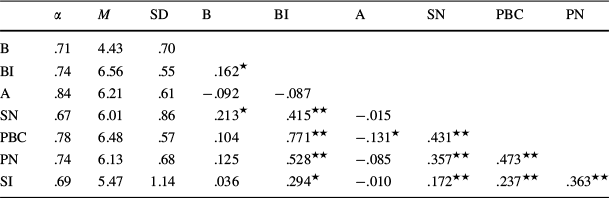
Self-identity was measured by two items scored 1 (strongly disagree) to 7 (strongly agree): “I would feel at a loss if I were forced to give up my volunteering” and “For me, being a volunteer means more than just volunteer work” (Armitage and Conner Reference Armitage and Conner2001b; Conner et al. Reference Conner, Warren, Close and Sparks1999; Conner and McMillan Reference Conner and McMillan1999; Terry et al. Reference Terry, Hogg and White1999). Table 1 shows the reliability, means, standard deviations, and Pearson correlations of the variables.
Table 1 Cronbach alphas (α), means, standard deviations, and correlation coefficients (r)

|
α |
M |
SD |
B |
BI |
A |
SN |
PBC |
PN |
|
|---|---|---|---|---|---|---|---|---|---|
|
B |
.71 |
4.43 |
.70 |
||||||
|
BI |
.74 |
6.56 |
.55 |
.162⋆ |
|||||
|
A |
.84 |
6.21 |
.61 |
−.092 |
−.087 |
||||
|
SN |
.67 |
6.01 |
.86 |
.213⋆ |
.415⋆⋆ |
−.015 |
|||
|
PBC |
.78 |
6.48 |
.57 |
.104 |
.771⋆⋆ |
−.131⋆ |
.431⋆⋆ |
||
|
PN |
.74 |
6.13 |
.68 |
.125 |
.528⋆⋆ |
−.085 |
.357⋆⋆ |
.473⋆⋆ |
|
|
SI |
.69 |
5.47 |
1.14 |
.036 |
.294⋆ |
−.010 |
.172⋆⋆ |
.237⋆⋆ |
.363⋆⋆ |
B behavior, BI behavioral intention, A attitude, SN subjective norm, PBC perceived behavioral control, PN personal norm, SI self-identity; ⋆ p < .05; ⋆⋆ p < .01; N = 237, except for behavior for which N = 161
Analysis
Predicting Volunteering Behavior
Prediction of volunteering behavior for the full project period employed hierarchical logistic regression, whereby volunteering behavior was regressed on behavioral intention and PBC. In doing so, the variable behavior was transformed into a dichotomic variable according to levels of volunteering commitment. The division of groups was based upon the analysis of quartiles and the respondents were categorized into highly committed volunteers (i.e., who finished their projects with the highest levels of attendance) and weakly committed volunteers (i.e., who either did not finish their projects or presented the highest levels of nonattendance). Analysis of the continuous variable “volunteering behavior” shows that 64 volunteers had the maximum score, that is, 5, corresponding to the 75th percentile. They were categorized under the “highly committed volunteers” group. Twenty-two volunteers had scores below 4, corresponding to the 25th percentile. Twenty-two volunteers presented scores greater than 4 and lower than 4.5, corresponding to the 25th–50th percentiles. They were put together to form the group of “weakly committed volunteers.” Volunteers with scores greater than 4.5 and lower than 5 were excluded from the analysis (50th–75th percentiles).
Logistic Regression Results
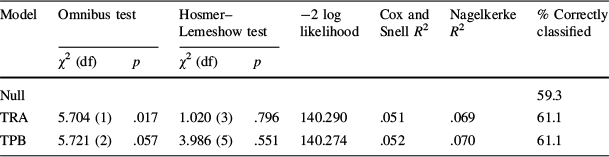
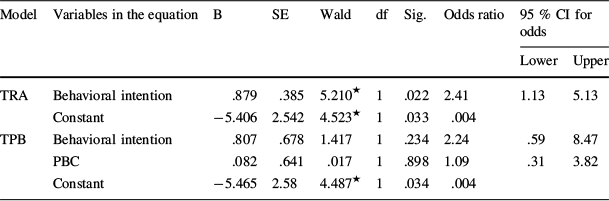
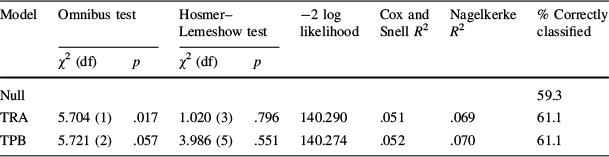
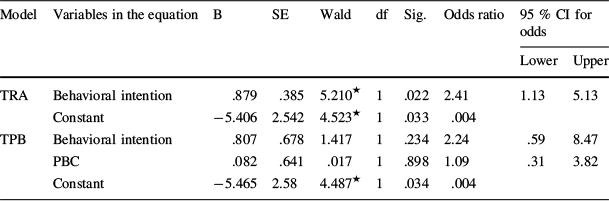
The goodness-of-fit indicators in Table 2 suggest that the TRA is a good representation of the data (i.e., omnibus test p < .05, Hosmer–Lemeshow test p > .05). The pseudo R 2 values suggest that the TRA explained between 5.1 and 6.9 % of the variability in volunteering behavior for the full project period. Table 2 shows that the TRA correctly classified 61.1 % of the volunteering behavior, a slight improvement of 1.8 % over the null model. H1 is, therefore, supported. While the TRA was able to predict accurately a substantial percentage (81.2 %) of the highly committed volunteers it correctly classified only 31.8 % of those who did not volunteer for the full project period. That is, the young volunteers who demonstrated the highest levels of commitment to the project had that intention to do so from the very beginning of their activities, but many of those who had lower levels of commitment were unable to follow through on their initial intention to volunteer for the full project period. The addition of PBC did not lead to an increase in the percentage correctly classified, so that the TPB did not improve the TRA explanation of volunteering behavior for the full project period. H2 is thus supported. This is confirmed by the analysis of the Wald statistic and its probability values in Table 3. As Table 3 shows, the odds in favor of completing the volunteering project are twice as high for those who reported having high behavioral intention than it was for those who reported lower behavioral intention (TRA: odds ratio of 2.41, 95 % CI 1.13–5.13; TPB: odds ratio of 2.24, 95 % CI .59–8.47). This unaccounted for variance reflects the difficulty volunteers that have in foreseeing the potential obstacles which can hamper the actual volunteering for the full project period.
Table 2 Logistic regression analysis for predicting volunteering behavior
|
Model |
Omnibus test |
Hosmer–Lemeshow test |
−2 log likelihood |
Cox and Snell R 2 |
Nagelkerke R 2 |
% Correctly classified |
||
|---|---|---|---|---|---|---|---|---|
|
χ2 (df) |
p |
χ2 (df) |
p |
|||||
|
Null |
59.3 |
|||||||
|
TRA |
5.704 (1) |
.017 |
1.020 (3) |
.796 |
140.290 |
.051 |
.069 |
61.1 |
|
TPB |
5.721 (2) |
.057 |
3.986 (5) |
.551 |
140.274 |
.052 |
.070 |
61.1 |
Table 3 Variables in the equation to predict volunteering behavior
|
Model |
Variables in the equation |
B |
SE |
Wald |
df |
Sig. |
Odds ratio |
95 % CI for odds |
|
|---|---|---|---|---|---|---|---|---|---|
|
Lower |
Upper |
||||||||
|
TRA |
Behavioral intention |
.879 |
.385 |
5.210⋆ |
1 |
.022 |
2.41 |
1.13 |
5.13 |
|
Constant |
−5.406 |
2.542 |
4.523⋆ |
1 |
.033 |
.004 |
|||
|
TPB |
Behavioral intention |
.807 |
.678 |
1.417 |
1 |
.234 |
2.24 |
.59 |
8.47 |
|
PBC |
.082 |
.641 |
.017 |
1 |
.898 |
1.09 |
.31 |
3.82 |
|
|
Constant |
−5.465 |
2.58 |
4.487⋆ |
1 |
.034 |
.004 |
|||
Predicting Intention to Volunteer
A hierarchical multiple linear regression analysis was performed to predict intention to volunteer for the full project period. Intention to volunteer was regressed on attitude, subjective norm, PBC, and the additional variables, as follows: measures of attitude and subjective norm were added at Block 1 (TRA), PBC at Block 2 (TPB), and personal norm and self-identity at Block 3.
Hierarchical Multiple Regression Results
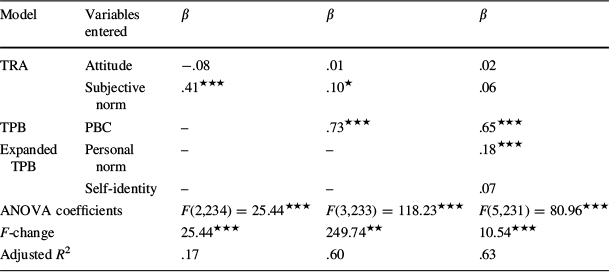
Table 4 shows that the TRA (F(2,234) = 25.44, p < .001), the TPB (F(3,233) = 118.23, p < .001) and the expanded TPB model (F(5,231) = 80.96, p < .001) were statistically significant. As regards the TRA and the TPB, subjective norm and PBC (but not attitude) produced a significant independent contribution to help explain intention to volunteer for the full project period. Subjective norm accounted for 17 % of variability in intention to volunteer, and the addition of PBC increased the adjusted R 2 of the model to 60 %. Therefore, H3a is rejected and H3b, H3c, and H4 are supported.
Table 4 Hierarchical multiple regression of intention to volunteer

|
Model |
Variables entered |
β |
β |
β |
|---|---|---|---|---|
|
TRA |
Attitude |
−.08 |
.01 |
.02 |
|
Subjective norm |
.41⋆⋆⋆ |
.10⋆ |
.06 |
|
|
TPB |
PBC |
– |
.73⋆⋆⋆ |
.65⋆⋆⋆ |
|
Expanded TPB |
Personal norm |
– |
– |
.18⋆⋆⋆ |
|
Self-identity |
– |
– |
.07 |
|
|
ANOVA coefficients |
F(2,234) = 25.44⋆⋆⋆ |
F(3,233) = 118.23⋆⋆⋆ |
F(5,231) = 80.96⋆⋆⋆ |
|
|
F-change |
25.44⋆⋆⋆ |
249.74⋆⋆ |
10.54⋆⋆⋆ |
|
|
Adjusted R 2 |
.17 |
.60 |
.63 |
|
⋆p < .05; ⋆⋆ p < .01; ⋆⋆⋆ p < .001
Looking at the contribution of additional variables to the expanded TPB model reveals that personal norm emerged as a strong predictor of volunteering intention, lending support to H5. Self-identity failed to predict intention to volunteer, therefore H6 is rejected. The expanded TPB model led to a slight but statistically significant increment in the variance explained in volunteering intention (adjusted R 2 change = 3 %, F change = 10.54, p < .001). H7a and H7b are thus supported.
Post Hoc Analysis
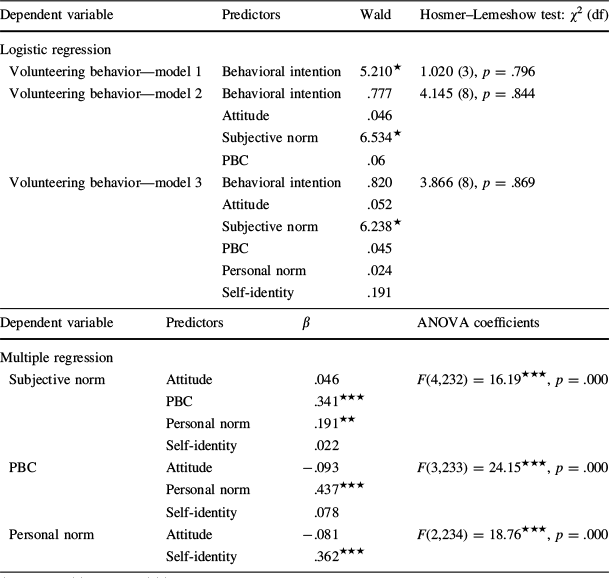
An integrated model of sustained volunteering was tested to identify new relationships and paths among the variables. The rationale for developing an integrated model was to find an alternative explanation for the relationships among the constructs, since some of them did not follow the hypothesized paths. In testing the integrated model, the dependent variable “volunteering behavior” was analyzed via logistic regression, whereas all the other dependent variables were analyzed via multiple regression. In Table 5, the Hosmer–Lemeshow test values (p > .05) show that the logistic models fit the data well. The addition of subjective norm to the logistic regression equation altered the contribution of behavioral intention, which turned out to be non-significant. Subjective norm is, therefore, the key predictor of volunteering behavior in the integrated model. Table 5 shows that all the multiple regression equations were significant (F statistics p < .001). PBC and personal norm are key predictors of subjective norm. PBC is also predicted by personal norm, which is predicted by self-identity. Attitude failed to contribute to the model.
Table 5 Results of logistic and multiple regressions of the integrated model of sustained volunteering

|
Dependent variable |
Predictors |
Wald |
Hosmer–Lemeshow test: χ2 (df) |
|---|---|---|---|
|
Logistic regression |
|||
|
Volunteering behavior—model 1 |
Behavioral intention |
5.210⋆ |
1.020 (3), p = .796 |
|
Volunteering behavior—model 2 |
Behavioral intention |
.777 |
4.145 (8), p = .844 |
|
Attitude |
.046 |
||
|
Subjective norm |
6.534⋆ |
||
|
PBC |
.06 |
||
|
Volunteering behavior—model 3 |
Behavioral intention |
.820 |
3.866 (8), p = .869 |
|
Attitude |
.052 |
||
|
Subjective norm |
6.238⋆ |
||
|
PBC |
.045 |
||
|
Personal norm |
.024 |
||
|
Self-identity |
.191 |
||
|
Dependent variable |
Predictors |
β |
ANOVA coefficients |
|---|---|---|---|
|
Multiple regression |
|||
|
Subjective norm |
Attitude |
.046 |
F(4,232) = 16.19⋆⋆⋆, p = .000 |
|
PBC |
.341⋆⋆⋆ |
||
|
Personal norm |
.191⋆⋆ |
||
|
Self-identity |
.022 |
||
|
PBC |
Attitude |
−.093 |
F(3,233) = 24.15⋆⋆⋆, p = .000 |
|
Personal norm |
.437⋆⋆⋆ |
||
|
Self-identity |
.078 |
||
|
Personal norm |
Attitude |
−.081 |
F(2,234) = 18.76⋆⋆⋆, p = .000 |
|
Self-identity |
.362⋆⋆⋆ |
||
⋆p < .05; ⋆⋆ p < .01; ⋆⋆⋆ p < .001
Discussion and Implications
What Motivates Volunteering Behavior?
Analysis of the survey data revealed that those young people who are more likely to carry out their activities as agreed hold high behavioral intention to do so. That is, it is likely that those who took part in the voluntary service for the full project period (i.e., highly committed volunteers) had that intention from the very beginning of their activities. On the other hand, there were those volunteers who reported low behavioral intention and who were not therefore expected to sustain their volunteering until the end of the project. If someone has a low level of intention then it is unlikely that they will continue volunteering for the full period of the project. This intention-behavior path is in accord with prior TRA and TPB research on time donation (i.e., Greenslade and White Reference Greenslade and White2005; Harrison Reference Harrison1995; Okun and Sloane Reference Okun and Sloane2002; Warburton and Terry Reference Warburton and Terry2000).
However, despite appearing significant at first glance, the prediction of volunteering behavior from behavioral intention was found to be weak. Behavioral intention had a significant effect upon volunteering behavior but only when subjective norm was not considered as a predictor of behavior in the integrated model. Such a weak prediction reveals that the intentions of Charity X volunteers did not adequately represent their actual participation in the projects. It is important to keep in mind that this research dealt with discrete volunteering projects which lasted for an extended period of time. The longer the project is the more likely it is that unexpected events will hinder the fulfillment of the original intention. As Ajzen (Reference Ajzen, Kuhl and Beckman1985) recognizes, even behavior which can be typically performed at will is sometimes subject to the influence of factors beyond individual conscious control. Eisenberg (Reference Eisenberg1986) argues that just because people decide to assist one another it does not necessarily mean that they will follow through on their intention. As the integrated model suggests, having the intention to assist someone is no guarantee in itself that the deed will actually be carried out. Therefore, contrary to the TRA tenets, which posit that behavioral intention is the single determinant of behavior, it was subjective norm which emerged instead as the key predictor of future actual volunteering behavior.
The Role of Subjective Norm: Volunteering as a Normative Behavior
The research findings of this study corroborated previous results from TPB investigations (e.g., Greenslade and White Reference Greenslade and White2005; Harrison Reference Harrison1995; Okun and Sloane Reference Okun and Sloane2002; Warburton and Terry Reference Warburton and Terry2000) which proposed that subjective norm be considered a strong predictor of volunteering intention. However, in addition to this finding and even more importantly to the conclusion of this study, subjective norm emerged from this research not only as a strong predictor of intention to volunteer but in fact as the only significant predictor of volunteering behavior. This finding is compatible with the view that volunteering is normative behavior (e.g., Fisher and Ackerman Reference Fisher and Ackerman1998).
The normative pressure upon young volunteers arises from diverse sources (e.g., society in general, the charitable organization, the audience being helped, the volunteer group). Within the context of this research, the normative pressure proved to be so strong that it influenced volunteering behavior directly. As Christian and Armitage (Reference Christian and Armitage2002) argue, that subjective norm is a significant predictor of behavior might sound incompatible with the TPB tenets, however, this idea is in complete agreement with other domains of social psychology which have long suggested that normative pressure exerts an influence upon behavior. The following testimonies from the focus group interviews outline the role of referent others in favor of volunteering initiation and continuation:
If I talk to other people about the project, – to my friends – that I am doing this project, it does have an influence actually. I remember being told about volunteering by my house-mates and thinking of doing something like that myself. [Female, 22 years old]
I know people who I care for belonging to a charity community and I see it working, so I go and volunteer. I have a friend, one of my best friends, involved with a charity and, because of him, I have realized how it works and it works very well. In this case, I contribute because I believe in the work and I have friends there. [Female, 26 years old]
It is interesting to note that among those TPB-based investigations which have tested the relationship between variables over and above the TPB tenets, the following three investigations have also found a direct link between subjective norm and behavior: the study of Davies et al. (Reference Davies, Foxall and Pallister2002) on recycling and the investigations of Christian and Armitage (Reference Christian and Armitage2002) and of Christian and Abrams (Reference Christian and Abrams2003) on homelessness. A common characteristic of these three TPB-based investigations is that, like this study, they also employed objective measures of behavior (i.e., direct and indirect observation). Volunteering seems to be a type of behavior which involves both high visibility (Davies et al. Reference Davies, Foxall and Pallister2002) and group membership (Christian and Abrams Reference Christian and Abrams2003; Christian and Armitage Reference Christian and Armitage2002) and these features can help to explain the successful prediction of the volunteering behavior of the young from subjective norm. The direct link between subjective norm and behavior is also consistent with the proposition that the subjective norm is especially important to people who are highly concerned with receiving the approval of others (Latimer and Ginis Reference Latimer and Ginis2005) as seems to be the case with this profile of young volunteers. Overall, the results of this research support the claim that subjective norm is particularly useful to predict specific behavioral aspects (e.g., Finlay et al. Reference Finlay, Trafimow and Moroi1999; Moan et al. Reference Moan, Rise and Andersen2005), such as volunteering behavior.
The Influence of Important Others
In the integrated model, subjective norm was found to be directly influenced by how much the volunteers believe that they have control over their participation in the project for the full project period (i.e., PBC → subjective norm) and also by how much the volunteers feel that they should volunteer for the full project period (i.e., personal norm → subjective norm).
In the context of the present research the PBC-subjective norm path might indicate that young volunteers consider that people who are important to them will only approve of their behavioral performance if they demonstrate proper control over it, such as by providing adequate conditions to carry out the voluntary service without harming either those being helped or themselves. The following testimony from the focus group gives that impression:
- Participant D:
-
My mother does not want me to volunteer because she thinks I am spending too much time on it and I should focus on my degree
- Participant C:
-
Really?
- Participant A:
-
My parents think the same. They think I should do a job instead… They are not nasty people…! […]
- Participant F:
-
Yeah… it is not that my family does not like my volunteering, but they are always saying ‘do not spend too much time on that’, ‘how long do you spend doing that?’
- Participant G:
-
It is because they do not really understand why we do it
[Focus group with Charity X’s volunteers]
In addition to the effects of PBC, subjective norm has been found to be strongly affected by personal norm. Notwithstanding the attribute of non-obligatory helping which is implied by the act of volunteering (Penner Reference Penner2002, Reference Penner2004), it seems that once a commitment to volunteering has been made then feelings of moral obligation (i.e., personal norm) will arise to guide the behavior. By discussing the role of social networks in volunteering, Wilson (Reference Wilson2000) has commented about the thinking of “we don’t want to let our friends down,” which he felt might be one reason why some people sustain their volunteering. Wilson’s view (Reference Wilson2000) is consistent with this personal norm-to-subjective norm path in the sense that the pressure to which some volunteers or specific community members feel themselves subject is associated with a duty not to disappoint the group to which they belong, which will consequently have an impact on their sustained volunteering (i.e., personal norm → subjective norm → behavior). This finding seems to be equally important in the analysis of other groups who are looking for social interaction through volunteering—which might be the case with elderly volunteers.
Consequently, besides the commitment to a cause, charitable organization, or the volunteering project per se, continued volunteering might represent a commitment to the social group. Because volunteering is a “conscience good or activity” (Freeman Reference Freeman1997, p. S140), people may feel morally obliged to commit to the project in support of the other members of the group. This finding suggests that having friends in a volunteer group not only encourages individuals to join charitable programs but also encourages them to sustain their volunteering. As Hustinx et al. (Reference Hustinx, Vanhove, Declercq, Hermans and Lammertyn2005) put it, volunteering is “socially contagious.” All this evidence is essentially compatible with the social function of volunteerism (Clary et al. Reference Clary, Snyder and Ridge1992, Reference Clary, Snyder, Ridge, Copeland, Stukas, Haugen and Miene1998; Snyder et al. Reference Snyder, Clary, Stukas, Maio and Olson2000) and again signals that the social group is of great importance to young volunteers.
Dealing with Factors Beyond Control
The integrated model suggests that Perceived Behavior Control (PBC) is affected by personal norm (i.e., personal norm → PBC). The path personal norm-to-PBC indicates that the stronger the moral obligation donors feel to volunteer, the greater the control they think they exercise over the voluntary action. It is possible that this young sample group (which shares a similar lifestage and a comparable lifestyle) feels it has an equally high level of control over the decision to volunteer for the full project period. It is not clear, however, whether the findings related to the PBC hold true for other groups of volunteers who have more diverse levels of control over their behavior. Therefore, the analysis of PBC deserves further consideration in future studies on volunteering. In addition to this, the relationship between personal norm and PBC also needs further consideration in future studies to assess whether the argument could be inverted in the sense that with perceptions of control comes a feeling of obligation.
Perceptions of Control and Actual Control Over Volunteering
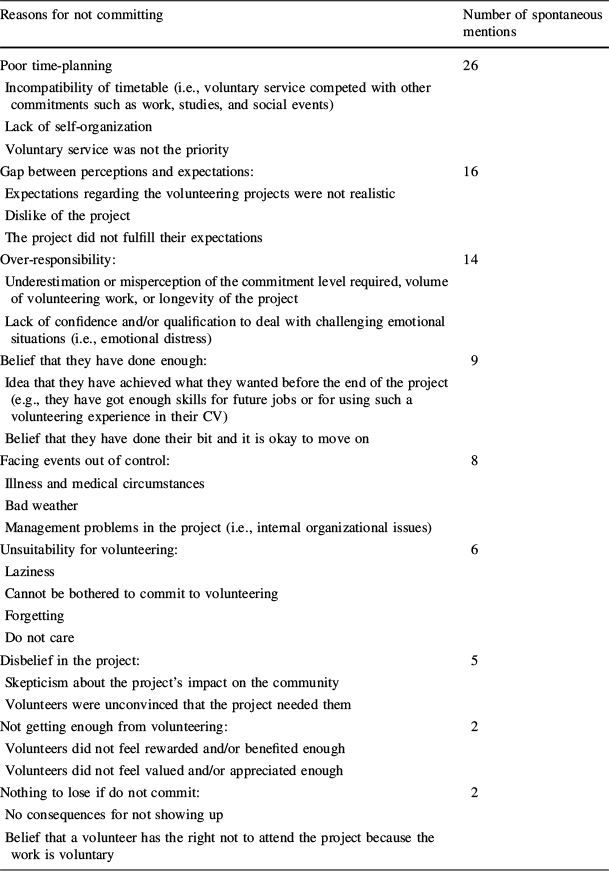
Another issue that deserves mention here is the extent to which a measure of PBC can substitute for a measure of actual control (Ajzen Reference Ajzen1991). When the perceptions of control are realistic, PBC is supposed to lead to behavior directly (Ajzen Reference Ajzen, Kuhl and Beckman1985, Reference Ajzen1991, Reference Ajzen2002, Reference Ajzen2005; Beck and Ajzen Reference Beck and Ajzen1991; Rhodes and Courneya Reference Rhodes and Courneya2003). That is, “to the extent that perceived behavioral control is veridical, it can serve as a proxy for actual control and be used to improve prediction of behavior” (Ajzen Reference Ajzen2005, p. 111). The perceptions of control felt by the volunteers proved to be unrealistic as there is no direct association between PBC and volunteering behavior. The inability of PBC to predict volunteering behavior is commensurate with previous TPB research on volunteering (i.e., Greenslade and White Reference Greenslade and White2005; Okun and Sloane Reference Okun and Sloane2002; Warburton and Terry Reference Warburton and Terry2000). PBC, therefore, seems to be incapable of serving as a proxy for actual control in the context of time donation. Table 6 shows the main factors and circumstances which have caused drop-outs and hampered the participation of volunteers in the projects, according to the coordinators of the 28 projects researched.
Table 6 Factors which caused drop-outs and hampered the volunteering

|
Reasons for not committing |
Number of spontaneous mentions |
|---|---|
|
Poor time-planning Incompatibility of timetable (i.e., voluntary service competed with other commitments such as work, studies, and social events) Lack of self-organization Voluntary service was not the priority |
26 |
|
Gap between perceptions and expectations: Expectations regarding the volunteering projects were not realistic Dislike of the project The project did not fulfill their expectations |
16 |
|
Over-responsibility: Underestimation or misperception of the commitment level required, volume of volunteering work, or longevity of the project Lack of confidence and/or qualification to deal with challenging emotional situations (i.e., emotional distress) |
14 |
|
Belief that they have done enough: Idea that they have achieved what they wanted before the end of the project (e.g., they have got enough skills for future jobs or for using such a volunteering experience in their CV) Belief that they have done their bit and it is okay to move on |
9 |
|
Facing events out of control: Illness and medical circumstances Bad weather Management problems in the project (i.e., internal organizational issues) |
8 |
|
Unsuitability for volunteering: Laziness Cannot be bothered to commit to volunteering Forgetting Do not care |
6 |
|
Disbelief in the project: Skepticism about the project’s impact on the community Volunteers were unconvinced that the project needed them |
5 |
|
Not getting enough from volunteering: Volunteers did not feel rewarded and/or benefited enough Volunteers did not feel valued and/or appreciated enough |
2 |
|
Nothing to lose if do not commit: No consequences for not showing up Belief that a volunteer has the right not to attend the project because the work is voluntary |
2 |
As Table 6 indicates, there is a convergence of control factors which can block sustained volunteering. The following extracts from the interviews illustrate examples of these factors. The first extract gives an example of those volunteers who did not realize the amount of work demanded from volunteers, nor of the emotional distress which it could involve.
I think that a lot of people who initially signed up to be volunteers for our project probably did not fully realize what would be expected of them in the beginning. I appreciate that working with homeless people – many of whom are drug addicts or alcoholics – can be a daunting experience and I think that this may have put some people off. [Female, 20 years old]
In tune with Thomas and Finch (Reference Thomas and Finch1990), the previous extract suggests that over-commitment (e.g., amount of work) and over-involvement (e.g., emotional distress) are key reasons why people give up their volunteering. The second extract illustrates the situation of those volunteers who underestimate the level of volunteering commitment which is required and of those who believe that they have the right not to attend the project because the nature of the work is voluntary:
I think a lot of people sign up to the projects without accepting the commitment that is required. Some people seem to think that because it is voluntary work that they can pick and choose when they go to best suit them. [Female, 22 years old]
Finally, the third extract refers to the situation of those who drop out because they believe that they have achieved what they wanted before the conclusion of the project:
They [i.e., the volunteers who give up] sign up just to tick a box in their CV, so that they can say they have done volunteering. They do not really care about the project or what is going on. It is just something they need to do to get their jobs or make awesome or something like that. It is not an important part of their lives. So, when it starts becoming a hassle or too much, they drop out. [Male, 21 years old]
The Emotional Impact of Being a Young Volunteer
Self-identity has been found to have a direct influence upon personal norm (i.e., self-identity → personal norm). That is, the greater the impact of volunteering in the lives of young donors then the more likely it will be that they will think that they should volunteer. This path of self-identity to personal norm is theoretically sound because people will naturally try to avoid feeling at a loss by leaving behind something that it is really important to them. Self-identity is illustrated in the following testimony:
It is not that volunteering is a part of my life; it is a big part of my life. These days one of the girls came to me and said: I love you. I felt so happy…! I was tired, but when I heard those magic words… they cheered me up. [Female, 25 years old]
Concluding Remarks
The vast majority of the TPB investigations have relied on self-reports or even on simplistic evaluations of intention. This study managed to measure the future behavior of young volunteers by observation and via a prospective design (time 1 and time 2), thereby contributing to the reduction of both the most common and problematical gaps in TPB research: the prediction of actual behavior and the measure of cognitive predictors and behavior at different moments in time. The integrative model of sustained volunteering tested in this study revealed important relationships which had not been considered in previous investigations into TPB and volunteering. This represents a step beyond the established intention-behavior approach to better comprehend volunteering in long-term projects. Further research should explore the behavioral domains and the conditions under which intention is not a good predictor of volitional behavior.
Acknowledgments
This research received support from the Coordination for Improvement of Higher Education Personnel (Capes), Brazilian Ministry of Education, Brazil.

 Open access

