


1. Introduction
Consider the existence and stability of solitary wave solutions of
 \begin{equation}
\phi_t+(\phi^p)_x+2\mathcal{H}\phi_{xx}+\phi_{xxx}=0,
\end{equation}
\begin{equation}
\phi_t+(\phi^p)_x+2\mathcal{H}\phi_{xx}+\phi_{xxx}=0,
\end{equation} where 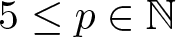 $5 \leq p\in\mathbb{N}$ and $\mathcal{H}$ is the Hilbert transform. Equation (1.1) is a generalized version of the Benjamin equation [Reference Benjamin7, Reference Benjamin8]
 \begin{equation*}
\eta_t+2\eta\eta_x+2\mathcal{H}\eta_{xx}+\eta_{xxx}=0,
\end{equation*}
\begin{equation*}
\eta_t+2\eta\eta_x+2\mathcal{H}\eta_{xx}+\eta_{xxx}=0,
\end{equation*}which describes the unidirectional propagation of internal waves and governs approximately the evolution of waves on the interface of a two-fluid system, where the lower fluid with greater density is deep, and the surface effect is not negligible. Here, the waves can propagate along the interface between two fluids [Reference Albert, Bona and Restrepo1] because of the density difference.
Equation (1.1) has attracted considerable attention in the past decades, see [Reference Albert, Bona and Restrepo1, Reference Albert and Linares3, Reference Amick and Toland6, Reference Bona and Chen9, Reference Bona, Souganidis and Strauss14, Reference Chen and Bona16, Reference Pava32, Reference Pava33]. It has the solitary wave solution of the form
 \begin{equation}
\phi(x,t)=u(x-ct),~~\xi=x-ct,
\end{equation}
\begin{equation}
\phi(x,t)=u(x-ct),~~\xi=x-ct,
\end{equation} where  $c \gt 0$ is the dimensionless wave speed and both $u(\xi)$ and its derivatives tend to zero as the variable $\xi$ approaches $\pm\infty$. By substitution of (1.2) into (1.1) and integration once, we have
 \begin{equation*}
u^{\prime\prime}+2\mathcal{H}u^{\prime}-cu+u^p=0,
\end{equation*}
\begin{equation*}
u^{\prime\prime}+2\mathcal{H}u^{\prime}-cu+u^p=0,
\end{equation*}whose action functional is given by
 \begin{equation*}
\mathcal{A}(u):=E(u)+c\|u\|_2^2,
\end{equation*}
\begin{equation*}
\mathcal{A}(u):=E(u)+c\|u\|_2^2,
\end{equation*} where the corresponding energy  $E(u)$ is defined by
 \begin{equation*}
E(u)=\int_{\mathbb{R}}\big[(u^{\prime})^2-2u\mathcal{H}u^{\prime}-\frac{2}{p+1}u^{p+1}\big]dx.
\end{equation*}
\begin{equation*}
E(u)=\int_{\mathbb{R}}\big[(u^{\prime})^2-2u\mathcal{H}u^{\prime}-\frac{2}{p+1}u^{p+1}\big]dx.
\end{equation*} By the Sobolev embedding theorem,  $E(u)$ is a continuous function from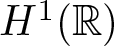 $H^1(\mathbb{R})$ to $\mathbb{R}$. One of interesting and important problems on equation (1.1) is the stability of solitary waves in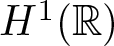 $H^1(\mathbb{R})$, which is defined by
Definition 1.1. We say that the set 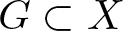 $G\subset X$ is stable, if for every $\epsilon \gt 0$ there exists $\delta \gt 0$ such that for every initial data $\phi_0$ satisfying
 \begin{equation*}
\inf_{g\in G}\|\phi_0-g\|_{X} \lt \delta,
\end{equation*}
\begin{equation*}
\inf_{g\in G}\|\phi_0-g\|_{X} \lt \delta,
\end{equation*} then the solution 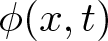 $\phi(x,t)$ of equation (1.1) with $\phi(x,0)=\phi_0$ satisfies
 \begin{equation*}
\inf_{g\in G}\|\phi(\cdot,t)-g\|_{X} \lt \epsilon,~~t\in\mathbb{R}.
\end{equation*}
\begin{equation*}
\inf_{g\in G}\|\phi(\cdot,t)-g\|_{X} \lt \epsilon,~~t\in\mathbb{R}.
\end{equation*} Otherwise, we say that the set  $G$ is unstable.
Quite a few powerful methods were proposed for studying the orbital stability of solitary waves in the past decades. For example, the stability/instability criterion was introduced by Grillakis–Shatah–Strauss (GSS) [Reference Grillakis, Shatah and Strauss20, Reference Grillakis, Shatah and Strauss21]. It usually needs to show that the solitary wave solution is a local constrained minimizer of a Hamiltonian functional, which can be undertaken by means of spectral properties of a linear operator derived from the solitary wave equation. The method developed by Cazenave-Lions [Reference Cazenave and Lions15] is associated with the constrained variational problem and the global minimization problem, based on the conservation laws of mass and energy and the compactness of any minimizing sequences. Both methods are widely used in various dispersive evolution equations, see [Reference Albert, Bona and Saut2, Reference Albert and Pava4, Reference Albert and Toland5, Reference Bona and Li10, Reference Bonheure, Casteras, Gou and Jeanjean11, Reference Bonheure, Casteras, Moreira dos Santos and Nascimento12, Reference Jeanjean, Jendrej, Le and Visciglia22, Reference Kichenassamy23, Reference Li and Bona24, Reference Lions26–Reference Lopes30, Reference Pava32, Reference Pava34].
For equation (1.1), there is no scale invariance and it contains the singular integral term  $\mathcal{H}u^{\prime}$ which makes the uniqueness of the solution be still an open problem, see [Reference Frank and Lenzmann18, Reference Frank, Lenzmann and Silvestre19]. To apply the Cazenave–Lions method, we shall consider a corresponding minimization problem
 \begin{equation}
I(m)=\inf\Big\{E(u):u\in S_m\Big\},
\end{equation}
\begin{equation}
I(m)=\inf\Big\{E(u):u\in S_m\Big\},
\end{equation}where
 \begin{equation*}
S_m:=\big\{u\in H^1(\mathbb{R})~\big|~F(u):=\int_{\mathbb{R}}u^2dx=m\big\}.
\end{equation*}
\begin{equation*}
S_m:=\big\{u\in H^1(\mathbb{R})~\big|~F(u):=\int_{\mathbb{R}}u^2dx=m\big\}.
\end{equation*} Since  $I(m) \lt -m$, it is difficult to prove the non-vanishing of any minimizing sequence by the concentration-compactness principle. To tackle this problem, under the assumption of the sufficiently small $m$, Angulo [Reference Pava32] applied a skilful auxiliary function to establish the compactness of any minimizing sequence when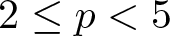 $2\leq p \lt 5$, which implies that the set of minimizers is orbitally stable. When $p \gt 5$, the instability of solitary wave solutions for (1.1) was explored in [Reference Pava33]. From the variational perspective, the energy functional $E$ has a geometry of local minima under the mass constraint when $p \gt 5$. However, it is natural to ask whether there exist stable solitary waves when $p \gt 5$ and $p=5$. The goal of this study is to answer this question.
In order to present our discussions in a straightforward manner, let us summarize our main results here.
Theorem 1.2 When  $p=5$, there exists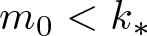 $m_0 \lt k_*$ such that when $m\in(m_0,k_*)$, for any sequence $\{u_n\}\subset H^1(\mathbb{R})$ satisfying $F(u_n)\to m$ and $E(u_n)\to I(m)$, there are a subsequence, still denoted by $\{u_n\}$, a sequence of points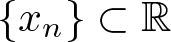 $\{x_n\}\subset \mathbb{R}$ and a function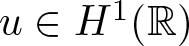 $u\in H^1(\mathbb{R})$ such that $u_n(\cdot+x_n)\to u$ strongly in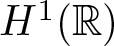 $H^1(\mathbb{R})$, where $k_*$ is given by (3.5). In particular, there exists a solution $u\in H^1(\mathbb{R})$ to the minimization problem (1.3).
Denote the set of the minimizers for  $I(m)$ by
 \begin{equation*}
\mathcal{G}_m:=\Big\{u\in H^1(\mathbb{R}):F(u)=m~{\rm{and}}~E(u)=I(m)\Big\}.
\end{equation*}
\begin{equation*}
\mathcal{G}_m:=\Big\{u\in H^1(\mathbb{R}):F(u)=m~{\rm{and}}~E(u)=I(m)\Big\}.
\end{equation*} From Theorem 1.2, it follows that the set  $\mathcal{G}_m$ is not empty.
Theorem 1.3 When  $p=5$, the set $\mathcal{G}_m$ is orbitally stable for all $m\in(m_0,k_*)$, where $m_0$ and $k_*$ are the same as given in Theorem 1.2.
When  $p \gt 5$, we see that $I(m)=-\infty$ for any $m \gt 0$. So, the minimization problem (1.3) becomes trivial. According to the geometry of local minima under the mass constraint, we can find an open set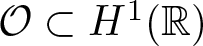 $\mathcal{O}\subset H^1(\mathbb{R})$ (see (4.6)) such that any possible local minimizer of $E$ under the mass constraint must belong to $\mathcal{O}$. To study the orbital stability of solitary wave solutions for $p \gt 5$, we shall consider the local minimization problem
 \begin{equation*}
\tilde{I}(m):=\inf\{E(u)~|~u\in \mathcal{O}~{\rm{and}}~F(u)=m\}.
\end{equation*}
\begin{equation*}
\tilde{I}(m):=\inf\{E(u)~|~u\in \mathcal{O}~{\rm{and}}~F(u)=m\}.
\end{equation*}Theorem 1.4 When  $p \gt 5$, the following three assertions are true.
(i) There exists 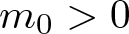 $m_0 \gt 0$ such that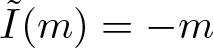 $\tilde{I}(m)=-m$ for any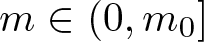 $m\in(0,m_0]$ and the infimum $\tilde{I}(m)$ is not achieved for any $m\in(0,m_0)$.
(ii) There exist  $\tilde{m}_0$ and $\mu_0$ such that for all $m\in(\tilde{m}_0,\mu_0)$, any minimizing sequence $\{u_n\}$ for $\tilde{I}(m)$ has a subsequence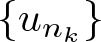 $\{u_{n_k}\}$, which converges to $u$ strongly in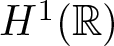 $H^1(\mathbb{R})$. Then,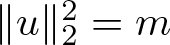 $\|u\|_2^2=m$ and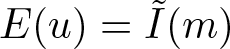 $E(u)=\tilde{I}(m)$.
(iii) Any minimizer of  $\tilde{I}(m)$ which solves
 \begin{equation*}
-u^{\prime\prime}-2\mathcal{H}u^{\prime}+(1+\omega)u-u^p=0~{\rm{in}}~\mathbb{R},
\end{equation*}
\begin{equation*}
-u^{\prime\prime}-2\mathcal{H}u^{\prime}+(1+\omega)u-u^p=0~{\rm{in}}~\mathbb{R},
\end{equation*}satisfies
 \begin{equation*}
0 \lt \omega \lt -1+\frac{(p-3)^2}{(p-1)(p-5)}+\frac{4(p-3)}{(p-5)^2}.
\end{equation*}
\begin{equation*}
0 \lt \omega \lt -1+\frac{(p-3)^2}{(p-1)(p-5)}+\frac{4(p-3)}{(p-5)^2}.
\end{equation*} For  $p \gt 5$, we denote
 \begin{equation*}
\tilde{\mathcal{G}}_m=\{u\in \mathcal{O}~|~F(u)=m~{\rm{and}}~E(u)=\tilde{I}(m)\}.
\end{equation*}
\begin{equation*}
\tilde{\mathcal{G}}_m=\{u\in \mathcal{O}~|~F(u)=m~{\rm{and}}~E(u)=\tilde{I}(m)\}.
\end{equation*} From Theorem 1.4, we know that the set  $\tilde{\mathcal{G}}_m$ is not empty.
Theorem 1.5 When  $p \gt 5$, the set $\tilde{\mathcal{G}}_m$ is orbitally stable for all $m\in(\tilde{m}_0, \mu_0)$, where $\tilde{m}_0$ and $\mu_0$ are the same as given in Theorem 1.4.
Throughout this article, we denote the Fourier transform by  $\mathcal{F}(u)(\xi)=\hat{u}(\xi)=\int_{\mathbb{R}}e^{-ix\cdot \xi}u(x)dx$ if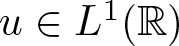 $u\in L^1(\mathbb{R})$. As usual, we extend it to tempered distributions, and introduce the Fourier integral operator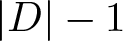 $|D|-1$ defined by $(|D|-1)u=\mathcal{F}^{-1}((|\cdot|-1)\hat{u})$. Given a tempered distribution $u$, we see that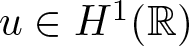 $u\in H^1(\mathbb{R})$ if and only if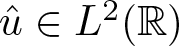 $\hat{u}\in L^2(\mathbb{R})$ and $(|\cdot|-1)\hat{u}\in L^2(\mathbb{R})$. We denote by $\|\cdot\|_p$ the standard norm on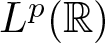 $L^p(\mathbb{R})$.
The remainder of this paper is organized as follows. We present several technical lemmas in Section 2. We consider the minimization problem (1.3) and prove Theorems 1.2 and 1.3 in Section 3. We investigate the problem of minimizing the energy with the  $L^2$-norm in the set $\mathcal{O}$ when $p \gt 5$ and then prove Theorems 1.4 and 1.5 in Section 4.
2. Several lemmas
In order to make the paper sufficiently self-contained, let us recall the local well-posedness of the Cauchy problem to (1.1) and Gagliardo–Nirenberg type inequalities for fractional derivatives.
Lemma 2.1. ([Reference Pava33, Theorem 2.1]) Let 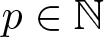 $p\in \mathbb{N}$ and $p\geq2$. For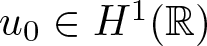 $u_0\in H^1(\mathbb{R})$ there exists
  $T=
T(\|u_0\|_{H^1}) \gt 0$ and a unique solution
$T=
T(\|u_0\|_{H^1}) \gt 0$ and a unique solution  $u(t)\equiv U(t)u_0\in C([0,T); H^1(\mathbb{R}))$ of (1.1) with $u(x,0)=u_0(x)$. For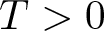 $T \gt 0$ the map $u_0\to U(t)u_0$ is Lipschitz continuous from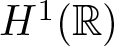 $H^1(\mathbb{R})$ to $C([0,T); H^1(\mathbb{R}))$. In addition,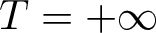 $T=+\infty$ if we have
(i) for 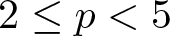 $2\leq p \lt 5$,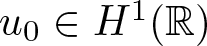 $u_0\in H^1(\mathbb{R})$ and no restriction on the data is needed;
(ii) for  $p=5$, $\|u_0\|_2$ has to be not too large; and
(iii) for  $p \gt 5$,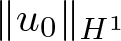 $\|u_0\|_{H^1}$ is small.
Lemma 2.2. ([Reference Brézis and Lieb13, Theorem 1])
Let  $0 \lt p \lt \infty$. Suppose that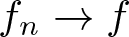 $f_n\to f$ almost everywhere and $\{f_n\}$ is a bounded sequence in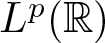 $L^p(\mathbb{R})$. Then $\lim\limits_{n\to\infty}(\|f_n\|_p^p-\|f_n-f\|_p^p-\|f\|_p^p)=0$.
Lemma 2.3. ([Reference Pava32, Lemma 2.1])
If 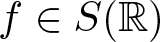 $f\in S(\mathbb{R})$, then
  $
\|D^sf\|_{p}\leq A_1\|D^{s_0}f\|_{p_0}^\theta\|D^{s_1}f\|_{p_1}^{1-\theta}
$ holds, where
$
\|D^sf\|_{p}\leq A_1\|D^{s_0}f\|_{p_0}^\theta\|D^{s_1}f\|_{p_1}^{1-\theta}
$ holds, where  $p_0,\,p_1\in(1,\infty)$, $s_0,\,s_1\in[0,\infty)$, $s=\theta s_0+(1-\theta)s_1$, and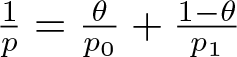 $\frac{1}{p}=\frac{\theta}{p_0}+\frac{1-\theta}{p_1}$, and $S(\mathbb{R})$ is the Schwartz space.
Lemma 2.4. ([Reference Ferndez, Jeanjean, Mandel and Maris17, Theorem 1.1])
If 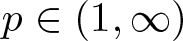 $p\in(1,\infty)$ and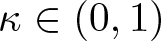 $\kappa\in(0,1)$, then
  $
\|u\|_{p+1}\leq \bar{Q}\|u\|_2^{\kappa}\|u^{\prime}-u\|_2^{1-\kappa}
$ holds for any
$
\|u\|_{p+1}\leq \bar{Q}\|u\|_2^{\kappa}\|u^{\prime}-u\|_2^{1-\kappa}
$ holds for any 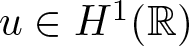 $u\in H^1(\mathbb{R})$ if and only if $p=5$, where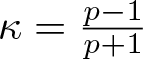 $\kappa=\frac{p-1}{p+1}$ and the best constant $\bar{Q}$ is defined in (3.13).
From Lemma 2.4, we can derive the following corollary immediately.
Corollary 2.5. The supremum  $
\sup\{Q_\kappa(u)~|~u\in H^1(\mathbb{R})\setminus\{0\}~{\rm{and}}~\|(|D|-1)u\|_2\leq R\|u\|_2\}
$ is finite for any fixed
$
\sup\{Q_\kappa(u)~|~u\in H^1(\mathbb{R})\setminus\{0\}~{\rm{and}}~\|(|D|-1)u\|_2\leq R\|u\|_2\}
$ is finite for any fixed  $R \gt 0$ if
 \begin{equation}
\kappa\geq\frac{1}{2}~~{\rm{and}}~~1-\kappa\leq\frac{1}{2}-\frac{1}{p+1},
\end{equation}
\begin{equation}
\kappa\geq\frac{1}{2}~~{\rm{and}}~~1-\kappa\leq\frac{1}{2}-\frac{1}{p+1},
\end{equation} where 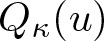 $Q_\kappa(u)$ is defined in (3.13).
3. Global minimization of the energy with  $L^2$-norm

In this section, we consider the minimization problem (1.3) and the orbital stability of solitary wave solutions for (1.1). For any function 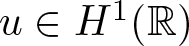 $u\in H^1(\mathbb{R})$ and any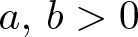 $a,\,b \gt 0$, setting $u_{a,b}(x)=au(\frac{x}{b})$, we get
 \begin{equation}
\begin{aligned}
&\|u^{\prime}_{a,b}\|_2^2=a^2b^{-1}\|u^{\prime}\|^2_2,~~~
\|D^{\frac{1}{2}}u_{a,b}\|_2^2=a^2\|D^{\frac{1}{2}}u\|_2^2,\\
&\|u_{a,b}\|_2^2=a^2b\|u\|^2_2,~~~
\int_{\mathbb{R}}u^{p+1}_{a,b}dx=a^{p+1}b\int_{\mathbb{R}}u^{p+1}dx.
\end{aligned}
\end{equation}
\begin{equation}
\begin{aligned}
&\|u^{\prime}_{a,b}\|_2^2=a^2b^{-1}\|u^{\prime}\|^2_2,~~~
\|D^{\frac{1}{2}}u_{a,b}\|_2^2=a^2\|D^{\frac{1}{2}}u\|_2^2,\\
&\|u_{a,b}\|_2^2=a^2b\|u\|^2_2,~~~
\int_{\mathbb{R}}u^{p+1}_{a,b}dx=a^{p+1}b\int_{\mathbb{R}}u^{p+1}dx.
\end{aligned}
\end{equation}Using Plancherel’s Theorem yields
 \begin{align*}
\|u\|^2_2&=\frac{1}{2\pi}\|\hat{u}\|^2_2,~~~
\|(|D|-1)u\|^2_2=\frac{1}{2\pi}\|(|\cdot|-1)\hat{u}\|^2_2,\\
\|u^{\prime}\|_2^2&=\frac{1}{2\pi}\||\xi|\hat{u}\|_2^2
=\frac{1}{2\pi}\int_{\mathbb{R}}|\xi|^2|\hat{u}|^2d\xi.
\end{align*}
\begin{align*}
\|u\|^2_2&=\frac{1}{2\pi}\|\hat{u}\|^2_2,~~~
\|(|D|-1)u\|^2_2=\frac{1}{2\pi}\|(|\cdot|-1)\hat{u}\|^2_2,\\
\|u^{\prime}\|_2^2&=\frac{1}{2\pi}\||\xi|\hat{u}\|_2^2
=\frac{1}{2\pi}\int_{\mathbb{R}}|\xi|^2|\hat{u}|^2d\xi.
\end{align*}From Lemma 2.3 it follows that
 \begin{equation}
\|D^{\frac{1}{2}}u\|_2^2\leq\|u^{\prime}\|_2\|u\|_2.
\end{equation}
\begin{equation}
\|D^{\frac{1}{2}}u\|_2^2\leq\|u^{\prime}\|_2\|u\|_2.
\end{equation} The strict inequality in (3.2) holds except for  $u=0$.
For any  $p\geq2$, we have the Gagliardo–Nirenberg–Sobolev inequality [Reference Nirenberg31]
 \begin{equation}
\|u\|_{p+1}^{p+1}\leq B\|u^{\prime}\|_2^{\frac{p-1}{2}}\|u\|_2^{\frac{p+3}{2}},~~~u\in H^1({\mathbb{R}}).
\end{equation}
\begin{equation}
\|u\|_{p+1}^{p+1}\leq B\|u^{\prime}\|_2^{\frac{p-1}{2}}\|u\|_2^{\frac{p+3}{2}},~~~u\in H^1({\mathbb{R}}).
\end{equation} We denote the best constant  $B$ in (3.3) by
 \begin{equation}
B(p)=\sup_{u\in{H^1({\mathbb{R}})}\setminus\{0\}}\frac{\|u\|_{p+1}^{p+1}}
{\|u^{\prime}\|_2^{\frac{p-1}{2}}\|u\|_2^{\frac{p+3}{2}}}.
\end{equation}
\begin{equation}
B(p)=\sup_{u\in{H^1({\mathbb{R}})}\setminus\{0\}}\frac{\|u\|_{p+1}^{p+1}}
{\|u^{\prime}\|_2^{\frac{p-1}{2}}\|u\|_2^{\frac{p+3}{2}}}.
\end{equation} For  $I(m)$ defined by (1.3), we have the following properties.
Proposition 3.1. (i) If  $p \gt 5$, we have $I(m)=-\infty$ for all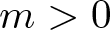 $m \gt 0$.
When  $p=5$, the following statements are true.
(ii) The function  $I(m)$ is concave on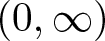 $(0,\infty)$.
(iii) For any 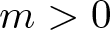 $m \gt 0$, we have $I(m)\leq-m$.
(iv) 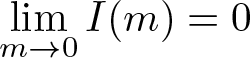 $\lim\limits_{m\to0}I(m)=0$ and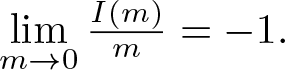 $\lim\limits_{m\to0}\frac{I(m)}{m}=-1.$
(v) Let  $B(p)$ be given as in (3.4) and
 \begin{equation}
k_*=3^{\frac{1}{2}}
B(p)^{-{\frac{1}{2}}}.
\end{equation}
\begin{equation}
k_*=3^{\frac{1}{2}}
B(p)^{-{\frac{1}{2}}}.
\end{equation} Then  $I(m)$ is finite for any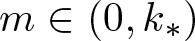 $m\in(0,k_*)$ and $I(m)=-\infty$ if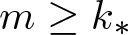 $m\geq k_*$. In addition, for any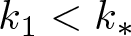 $k_1 \lt k_*$ and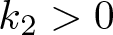 $k_2 \gt 0$, the set $\big\{u\in H^1(\mathbb{R})\big|\|u\|_2^2\leq k_1~and~E(u)\leq k_2\big\}$ is bounded in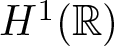 $H^1(\mathbb{R})$.
Proof. (i) Let 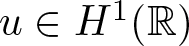 $u\in H^1({\mathbb{R}})$ satisfy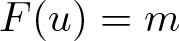 $F(u)=m$ and $\int_{\mathbb{R}}u^{p+1}dx \gt 0$. Set $u_t(x):=t^{\frac{1}{2}}u(tx)$. Then $F(u_t)=\|u_t\|_2^2=\|u\|_2^2=m$ according to (3.1). So we have $I(m)\leq E(u_t)$. From (3.1) it follows that
 \begin{equation}
\begin{aligned}
E(u_t)&=t^2\int_{\mathbb{R}}(u^{\prime})^2dx-2t\int_{\mathbb{R}}u\mathcal{H}u^{\prime}dx
-\frac{2}{p+1}t^{\frac{p-1}{2}}\int_{\mathbb{R}}u^{p+1}dx\\
&=t^2\|u^{\prime}\|_2^2-2t\|D^{\frac{1}{2}}u\|_2^2-\frac{2}{p+1}t^{\frac{p-1}{2}}
\int_{\mathbb{R}}u^{p+1}dx.
\end{aligned}
\end{equation}
\begin{equation}
\begin{aligned}
E(u_t)&=t^2\int_{\mathbb{R}}(u^{\prime})^2dx-2t\int_{\mathbb{R}}u\mathcal{H}u^{\prime}dx
-\frac{2}{p+1}t^{\frac{p-1}{2}}\int_{\mathbb{R}}u^{p+1}dx\\
&=t^2\|u^{\prime}\|_2^2-2t\|D^{\frac{1}{2}}u\|_2^2-\frac{2}{p+1}t^{\frac{p-1}{2}}
\int_{\mathbb{R}}u^{p+1}dx.
\end{aligned}
\end{equation} When  $p \gt 5$, letting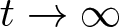 $t\to \infty$, we obtain
  $
I(m)\leq\lim\limits_{t\to\infty}E(u_t)=-\infty.
$
$
I(m)\leq\lim\limits_{t\to\infty}E(u_t)=-\infty.
$
(ii) Notice that 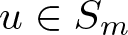 $u\in S_m$ if and only if there exists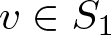 $v\in S_1$ such that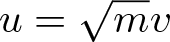 $u=\sqrt{m}v$. For any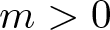 $m \gt 0$ and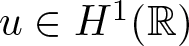 $u\in H^1(\mathbb{R})$ satisfying $\int_{\mathbb{R}}u^{p+1}dx \gt 0$, there holds
 \begin{equation}
\begin{aligned}
E(u)=E(\sqrt{m}v)&=m\|v'\|_2^2-2m\|D^{\frac{1}{2}}v\|_2^2
-\frac{2}{p+1}m^{\frac{p+1}{2}}\int_{\mathbb{R}}v^{p+1}dx\\
&=m\big(\|v'\|_2^2-2\|D^{\frac{1}{2}}v\|_2^2\big)
-\frac{2}{p+1}m^{\frac{p+1}{2}}\int_{\mathbb{R}}v^{p+1}dx.
\end{aligned}
\end{equation}
\begin{equation}
\begin{aligned}
E(u)=E(\sqrt{m}v)&=m\|v'\|_2^2-2m\|D^{\frac{1}{2}}v\|_2^2
-\frac{2}{p+1}m^{\frac{p+1}{2}}\int_{\mathbb{R}}v^{p+1}dx\\
&=m\big(\|v'\|_2^2-2\|D^{\frac{1}{2}}v\|_2^2\big)
-\frac{2}{p+1}m^{\frac{p+1}{2}}\int_{\mathbb{R}}v^{p+1}dx.
\end{aligned}
\end{equation}It follows from (1.3) and (3.7) that
 \begin{equation*}
\begin{aligned}
I(m)&=\inf\big\{E(\sqrt{m}v)|v\in S_1\big\}\\
&=\inf\Big\{m\big(\|v'\|_2^2-2\|D^{\frac{1}{2}}v\|_2^2\big)
-\frac{2}{p+1}m^{\frac{p+1}{2}}\int_{\mathbb{R}}v^{p+1}dx~\Big|~v\in S_1\Big\}.
\end{aligned}
\end{equation*}
\begin{equation*}
\begin{aligned}
I(m)&=\inf\big\{E(\sqrt{m}v)|v\in S_1\big\}\\
&=\inf\Big\{m\big(\|v'\|_2^2-2\|D^{\frac{1}{2}}v\|_2^2\big)
-\frac{2}{p+1}m^{\frac{p+1}{2}}\int_{\mathbb{R}}v^{p+1}dx~\Big|~v\in S_1\Big\}.
\end{aligned}
\end{equation*} For any  $A\in\mathbb{R}$ and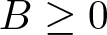 $B\geq0$, setting $f(m)=Am-Bm^{\frac{p+1}{2}}$, we have
 \begin{equation*}
f'(m)=A-\frac{p+1}{2}Bm^\frac{p-1}{2}~~{\rm{and}}~~f^{\prime\prime}(m)=-\frac{(p+1)(p-1)}{4}B
m^\frac{p-3}{2}.
\end{equation*}
\begin{equation*}
f'(m)=A-\frac{p+1}{2}Bm^\frac{p-1}{2}~~{\rm{and}}~~f^{\prime\prime}(m)=-\frac{(p+1)(p-1)}{4}B
m^\frac{p-3}{2}.
\end{equation*} It is easy to see that 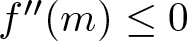 $f^{\prime\prime}(m)\leq0$, and thus $f$ is concave on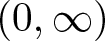 $(0,\infty)$. Therefore, the infimum of a family of concave functions is also a concave function.
(iii) For any 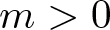 $m \gt 0$ and $\epsilon \gt 0$, we choose a function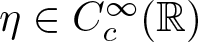 $\eta\in C_c^{\infty}(\mathbb{R})$ such that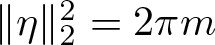 $\|\eta\|_2^2=2\pi m$ and the support of $\eta$ is contained in the annulus $B(0,1)\setminus B(0,1-\epsilon)$. Let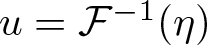 $u=\mathcal{F}^{-1}(\eta)$. Then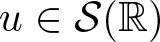 $u\in \mathcal{S}(\mathbb{R})$ and $\|u\|_2^2=\frac{1}{2\pi}\|\eta\|_2^2=m$. By the Fourier transform, Plancherel’s formula and the fact that $0\leq(|\xi|-1)^2\leq4\epsilon^2$ on the support of $\eta$, we deduce
 \begin{equation*}
\begin{aligned}
&\int_{\mathbb{R}}(u^{\prime})^2dx-2\int_{\mathbb{R}}u\mathcal{H}u^{\prime}dx
+\int_{\mathbb{R}}u^2dx
=\frac{1}{2\pi}\int_{\mathbb{R}}\big(|\xi|^2-2\xi+1\big)|\hat{u}(\xi)|^2d\xi\\
&\quad =\frac{1}{2\pi}\int_{B(0,1)\setminus B(0,1-\epsilon)}
\big(|\xi|-1\big)^2|\eta(\xi)|^2d\xi
\leq\frac{4\epsilon^2}{2\pi}\int_{\mathbb{R}}|\eta(\xi)|^2d\xi=4\epsilon^2m
\end{aligned}
\end{equation*}
\begin{equation*}
\begin{aligned}
&\int_{\mathbb{R}}(u^{\prime})^2dx-2\int_{\mathbb{R}}u\mathcal{H}u^{\prime}dx
+\int_{\mathbb{R}}u^2dx
=\frac{1}{2\pi}\int_{\mathbb{R}}\big(|\xi|^2-2\xi+1\big)|\hat{u}(\xi)|^2d\xi\\
&\quad =\frac{1}{2\pi}\int_{B(0,1)\setminus B(0,1-\epsilon)}
\big(|\xi|-1\big)^2|\eta(\xi)|^2d\xi
\leq\frac{4\epsilon^2}{2\pi}\int_{\mathbb{R}}|\eta(\xi)|^2d\xi=4\epsilon^2m
\end{aligned}
\end{equation*}and
 \begin{equation*}
I(m)+m\leq E(u)+\|u\|_2^2\leq
\int_{\mathbb{R}}(u^{\prime})^2dx-2\int_{\mathbb{R}}u\mathcal{H}u^{\prime}dx
+\int_{\mathbb{R}}u^2dx\leq4\epsilon^2m.
\end{equation*}
\begin{equation*}
I(m)+m\leq E(u)+\|u\|_2^2\leq
\int_{\mathbb{R}}(u^{\prime})^2dx-2\int_{\mathbb{R}}u\mathcal{H}u^{\prime}dx
+\int_{\mathbb{R}}u^2dx\leq4\epsilon^2m.
\end{equation*} This indicates that  $I(m)\leq-m+4\epsilon^2m$. Given that $\epsilon \gt 0$ is arbitrary, we see that (iii) follows.
(iv) Using Plancherel’s formula again leads to
 \begin{equation}
(1-\epsilon)\|v'\|_2^2-2\|D^{\frac{1}{2}}v\|_2^2+\frac{1}{1-\epsilon}\|v\|_2^2
=\frac{1-\epsilon}{2\pi}\int_{\mathbb{R}}\Big(|\xi|-\frac{1}{1-\epsilon}\Big)^2|\hat{v}
(\xi)|^2d\xi\geq0.
\end{equation}
\begin{equation}
(1-\epsilon)\|v'\|_2^2-2\|D^{\frac{1}{2}}v\|_2^2+\frac{1}{1-\epsilon}\|v\|_2^2
=\frac{1-\epsilon}{2\pi}\int_{\mathbb{R}}\Big(|\xi|-\frac{1}{1-\epsilon}\Big)^2|\hat{v}
(\xi)|^2d\xi\geq0.
\end{equation} Notice that the inequality sign in (3.8) is strict if  $v\neq0$. When $p=5$, the Gagliardo–Nirenberg–Sobolev inequality (3.3) gives
 \begin{equation}
\|v\|_{p+1}^{p+1}\leq B\|v'\|_2^2\|v\|_2^4.
\end{equation}
\begin{equation}
\|v\|_{p+1}^{p+1}\leq B\|v'\|_2^2\|v\|_2^4.
\end{equation} Let  $0 \lt \epsilon \lt 1$. For any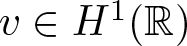 $v\in H^1(\mathbb{R})$ satisfying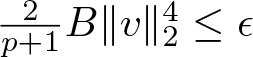 $\frac{2}{p+1} B \|v\|_2^4 \leq \epsilon$, from (3.9) we derive
 \begin{equation*}
E(v)\geq(1-\epsilon)\|v'\|^2_2-2\|D^{\frac{1}{2}}v\|_2^2
\end{equation*}
\begin{equation*}
E(v)\geq(1-\epsilon)\|v'\|^2_2-2\|D^{\frac{1}{2}}v\|_2^2
\end{equation*} and from (3.8) we get  $E(v)\geq-\frac{1}{1-\epsilon}\|v\|^2_2$. This gives $I(m)\geq-\frac{m}{1-\epsilon}$ for the positive $m$ satisfying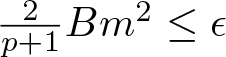 $\frac{2}{p+1} B m^2 \leq \epsilon$. Taking into account (iii), we obtain the desired result (iv).
(v) For 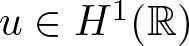 $u\in H^1({\mathbb{R}})$, we deduce from (3.2) and (3.3) that
 \begin{equation}
\begin{aligned}
E(u)&\geq\|u^{\prime}\|_2^2-2\|u\|_2\|u^{\prime}\|_2-\frac{2}{p+1}B(p)\|u^{\prime}\|_2^2\|u\|_2^4\\
&=\Big(1-\frac{B(p)}{3}\|u\|_2^4\Big)\|u^{\prime}\|_2^2-2\|u\|_2\|u^{\prime}\|_2.
\end{aligned}
\end{equation}
\begin{equation}
\begin{aligned}
E(u)&\geq\|u^{\prime}\|_2^2-2\|u\|_2\|u^{\prime}\|_2-\frac{2}{p+1}B(p)\|u^{\prime}\|_2^2\|u\|_2^4\\
&=\Big(1-\frac{B(p)}{3}\|u\|_2^4\Big)\|u^{\prime}\|_2^2-2\|u\|_2\|u^{\prime}\|_2.
\end{aligned}
\end{equation} Let  $k_1 \lt k_*=3^{\frac{1}{2}}B(p)^{-{\frac{1}{2}}}$ and $\tau(k_1)=1-\frac{B(p)}{3}k_1^2 \gt 0$. For any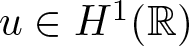 $u\in H^1({\mathbb{R}})$ such that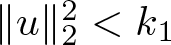 $\|u\|_2^2 \lt k_1$, from 3.12 it follows that
 \begin{equation}
E(u)\geq\tau(k_1)\|u^{\prime}\|_2^2-2k_1^{\frac{1}{2}}\|u^{\prime}\|_2
\geq\min_{s\in \mathbb{R}}\big(\tau(k_1)s^2-2k_1^{\frac{1}{2}}s\big)
=-\frac{k_1}{\tau(k_1)}.
\end{equation}
\begin{equation}
E(u)\geq\tau(k_1)\|u^{\prime}\|_2^2-2k_1^{\frac{1}{2}}\|u^{\prime}\|_2
\geq\min_{s\in \mathbb{R}}\big(\tau(k_1)s^2-2k_1^{\frac{1}{2}}s\big)
=-\frac{k_1}{\tau(k_1)}.
\end{equation} We infer that  $I(m)\geq -\frac{k_1}{\tau(k_1)} \gt -\infty$ for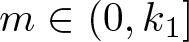 $m\in(0, k_1]$. Since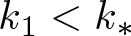 $k_1 \lt k_*$ is arbitrary, we see that $I(m)$ is finite on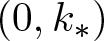 $(0, k_*)$. Moreover, if $\|u\|_2^2\leq k_1 \lt k_*$ and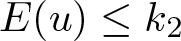 $E(u)\leq k_2$, then (3.11) implies that $\|u^{\prime}\|_2$ is bounded. Thus,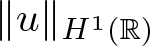 $\|u\|_{H^1(\mathbb{R})}$ is bounded.
Let  $Q$ be an optimal function for the Gagliardo–Nirenberg–Sobolev inequality (3.3) with $p=5$ such that $\|Q\|_2=k_*^{\frac{1}{2}}=3^{\frac{1}{4}}B(p)^{-{\frac{1}{4}}}$. Such a function $Q$ exists because if $u$ is an optimal function for (3.3), the rescaled function $u_t(x)$ is an optimal function too. Then
 \begin{equation*}
\frac{2}{p+1}\|Q\|_{p+1}^{p+1}=\frac{2}{p+1}B(p)\|Q'\|_2^2\|Q\|_2^4=\|Q'\|_2^2.
\end{equation*}
\begin{equation*}
\frac{2}{p+1}\|Q\|_{p+1}^{p+1}=\frac{2}{p+1}B(p)\|Q'\|_2^2\|Q\|_2^4=\|Q'\|_2^2.
\end{equation*} For  $t \gt 0$, let $u_t(x)=t^{\frac{1}{2}}Q(tx)$. From (3.1) and (3.6) it follows that $\|u_t\|_2^2= \|Q\|_2^2=k_*$ and $E(u_t)=-2t\|D^{\frac{1}{2}}Q\|_2^2$. Letting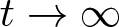 $t\to\infty$ leads to $I(k_*)=-\infty$. If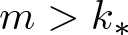 $m \gt k_*$, using the test function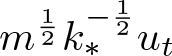 $m^{\frac{1}{2}}k_*^{-\frac{1}{2}}u_t$ and letting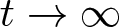 $t\to\infty$, we obtain $I(m) =-\infty$.
For any 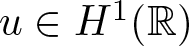 $u\in H^1(\mathbb{R})$ satisfying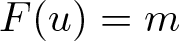 $F(u)=m$ and $\int_{\mathbb{R}}u^{p+1}dx \gt 0$, a direct calculation gives
 \begin{equation}
\begin{aligned}
E(u)+\|u\|_2^2&=\int_{\mathbb{R}}\big[(u^{\prime})^2-2u\mathcal{H}u^{\prime}-\frac{2}{p+1}u^{p+1}\big]dx
+\|u\|_2^2\\
&=\|u^{\prime}-u\|_2^2\Big(1-\frac{2m^{\frac{p-1}{2}}}{p+1}Q(u)^{p+1}\Big),
\end{aligned}
\end{equation}
\begin{equation}
\begin{aligned}
E(u)+\|u\|_2^2&=\int_{\mathbb{R}}\big[(u^{\prime})^2-2u\mathcal{H}u^{\prime}-\frac{2}{p+1}u^{p+1}\big]dx
+\|u\|_2^2\\
&=\|u^{\prime}-u\|_2^2\Big(1-\frac{2m^{\frac{p-1}{2}}}{p+1}Q(u)^{p+1}\Big),
\end{aligned}
\end{equation} where 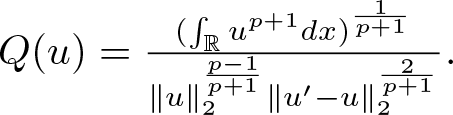 $
Q(u)=\frac{(\int_{\mathbb{R}}u^{p+1}dx)^{\frac{1}{p+1}}}
{\|u\|_2^{\frac{p-1}{p+1}}\|u^{\prime}-u\|_2^{\frac{2}{p+1}}}.
$ Denote
$
Q(u)=\frac{(\int_{\mathbb{R}}u^{p+1}dx)^{\frac{1}{p+1}}}
{\|u\|_2^{\frac{p-1}{p+1}}\|u^{\prime}-u\|_2^{\frac{2}{p+1}}}.
$ Denote
 \begin{equation*}
\tilde{Q}:=\sup\{Q(u):u\in H^1({\mathbb{R})\setminus \{0\}}\}.
\end{equation*}
\begin{equation*}
\tilde{Q}:=\sup\{Q(u):u\in H^1({\mathbb{R})\setminus \{0\}}\}.
\end{equation*}Remark 3.2. If  $\tilde{Q}$ is finite, it follows from (3.12) that
  $
E(u)+\|u\|_2^2\geq0
$ for any
$
E(u)+\|u\|_2^2\geq0
$ for any  $u$ satisfying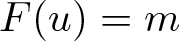 $F(u)=m$, provided that $m$ is small enough so that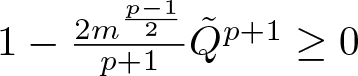 $1-\frac{2m^{\frac{p-1}{2}}}{p+1}\tilde{Q}^{p+1}\geq0$. This indicates that $I(m)\geq -m$ for the sufficiently small $m$, and thus the minimization problem (1.3) does not admit minimizers for the sufficiently small $m$ either. If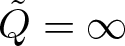 $\tilde{Q}=\infty$, for any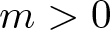 $m \gt 0$ we can find $u\in H^1(\mathbb{R})\setminus\{0\}$ such that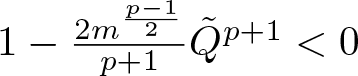 $1-\frac{2m^{\frac{p-1}{2}}}{p+1}\tilde{Q}^{p+1} \lt 0$. Then taking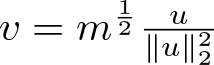 $v=m^{\frac{1}{2}}\frac{u}{\|u\|_2^2}$ leads to
 \begin{equation*}
\|v\|_2^2=\|u\|_2^2=m~~{\rm{and}}~~
Q(v)=Q(u).
\end{equation*}
\begin{equation*}
\|v\|_2^2=\|u\|_2^2=m~~{\rm{and}}~~
Q(v)=Q(u).
\end{equation*} From (3.12) we can see that  $E(v)+\|v\|_2^2 \lt 0$, and thus $I(m) \lt -m$.
Let 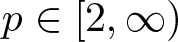 $p\in[2,\infty)$ and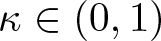 $\kappa\in(0,1)$. For all $u\in H^1(\mathbb{R})\setminus\{0\}$ we define
 \begin{equation}
Q_\kappa(u)=\frac{\|u\|_{p+1}}{\|u\|_2^\kappa\|(|D|-1)u\|_2^{1-\kappa}},~~~
\bar{Q}:=\sup_{u\in H^1(\mathbb{R})\setminus\{0\}}Q_\kappa(u).
\end{equation}
\begin{equation}
Q_\kappa(u)=\frac{\|u\|_{p+1}}{\|u\|_2^\kappa\|(|D|-1)u\|_2^{1-\kappa}},~~~
\bar{Q}:=\sup_{u\in H^1(\mathbb{R})\setminus\{0\}}Q_\kappa(u).
\end{equation} Note that  $\bar{Q}$ is finite if and only if the Gagliardo–Nirenberg type inequality
 \begin{equation*}
\|u\|_{p+1}\leq C\|u\|_2^{\frac{p-1}{p+1}}\|u^{\prime}-u\|_2^{\frac{2}{p+1}}
\end{equation*}
\begin{equation*}
\|u\|_{p+1}\leq C\|u\|_2^{\frac{p-1}{p+1}}\|u^{\prime}-u\|_2^{\frac{2}{p+1}}
\end{equation*} holds for all 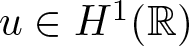 $u\in H^1({\mathbb{R}})$. Thus, $\bar{Q}$ is the best constant of this inequality.
Let
 \begin{equation}
m_0:=\Big(\frac{p+1}{2}\Big)^{\frac{2}{p-1}}\bar{Q}^{-\frac{2(p+1)}{p-1}}.
\end{equation}
\begin{equation}
m_0:=\Big(\frac{p+1}{2}\Big)^{\frac{2}{p-1}}\bar{Q}^{-\frac{2(p+1)}{p-1}}.
\end{equation} As we will see later, the problem (1.3) admits solutions if and only if  $-\infty \lt I(m) \lt -m$. We have already known that $I(m) =-\infty$ for all $m$ when $p \gt 5$, see Proposition 3.1 (i).
Proposition 3.3. When  $p=5$ and $m_0$ is given by (3.14), we have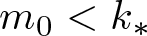 $m_0 \lt k_*$ and $I(m)=-m$ when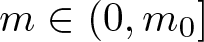 $m\in(0,m_0]$ and $-\infty \lt I(m) \lt -m$ when $m\in(m_0,k_*)$, where $k_*$ is given in Proposition 3.1 (v).
Proof. If 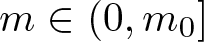 $m\in(0,m_0]$, for all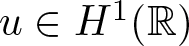 $u\in H^1(\mathbb{R})$ satisfying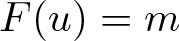 $F(u)=m$, from Lemma 2.4 and Remark 3.2 it follows that,
 \begin{equation*}
E(u)+\|u\|_2^2\geq0.
\end{equation*}
\begin{equation*}
E(u)+\|u\|_2^2\geq0.
\end{equation*} Hence,  $I(m)+m\geq0$. By virtue of Proposition 3.1 (iii), we obtain $I(m)=-m$.
If  $m \gt m_0$, then $\big(\frac{p+1}{2}\big)^{\frac{1}{p+1}}m^{-\frac{p-1}{2 (p+1)}} \lt \bar{Q}$. Choose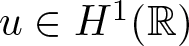 $u\in H^1({\mathbb{R}})$ such that
 \begin{equation*}
Q(u) \gt \Big(\frac{p+1}{2}\Big)^{\frac{1}{p+1}}m^{-\frac{p-1}{2 (p+1)}}.
\end{equation*}
\begin{equation*}
Q(u) \gt \Big(\frac{p+1}{2}\Big)^{\frac{1}{p+1}}m^{-\frac{p-1}{2 (p+1)}}.
\end{equation*} Let 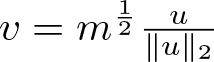 $v=m^{\frac{1}{2}}\frac{u}{\|u\|_2}$. Then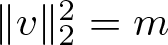 $\|v\|_2^2=m$ and $Q(v)=Q(u)$. From (3.12) it follows that $E(v)+\|v\|_2^2 \lt 0$. Thus, we have $I(m) \lt -m$.
To show 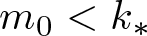 $m_0 \lt k_*$, which is equivalent to that $B(p) \lt \bar{Q}^{p+1}$ when $p=5$, where $B(p)$ is given by (3.4), we denote by $\mathcal{Q}(u)$ the quotient in the right-hand side of (3.4). Let $u_*$ be an optimal function for (3.4). Then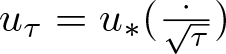 $u_{\tau}=u_*(\frac{\cdot}{\sqrt{\tau}})$ is also an optimal function for (3.4), that is, $\mathcal{Q}(u_{\tau})=B(p)$ for $\tau \gt 0$. The conclusion follows if there is $\tau \gt 0$ such that $\mathcal{Q}(u_{\tau}) \lt Q_{\kappa}(u_\tau)^{p+1}$ which is equivalent to that $\|u^{\prime}_{\tau}-u_\tau\|_2^2 \lt \|u^{\prime}_\tau\|_2^2$, or using Plancherel’s theorem gives
 \begin{equation*}
\int_{\mathbb{R}}(|\xi|-\tau)^2|\hat{u}_*(\xi)|^2d\xi \lt \int_{\mathbb{R}}|\xi|^2|\hat{u}_*(\xi)|^2d\xi.
\end{equation*}
\begin{equation*}
\int_{\mathbb{R}}(|\xi|-\tau)^2|\hat{u}_*(\xi)|^2d\xi \lt \int_{\mathbb{R}}|\xi|^2|\hat{u}_*(\xi)|^2d\xi.
\end{equation*}The inequality can be written as
 \begin{equation*}
-2\tau\int_{\mathbb{R}}|\xi||\hat{u}_*(\xi)|^2d\xi+
\tau^2\int_{\mathbb{R}}|\hat{u}_*(\xi)|^2d\xi \lt 0,
\end{equation*}
\begin{equation*}
-2\tau\int_{\mathbb{R}}|\xi||\hat{u}_*(\xi)|^2d\xi+
\tau^2\int_{\mathbb{R}}|\hat{u}_*(\xi)|^2d\xi \lt 0,
\end{equation*} if  $0 \lt \tau \lt \frac{2\int_{\mathbb{R}}|\xi||\hat{u}_*(\xi)|^2d\xi}{\|\hat{u}_*\|_2^2}$. Thus, we have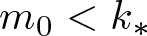 $m_0 \lt k_*$. The rest arguments follow directly from Proposition 3.1 (v).
Lemma 3.4. Assume that  $p=5$ and $m\in(m_0,k_*)$, where $m_0$ and $k_*$ are defined by (3.14) and (3.5), respectively. Then for any $m'\in(m_0,m)$ we have $I(m) \lt I(m')+I(m-m')$.
Proof. For the fixed  $m'\in(m_0,m)$, it suffices to prove that
 \begin{equation}
\forall~\theta\in(1,\frac{m}{m'}):~~I(\theta m') \lt \theta I(m').
\end{equation}
\begin{equation}
\forall~\theta\in(1,\frac{m}{m'}):~~I(\theta m') \lt \theta I(m').
\end{equation}Note that if (3.15) holds, then we have
 \begin{equation*}
\begin{aligned}
I(m)=& \frac{m-m'}{m}I(m)+\frac{m'}{m}I(m)=\frac{m-m'}{m}I\left(\frac{m}{m-m'}(m-m')\right)
+\frac{m'}{m}
I\left(\frac{m}{m'}m'\right)\\ \lt &I(m')+I(m-m').
\end{aligned}
\end{equation*}
\begin{equation*}
\begin{aligned}
I(m)=& \frac{m-m'}{m}I(m)+\frac{m'}{m}I(m)=\frac{m-m'}{m}I\left(\frac{m}{m-m'}(m-m')\right)
+\frac{m'}{m}
I\left(\frac{m}{m'}m'\right)\\ \lt &I(m')+I(m-m').
\end{aligned}
\end{equation*} Assume that 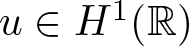 $u\in H^1(\mathbb{R})$ satisfies $\|u\|_2^2=m'$. To prove (3.15), we consider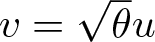 $v=\sqrt{\theta}u$. Note that $\|\sqrt{\theta}u\|_2^2=\theta\|u\|_2^2=\theta m'$ and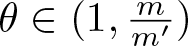 $\theta\in(1,\frac{m}{m'})$. Then
 \begin{equation}
I(\theta m')\leq E(\sqrt{\theta}u)=\theta E(u)+\frac{2}{p+1}(\theta-\theta^{\frac{p+1}{2}})
\int_{\mathbb{R}}u^{p+1}dx \lt \theta E(u) \lt \theta (I(m')+\epsilon).
\end{equation}
\begin{equation}
I(\theta m')\leq E(\sqrt{\theta}u)=\theta E(u)+\frac{2}{p+1}(\theta-\theta^{\frac{p+1}{2}})
\int_{\mathbb{R}}u^{p+1}dx \lt \theta E(u) \lt \theta (I(m')+\epsilon).
\end{equation} Taking into account the arbitrariness of  $\epsilon \gt 0$, we obtain $I(\theta m') \lt \theta I(m')$.
Now, we are ready to prove Theorem 1.2.
Proof of Theorem 1.2
Let  $\{u_n\}$ be a minimizing sequence. It follows from Proposition 3.1 (v) that $\{u_n\}$ is bounded in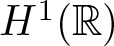 $H^1(\mathbb{R})$. Using (3.8) with $\epsilon=0$ we infer that for any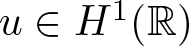 $u\in H^1(\mathbb{R})$ satisfying $\int_{\mathbb{R}}u^{p+1}dx \gt 0$ there holds
 \begin{equation}
\begin{aligned}
\int_{\mathbb{R}}u^{p+1}dx&=\frac{p+1}{2}\big(\|u^{\prime}\|_2^2-2\|D^{\frac{1}{2}}u\|_2^2+\|u\|_2^2\big)
-\frac{p+1}{2}\big(E(u)+\|u\|_2^2\big)\\
&\geq -\frac{p+1}{2}\big(E(u)+\|u\|_2^2\big).
\end{aligned}
\end{equation}
\begin{equation}
\begin{aligned}
\int_{\mathbb{R}}u^{p+1}dx&=\frac{p+1}{2}\big(\|u^{\prime}\|_2^2-2\|D^{\frac{1}{2}}u\|_2^2+\|u\|_2^2\big)
-\frac{p+1}{2}\big(E(u)+\|u\|_2^2\big)\\
&\geq -\frac{p+1}{2}\big(E(u)+\|u\|_2^2\big).
\end{aligned}
\end{equation} For 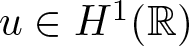 $u\in H^1(\mathbb{R})$ and $t \gt 0$, using Hölder’s inequality and the Sobolev embedding yields
 \begin{equation}
\begin{aligned}
\int_{\mathbb{R}}u^{p+1}dx&=\int_{\{u \lt t\}}u^{p+1}dx+\int_{\{u\geq t\}}u^{p+1}dx\\
&\leq t^{p-1}\int_{\{u \lt t\}}u^2dx+\Big(\int_{\{u\geq t\}}u^{p'+1}dx\Big)^{\frac{p+1}{p'+1}}
\mathcal{L}\big(\{u\geq t\}\big)^{1-\frac{p+1}{p'+1}}\\
&\leq t^{p-1}\|u\|_2^2+\Big(C_S\|u\|_{H^1({\mathbb{R}})}\Big)^{p+1}
\mathcal{L}\big(\{u\geq t\}\big)^{1-\frac{p+1}{p'+1}},
\end{aligned}
\end{equation}
\begin{equation}
\begin{aligned}
\int_{\mathbb{R}}u^{p+1}dx&=\int_{\{u \lt t\}}u^{p+1}dx+\int_{\{u\geq t\}}u^{p+1}dx\\
&\leq t^{p-1}\int_{\{u \lt t\}}u^2dx+\Big(\int_{\{u\geq t\}}u^{p'+1}dx\Big)^{\frac{p+1}{p'+1}}
\mathcal{L}\big(\{u\geq t\}\big)^{1-\frac{p+1}{p'+1}}\\
&\leq t^{p-1}\|u\|_2^2+\Big(C_S\|u\|_{H^1({\mathbb{R}})}\Big)^{p+1}
\mathcal{L}\big(\{u\geq t\}\big)^{1-\frac{p+1}{p'+1}},
\end{aligned}
\end{equation} where 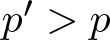 $p' \gt p$ and $\mathcal{L}$ denotes the Lebesgue measure in $\mathbb{R}$.
Choose  $0 \lt \delta \lt -\frac{p+1}{4}\big(I(m)+m\big)$. Since $F(u_n)\to m$ and $E(u_n)\to I(m)$ as $n\to\infty$, from (3.17) we have $\int_{\mathbb{R}}u_n^{p+1}dx \gt 2\delta$ for the sufficiently large $n$. Choose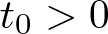 $t_0 \gt 0$ such that $t_0^{p-1}(m+1)=\delta$. Given the boundedness of $\{u_n\}$ in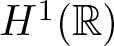 $H^1({\mathbb{R}})$ and (3.18), there is a constant $a \gt 0$ independent of $n$, such that
  $\mathcal{L}(\{u_n\}\geq t_0
\})\geq a$ for the sufficiently large
$\mathcal{L}(\{u_n\}\geq t_0
\})\geq a$ for the sufficiently large  $n$. According to Lieb’s Lemma [Reference Lieb25], there exists a constant $b \gt 0$ independent of $n$, and for the large $n$ there exists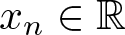 $x_n\in \mathbb{R}$ such that
 \begin{equation}
\mathcal{L}\Big(\{x\in B(x_n,1)\big|u_n\geq\frac{t_0}{2}\}\Big)\geq b.
\end{equation}
\begin{equation}
\mathcal{L}\Big(\{x\in B(x_n,1)\big|u_n\geq\frac{t_0}{2}\}\Big)\geq b.
\end{equation} We now replace  $u_n$ by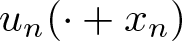 $u_n(\cdot+x_n)$, which is still a minimizing sequence and satisfies (3.19). Since $\{u_n\}$ is bounded in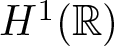 $H^1(\mathbb{R})$, there exists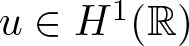 $u\in H^1(\mathbb{R})$ and a subsequence, still denoted by $u_n$, such that
 \begin{equation}
\begin{aligned}
&u_n\rightharpoonup u ~~~{\rm{weakly~in}}~H^1({\mathbb{R}}),\\
&u_n\to u~~~{\rm{in}}~L^p_{loc}({\mathbb{R}})~~{\rm{for}}~p\geq1~{\rm{a.e.}}
\end{aligned}
\end{equation}
\begin{equation}
\begin{aligned}
&u_n\rightharpoonup u ~~~{\rm{weakly~in}}~H^1({\mathbb{R}}),\\
&u_n\to u~~~{\rm{in}}~L^p_{loc}({\mathbb{R}})~~{\rm{for}}~p\geq1~{\rm{a.e.}}
\end{aligned}
\end{equation} Clearly,  $\int_{B(0,1)}u_n^pdx\geq b\big(\frac{t_0}{2}\big)^{p}$ holds for the sufficiently large $n$. Passing to the limit, we get $\int_{B(0,1)}u^pdx\geq b\big(\frac{t_0}{2}\big)^{p}$. Then we get $u\neq 0$. Let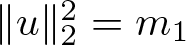 $\|u\|_2^2=m_1$. We know that $0 \lt m_1\leq\liminf\limits_{n\to\infty}\|u_n\|_2^2=m$. To show that $m_1$ can be equal to $m$, we argue by contradiction by assuming that $m_1 \lt m$. Then
 \begin{equation}
I(m)\geq I(m_1)+I(m-m_1).
\end{equation}
\begin{equation}
I(m)\geq I(m_1)+I(m-m_1).
\end{equation} Observe that if  $\epsilon$ is positive and small, and $f$ is a function such that $|F(f)-m| \lt \epsilon$, then $F(\beta f)=m$, where $\beta =(m/F(f))^{\frac{1}{2}}$ satisfies $|\beta-1|\leq A_1\epsilon$ with $A_1$ independent of $f$ and $\epsilon$. So we get
 \begin{equation*}
I(m_1)\leq E(\beta f)\leq E(f)+A_2\epsilon,
\end{equation*}
\begin{equation*}
I(m_1)\leq E(\beta f)\leq E(f)+A_2\epsilon,
\end{equation*} where  $A_2$ depends only on $A_1$ and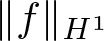 $\|f\|_{H^1}$. A similar result holds for the function $g$ such that $|F(g)-(m-m_1)| \lt \epsilon$.
From [Reference Pava32, Theorem 2.8], there exist a subsequence 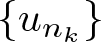 $\{u_{n_k}\}$ of $\{u_n\}$ and the associated functions $f_{n_k}$ and $g_{n_k}$ such that for all $k$ there hold
 \begin{equation*}
E(f_{n_k})\geq I(m)-\frac{1}{k},\ \
E(g_{n_k})\geq I(m-m_1)-\frac{1}{k},\ \
E(u_{n_k})\geq E(f_{n_k})+E(g_{n_k})-\frac{1}{k}.
\end{equation*}
\begin{equation*}
E(f_{n_k})\geq I(m)-\frac{1}{k},\ \
E(g_{n_k})\geq I(m-m_1)-\frac{1}{k},\ \
E(u_{n_k})\geq E(f_{n_k})+E(g_{n_k})-\frac{1}{k}.
\end{equation*}Then we have
 \begin{equation*}
E(u_{n_k})\geq I(m)+I(m-m_1)-\frac{3}{k}.
\end{equation*}
\begin{equation*}
E(u_{n_k})\geq I(m)+I(m-m_1)-\frac{3}{k}.
\end{equation*} Thus, (3.21) follows by taking the limit 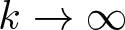 $k\to\infty$. However, from Lemma 3.4 we know that $I(m) \lt I(m_1)+I(m-m_1)$. This contradiction means that $m_1=m$.
To show that 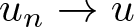 $u_n\to u$ strongly in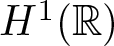 $H^1(\mathbb{R})$, we know that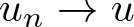 $u_n\to u$ strongly in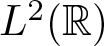 $L^2(\mathbb{R})$ due to (3.20) and the fact of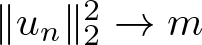 $\|u_n\|_2^2\to m$. The weak convergence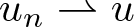 $u_n\rightharpoonup u$ in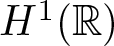 $H^1(\mathbb{R})$ indicates that $\|u^{\prime}\|_2^2\leq \liminf\limits_{n\to\infty}\|u^{\prime}_n\|_2^2$ and $E(u)\leq \liminf\limits_{n\to\infty}E(u_n)=I(m)$.
On the other hand, we have  $E(u)\geq I(m)$ due to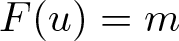 $F(u)=m$. Thus, $E(u)=I(m)$ and $u$ solves the minimization problem (1.3). Moreover, we have $\|u^{\prime}_n\|_2^2\to\|u^{\prime}\|_2^2$. Since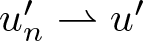 $u^{\prime}_n\rightharpoonup u^{\prime}$ weakly in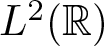 $L^2(\mathbb{R})$, we infer that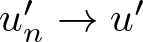 $u^{\prime}_n\to u^{\prime}$ strongly in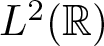 $L^2(\mathbb{R})$. This implies that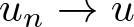 $u_n\to u$ strongly in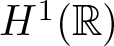 $H^1(\mathbb{R})$.
Proof of Theorem 1.3
In view of the definition of the orbital stability, we need to prove that the solution  $\phi(t)$ of (1.1) exists globally, at least for initial data $\phi_0$ sufficiently close to $\mathcal{G}_m$.
Since  $p=5$, we deduce from the conservation laws and (3.2) and (3.3) that
 \begin{equation}
\begin{aligned}
E(\phi_0)=E(\phi(t))&=\|\phi'(t)\|_2^2-2\|D^{\frac{1}{2}}\phi(t)\|_2^2-\frac{1}{3}
\int_{\mathbb{R}}(\phi(t,x))^{6}dx\\
&\geq\|\phi'(t)\|_2^2-2\|\phi'(t)\|_2\|\phi_0\|_2-\frac{1}{3}B(p)
\|\phi'(t)\|^{2}_2\|\phi_0\|^{4}_2\\
&\geq\|\phi'(t)\|_2^2-2\epsilon\|\phi'(t)\|^2_2-2C(\epsilon,\|\phi_0\|_2)
-\Big(\frac{\|\phi_0\|^2_2}{k_*}\Big)^2
\|\phi'(t)\|^2_2.
\end{aligned}
\end{equation}
\begin{equation}
\begin{aligned}
E(\phi_0)=E(\phi(t))&=\|\phi'(t)\|_2^2-2\|D^{\frac{1}{2}}\phi(t)\|_2^2-\frac{1}{3}
\int_{\mathbb{R}}(\phi(t,x))^{6}dx\\
&\geq\|\phi'(t)\|_2^2-2\|\phi'(t)\|_2\|\phi_0\|_2-\frac{1}{3}B(p)
\|\phi'(t)\|^{2}_2\|\phi_0\|^{4}_2\\
&\geq\|\phi'(t)\|_2^2-2\epsilon\|\phi'(t)\|^2_2-2C(\epsilon,\|\phi_0\|_2)
-\Big(\frac{\|\phi_0\|^2_2}{k_*}\Big)^2
\|\phi'(t)\|^2_2.
\end{aligned}
\end{equation} This implies that the solution  $\phi(t)$ of (1.1) with initial data $\phi_0$ is global when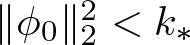 $\|\phi_0\|^2_2 \lt k_*$. In addition, we deduce from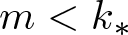 $m \lt k_*$ that there exists $\epsilon \gt 0$ such that $\|v\|^2_2 \lt k_*$ for all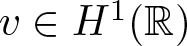 $v\in H^1(\mathbb{R})$ satisfying $dist(v,\mathcal{G}_m) \lt \epsilon$. Thus, when $dist(\phi_0,\mathcal{G}_m) \lt \epsilon$, the solution $\phi(t)$ of (1.1) with initial data $\phi_0$ exists globally.
To show the stability of the set  $\mathcal{G}_m$, we prove by way of contradiction. Assume that there exist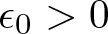 $\epsilon_0 \gt 0$ and a sequence of initial data $\{\phi_0^n\}$ such that
 \begin{equation}
dist(\phi^n_0, \mathcal{G}_m) \lt \frac{1}{n},
\end{equation}
\begin{equation}
dist(\phi^n_0, \mathcal{G}_m) \lt \frac{1}{n},
\end{equation} and there exists  $\{t_n\}$ such that the corresponding solution sequence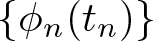 $\{\phi_n(t_n)\}$ of (1.1) satisfies
 \begin{equation}
dist(\phi_n(t_n), \mathcal{G}_m)\geq\epsilon_0.
\end{equation}
\begin{equation}
dist(\phi_n(t_n), \mathcal{G}_m)\geq\epsilon_0.
\end{equation} We claim that there exists 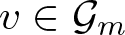 $v\in \mathcal{G}_m$ such that
 \begin{equation*}
\lim\limits_{n\to\infty}\|\phi_{0,n}-v\|_{H^1}=0.
\end{equation*}
\begin{equation*}
\lim\limits_{n\to\infty}\|\phi_{0,n}-v\|_{H^1}=0.
\end{equation*} Indeed, by (3.23) there exists 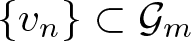 $\{v_n\}\subset \mathcal{G}_m$ such that
 \begin{equation}
\|\phi_{0,n}-v_n\|_{H^1} \lt \frac{2}{n}.
\end{equation}
\begin{equation}
\|\phi_{0,n}-v_n\|_{H^1} \lt \frac{2}{n}.
\end{equation} That is, 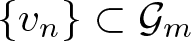 $\{v_n\}\subset \mathcal{G}_m$ implies that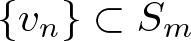 $\{v_n\}\subset S_m$ is a minimizing sequence of $E$. By virtue of Theorem 1.2, there exist a subsequence $\{v_{n}\}$, a sequence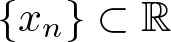 $\{x_n\}\subset \mathbb{R}$ and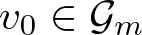 $v_0\in\mathcal{G}_m$ such that
 \begin{equation}
\lim_{n\to\infty}\|v_{n}(\cdot+x_n)-v_0\|_{H^1}=0.
\end{equation}
\begin{equation}
\lim_{n\to\infty}\|v_{n}(\cdot+x_n)-v_0\|_{H^1}=0.
\end{equation}Therefore, the above claim follows from (3.25) and (3.26) immediately. Then we get
 \begin{equation*}
\lim_{n\to\infty}\|\phi_{0,n}\|_2^2=\|v\|_2^2=m,~\ \
\lim_{n\to\infty}E(\phi_{0,n})=E(v)=I(m).
\end{equation*}
\begin{equation*}
\lim_{n\to\infty}\|\phi_{0,n}\|_2^2=\|v\|_2^2=m,~\ \
\lim_{n\to\infty}E(\phi_{0,n})=E(v)=I(m).
\end{equation*}By the conservation of mass and energy, we have
 \begin{equation*}
\lim_{n\to\infty}\|\phi_n(t_n)\|_2^2=m,~\ \ \lim_{n\to\infty}E(\phi_n(t_n))=E(v)=I(m).
\end{equation*}
\begin{equation*}
\lim_{n\to\infty}\|\phi_n(t_n)\|_2^2=m,~\ \ \lim_{n\to\infty}E(\phi_n(t_n))=E(v)=I(m).
\end{equation*} Using (3.22) and the fact that 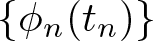 $\{\phi_n(t_n)\}$ is bounded in $H^1$, we set
 \begin{equation*}
\varphi_n=\frac{\sqrt{m}\phi_n(t_n)}{\|\phi_n(t_n)\|_2}.
\end{equation*}
\begin{equation*}
\varphi_n=\frac{\sqrt{m}\phi_n(t_n)}{\|\phi_n(t_n)\|_2}.
\end{equation*} Then 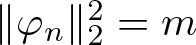 $\|\varphi_n\|^2_2=m$ and
 \begin{align*}
E(\varphi_n)&=\Big(\frac{\sqrt{m}}{\|\phi_n(t_n)\|_2}\Big)^2
\Big(\|\phi^{\prime}_n(t_n)\|^2_2-\frac{1}{2}\|D^{\frac{1}{2}}\phi_n(t_n)\|_2^2\Big)\\
&~~~~-\Big(\frac{\sqrt{m}}{\|\phi_n(t_n)\|_2}\Big)^{p+1}\frac{2}{p+1}
\int_{\mathbb{R}}(\phi_n(t_n,x))^{p+1}dx\\
&=\frac{m}{\|\phi_n(t_n)\|_2^2}E(\phi_n(t_n))\\
&\quad +\Bigg[\Big(\frac{\sqrt{m}}
{\|\phi_n(t_n)\|_2}\Big)^2
-\Big(\frac{\sqrt{m}}{\|\phi_n(t_n)\|_2}\Big)^{p+1}\Bigg]\frac{2}{p+1}
\int_{\mathbb{R}}(\phi_n(t_n,x))^{p+1}dx,
\end{align*}
\begin{align*}
E(\varphi_n)&=\Big(\frac{\sqrt{m}}{\|\phi_n(t_n)\|_2}\Big)^2
\Big(\|\phi^{\prime}_n(t_n)\|^2_2-\frac{1}{2}\|D^{\frac{1}{2}}\phi_n(t_n)\|_2^2\Big)\\
&~~~~-\Big(\frac{\sqrt{m}}{\|\phi_n(t_n)\|_2}\Big)^{p+1}\frac{2}{p+1}
\int_{\mathbb{R}}(\phi_n(t_n,x))^{p+1}dx\\
&=\frac{m}{\|\phi_n(t_n)\|_2^2}E(\phi_n(t_n))\\
&\quad +\Bigg[\Big(\frac{\sqrt{m}}
{\|\phi_n(t_n)\|_2}\Big)^2
-\Big(\frac{\sqrt{m}}{\|\phi_n(t_n)\|_2}\Big)^{p+1}\Bigg]\frac{2}{p+1}
\int_{\mathbb{R}}(\phi_n(t_n,x))^{p+1}dx,
\end{align*}which implies that
 \begin{equation*}
\lim_{n\to\infty}E(\varphi_n)=\lim_{n\to\infty}E(\phi_n(t_n))=I(m).
\end{equation*}
\begin{equation*}
\lim_{n\to\infty}E(\varphi_n)=\lim_{n\to\infty}E(\phi_n(t_n))=I(m).
\end{equation*} Thus, 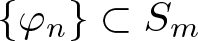 $\{\varphi_n\}\subset S_m$ is a minimizing sequence of $E$. According to Theorem 1.2, there exist a subsequence (still denoted by) $\{\varphi_{n}\}$, a sequence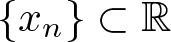 $\{x_n\}\subset \mathbb{R}$ and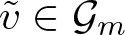 $\tilde{v}\in \mathcal{G}_m$ such that
 \begin{equation}
\lim_{n\to\infty}\|\varphi_n(\cdot+x_n)-\tilde{v}\|_{H^1}=0.
\end{equation}
\begin{equation}
\lim_{n\to\infty}\|\varphi_n(\cdot+x_n)-\tilde{v}\|_{H^1}=0.
\end{equation} By the definition of  $\varphi_n$, we obtain
 \begin{equation}
\lim_{n\to\infty}\|\varphi_n-\phi_n(t_n)\|_{H^1}
=\lim_{n\to\infty}\Big(1-\frac{\sqrt{m}}{\|\phi_n(t_n)\|_2}\Big)
\|\phi_n(t_n)\|_{H^1}=0.
\end{equation}
\begin{equation}
\lim_{n\to\infty}\|\varphi_n-\phi_n(t_n)\|_{H^1}
=\lim_{n\to\infty}\Big(1-\frac{\sqrt{m}}{\|\phi_n(t_n)\|_2}\Big)
\|\phi_n(t_n)\|_{H^1}=0.
\end{equation}From (3.27) and (3.28) it follows that
 \begin{equation*}
dist(\phi_n(t_n), \mathcal{G}_m)\leq
\|\phi_n(t_n)-\tilde{v}(\cdot-x_n)\|_{H^1}=
\|\phi_n(t_n, \cdot+x_n)-\tilde{v}\|_{H^1}\to0,\ \rm{as}\ n\to\infty,
\end{equation*}
\begin{equation*}
dist(\phi_n(t_n), \mathcal{G}_m)\leq
\|\phi_n(t_n)-\tilde{v}(\cdot-x_n)\|_{H^1}=
\|\phi_n(t_n, \cdot+x_n)-\tilde{v}\|_{H^1}\to0,\ \rm{as}\ n\to\infty,
\end{equation*}which contradicts (3.24). Consequently, the proof is complete.
4. A local minimization problem
In this section, we investigate the  $L^2$-supercritical case by considering a local minimization problem. For any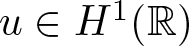 $u\in H^1(\mathbb{R})$ satisfying $\int_{\mathbb{R}}u^{p+1}dx \gt 0$, we let $u_t(x)=t^{\frac{1}{2}}u(tx)$ and denote
 \begin{equation*}
\varphi_u(t)=E(u_t)=t^2\|u^{\prime}\|_2^2-2t\|D^{\frac{1}{2}}u\|_2^2-\frac{2}{p+1}
t^{\frac{p-1}{2}}\int_{\mathbb{R}}u^{p+1}dx,
\end{equation*}
\begin{equation*}
\varphi_u(t)=E(u_t)=t^2\|u^{\prime}\|_2^2-2t\|D^{\frac{1}{2}}u\|_2^2-\frac{2}{p+1}
t^{\frac{p-1}{2}}\int_{\mathbb{R}}u^{p+1}dx,
\end{equation*} \begin{equation}
D(u)=\|u^{\prime}\|_2^2-\frac{(p-1)(p-3)}{4(p+1)}\int_{\mathbb{R}}u^{p+1}dx.
\end{equation}
\begin{equation}
D(u)=\|u^{\prime}\|_2^2-\frac{(p-1)(p-3)}{4(p+1)}\int_{\mathbb{R}}u^{p+1}dx.
\end{equation}Lemma 4.1. Let  $a,~b,~c \gt 0$ and define $f:~[0,\infty)\to \mathbb{R}$ by
 \begin{equation}
f(t)=at^2-2bt-ct^{\frac{p-1}{2}}.
\end{equation}
\begin{equation}
f(t)=at^2-2bt-ct^{\frac{p-1}{2}}.
\end{equation}Then we have
(i) The second derivative  $f^{\prime\prime}$ is decreasing. There exists a unique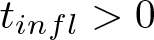 $t_{infl} \gt 0$ such that $f^{\prime\prime}(t_{infl})=0$, where $t_{infl}$ is given by
 \begin{equation*}
t_{infl}=\Big(\frac{8a}{(p-1)(p-3)c}\Big)^{\frac{2}{p-5}}.
\end{equation*}
\begin{equation*}
t_{infl}=\Big(\frac{8a}{(p-1)(p-3)c}\Big)^{\frac{2}{p-5}}.
\end{equation*} (ii) The derivative  $f'$ is increasing on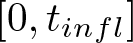 $[0,t_{infl}]$ and decreasing on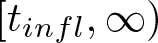 $[t_{infl},\infty)$, and we have $f'(t_{infl}) \gt 0$ if and only if
 \begin{equation*}
a^{\frac{3-p}{2}}b^{\frac{p-5}{2}}c \lt \frac{8}{(p-1)(p-3)}\Big(\frac{p-5}{p-3}\Big)
^{\frac{p-5}{2}}.
\end{equation*}
\begin{equation*}
a^{\frac{3-p}{2}}b^{\frac{p-5}{2}}c \lt \frac{8}{(p-1)(p-3)}\Big(\frac{p-5}{p-3}\Big)
^{\frac{p-5}{2}}.
\end{equation*} When  $f'(t_{infl}) \gt 0$, the following three statements are true.
(iii) There exist a unique  $t_1\in(0,t_{infl})$ and a unique $t_2\in(t_{infl},\infty)$ such that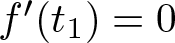 $f'(t_1)=0$ and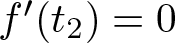 $f'(t_2)=0$. The map $f$ is decreasing on $[0,t_1]$, increasing on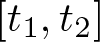 $[t_1,t_2]$, decreasing on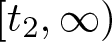 $[t_2,\infty)$ and attains its minimum at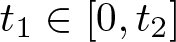 $t_1\in [0,t_2]$.
(iv) For  $t_2\leq t' \lt t^{\prime\prime}$, we have $f(t^{\prime\prime})-f(t')\leq\frac{1}{2}(t^{\prime\prime}- t')^2f^{\prime\prime}(t_2)$.
(v) We have
 \begin{equation*}
f(t_{infl})-f(t_1)=h\Big(\frac{t_{infl}}{t_1}\Big)t_1^{\frac{p-1}{2}}c,
\end{equation*}
\begin{equation*}
f(t_{infl})-f(t_1)=h\Big(\frac{t_{infl}}{t_1}\Big)t_1^{\frac{p-1}{2}}c,
\end{equation*}where
 \begin{align*}
h(s)&=\frac{(p+1)(p-5)}{8}s^{\frac{p-1}{2}}-\frac{(p-1)(p-3)}{4}s^{\frac{p-3}{2}}\\
&\quad+\frac{(p-1)(p-3)}{8}s^{\frac{p-5}{2}}+\frac{p-1}{2}(s-1)+1,
\end{align*}
\begin{align*}
h(s)&=\frac{(p+1)(p-5)}{8}s^{\frac{p-1}{2}}-\frac{(p-1)(p-3)}{4}s^{\frac{p-3}{2}}\\
&\quad+\frac{(p-1)(p-3)}{8}s^{\frac{p-5}{2}}+\frac{p-1}{2}(s-1)+1,
\end{align*} and the function  $h(s)$ satisfies $h(1)=h'(1)=h^{\prime\prime}(1)$ and
 \begin{equation*}
h^{\prime\prime}(s)=\frac{(p-1)(p-3)(p-5)}{16}s^{\frac{p-9}{2}}(s-1)\Big(\frac{p+1}{2}s-\frac{p-7}{2}
\Big).
\end{equation*}
\begin{equation*}
h^{\prime\prime}(s)=\frac{(p-1)(p-3)(p-5)}{16}s^{\frac{p-9}{2}}(s-1)\Big(\frac{p+1}{2}s-\frac{p-7}{2}
\Big).
\end{equation*} Hence,  $h(s)$ is positive, increasing and convex on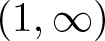 $(1,\infty)$.
Proof. (i) From (4.2) it follows that
 \begin{equation*}
\begin{aligned}
f^{\prime\prime}(t)&=2a-\frac{(p-1)(p-3)}{4}ct^{\frac{p-5}{2}},\\
f^{\prime\prime\prime}(t)&=-\frac{(p-1)(p-3)(p-5)}{8}ct^{\frac{p-7}{2}} \lt 0.
\end{aligned}
\end{equation*}
\begin{equation*}
\begin{aligned}
f^{\prime\prime}(t)&=2a-\frac{(p-1)(p-3)}{4}ct^{\frac{p-5}{2}},\\
f^{\prime\prime\prime}(t)&=-\frac{(p-1)(p-3)(p-5)}{8}ct^{\frac{p-7}{2}} \lt 0.
\end{aligned}
\end{equation*} So,  $f^{\prime\prime}$ is decreasing. Solving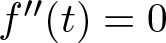 $f^{\prime\prime}(t)=0$, we know that there exists a unique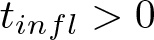 $t_{infl} \gt 0$ such that $f^{\prime\prime}(t_{infl})=0$, where
 \begin{equation*}
t_{infl}=\Big(\frac{8a}{(p-1)(p-3)c}\Big)^{\frac{2}{p-5}}.
\end{equation*}
\begin{equation*}
t_{infl}=\Big(\frac{8a}{(p-1)(p-3)c}\Big)^{\frac{2}{p-5}}.
\end{equation*} (ii) From  $f^{\prime\prime}(t_{infl})=0$, we have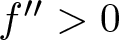 $f^{\prime\prime} \gt 0$ on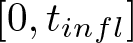 $[0,t_{infl}]$ and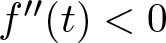 $f^{\prime\prime}(t) \lt 0$ on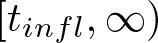 $[t_{infl},\infty)$. Then $f'$ is increasing on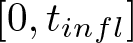 $[0,t_{infl}]$ and decreasing on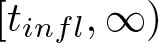 $[t_{infl},\infty)$. From the derivative expression
 \begin{equation*}
f'(t_{infl})=\Big[\frac{8}{(p-1)(p-3)}\Big]^{\frac{2}{p-5}}\frac{2(p-5)}{p-3}a^{\frac{p-3}{p-5}}
c^{-\frac{2}{p-5}}-2b \gt 0,
\end{equation*}
\begin{equation*}
f'(t_{infl})=\Big[\frac{8}{(p-1)(p-3)}\Big]^{\frac{2}{p-5}}\frac{2(p-5)}{p-3}a^{\frac{p-3}{p-5}}
c^{-\frac{2}{p-5}}-2b \gt 0,
\end{equation*} we know that  $f'(t_{infl}) \gt 0$ is equivalent to
 \begin{equation*}
a^{\frac{3-p}{2}}b^{\frac{p-5}{2}}c \lt \frac{8}{(p-1)(p-3)}\Big(\frac{p-5}{p-3}\Big)
^{\frac{p-5}{2}}.
\end{equation*}
\begin{equation*}
a^{\frac{3-p}{2}}b^{\frac{p-5}{2}}c \lt \frac{8}{(p-1)(p-3)}\Big(\frac{p-5}{p-3}\Big)
^{\frac{p-5}{2}}.
\end{equation*}(iii) By using (i) and (ii), we see that (iii) follows immediately.
(iv) Given that  $f^{\prime\prime}$ is decreasing on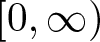 $[0,\infty)$ and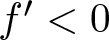 $f' \lt 0$ on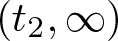 $(t_2,\infty)$, we have
 \begin{align*}
f(t^{\prime\prime})-f(t')&=\int_{t'}^{t^{\prime\prime}}\Big(f'(t'+\int_{t'}^sf^{\prime\prime}(\tau)d\tau)\Big)ds
\leq\int_{t'}^{t^{\prime\prime}}\int_{t'}^sf^{\prime\prime}(\tau)d\tau ds\\
&=\frac{1}{2}(t^{\prime\prime}-t')^2f^{\prime\prime}(t_2).
\end{align*}
\begin{align*}
f(t^{\prime\prime})-f(t')&=\int_{t'}^{t^{\prime\prime}}\Big(f'(t'+\int_{t'}^sf^{\prime\prime}(\tau)d\tau)\Big)ds
\leq\int_{t'}^{t^{\prime\prime}}\int_{t'}^sf^{\prime\prime}(\tau)d\tau ds\\
&=\frac{1}{2}(t^{\prime\prime}-t')^2f^{\prime\prime}(t_2).
\end{align*} (v) Let 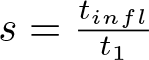 $s=\frac{t_{infl}}{t_1}$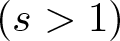 $(s \gt 1)$. Letting $f^{\prime\prime}(t_{infl})=f^{\prime\prime}(t_1s)=0$, we get $a=\frac{(p-1)(p-3)}{8}ct_1^{\frac{p-5}{2}}s^{\frac{p-5}{2}}$. Combining this with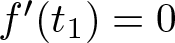 $f'(t_1)=0$ gives $b=\frac{(p-1)c}{4}t_1^{\frac{p-3}{2}}\big(\frac{p-3}{2}s^{\frac{p-5}{2}}-1\big)$. Substituting the values of $a$ and $b$ into $f(t_1s)-f(t_1)$, we can arrive at the desired result (v).
We now take the  $H^{-1}-H^1$ duality product of the equation
 \begin{equation}
-u^{\prime\prime}-2\mathcal{H}u^{\prime}+(1+\omega)u-u^p=0~~{\rm{in}}~H^{-1}({\mathbb{R}})
\end{equation}
\begin{equation}
-u^{\prime\prime}-2\mathcal{H}u^{\prime}+(1+\omega)u-u^p=0~~{\rm{in}}~H^{-1}({\mathbb{R}})
\end{equation} with  $u$. Then any solution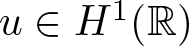 $u\in H^1(\mathbb{R})$ of (4.3) satisfies the identities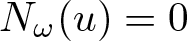 $N_\omega(u)=0$ and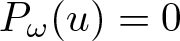 $P_\omega(u)=0$, where
 \begin{equation*}
\begin{aligned}
N_\omega(u)&=\|u^{\prime}\|_2^2-2\|D^{\frac{1}{2}}u\|_2^2+(1+\omega)\|u\|_2^2-
\int_{\mathbb{R}}u^{p+1}dx,\\
P_\omega(u)&=-\|u^{\prime}\|_2^2+(1+\omega)\|u\|_2^2-\frac{2}{p+1}\int_{\mathbb{R}}u^{p+1}dx.
\end{aligned}
\end{equation*}
\begin{equation*}
\begin{aligned}
N_\omega(u)&=\|u^{\prime}\|_2^2-2\|D^{\frac{1}{2}}u\|_2^2+(1+\omega)\|u\|_2^2-
\int_{\mathbb{R}}u^{p+1}dx,\\
P_\omega(u)&=-\|u^{\prime}\|_2^2+(1+\omega)\|u\|_2^2-\frac{2}{p+1}\int_{\mathbb{R}}u^{p+1}dx.
\end{aligned}
\end{equation*}Let
 \begin{equation*}
P_1(u)=\frac{1}{2}\Big(N_\omega(u)-P_\omega(u)\Big)=\|u^{\prime}\|_2^2-
\|D^{\frac{1}{2}}u\|_2^2
-\frac{p-1}{2(p+1)}\int_{\mathbb{R}}u^{p+1}dx.\\
\end{equation*}
\begin{equation*}
P_1(u)=\frac{1}{2}\Big(N_\omega(u)-P_\omega(u)\Big)=\|u^{\prime}\|_2^2-
\|D^{\frac{1}{2}}u\|_2^2
-\frac{p-1}{2(p+1)}\int_{\mathbb{R}}u^{p+1}dx.\\
\end{equation*} To analyze the properties of the function  $\varphi_u$, we observe
 \begin{equation}
\begin{aligned}
\varphi^{\prime}_u(t)&=2t\|u^{\prime}\|_2^2-2\|D^{\frac{1}{2}}u\|_2^2-\frac{p-1}{p+1}t^{\frac{p-3}{2}}
\int_{\mathbb{R}}u^{p+1}dx=\frac{2}{t}P_1(u_t),\\
\varphi^{\prime\prime}_u(t)&=2\|u^{\prime}\|_2^2-\frac{(p-1)(p-3)}{2(p+1)}t^{\frac{p-5}{2}}
\int_{\mathbb{R}}u^{p+1}dx=\frac{2}{t^2}D(u_t).
\end{aligned}
\end{equation}
\begin{equation}
\begin{aligned}
\varphi^{\prime}_u(t)&=2t\|u^{\prime}\|_2^2-2\|D^{\frac{1}{2}}u\|_2^2-\frac{p-1}{p+1}t^{\frac{p-3}{2}}
\int_{\mathbb{R}}u^{p+1}dx=\frac{2}{t}P_1(u_t),\\
\varphi^{\prime\prime}_u(t)&=2\|u^{\prime}\|_2^2-\frac{(p-1)(p-3)}{2(p+1)}t^{\frac{p-5}{2}}
\int_{\mathbb{R}}u^{p+1}dx=\frac{2}{t^2}D(u_t).
\end{aligned}
\end{equation} For any  $u\neq0$, there exists a unique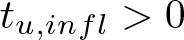 $t_{u,infl} \gt 0$ such that $\varphi^{\prime\prime}_u(t_{u,infl})=0$, where
 \begin{equation}
t_{u,infl}=\Big(\frac{4(p+1)}{(p-1)(p-3)}\int_{\mathbb{R}}(u^{\prime})^2dx\Big)
^{\frac{2}{p-5}}\Big(\int_{\mathbb{R}}u^{p+1}dx\Big)
^{-\frac{2}{p-5}}.
\end{equation}
\begin{equation}
t_{u,infl}=\Big(\frac{4(p+1)}{(p-1)(p-3)}\int_{\mathbb{R}}(u^{\prime})^2dx\Big)
^{\frac{2}{p-5}}\Big(\int_{\mathbb{R}}u^{p+1}dx\Big)
^{-\frac{2}{p-5}}.
\end{equation} We have 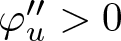 $\varphi^{\prime\prime}_u \gt 0$ on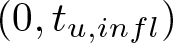 $(0,t_{u,infl})$ and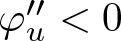 $\varphi^{\prime\prime}_u \lt 0$ on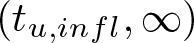 $(t_{u,infl},\infty)$. Hence, $\varphi ^{\prime}_u$ is increasing on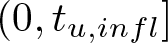 $(0,t_{u,infl}]$ and decreasing on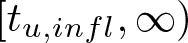 $[t_{u,infl},\infty)$, and attains its maximum at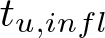 $t_{u,infl}$. If $\varphi^{\prime}_u(t_{u,infl})\leq0$, the mapping $\varphi_u$ is decreasing on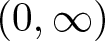 $(0,\infty)$ and thus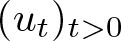 $(u_t)_{t \gt 0}$ cannot be a local minimizer of $E$ when the $L^2$-norm remains fixed. If $\varphi^{\prime}_u(t_{u,infl}) \gt 0$, there exist a unique $t_{u,1}\in(0,t_{u,infl})$ and a unique $t_{u,2}\in(t_{u,infl},\infty)$ such that $\varphi_u(t_{u,1})=\varphi_u(t_{u,2})=0$. We have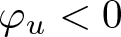 $\varphi_u \lt 0$ on $(0,t_{u,1})\cup(t_{u,2},\infty)$ and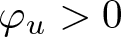 $\varphi_u \gt 0$ on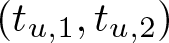 $(t_{u,1},t_{u,2})$. So, $\varphi_u$ is decreasing on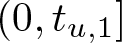 $(0,t_{u,1}]$, increasing on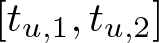 $[t_{u,1},t_{u,2}]$ and decreasing on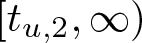 $[t_{u,2},\infty)$. Clearly, among the functions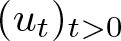 $(u_t)_{t \gt 0}$, the only one that can eventually be a local minimizer of $E$ is $u_{t_{u,1}}$ when the $L^2$-norm is fixed. If $u$ is a local minimizer of $E$, we must have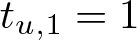 $t_{u,1}=1$ and $1 \lt t_{u,infl} \lt t_{u,2}$ with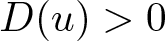 $D(u) \gt 0$. Thus, it is natural to look for a local minimizer of $E$ under the $L^2$-norm in the set
 \begin{equation}
\begin{aligned}
\mathcal{O}&=\big\{u\in H^1(\mathbb{R})\setminus\{0\}~|~t_{u,infl} \gt 1~{\rm{and}}~\varphi^{\prime}_u(t_{u,infl}) \gt 0\big\}\\
&=\big\{u\in H^1(\mathbb{R})\setminus\{0\}~|~D(u) \gt 0~{\rm{and}}~\varphi^{\prime}_u(t_{u,infl}) \gt 0\big\}.
\end{aligned}
\end{equation}
\begin{equation}
\begin{aligned}
\mathcal{O}&=\big\{u\in H^1(\mathbb{R})\setminus\{0\}~|~t_{u,infl} \gt 1~{\rm{and}}~\varphi^{\prime}_u(t_{u,infl}) \gt 0\big\}\\
&=\big\{u\in H^1(\mathbb{R})\setminus\{0\}~|~D(u) \gt 0~{\rm{and}}~\varphi^{\prime}_u(t_{u,infl}) \gt 0\big\}.
\end{aligned}
\end{equation} Clearly, in view of (4.5),  $u\mapsto t_{u,infl}$ and $u\mapsto P_1(u_{t_{u,infl}})$ are continuous on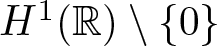 $H^1(\mathbb{R})\setminus\{0\}$. Hence, $\mathcal{O}$ is open. Given any $u\in H^1(\mathbb{R})\setminus\{0\}$, using Lemma 4.1 (ii), we see that $\varphi^{\prime}_u(t_{u,infl}) \gt 0$ if and only if
 \begin{equation}
H(u):=\frac{\|u^{\prime}\|_2^{p-3}}{\|D^{\frac{1}{2}}u\|_2^{p-5}\int_{\mathbb{R}}u^{p+1}dx} \gt \frac{(p-1)(p-3)}{4(p+1)}\Big(\frac{p-3}{p-5}\Big)^{\frac{p-5}{2}}.
\end{equation}
\begin{equation}
H(u):=\frac{\|u^{\prime}\|_2^{p-3}}{\|D^{\frac{1}{2}}u\|_2^{p-5}\int_{\mathbb{R}}u^{p+1}dx} \gt \frac{(p-1)(p-3)}{4(p+1)}\Big(\frac{p-3}{p-5}\Big)^{\frac{p-5}{2}}.
\end{equation} Using (3.2) (with strict inequality due to  $u\neq0$) and (3.3), we have
 \begin{equation*}
\|D^{\frac{1}{2}}u\|_2^{p-5}\|u\|_{p+1}^{p+1} \lt B(p)\|u^{\prime}\|_2^{p-3}\|u\|_2^{p-1}.
\end{equation*}
\begin{equation*}
\|D^{\frac{1}{2}}u\|_2^{p-5}\|u\|_{p+1}^{p+1} \lt B(p)\|u^{\prime}\|_2^{p-3}\|u\|_2^{p-1}.
\end{equation*}Thus we obtain
 \begin{equation*}
H(u)\geq\frac{\|u^{\prime}\|_2^{p-3}}{\|D^{\frac{1}{2}}u\|_2^{p-5}\|u\|_{p+1}^{p+1}} \gt \frac{1}{B(p)\|u\|_2^{p-1}}.
\end{equation*}
\begin{equation*}
H(u)\geq\frac{\|u^{\prime}\|_2^{p-3}}{\|D^{\frac{1}{2}}u\|_2^{p-5}\|u\|_{p+1}^{p+1}} \gt \frac{1}{B(p)\|u\|_2^{p-1}}.
\end{equation*}Let
 \begin{equation}
\mu_0=B(p)^{-\frac{2}{p-1}}\Big(\frac{(p-1)(p-3)}{4(p+1)}\Big)^{-\frac{2}{p-1}}
\Big(\frac{p-3}{p-5}\Big)^{-\frac{p-5}{p-1}}.
\end{equation}
\begin{equation}
\mu_0=B(p)^{-\frac{2}{p-1}}\Big(\frac{(p-1)(p-3)}{4(p+1)}\Big)^{-\frac{2}{p-1}}
\Big(\frac{p-3}{p-5}\Big)^{-\frac{p-5}{p-1}}.
\end{equation} We infer that (4.7) holds for any  $u\in H^1(\mathbb{R})\setminus\{0\}$ satisfying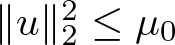 $\|u\|_2^2\leq\mu_0$.
From (3.3) it follows that
 \begin{equation*}
D(u)\geq\|u^{\prime}\|_2^2-\frac{(p-1)(p-3)}{4(p+1)}B(p)\|u^{\prime}\|_2^{\frac{p-1}{2}}\|u\|_2^
{\frac{p+3}{2}}
\end{equation*}
\begin{equation*}
D(u)\geq\|u^{\prime}\|_2^2-\frac{(p-1)(p-3)}{4(p+1)}B(p)\|u^{\prime}\|_2^{\frac{p-1}{2}}\|u\|_2^
{\frac{p+3}{2}}
\end{equation*} for all 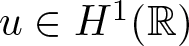 $u\in H^1(\mathbb{R})$. Hence,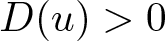 $D(u) \gt 0$ if $u\neq0$ and
 \begin{equation*}
\frac{(p-1)(p-3)}{4(p+1)}B(p)\|u^{\prime}\|_2^{\frac{p-5}{2}}\|u\|_2^
{\frac{p+3}{2}} \lt 1.
\end{equation*}
\begin{equation*}
\frac{(p-1)(p-3)}{4(p+1)}B(p)\|u^{\prime}\|_2^{\frac{p-5}{2}}\|u\|_2^
{\frac{p+3}{2}} \lt 1.
\end{equation*}Let
 \begin{equation*}
\mathcal{O}_1=\left\{u\in H^1(\mathbb{R})\setminus\{0\}~|~
\|u^{\prime}\|_2^{\frac{p-5}{2}}\|u\|_2^
{\frac{p+3}{2}} \lt \frac{4(p+1)}{(p-1)(p-3)B(p)},~\|u\|_2^2 \lt \mu_0 \right\}.
\end{equation*}
\begin{equation*}
\mathcal{O}_1=\left\{u\in H^1(\mathbb{R})\setminus\{0\}~|~
\|u^{\prime}\|_2^{\frac{p-5}{2}}\|u\|_2^
{\frac{p+3}{2}} \lt \frac{4(p+1)}{(p-1)(p-3)B(p)},~\|u\|_2^2 \lt \mu_0 \right\}.
\end{equation*} We can observe that 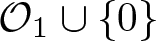 $\mathcal{O}_1\cup\{0\}$ is an open neighbourhood of $0$ in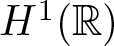 $H^1(\mathbb{R})$ and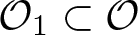 $\mathcal{O}_1\subset\mathcal{O}$. It follows from (4.1) and (4.7) that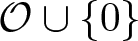 $\mathcal{O}\cup\{0\}$ is star-shaped: for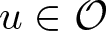 $u\in\mathcal{O}$ and for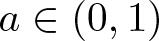 $a\in(0,1)$ we have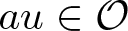 $au\in\mathcal{O}$. For any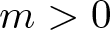 $m \gt 0$, we denote
 \begin{equation}
\tilde{I}(m)=\inf\big\{E(u)~|~u\in
\mathcal{O}~{\rm{and}}~F(u)=m\big\}.
\end{equation}
\begin{equation}
\tilde{I}(m)=\inf\big\{E(u)~|~u\in
\mathcal{O}~{\rm{and}}~F(u)=m\big\}.
\end{equation} Clearly, 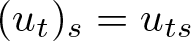 $(u_t)_s=u_{ts}$. If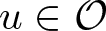 $u\in\mathcal{O}$ and $t \gt 0$, we have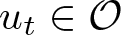 $u_t\in\mathcal{O}$ if and only if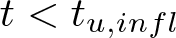 $t \lt t_{u,infl}$, and $t_{u_t,infl}=\frac{t_{u,infl}}{t}$,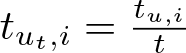 $t_{u_t,i}=\frac{t_{u,i}}{t}$ for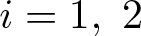 $i=1,~2$. If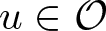 $u\in \mathcal{O}$ satisfies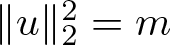 $\|u\|_2^2=m$, then
 \begin{equation*}
\min\{E(u_t)~|~0 \lt t \lt t_{u,infl}\}=E(u_{t_u,1}),
\end{equation*}
\begin{equation*}
\min\{E(u_t)~|~0 \lt t \lt t_{u,infl}\}=E(u_{t_u,1}),
\end{equation*} and  $u_{t_{u,1}}$ is the only function among the functions $(u_t)_{0 \lt t \lt t_{u,infl}}$ such that $P_1$ vanishes. We thus have
 \begin{equation}
\tilde{I}(m)=\inf\big\{E(u)~|~u\in\mathcal{O}~{\rm{and}}~\|u\|_2^2=m~{\rm{and}}~P_1
(u)=0\big\}.
\end{equation}
\begin{equation}
\tilde{I}(m)=\inf\big\{E(u)~|~u\in\mathcal{O}~{\rm{and}}~\|u\|_2^2=m~{\rm{and}}~P_1
(u)=0\big\}.
\end{equation} Therefore, we can summarize the properties of  $\tilde{I}(m)$ as follows.
Lemma 4.2. The following assertions are true.
(i) For 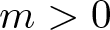 $m \gt 0$, the set $\{u\in \mathcal{O}~|~\|u\|_2^2=m~{\rm{and}}~P_1(u)=0\}$ is not empty and $\tilde{I}(m)\geq-\frac{(p-3)^2}{(p-1)(p-5)}m$.
(ii) For 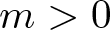 $m \gt 0$ and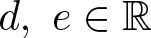 $d,~e\in\mathbb{R}$, the set $\{u\in H^1(\mathbb{R})~|~D(u)\geq d,~\|u\|_2^2\leq m~{\rm{and}}~E(u)\leq e\}$ is bounded in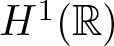 $H^1(\mathbb{R})$.
(iii)  $\tilde{I}$ is sub-additive: $\tilde{I}(m_1+m_2)\leq\tilde{I}(m_1)+\tilde{I}(m_2)$ for $m_1,~m_2 \gt 0$.
(iv) 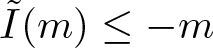 $\tilde{I}(m)\leq -m$ for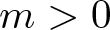 $m \gt 0$.
(v)  $\tilde{I}$ is decreasing and continuous on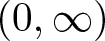 $(0,\infty)$, and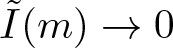 $\tilde{I}(m)\to 0$ as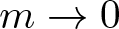 $m\to 0$.
(vi) Let 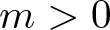 $m \gt 0$. Assume that $\{u_n\}$ is a bounded sequence in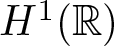 $H^1(\mathbb{R})$ such that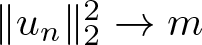 $\|u_n\|_2^2\to m$ and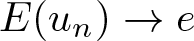 $E(u_n)\to e$ as $n\to\infty$, where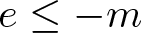 $e\leq -m$. Then we have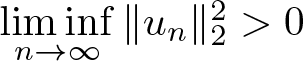 $\liminf\limits_{n\to\infty}\|u_n\|_2^2 \gt 0$. In addition, if $e \lt -m$, then we have $\liminf\limits_{n\to\infty}\int_{\mathbb{R}}u_n^{p+1}dx \gt 0$.
(vii) If 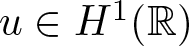 $u\in H^1(\mathbb{R})$ satisfies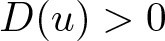 $D(u) \gt 0$ and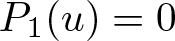 $P_1(u)=0$, we have
 \begin{equation}
\frac{p-3}{p-5}\|u\|_2^2 \gt \|D^{\frac{1}{2}}u\|_2^2 \gt \frac{p-5}{p-3}\|u^{\prime}\|_2^2 \gt \frac{(p-1)(p-5)}{4(p+1)}\int_{\mathbb{R}}u^{p+1}dx.
\end{equation}
\begin{equation}
\frac{p-3}{p-5}\|u\|_2^2 \gt \|D^{\frac{1}{2}}u\|_2^2 \gt \frac{p-5}{p-3}\|u^{\prime}\|_2^2 \gt \frac{(p-1)(p-5)}{4(p+1)}\int_{\mathbb{R}}u^{p+1}dx.
\end{equation}Proof. (i) If 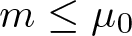 $m\leq \mu_0$, where $\mu_0$ is given by (4.8), for any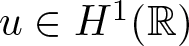 $u\in H^1(\mathbb{R})$ with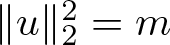 $\|u\|_2^2=m$ satisfying (4.7) and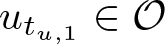 $u_{t_{u,1}}\in \mathcal{O}$, then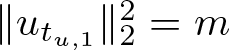 $\|u_{t_{u,1}}\|_2^2=m$ and $P_1(u_{t_{u,1}})=0$. If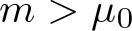 $m \gt \mu_0$, we choose an integer $n$ such that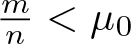 $\frac{m}{n} \lt \mu_0$ and take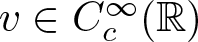 $v\in C_c^{\infty}(\mathbb{R})$ such that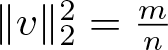 $\|v\|_2^2=\frac{m}{n}$. Let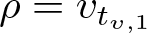 $\rho=v_{t_{v,1}}$, so that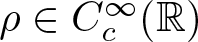 $\rho \in C_c^\infty(\mathbb{R})$,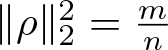 $\|\rho\|_2^2=\frac{m}{n}$,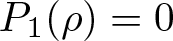 $P_1(\rho)=0$ and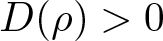 $D(\rho) \gt 0$. Choose $\mathbb{R} \gt 0$ such that ${\rm{supp}}(\rho)\subset B(0,R)$ and choose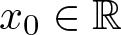 $x_0\in\mathbb{R}$ such that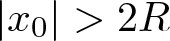 $|x_0| \gt 2R$. Let
 \begin{equation*}
u=\rho+\rho(\cdot+x_0)+\rho(\cdot+2x_0)+\cdots+\rho(\cdot+(n-1)x_0).
\end{equation*}
\begin{equation*}
u=\rho+\rho(\cdot+x_0)+\rho(\cdot+2x_0)+\cdots+\rho(\cdot+(n-1)x_0).
\end{equation*} Then we have  $\|u\|_2^2=n\|\rho\|_2^2=m$, $P_1(u)=nP_1(\rho)=0$ and $D(u)=nD(\rho) \gt 0$. From (4.4) we see that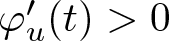 $\varphi^{\prime}_u(t) \gt 0$ if $t \gt 1$ and $t$ is close to $1$. Hence, $\varphi^{\prime}_u(t_{u,infl}) \gt 0$ and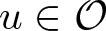 $u\in\mathcal{O}$.
From (4.10) we find a lower bound for  $I(m)$ and choose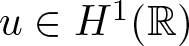 $u\in H^1(\mathbb{R})$ such that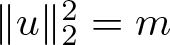 $\|u\|_2^2=m$, $\int_{\mathbb{R}}u^{p+1}dx \gt 0$ and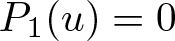 $P_1(u)=0$. From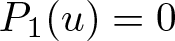 $P_1(u)=0$ we obtain
 \begin{equation*}
\frac{2}{p+1}\int_{\mathbb{R}}u^{p+1}dx=\frac{4}{p-1}\|u^{\prime}\|_2^2-\frac{4}{p-1}
\|D^{\frac{1}{2}}u\|_2^2.
\end{equation*}
\begin{equation*}
\frac{2}{p+1}\int_{\mathbb{R}}u^{p+1}dx=\frac{4}{p-1}\|u^{\prime}\|_2^2-\frac{4}{p-1}
\|D^{\frac{1}{2}}u\|_2^2.
\end{equation*}From (3.2) it follows that
 \begin{equation*}
\begin{aligned}
E(u)&=\Big(1-\frac{4}{p-1}\Big)\|u^{\prime}\|_2^2-2\Big(1-\frac{2}{p-1}\Big)
\|D^{\frac{1}{2}}u\|_2^2\\
&\geq\frac{p-5}{p-1}\|u^{\prime}\|_2^2-\frac{2(p-3)}{p-1}
\|u^{\prime}\|_2\|u\|_2\geq\inf_{s \gt 0}\Big\{\frac{p-5}{p-1}s^2-\frac{2(p-3)}{p-1}m^{\frac{1}{2}}s\Big\}\\
&=-\frac{(p-3)^2}{(p-1)(p-5)}m.
\end{aligned}
\end{equation*}
\begin{equation*}
\begin{aligned}
E(u)&=\Big(1-\frac{4}{p-1}\Big)\|u^{\prime}\|_2^2-2\Big(1-\frac{2}{p-1}\Big)
\|D^{\frac{1}{2}}u\|_2^2\\
&\geq\frac{p-5}{p-1}\|u^{\prime}\|_2^2-\frac{2(p-3)}{p-1}
\|u^{\prime}\|_2\|u\|_2\geq\inf_{s \gt 0}\Big\{\frac{p-5}{p-1}s^2-\frac{2(p-3)}{p-1}m^{\frac{1}{2}}s\Big\}\\
&=-\frac{(p-3)^2}{(p-1)(p-5)}m.
\end{aligned}
\end{equation*} (ii) From 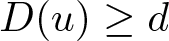 $D(u)\geq d$ we get
 \begin{equation*}
\frac{2}{p+1}\int_{\mathbb{R}}u^{p+1}dx\leq\frac{8}{(p-1)(p-3)}\|u^{\prime}\|_2^2-\frac{8d}{(p-1)(p-3)}.
\end{equation*}
\begin{equation*}
\frac{2}{p+1}\int_{\mathbb{R}}u^{p+1}dx\leq\frac{8}{(p-1)(p-3)}\|u^{\prime}\|_2^2-\frac{8d}{(p-1)(p-3)}.
\end{equation*} Given the fact of 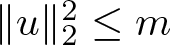 $\|u\|_2^2\leq m$, $E(u)\leq e$ and (3.2), we have
 \begin{equation*}
\begin{aligned}
e & \geq E(u) \geq\Big(1-\frac{8}{(p-1)(p-3)}\Big)\|u^{\prime}\|_2^2-2\|D^{\frac{1}{2}}u\|_2^2
+\frac{8d}{(p-1)(p-3)}\\
&\geq\Big(1-\frac{8}{(p-1)(p-3)}\Big)\|u^{\prime}\|_2^2-2m^{\frac{1}{2}}\|u^{\prime}\|_2
+\frac{8d}{(p-1)(p-3)}.
\end{aligned}
\end{equation*}
\begin{equation*}
\begin{aligned}
e & \geq E(u) \geq\Big(1-\frac{8}{(p-1)(p-3)}\Big)\|u^{\prime}\|_2^2-2\|D^{\frac{1}{2}}u\|_2^2
+\frac{8d}{(p-1)(p-3)}\\
&\geq\Big(1-\frac{8}{(p-1)(p-3)}\Big)\|u^{\prime}\|_2^2-2m^{\frac{1}{2}}\|u^{\prime}\|_2
+\frac{8d}{(p-1)(p-3)}.
\end{aligned}
\end{equation*} This implies that  $\|u\|_2$ is bounded due to $1-\frac{8}{(p-1)(p-3)} \gt 0$, and thus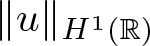 $\|u\|_{H^1(\mathbb{R})}$ is bounded.
(iii) Fix  $m_1,~m_2 \gt 0$ and $\epsilon \gt 0$. Using the density of $C^\infty_c(\mathbb{R})$ in $H^1(\mathbb{R})$, we see that for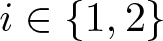 $i\in\{1, 2\}$ there exist $u_i\in C^\infty_c(\mathbb{R})\cap\mathcal{O}$ such that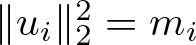 $\|u_i\|_2^2=m_i$ and $E(u_i) \lt \tilde{I}(m_i)+\frac{\epsilon}{2}$. We may assume that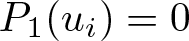 $P_1(u_i)=0$ for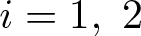 $i=1,~2$ (otherwise we replace $u_i$ by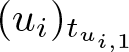 $(u_i)_{t_{u_{i,1}}}$). Choose the large $R \gt 0$ such that ${\rm{supp}}(u_i)\subset B(0,R)$ for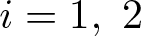 $i=1,~2$, and choose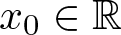 $x_0\in\mathbb{R}$ such that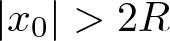 $|x_0| \gt 2R$. Let $u=u_1+u_2(\cdot+x_0)$. Then
 \begin{equation*}
\begin{aligned}
\|u\|_2^2&=\|u_1\|_2^2+\|u_2\|_2^2=m_1 +m_2,\\
D(u)&=D(u_1)+D(u_2) \gt 0~~{\rm{and}}\ \,
P_1(u)=P_1(u_1)+P_1(u_2)=0.
\end{aligned}
\end{equation*}
\begin{equation*}
\begin{aligned}
\|u\|_2^2&=\|u_1\|_2^2+\|u_2\|_2^2=m_1 +m_2,\\
D(u)&=D(u_1)+D(u_2) \gt 0~~{\rm{and}}\ \,
P_1(u)=P_1(u_1)+P_1(u_2)=0.
\end{aligned}
\end{equation*} This implies that 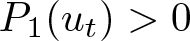 $P_1(u_t) \gt 0$ for $t \gt 1$ and $t$ is close to $1$. We infer that $\varphi^{\prime}_u(t_{u,infl}) \gt 0$, and thus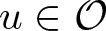 $u\in\mathcal{O}$. Then we have
 \begin{equation*}
\tilde{I}(m_1+m_2)\leq E(u)=E(u_1)+E(u_2)\leq\tilde{I}(m_1)+\tilde{I}(m_2)+\epsilon.
\end{equation*}
\begin{equation*}
\tilde{I}(m_1+m_2)\leq E(u)=E(u_1)+E(u_2)\leq\tilde{I}(m_1)+\tilde{I}(m_2)+\epsilon.
\end{equation*} Consequently, we arrive at the desired result, because  $\epsilon$ is arbitrary.
(iv) Let 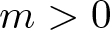 $m \gt 0$, $\epsilon \gt 0$, and $u$ be the function as constructed in the proof of Proposition 3.1 (iii). Since ${\rm{supp}}(\hat{u})\subset B(0,1)\setminus B(0, 1-\epsilon)$, we have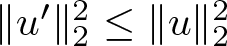 $\|u^{\prime}\|_2^2\leq \|u\|_2^2$. From (3.3) and $p \gt 5$ it follows that
 \begin{equation*}
\|u\|_{p+1}^{p+1}\leq B(p)\|u^{\prime}\|_2^{\frac{p-1}{2}}\|u\|_2^{\frac{p+3}{2}}
\leq B(p)\|u^{\prime}\|_2^2\|u\|_2^{p-1},
\end{equation*}
\begin{equation*}
\|u\|_{p+1}^{p+1}\leq B(p)\|u^{\prime}\|_2^{\frac{p-1}{2}}\|u\|_2^{\frac{p+3}{2}}
\leq B(p)\|u^{\prime}\|_2^2\|u\|_2^{p-1},
\end{equation*} \begin{equation*}
D(u)\geq \|u^{\prime}\|_2^2\Big(1-\frac{(p-1)(p-3)}{4(p+1)}B(p)\|u\|_2^{p-1}\Big).
\end{equation*}
\begin{equation*}
D(u)\geq \|u^{\prime}\|_2^2\Big(1-\frac{(p-1)(p-3)}{4(p+1)}B(p)\|u\|_2^{p-1}\Big).
\end{equation*} Let  $m_1=\min\{\mu_0,\big(\frac{4(p+1)}{(p-1)(p-3)B(p)}\big)^{\frac{1}{p-1}}\}$. If $m \lt m_1$, we have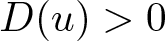 $D(u) \gt 0$. It is easy to see that $u$ satisfies (4.7) because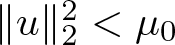 $\|u\|_2^2 \lt \mu_0$. Hence,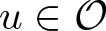 $u\in\mathcal{O}$. As discussing for Proposition 3.1 (iii) that
  $
E(u)\leq -\|u\|_2^2+4\epsilon^2m,
$ we can derive
$
E(u)\leq -\|u\|_2^2+4\epsilon^2m,
$ we can derive
 \begin{equation*}
\tilde{I}(m)\leq E(u)\leq-m+4\epsilon^2m.
\end{equation*}
\begin{equation*}
\tilde{I}(m)\leq E(u)\leq-m+4\epsilon^2m.
\end{equation*} Given that  $\epsilon \gt 0$ is arbitrary, we complete the proof for assertion (iv) in the case of $m \lt m_1$.
If 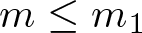 $m\leq m_1$, we choose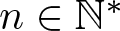 $n\in \mathbb{N}^*$ such that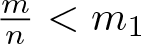 $\frac{m}{n} \lt m_1$. Using the sub-additivity of $\tilde{I}$ gives
 \begin{equation*}
\tilde{I}(m)\leq n \tilde{I}(\frac{m}{n})\leq-m.
\end{equation*}
\begin{equation*}
\tilde{I}(m)\leq n \tilde{I}(\frac{m}{n})\leq-m.
\end{equation*} (v) From (i) and (iv) we get 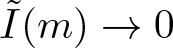 $\tilde{I}(m)\to0$ as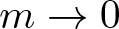 $m\to0$. If $0 \lt m_1 \lt m_2$, from (iii) and (iv) it follows that
 \begin{equation*}
\tilde{I}(m_2)\leq \tilde{I}(m_1)+ \tilde{I}(m_2-m_1) \leq \tilde{I}(m_1)-(m_2-m_1). \end{equation*}
\begin{equation*}
\tilde{I}(m_2)\leq \tilde{I}(m_1)+ \tilde{I}(m_2-m_1) \leq \tilde{I}(m_1)-(m_2-m_1). \end{equation*} Thus,  $\tilde{I}$ is decreasing.
Fix 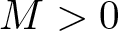 $M \gt 0$. By (ii), the set $E=\{u\in\mathcal{O}~|~\|u\|_2^2\leq M~{\rm{and}}~E(u)\leq0\}$ is bounded in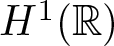 $H^1(\mathbb{R})$. By the Sobolev embedding theorem, there exists $K=K(M,p) \gt 0$ such that for any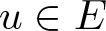 $u \in E$ we have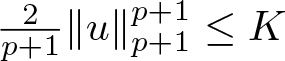 $\frac{2}{p+1}\|u\|_{p+1}^{p+1}\leq K$. It is easily seen that for any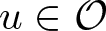 $u\in\mathcal{O}$ and any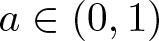 $a\in(0, 1)$ we have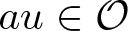 $au\in\mathcal{O}$. Let $0 \lt m_1 \lt m_2\leq M$ and
 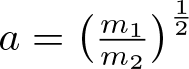 $a=\big(\frac{m_1}{m_2}\big)
^{\frac{1}{2}}$. Choose
$a=\big(\frac{m_1}{m_2}\big)
^{\frac{1}{2}}$. Choose 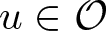 $u\in\mathcal{O}$ such that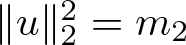 $\|u\|_2^2=m_2$ and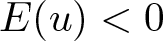 $E(u) \lt 0$. We have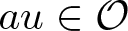 $au\in\mathcal{O}$,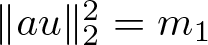 $\|au\|_2^2=m_1$ and
 \begin{equation*}
\begin{aligned}
\tilde{I}(m_1)\leq E(au)&=a^2E(u)+\frac{2}{p+1}(a^2-a^{p+1})\int_{\mathbb{R}}u^{p+1}dx\\
&\leq a^2E(u)+(a^2-a^{p+1})K.
\end{aligned}
\end{equation*}
\begin{equation*}
\begin{aligned}
\tilde{I}(m_1)\leq E(au)&=a^2E(u)+\frac{2}{p+1}(a^2-a^{p+1})\int_{\mathbb{R}}u^{p+1}dx\\
&\leq a^2E(u)+(a^2-a^{p+1})K.
\end{aligned}
\end{equation*}Taking the infimum in the above inequality leads to
 \begin{equation*}
\tilde{I}(m_1)\leq\frac{m_1}{m_2}\tilde{I}(m_2)+\bigg(\frac{m_1}{m_2}-
\frac{m^{\frac{p+1}{2}}_1}{m^{\frac{p+1}{2}}_2}\bigg)K.
\end{equation*}
\begin{equation*}
\tilde{I}(m_1)\leq\frac{m_1}{m_2}\tilde{I}(m_2)+\bigg(\frac{m_1}{m_2}-
\frac{m^{\frac{p+1}{2}}_1}{m^{\frac{p+1}{2}}_2}\bigg)K.
\end{equation*}Thus we obtain
 \begin{equation*}
0 \lt \tilde{I}(m_1)-\tilde{I}(m_2)\leq \Big(\frac{m_1}{m_2}-1\Big)\tilde{I}(m_2)+\bigg(\frac{m_1}{m_2}-
\frac{m^{\frac{p+1}{2}}_1}{m^{\frac{p+1}{2}}_2}\bigg)K.
\end{equation*}
\begin{equation*}
0 \lt \tilde{I}(m_1)-\tilde{I}(m_2)\leq \Big(\frac{m_1}{m_2}-1\Big)\tilde{I}(m_2)+\bigg(\frac{m_1}{m_2}-
\frac{m^{\frac{p+1}{2}}_1}{m^{\frac{p+1}{2}}_2}\bigg)K.
\end{equation*} From (i) we derive that  $\tilde{I}$ is continuous on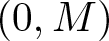 $(0,M)$. Due to the arbitrariness of $M$, we arrive at (v) immediately.
(vi) Let  $\ell=\liminf\limits_{n\to\infty}\int_{\mathbb{R}}u_n^{p+1}dx$. If $\ell=0$, there is a subsequence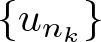 $\{u_{n_k}\}$ such that
  $\int_{\mathbb{R}}u_{n_k}^{p+1}dx
\to 0$. By using (3.8) with
$\int_{\mathbb{R}}u_{n_k}^{p+1}dx
\to 0$. By using (3.8) with  $\epsilon=0$, we get
  $\limsup\limits_{k\to\infty}
E(u_{n_k})\geq-m$. Since
$\limsup\limits_{k\to\infty}
E(u_{n_k})\geq-m$. Since  $E(u_{n_k})\to e\leq m$, we infer that $e=-m$. Moreover, from (3.8) it follows that
 \begin{equation*}
\int_{\mathbb{R}}(|\xi|^2-1)|\hat{u}_{n_k}(\xi)|^2d\xi=2\pi\Big(E(u_{n_k})+\|u_{n_k}\|_2^2
+\frac{2}{p+1}\int_{\mathbb{R}}u_{n_k}^{p+1}dx\Big)\to 0, \ {\rm as}\ k \to \infty.
\end{equation*}
\begin{equation*}
\int_{\mathbb{R}}(|\xi|^2-1)|\hat{u}_{n_k}(\xi)|^2d\xi=2\pi\Big(E(u_{n_k})+\|u_{n_k}\|_2^2
+\frac{2}{p+1}\int_{\mathbb{R}}u_{n_k}^{p+1}dx\Big)\to 0, \ {\rm as}\ k \to \infty.
\end{equation*}Using the Plancherel formula and the Cauchy-Schwarz inequality, we deduce
 \begin{equation*}
\begin{aligned}
|\|u^{\prime}_{n_k}\|_2^2-\|u_{n_k}\|_2^2|
\leq& \frac{1}{2\pi}
\int_{\mathbb{R}}(|\xi|^2-1)|\hat{u}_{n_k}(\xi)|^2d\xi\\
\leq&\frac{1}{2\pi}
\Big(\int_{\mathbb{R}}(|\xi|-1)^2|\hat{u}_{n_k}(\xi)|^2d\xi\Big)^{\frac{1}{2}}
\Big(\int_{\mathbb{R}}(|\xi|+1)^2|\hat{u}_{n_k}(\xi)|^2d\xi\Big)^{\frac{1}{2}}\\
\to&0,\, ~{\rm{as}}~k\to\infty
\end{aligned}
\end{equation*}
\begin{equation*}
\begin{aligned}
|\|u^{\prime}_{n_k}\|_2^2-\|u_{n_k}\|_2^2|
\leq& \frac{1}{2\pi}
\int_{\mathbb{R}}(|\xi|^2-1)|\hat{u}_{n_k}(\xi)|^2d\xi\\
\leq&\frac{1}{2\pi}
\Big(\int_{\mathbb{R}}(|\xi|-1)^2|\hat{u}_{n_k}(\xi)|^2d\xi\Big)^{\frac{1}{2}}
\Big(\int_{\mathbb{R}}(|\xi|+1)^2|\hat{u}_{n_k}(\xi)|^2d\xi\Big)^{\frac{1}{2}}\\
\to&0,\, ~{\rm{as}}~k\to\infty
\end{aligned}
\end{equation*}and
 \begin{equation*}
\lim_{k\to\infty}\|u^{\prime}_{n_k}\|_2^2=\lim_{k\to\infty}\|u_{n_k}\|_2^2=m.
\end{equation*}
\begin{equation*}
\lim_{k\to\infty}\|u^{\prime}_{n_k}\|_2^2=\lim_{k\to\infty}\|u_{n_k}\|_2^2=m.
\end{equation*} If  $\ell \gt 0$, from (3.3) and the fact that $\|u_n\|_2$ is bounded, there exist $\eta \gt 0$ and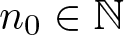 $n_0\in\mathbb{N}$ such that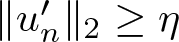 $\|u^{\prime}_n\|_2\geq \eta$ for all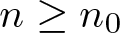 $n\geq n_0$. Then we obtain
 \begin{equation*}
\liminf_{n\to\infty}\|u_n\|_2^2\geq\eta^2 \gt 0.
\end{equation*}
\begin{equation*}
\liminf_{n\to\infty}\|u_n\|_2^2\geq\eta^2 \gt 0.
\end{equation*} From the above arguments that in the case of  $e \lt -m$ we must have $\ell \gt 0$, the second assertion of (vi) follows immediately.
(vii) Assume that 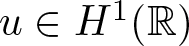 $u\in H^1(\mathbb{R})$ satisfies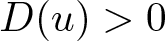 $D(u) \gt 0$ and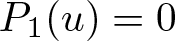 $P_1(u)=0$. From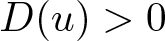 $D(u) \gt 0$ we get
 \begin{equation*}
\|u^{\prime}\|_2^2 \gt \frac{(p-1)(p-3)}{4(p+1)}\int_{\mathbb{R}}u^{p+1}dx,
\end{equation*}
\begin{equation*}
\|u^{\prime}\|_2^2 \gt \frac{(p-1)(p-3)}{4(p+1)}\int_{\mathbb{R}}u^{p+1}dx,
\end{equation*} which is the last inequality in (4.11). Plugging this into 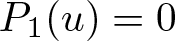 $P_1(u)=0$ leads to the second inequality in (4.11). Using the second inequality of (4.11) and (3.2) gives $\|u\|_2 \gt \frac{p-5}{p-3}\|u^{\prime}\|_2$. Combining this with (3.2), we thus obtain the first inequality of (4.11).
Lemma 4.3. If  $p \gt 5$, then there exists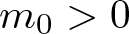 $m_0 \gt 0$ such that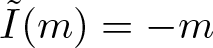 $\tilde{I}(m)=-m$ for any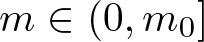 $m\in (0,m_0]$.
Proof. Recall that by (3.12) we have
 \begin{equation}
E(u)+\|u\|_2^2\geq\|u^{\prime}-u\|_2^2\Big(1-\frac{2}{p+1}\|u\|_2^{p-1}Q_{\kappa}^{p+1}(u)\Big)
\end{equation}
\begin{equation}
E(u)+\|u\|_2^2\geq\|u^{\prime}-u\|_2^2\Big(1-\frac{2}{p+1}\|u\|_2^{p-1}Q_{\kappa}^{p+1}(u)\Big)
\end{equation} for any  $u\in H^1({\mathbb{R}})\setminus \{0\}$, where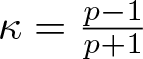 $\kappa=\frac{p-1}{p+1}$. Lemma 4.2 (vii) implies that there exists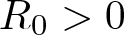 $R_0 \gt 0$ such that $\|u^{\prime}-u\|_2\leq R_0\|u\|_2$ for any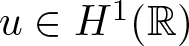 $u\in H^1(\mathbb{R})$ satisfying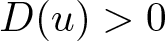 $D(u) \gt 0$ and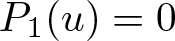 $P_1(u)=0$. Since $p \gt 5$, condition (2.1) is satisfied with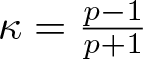 $\kappa=\frac{p-1}{p+1}$. By virtue of Corollary 2.5, there exists an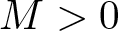 $M \gt 0$ such that $Q_\kappa(u)\leq M$. From (4.10) and (4.12) we infer that
 \begin{equation*}
\tilde{I}(m)+m \geq 0,
\end{equation*}
\begin{equation*}
\tilde{I}(m)+m \geq 0,
\end{equation*}if
 \begin{equation*}
0 \lt m\leq\Big(\frac{p+1}{2}\Big)^{\frac{2}{p-1}}M^{-{\frac{2(p+1)}{p-1}}}.
\end{equation*}
\begin{equation*}
0 \lt m\leq\Big(\frac{p+1}{2}\Big)^{\frac{2}{p-1}}M^{-{\frac{2(p+1)}{p-1}}}.
\end{equation*}Therefore, the desired result follows from this inequality and Lemma 4.2 (iv).
Lemma 4.4. Let 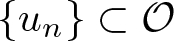 $\{u_n\}\subset \mathcal{O}$ be a sequence satisfying (a) $P_1(u_n)\to 0$; (b)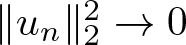 $\|u_n\|_2^2\to0$ as $n\to\infty$ and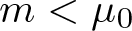 $m \lt \mu_0$, where $\mu_0$ is given by (4.8); and (c) there exists $k \gt 0$ such that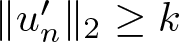 $\|u^{\prime}_n\|_2\geq k$ for all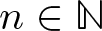 $n\in {\Bbb N}$. Then $\liminf\limits_{n\to\infty}D(u_n) \gt 0$. Moreover, if $\|u^{\prime}_n\|_2$ is bounded, then we have $\liminf\limits_{n\to\infty}t_{u_n,infl} \gt 1$.
Proof. We have 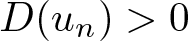 $D(u_n) \gt 0$ for all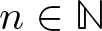 $n\in {\Bbb N}$ if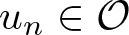 $u_n\in \mathcal{O}$. By way of contradiction, we assume that there exists a subsequence, still denoted by $\{u_n\}$, such that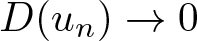 $D(u_n)\to0$. Then
 \begin{equation}
\frac{p-1}{2(p+1)}\int_{\mathbb{R}}u^{p+1}dx=\frac{2}{p-3}\Big(\|u^{\prime}_n\|_2^2-D(u_n)\Big).
\end{equation}
\begin{equation}
\frac{p-1}{2(p+1)}\int_{\mathbb{R}}u^{p+1}dx=\frac{2}{p-3}\Big(\|u^{\prime}_n\|_2^2-D(u_n)\Big).
\end{equation} Substituting (4.13) into 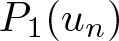 $P_1(u_n)$ yields
 \begin{equation}
P_1(u_n)=\frac{p-5}{p-3}\|u^{\prime}_n\|_2^2-\|D^{\frac{1}{2}}u_n\|_2^2+
\frac{2}{p-3}D(u_n).
\end{equation}
\begin{equation}
P_1(u_n)=\frac{p-5}{p-3}\|u^{\prime}_n\|_2^2-\|D^{\frac{1}{2}}u_n\|_2^2+
\frac{2}{p-3}D(u_n).
\end{equation}From (4.14) and (3.2) it follows that
 \begin{equation}
\|u^{\prime}_n\|_2\|u_n\|_2 \gt \|D^{\frac{1}{2}}u_n\|^2_2=\frac{p-5}{p-3}\|u^{\prime}_n\|_2^2
+\frac{2}{p-3}D(u_n)-P_1(u_n).
\end{equation}
\begin{equation}
\|u^{\prime}_n\|_2\|u_n\|_2 \gt \|D^{\frac{1}{2}}u_n\|^2_2=\frac{p-5}{p-3}\|u^{\prime}_n\|_2^2
+\frac{2}{p-3}D(u_n)-P_1(u_n).
\end{equation} In view of assumptions 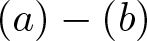 $(a)-(b)$ and the fact that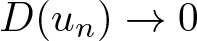 $D(u_n)\to0$ as $n \to \infty$, we see that $\|u^{\prime}_n\|_2$ is bounded. Rewrite (4.15) as
 \begin{equation}
\|u^{\prime}_n\|_2^2 \lt \frac{p-3}{p-5}\Big(\|u_n\|_2-\frac{2}{p-3}
\frac{D(u_n)}{\|u^{\prime}_n\|_2}+\frac{P_1(u_n)}{\|u^{\prime}_n\|_2}\Big).
\end{equation}
\begin{equation}
\|u^{\prime}_n\|_2^2 \lt \frac{p-3}{p-5}\Big(\|u_n\|_2-\frac{2}{p-3}
\frac{D(u_n)}{\|u^{\prime}_n\|_2}+\frac{P_1(u_n)}{\|u^{\prime}_n\|_2}\Big).
\end{equation}From (4.1) and (3.3) we derive
 \begin{align*}
\|u^{\prime}_n\|_2^2-D(u_n)&=\frac{(p-1)(p-3)}{4(p+1)}\int_{\mathbb{R}}u_n^{p+1}dx\\
&
\leq\frac{(p-1)(p-3)}{4(p+1)}B(p)\|u^{\prime}_n\|_2^{\frac{p-1}{2}}\|u_n\|_2^{\frac{p+3}{2}}.
\end{align*}
\begin{align*}
\|u^{\prime}_n\|_2^2-D(u_n)&=\frac{(p-1)(p-3)}{4(p+1)}\int_{\mathbb{R}}u_n^{p+1}dx\\
&
\leq\frac{(p-1)(p-3)}{4(p+1)}B(p)\|u^{\prime}_n\|_2^{\frac{p-1}{2}}\|u_n\|_2^{\frac{p+3}{2}}.
\end{align*} Dividing by  $\|u^{\prime}_n\|_2^2$ and using (4.16) yields
 \begin{equation*}
\begin{aligned}
&1-\frac{D(u_n)}{\|u^{\prime}_n\|^2_2}\leq \frac{(p-1)(p-3)}{4(p+1)}B(p)\|u^{\prime}_n\|_2^{\frac{p-5}{2}}\|u_n\|_2^{\frac{p+3}{2}}\\ \lt &\frac{(p-1)(p-3)}{4(p+1)}B(p)\bigg[\frac{p-3}{p-5}\Big(\|u_n\|_2-\frac{2}{p-3}
\frac{D(u_n)}{\|u^{\prime}_n\|_2}+\frac{P_1(u_n)}{\|u^{\prime}_n\|_2}\Big)\bigg]
^{\frac{p-5}{2}}\|u_n\|_2^{\frac{p+3}{2}}.
\end{aligned}
\end{equation*}
\begin{equation*}
\begin{aligned}
&1-\frac{D(u_n)}{\|u^{\prime}_n\|^2_2}\leq \frac{(p-1)(p-3)}{4(p+1)}B(p)\|u^{\prime}_n\|_2^{\frac{p-5}{2}}\|u_n\|_2^{\frac{p+3}{2}}\\ \lt &\frac{(p-1)(p-3)}{4(p+1)}B(p)\bigg[\frac{p-3}{p-5}\Big(\|u_n\|_2-\frac{2}{p-3}
\frac{D(u_n)}{\|u^{\prime}_n\|_2}+\frac{P_1(u_n)}{\|u^{\prime}_n\|_2}\Big)\bigg]
^{\frac{p-5}{2}}\|u_n\|_2^{\frac{p+3}{2}}.
\end{aligned}
\end{equation*} Letting  $n\to\infty$ in the above inequality and using assumptions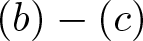 $(b)-(c)$ and (4.8), we obtain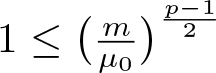 $1\leq\big(\frac{m}{\mu_0}\big)^{\frac{p-1}{2}}$. This contradicts the fact that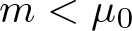 $m \lt \mu_0$. Therefore, we have $\liminf\limits_{n\to\infty}D(u_n) \gt 0$.
Similarly, if  $\|u^{\prime}_n\|_2$ is bounded, using assumption $(c)$ we can obtain $\liminf\limits_{n\to\infty}t_{u_n,infl} \gt 1$ by way of contradiction. To avoid unnecessary repetitions, we omit it.
Lemma 4.5. Assume that 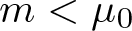 $m \lt \mu_0$, where $\mu_0$ is given by (4.8). Suppose that the sequence $\{u_n\}\subset H^1(\mathbb{R})$ satisfies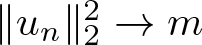 $\|u_n\|_2^2\to m$ and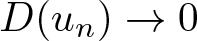 $D(u_n)\to0$ as $n\to\infty$. Then we have $\liminf\limits_{n\to\infty}E(u_n)\geq\tilde{I}(m)$. Moreover, if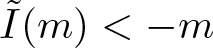 $\tilde{I}(m) \lt -m$, we have $\liminf\limits_{n\to\infty}E(u_n) \gt \tilde{I}(m)$.
Proof. The sequence  $\{u_n\}$ is bounded in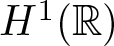 $H^1(\mathbb{R})$ by Lemma 4.2 (ii). By Lemma 4.2 (iv), we have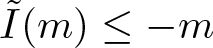 $\tilde{I}(m)\leq -m$, so the proof becomes trivial if $\liminf\limits_{n\to\infty}E(u_n)\geq -m$. We only need to consider the case when $\liminf\limits_{n\to\infty}E(u_n) \lt -m$. Passing to a subsequence we may assume that $E(u_n)\to e \lt -m$ as $n\to\infty$ and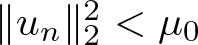 $\|u_n\|_2^2 \lt \mu_0$ for all $n\geq1$, so that $\varphi^{\prime}_{u_n}(t_{u_n,infl}) \gt 0$.
It follows from Lemma 4.2 (vi) that there exist  $\eta \gt 0$ and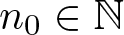 $n_0\in\mathbb{N}$ such that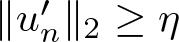 $\|u^{\prime}_n\|_2\geq\eta$ for all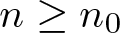 $n\geq n_0$. Using (4.13) and (3.3) we get for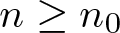 $n\geq n_0$,
 \begin{equation*}
\frac{p-1}{2(p+1)}B(p)\|u^{\prime}_n\|_2^{\frac{p-5}{2}}\|u_n\|_2^{\frac{p+3}{2}}
\geq\frac{2}{p-3}\Big(1-\frac{1}{\eta^2}D(u_n)\Big).
\end{equation*}
\begin{equation*}
\frac{p-1}{2(p+1)}B(p)\|u^{\prime}_n\|_2^{\frac{p-5}{2}}\|u_n\|_2^{\frac{p+3}{2}}
\geq\frac{2}{p-3}\Big(1-\frac{1}{\eta^2}D(u_n)\Big).
\end{equation*} From (4.14) and (3.2), for 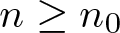 $n\geq n_0$ it follows that
 \begin{equation*}
\begin{aligned}
P_1(u_n)\geq& \|u^{\prime}_n\|_2\Big(\frac{p-5}{p-3}\|u^{\prime}_n\|_2-\|u_n\|_2\Big)+
\frac{2}{p-3}D(u_n)\\
\geq& \|u^{\prime}_n\|_2\bigg[\frac{p-5}{p-3}\big[\frac{4(p+1)}{(p-1)(p-3)B(p)}
\big(1-\frac{1}{\eta^2}D(u_n)\big)\big]^{\frac{2}{p-5}}\|u_n\|_2^
{-\frac{p+3}{p-5}}-\|u_n\|_2\bigg]\\
&+\frac{2}{p-3}D(u_n).
\end{aligned}
\end{equation*}
\begin{equation*}
\begin{aligned}
P_1(u_n)\geq& \|u^{\prime}_n\|_2\Big(\frac{p-5}{p-3}\|u^{\prime}_n\|_2-\|u_n\|_2\Big)+
\frac{2}{p-3}D(u_n)\\
\geq& \|u^{\prime}_n\|_2\bigg[\frac{p-5}{p-3}\big[\frac{4(p+1)}{(p-1)(p-3)B(p)}
\big(1-\frac{1}{\eta^2}D(u_n)\big)\big]^{\frac{2}{p-5}}\|u_n\|_2^
{-\frac{p+3}{p-5}}-\|u_n\|_2\bigg]\\
&+\frac{2}{p-3}D(u_n).
\end{aligned}
\end{equation*} Letting  $n\to\infty$ and using the fact that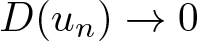 $D(u_n)\to0$ gives
 \begin{equation}
\liminf_{n\to\infty}P_1(u_n)\geq\eta\bigg[\frac{p-5}{p-3}
\Big(\frac{4(p+1)}{(p-1)(p-3)B(p)}\Big)^{\frac{2}{p-5}}m^{-\frac{p+3}{2(p-5)}}
-m^{\frac{1}{2}}\bigg].
\end{equation}
\begin{equation}
\liminf_{n\to\infty}P_1(u_n)\geq\eta\bigg[\frac{p-5}{p-3}
\Big(\frac{4(p+1)}{(p-1)(p-3)B(p)}\Big)^{\frac{2}{p-5}}m^{-\frac{p+3}{2(p-5)}}
-m^{\frac{1}{2}}\bigg].
\end{equation} Since  $0 \lt m \lt \mu_0$, where $\mu_0$ is given by (4.8), the right-hand side of (4.17) is equal to $\eta m^{\frac{1}{2}}\big[(\frac{\mu_0}{m})^{\frac{p-1}{p-5}}-1\big] \gt 0$. So there exists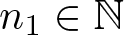 $n_1\in\mathbb{N}$ such that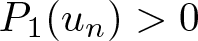 $P_1(u_n) \gt 0$ for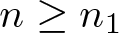 $n\geq n_1$. This means that $t_{u_n,1} \lt 1 \lt t_{u_n,2}$ for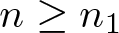 $n\geq n_1$.
Let  $v_n=(u_n)_{t_{u_n,1}}$ such that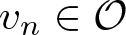 $v_n\in\mathcal{O}$, $\|v_n\|_2=\|u_n\|_2$,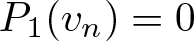 $P_1(v_n)=0$ and $E(v_n)\leq E(u_n)$ for each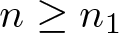 $n\geq n_1$ (recall that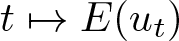 $t\mapsto E(u_t)$ is increasing on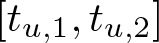 $[t_{u,1},t_{u,2}]$). By Lemma 4.2 (ii), the sequence $\{v_n\}$ is bounded in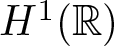 $H^1(\mathbb{R})$. Since $\tilde{I}(\|v_n\|_2^2) \leq E(v_n)\leq E(u_n)$, passing to the limit and using the continuity of $\tilde{I}$ (see Lemma 4.2 (v)) we get
 \begin{equation}
\tilde{I}(m)\leq\liminf_{n\to\infty}E(v_n)\leq\limsup_{n\to\infty}E(v_n)\leq
\lim_{n\to\infty}E(u_n)=e.
\end{equation}
\begin{equation}
\tilde{I}(m)\leq\liminf_{n\to\infty}E(v_n)\leq\limsup_{n\to\infty}E(v_n)\leq
\lim_{n\to\infty}E(u_n)=e.
\end{equation} We show that if 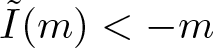 $\tilde{I}(m) \lt -m$, then at least one inequality in (4.18) is strict. This explicitly implies the conclusion of Lemma 4.5. We assume that the equality occurs in the first two inequalities in (4.18), which means that $E(v_n)\to\tilde{I}(m) \lt -m$. We show that in this case the last inequality in (4.18) must be strict. Set
  $\ell:=\liminf\limits
_{n\to\infty}\int_{\mathbb{R}}v_n^{p+1}dx$. Using Lemma 4.2 (vi) we see that
$\ell:=\liminf\limits
_{n\to\infty}\int_{\mathbb{R}}v_n^{p+1}dx$. Using Lemma 4.2 (vi) we see that  $\ell \gt 0$ and there exists an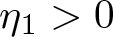 $\eta_1 \gt 0$ such that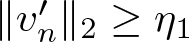 $\|v^{\prime}_n\|_2\geq\eta_1$ for all sufficiently large $n$. Now we may apply Lemma 4.4 to $\{v_n\}$ and infer that $\liminf\limits_{n\to\infty}D(v_n) \gt 0$ and $\liminf\limits_{n\to\infty}t_{v_n,infl} \gt 1$.
Let  $s_n=(t_{u_n,1})^{-1}$ such that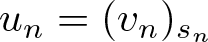 $u_n=(v_n)_{s_n}$. Recall that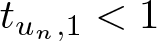 $t_{u_n,1} \lt 1$. Hence,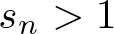 $s_n \gt 1$ holds for all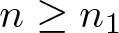 $n\geq n_1$. Then
 \begin{equation*}
D(u_n)=D((v_n)_{s_n})=s_n^2\Big(\|v^{\prime}_n\|_2^2-\frac{(p-1)(p-3)}{4(p+1)}
s_n^{\frac{p-5}{2}}\int_{\mathbb{R}}v_n^{p+1}dx\Big).
\end{equation*}
\begin{equation*}
D(u_n)=D((v_n)_{s_n})=s_n^2\Big(\|v^{\prime}_n\|_2^2-\frac{(p-1)(p-3)}{4(p+1)}
s_n^{\frac{p-5}{2}}\int_{\mathbb{R}}v_n^{p+1}dx\Big).
\end{equation*} Since 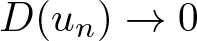 $D(u_n)\to0$, the second factor in the expression of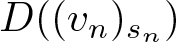 $D((v_n)_{s_n})$ must tend to $0$, and from (4.5) and the fact $\ell \gt 0$ we deduce that $r_n:=\frac{s_n}{t_{v_n,infl}}\to1$ as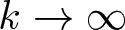 $k\to\infty$. Using the boundedness of $\{u_n\}$ in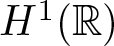 $H^1(\mathbb{R})$ leads to
 \begin{equation}
E(u_n)-E((v_n)_{t_{v_n,infl}})=E(u_n)-E((u_n)_{{r^{-1}_n}})\to0, \ {\rm as}\ n\to\infty.
\end{equation}
\begin{equation}
E(u_n)-E((v_n)_{t_{v_n,infl}})=E(u_n)-E((u_n)_{{r^{-1}_n}})\to0, \ {\rm as}\ n\to\infty.
\end{equation}From Lemma 4.1 (v) it follows that
 \begin{equation}
E((v_n)_{t_{v_n,infl}})-E(v_n)=\frac{2}{p+1}h(t_{v_n,infl})\int_{\mathbb{R}}v_n^{p+1}dx.
\end{equation}
\begin{equation}
E((v_n)_{t_{v_n,infl}})-E(v_n)=\frac{2}{p+1}h(t_{v_n,infl})\int_{\mathbb{R}}v_n^{p+1}dx.
\end{equation} Fix  $t_*$ such that $1 \lt t_* \lt \liminf\limits_{n\to\infty}t_{v_n,infl}$. From (4.19) and (4.20) it follows that
 \begin{equation*}
E(u_n)-E(v_n) \gt \frac{\ell}{p+1}h(t_*)
\end{equation*}
\begin{equation*}
E(u_n)-E(v_n) \gt \frac{\ell}{p+1}h(t_*)
\end{equation*} for all sufficiently large  $n$. Therefore, the last inequality in (4.18) is strict.
Lemma 4.6. Let  $
\tilde{m}_0=\inf\{m\in(0,\mu_0]~|~\tilde{I}(m) \lt -m\},
$ where
$
\tilde{m}_0=\inf\{m\in(0,\mu_0]~|~\tilde{I}(m) \lt -m\},
$ where  $\mu_0$ is given by (4.8). Then
(i) The mapping  $m\mapsto\frac{\tilde{I}(m)}{m}$ is non-increasing on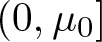 $(0,\mu_0]$ and decreasing on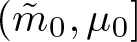 $(\tilde{m}_0,\mu_0]$.
(ii) If 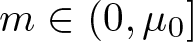 $m\in(0,\mu_0]$ satisfies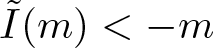 $\tilde{I}(m) \lt -m$, then for any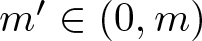 $m'\in(0,m)$ we have
 \begin{equation*}
\tilde{I}(m) \lt \tilde{I}(m')+\tilde{I}(m-m').
\end{equation*}
\begin{equation*}
\tilde{I}(m) \lt \tilde{I}(m')+\tilde{I}(m-m').
\end{equation*}Proof. It is easy to see that for any 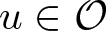 $u\in\mathcal{O}$ and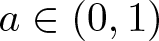 $a\in(0,1)$ we have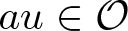 $au\in \mathcal{O}$. Assume that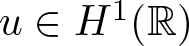 $u\in H^1(\mathbb{R})$ satisfies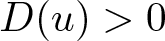 $D(u) \gt 0$,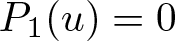 $P_1(u)=0$ and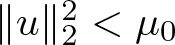 $\|u\|_2^2 \lt \mu_0$. To show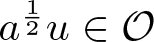 $a^\frac{1}{2}u\in\mathcal{O}$ for any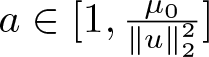 $a\in[1,\frac{\mu_0}{\|u\|_2^2}]$, we only need to prove that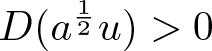 $D(a^\frac{1}{2}u) \gt 0$, this is because $\|a^\frac{1}{2}u\|_2^2=a\|u\|_2^2\leq\mu_0$ and the function $a^\frac{1}{2}u$ automatically satisfies (4.7). From (3.3) and (4.11) we deduce
 \begin{equation*}
\begin{aligned}
D(a^\frac{1}{2}u)&=a\|u^{\prime}\|_2^2-\frac{(p-1)(p-3)}{4(p+1)}a^{\frac{p+1}{2}}
\int_{\mathbb{R}}u^{p+1}dx\\
&\geq a\|u^{\prime}\|_2^2\bigg(1-\frac{(p-1)(p-3)}{4(p+1)}B(p)a^{\frac{p-1}{2}}
\|u^{\prime}\|_2^{\frac{p-5}{2}}\|u\|_2^{\frac{p+3}{2}}\bigg)\\
& \gt a\|u^{\prime}\|_2^2\bigg(1-\frac{(p-1)(p-3)}{4(p+1)}B(p)
\Big(\frac{p-3}{p-5}\Big)^{\frac{p-5}{2}}a^{\frac{p-1}{2}}
\|u\|_2^{p-1}\bigg).
\end{aligned}
\end{equation*}
\begin{equation*}
\begin{aligned}
D(a^\frac{1}{2}u)&=a\|u^{\prime}\|_2^2-\frac{(p-1)(p-3)}{4(p+1)}a^{\frac{p+1}{2}}
\int_{\mathbb{R}}u^{p+1}dx\\
&\geq a\|u^{\prime}\|_2^2\bigg(1-\frac{(p-1)(p-3)}{4(p+1)}B(p)a^{\frac{p-1}{2}}
\|u^{\prime}\|_2^{\frac{p-5}{2}}\|u\|_2^{\frac{p+3}{2}}\bigg)\\
& \gt a\|u^{\prime}\|_2^2\bigg(1-\frac{(p-1)(p-3)}{4(p+1)}B(p)
\Big(\frac{p-3}{p-5}\Big)^{\frac{p-5}{2}}a^{\frac{p-1}{2}}
\|u\|_2^{p-1}\bigg).
\end{aligned}
\end{equation*} The right-hand side is non-negative if 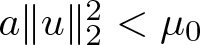 $a\|u\|_2^2 \lt \mu_0$ by (4.8), i.e.,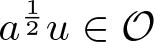 $a^{\frac{1}{2}}u\in\mathcal{O}$. Thus we have
 \begin{equation}
\tilde{I}(a\|u\|_2^2)\leq E(a^\frac{1}{2}u)=aE(u)+\frac{2}{p+1}(a-a^{\frac{p+1}{2}})
\int_{\mathbb{R}}u^{p+1}dx
\end{equation}
\begin{equation}
\tilde{I}(a\|u\|_2^2)\leq E(a^\frac{1}{2}u)=aE(u)+\frac{2}{p+1}(a-a^{\frac{p+1}{2}})
\int_{\mathbb{R}}u^{p+1}dx
\end{equation} for 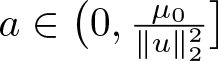 $a\in\big(0,\frac{\mu_0}{\|u\|_2^2}\big]$.
Let 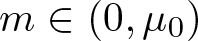 $m\in (0,\mu_0)$. Take a minimizing sequence $\{u_n\}\subset\mathcal{O}$ such that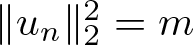 $\|u_n\|_2^2=m$,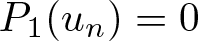 $P_1(u_n)=0$ and $E(u_n)\to\tilde{I}(m)$. From (3.8), for each $n$ we have
 \begin{equation*}
\frac{2}{p+1}\int_{\mathbb{R}}u_n^{p+1}dx\geq -\big(E(u_n)+\|u_n\|_2^2\big).
\end{equation*}
\begin{equation*}
\frac{2}{p+1}\int_{\mathbb{R}}u_n^{p+1}dx\geq -\big(E(u_n)+\|u_n\|_2^2\big).
\end{equation*} Combining this with (4.21) and letting  $n\to\infty$ leads to
 \begin{equation}
\frac{\tilde{I}(am)}{am}\leq \frac{\tilde{I}(m)}{m}+(a^{\frac{p-1}{2}}-1)\Big(\frac{\tilde{I}(m)}{m}+1\Big)
\end{equation}
\begin{equation}
\frac{\tilde{I}(am)}{am}\leq \frac{\tilde{I}(m)}{m}+(a^{\frac{p-1}{2}}-1)\Big(\frac{\tilde{I}(m)}{m}+1\Big)
\end{equation} for 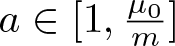 $a\in[1,\frac{\mu_0}{m}]$. Since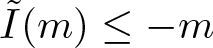 $\tilde{I}(m)\leq-m$ (see Lemma 4.2 (iv)), we can see that Lemma 4.6 (i) follows from (4.22) immediately.
(ii) Given the continuity of  $\tilde{I}$, we know that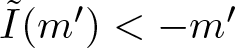 $\tilde{I}(m') \lt -m'$ holds for $m'$ in a neighbourhood of $m$. From (i) we see that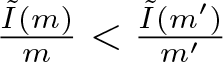 $\frac{\tilde{I}(m)} {m} \lt \frac{\tilde{I}(m')}{m'}$ and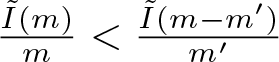 $\frac{\tilde{I}(m)}{m} \lt \frac{\tilde{I}(m-m')}{m'}$ for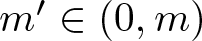 $m'\in(0,m)$. This implies (ii).
We now summarize the result on the existence of local minimizers for  $\tilde{I}(m)$.
Proposition 4.7. When  $p \gt 5$, there exist $\tilde{m}_0$ and $\mu_0$ such that when $m\in(\tilde{m}_0,\mu_0)$, $\tilde{I}(m)$ is achieved. Moreover, for any sequence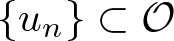 $\{u_n\}\subset\mathcal{O}$ satisfying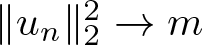 $\|u_n\|_2^2\to m$ and $E(u_n)\to\tilde{I}(m)$, there exist a subsequence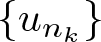 $\{u_{n_k}\}$, a sequence of points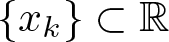 $\{x_k\}\subset \mathbb{R}$ and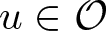 $u\in\mathcal{O}$ such that $u_{n_k}(\cdot+x_k)\to u$ strongly in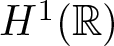 $H^1(\mathbb{R})$. Then,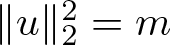 $\|u\|_2^2= m$ and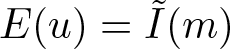 $E(u)=\tilde{I}(m)$.
Proof. Assume that the sequence 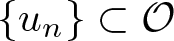 $\{u_n\}\subset\mathcal{O}$ satisfies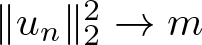 $\|u_n\|_2^2\to m$ and $E(u_n)\to\tilde{I}(m)$. From Lemma 4.2 (ii) it follows that $\{u_n\}$ is bounded in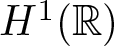 $H^1(\mathbb{R})$. From Lemma 4.2 (vi), there exist $\delta \gt 0$ and $\ell \gt 0$ such that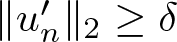 $\|u^{\prime}_n\|_2\geq\delta$ and $\int_{\mathbb{R}}u_n^{p+1}dx\geq \ell$ for the sufficiently large $n$. As shown in the proof of Proposition 1.2, there exists a subsequence, still denoted by $\{u_n\}$, a sequence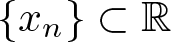 $\{x_n\}\subset\mathbb{R}$ and $u\in H^1(\mathbb{R})\setminus\{0\}$ such that (3.20) holds when we replace $u_n$ by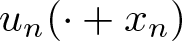 $u_n(\cdot+x_n)$. The weak convergence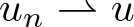 $u_n\rightharpoonup u$ as $n\to\infty$ gives
 \begin{equation}
\begin{aligned}
F(u_n)&=F(u)+F(u_n-u)+o(1),\\
\|D^{\frac{1}{2}}u_n\|_2^2&=\|D^{\frac{1}{2}}u\|_2^2
+\|D^{\frac{1}{2}}(u_n-u)\|_2^2+o(1),\\
\|u^{\prime}_n\|_2^2&=\|u^{\prime}\|_2^2+\|u^{\prime}_n-u^{\prime}\|_2^2+o(1).
\end{aligned}
\end{equation}
\begin{equation}
\begin{aligned}
F(u_n)&=F(u)+F(u_n-u)+o(1),\\
\|D^{\frac{1}{2}}u_n\|_2^2&=\|D^{\frac{1}{2}}u\|_2^2
+\|D^{\frac{1}{2}}(u_n-u)\|_2^2+o(1),\\
\|u^{\prime}_n\|_2^2&=\|u^{\prime}\|_2^2+\|u^{\prime}_n-u^{\prime}\|_2^2+o(1).
\end{aligned}
\end{equation} Let  $v_n=(u_n)_{t_{u_n},1}$. Then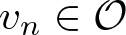 $v_n\in\mathcal{O}$, $\|v_n\|_2=\|u_n\|_2$,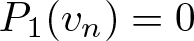 $P_1(v_n)=0$, and $\tilde{I}(\|v_n\|_2^2)\leq E(v_n)\leq E(u_n)$ for all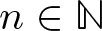 $n\in {\Bbb N}$. Thus we have $E(v_n)\to\tilde{I}(m) \lt -m$ as $n\to\infty$. From Lemma 4.2 (ii) we know that $\{v_n\}$ is bounded in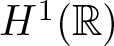 $H^1(\mathbb{R})$. According to Lemma 4.2 (vi), there exist $\tilde{\delta} \gt 0$ and $\tilde{\ell} \gt 0$ such that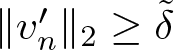 $\|v^{\prime}_n\|_2\geq \tilde{\delta}$ and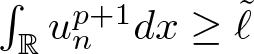 $\int_{\mathbb{R}}u_n^{p+1}dx\geq\tilde{\ell}$ for the sufficiently large $n$. In view of $\|v^{\prime}_n\|_2=t_{u_n,1}\|u^{\prime}_n\|_2$ and the boundedness of $\|v^{\prime}_n\|_2$, we see that the sequence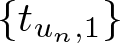 $\{t_{u_n,1}\}$ is bounded and stays away from zero. So there exists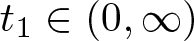 $t_1\in(0,\infty)$ such that after passing to a subsequence of $\{u_n\}$, still denoted by $\{u_n\}$, we have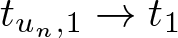 $t_{u_n,1}\to t_1$ as $n\to\infty$. Note that $(u_n)_{t_{u_n,1}}\rightharpoonup u_{t_1}\neq0$ as $n\to\infty$. Let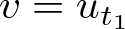 $v=u_{t_1}$. Then $v\neq0$ and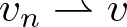 $v_n\rightharpoonup v$ weakly in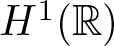 $H^1(\mathbb{R})$. There exist subsequences of $\{u_n\}$ and of $\{v_n\}$ such that (4.23) holds with $v_n$ and $v$ instead of $u_n$ and $u$, respectively.
It suffices to show that 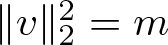 $\|v\|_2^2=m$. This can be achieved by way of contradiction, as we have discussed in the proofs of Theorem 1.2 and Lemma 4.6 (ii), so we omit it.
To prove that 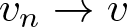 $v_n\to v$ in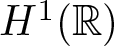 $H^1(\mathbb{R})$ and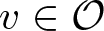 $v\in\mathcal{O}$, given the weak convergence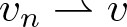 $v_n\rightharpoonup v$ in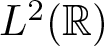 $L^2(\mathbb{R})$ and the convergence of norms
  $\|v_n\|_2
^2\to m=\|v\|_2^2$, we know that
$\|v_n\|_2
^2\to m=\|v\|_2^2$, we know that 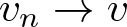 $v_n\to v$ strongly in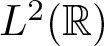 $L^2(\mathbb{R})$. From (3.2)-(3.3) and the boundedness of $v_n$ in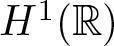 $H^1(\mathbb{R})$ it follows that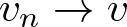 $v_n\to v$ in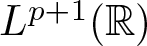 $L^{p+1}(\mathbb{R})$ and
  $D^{\frac{1}{2}}
v_n\to D^{\frac{1}{2}}v$ in
$D^{\frac{1}{2}}
v_n\to D^{\frac{1}{2}}v$ in 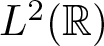 $L^2(\mathbb{R})$. Using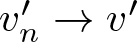 $v^{\prime}_n\to v'$ in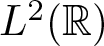 $L^2(\mathbb{R})$ gives
 \begin{equation*}
\|v^{\prime}_n\|_2^2=\|v'\|_2^2+\|v^{\prime}_n-v'\|_2^2+o(1).
\end{equation*}
\begin{equation*}
\|v^{\prime}_n\|_2^2=\|v'\|_2^2+\|v^{\prime}_n-v'\|_2^2+o(1).
\end{equation*} Thus,  $E(v_n)=E(v)+\|v^{\prime}_n-v'\|_2^2+o(1)$, from which we deduce that $E(v_n)\to \tilde{I}(m)$ and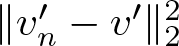 $\|v^{\prime}_n-v'\|_2^2$ converges in $\mathbb{R}$. Note that $D(v_n)=D(v)+ \|v^{\prime}_n-v'\|_2^2+o(1)$. From Lemma 4.4 we obtain $\liminf\limits_{n\to\infty}D(v_n) \gt 0$ and thus
  $
D(v)+\lim_{n\to\infty}\|v^{\prime}_n-v'\|_2^2 \gt 0.
$
$
D(v)+\lim_{n\to\infty}\|v^{\prime}_n-v'\|_2^2 \gt 0.
$
Choose 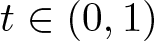 $t\in(0,1)$ such that $D(v)+t^2\|v^{\prime}_n-v'\|_2^2 \gt 0$ for the sufficiently large $n$ and let $\tilde{v}_n=v+t(v_n-v)$. Since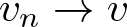 $v_n\to v$ in $L^2\cap L^{p+1}(\mathbb{R})$, we have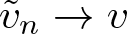 $\tilde{v}_n\to v$ in $L^2\cap L^{p+1}(\mathbb{R})$. Similarly, we have
  $D^{\frac{1}{2}}
\tilde{v}_n\to D^{\frac{1}{2}}v$ in
$D^{\frac{1}{2}}
\tilde{v}_n\to D^{\frac{1}{2}}v$ in 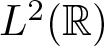 $L^2(\mathbb{R})$. Using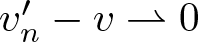 $v^{\prime}_n-v\rightharpoonup0$ as $n \to \infty$, we get
 \begin{equation*}
\|\tilde{v}^{\prime}_n\|_2^2=\|v'\|_2^2+t^2\|v^{\prime}_n-v'\|_2^2+o(1),\ \
D(\tilde{v}_n)=D(v)+t^2\|v^{\prime}_n-v'\|_2^2+o(1).
\end{equation*}
\begin{equation*}
\|\tilde{v}^{\prime}_n\|_2^2=\|v'\|_2^2+t^2\|v^{\prime}_n-v'\|_2^2+o(1),\ \
D(\tilde{v}_n)=D(v)+t^2\|v^{\prime}_n-v'\|_2^2+o(1).
\end{equation*} Thus, 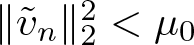 $\|\tilde{v}_n\|_2^2 \lt \mu_0$ and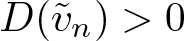 $D(\tilde{v}_n) \gt 0$ for the sufficiently large $n$, which implies that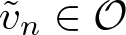 $\tilde{v}_n\in \mathcal{O}$ and $E(\tilde{v}_n)\geq \tilde{I}(\|\tilde{v}_n\|_2^2)$ for the large $n$. Letting $n\to\infty$ leads to
 \begin{equation*}
\liminf_{n\to\infty}E(\tilde{v}_n)\geq\tilde{I}(m).
\end{equation*}
\begin{equation*}
\liminf_{n\to\infty}E(\tilde{v}_n)\geq\tilde{I}(m).
\end{equation*}On the other hand, we note that
 \begin{align*}
E(\tilde{v}_n)&=E(v)+t^2\|v^{\prime}_n-v'\|_2^2+o(1)=\big(E(v)+\|v^{\prime}_n-v'\|_2^2\big)\\
&\quad +(t^2-1)\|v^{\prime}_n-v'\|_2^2+o(1).
\end{align*}
\begin{align*}
E(\tilde{v}_n)&=E(v)+t^2\|v^{\prime}_n-v'\|_2^2+o(1)=\big(E(v)+\|v^{\prime}_n-v'\|_2^2\big)\\
&\quad +(t^2-1)\|v^{\prime}_n-v'\|_2^2+o(1).
\end{align*} Letting  $n\to\infty$ yields
 \begin{equation*}
\tilde{I}(m)\leq\liminf_{n\to\infty}E(\tilde{v}_n)=
\tilde{I}(m)+(t^2-1)\lim_{n\to\infty}\|v^{\prime}_n-v'\|_2^2.
\end{equation*}
\begin{equation*}
\tilde{I}(m)\leq\liminf_{n\to\infty}E(\tilde{v}_n)=
\tilde{I}(m)+(t^2-1)\lim_{n\to\infty}\|v^{\prime}_n-v'\|_2^2.
\end{equation*} This indicates that  $\|v^{\prime}_n-v'\|_2^2\to0$ as $n \to \infty$. This together with that $\|v_n-v\|_2^2\to0$, implies that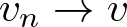 $v_n\to v$ in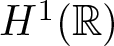 $H^1(\mathbb{R})$, as desired. From $D(v)=\lim\limits_{n\to\infty} D(v_n)$ and Lemma 4.4, we get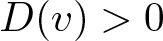 $D(v) \gt 0$, and thus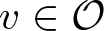 $v\in\mathcal{O}$. Moreover, we have $E(v)=\lim\limits_{n\to\infty}E(v_n)=\tilde{I}(m)$. Consequently, $v$ minimizes $E$ in the set $\{\omega\in\mathcal{O}~|~\|\omega\|_2^2=m\}$, and $P_1(v)= \lim\limits_{n\to\infty}P_1(v_n)=0$.
Recall that  $v_n=(u_n)_{t_{u_n,1}}$ and $t_{u_n,1}\to t_1\in(0,\infty)$ as $n\to\infty$. Then we have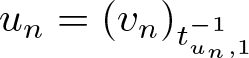 $u_n=(v_n)_{t_{u_n,1}^{-1}}$. Since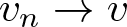 $v_n\to v$ in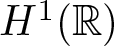 $H^1(\mathbb{R})$, it is easy to see that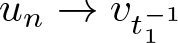 $u_n\to v_{t^{-1}_1}$ in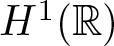 $H^1(\mathbb{R})$. This implies that $E(u_n)\to E(v_{t^{-1}_1})$, i.e.,
 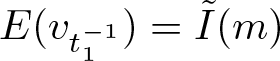 $E(v
_{t^{-1}_1})=\tilde{I}(m)$. We have
$E(v
_{t^{-1}_1})=\tilde{I}(m)$. We have 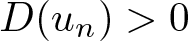 $D(u_n) \gt 0$ for all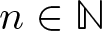 $n\in {\Bbb N}$ and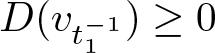 $D(v_{t^{-1}_1})\geq0$, i.e.,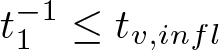 $t_1^{-1}\leq t_{v,infl}$. Thus, we obtain
  $0 \lt t_1
^{-1}\leq t_{v,infl}$ and
$0 \lt t_1
^{-1}\leq t_{v,infl}$ and  $E(v_{t^{-1}_1})=E(v)=\tilde{I}(m)$. Since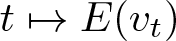 $t\mapsto E(v_t)$ attains the minimum on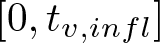 $[0,t_{v,infl}]$ only at $t=1$, we have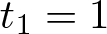 $t_1=1$. Therefore, $u=v$ and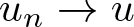 $u_n\to u$ strongly in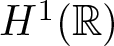 $H^1(\mathbb{R})$.
Proof of Theorem 1.4
As we can see, the first assertion of Theorem 1.4 (i) follows from Lemma 4.3 and Theorem 1.4 (ii) follows from Proposition 4.7.
To prove the second assertion of Theorem 1.4 (i), we assume on the contrary that if there exists 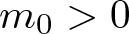 $m_0 \gt 0$ such that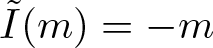 $\tilde{I}(m)=-m$ on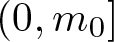 $(0,m_0]$, then $\tilde{I}(m)$ is not achieved for $m\in(0,m_0)$. Indeed, if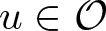 $u\in\mathcal{O}$ is a minimizer for $\tilde{I}(m)$, then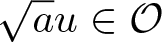 $\sqrt{a}u\in \mathcal{O}$ for $a \gt 1$ with $a$ being close to $1$ and
 \begin{equation*}
\tilde{I}(am)\leq E(\sqrt{a}u) \lt aE(u)=-am.
\end{equation*}
\begin{equation*}
\tilde{I}(am)\leq E(\sqrt{a}u) \lt aE(u)=-am.
\end{equation*} This is a contradiction with the fact that  $\tilde{I}(am)=-am$.
Let  $u$ be a minimizer of $\tilde{I}(m)$, as given by Proposition 4.7. Clearly,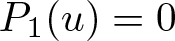 $P_1(u)=0$ and $u$ satisfies (4.11). In particular, we have $\|u\|^2_{H^1}\leq Cm=C\|u\|_2^2$, where $C$ depends only on $p$. Since $u$ minimizes $E$ under the $L^2$-norm in the open set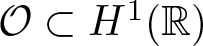 $\mathcal{O}\subset H^1(\mathbb{R})$, there exists a Lagrange multiplier $\lambda_u$ such that
 \begin{equation}
-u^{\prime\prime}-2\mathcal{H}u^{\prime}-\lambda_u u-u^p=0~~{\rm{in}}~H^{-1}({\mathbb{R}}).
\end{equation}
\begin{equation}
-u^{\prime\prime}-2\mathcal{H}u^{\prime}-\lambda_u u-u^p=0~~{\rm{in}}~H^{-1}({\mathbb{R}}).
\end{equation} Taking the  $H^{-1}-H^1$ duality product of (4.24) with $u$ gives
 \begin{equation*}
\|u^{\prime}\|_2^2-2\|D^{\frac{1}{2}}u\|_{2}^2-\lambda_u\|u\|_2^2-\int_{\mathbb{R}}u^{p+1}dx=0,
\end{equation*}
\begin{equation*}
\|u^{\prime}\|_2^2-2\|D^{\frac{1}{2}}u\|_{2}^2-\lambda_u\|u\|_2^2-\int_{\mathbb{R}}u^{p+1}dx=0,
\end{equation*}which can be written as
 \begin{equation*}
E(u)-\frac{p-1}{p+1}\int_{\mathbb{R}}u^{p+1}dx=\lambda_u\|u\|_2^2.
\end{equation*}
\begin{equation*}
E(u)-\frac{p-1}{p+1}\int_{\mathbb{R}}u^{p+1}dx=\lambda_u\|u\|_2^2.
\end{equation*} Since  $0 \lt \frac{p-1}{p+1}\int_{\mathbb{R}}u^{p+1}dx \lt \frac{4(p-3)}{(p-5)^2}\|u\|_2^2$ (see (4.11)), we get
 \begin{equation*}
-1\geq\frac{\tilde{I}(m)}{m} \gt \lambda_u \gt \frac{\tilde{I}(m)}{m}-
\frac{4(p-3)}{(p-5)^2}.
\end{equation*}
\begin{equation*}
-1\geq\frac{\tilde{I}(m)}{m} \gt \lambda_u \gt \frac{\tilde{I}(m)}{m}-
\frac{4(p-3)}{(p-5)^2}.
\end{equation*} Letting  $\lambda_u=-1-\omega(u)$ and using Lemma 4.2 (i), we see that $u$ satisfies (4.3) with
 \begin{equation*}
0 \lt \omega(u) \lt -1+\frac{(p-3)^2}{(p-1)(p-5)}+\frac{4(p-3)}{(p-5)^2}.
\end{equation*}
\begin{equation*}
0 \lt \omega(u) \lt -1+\frac{(p-3)^2}{(p-1)(p-5)}+\frac{4(p-3)}{(p-5)^2}.
\end{equation*}Thus, we obtain an explicit bound on the Lagrange multipliers associated with local minimizers according to Proposition 4.7. Therefore, we have completed the proof of Theorem 1.4 (iii).
Proof of Theorem 1.5
Recalling the definition of the orbital stability, we need to prove that the solution  $\phi(t)$ of (1.1) exists globally, at least for initial data $\phi_0$ sufficiently close to $\tilde{\mathcal{G}}_m$.
We argue by contradiction, i.e., assume that there exist 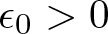 $\epsilon_0 \gt 0 $ and a sequence of initial data $\{\phi_0^n\}\subset H^1(\mathbb{R})$ such that $\delta_n: =dist(\phi_0^n, \tilde{\mathcal{G}}_m) \to 0$ and the solution $\phi_n(t)$ of (1.1) with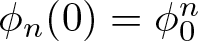 $ \phi_n(0)=\phi_0^n $ blows up in finite time. Denote
 \begin{equation*}
t_n=\inf\{t \gt 0~|~dist(\phi_n(t),\tilde{\mathcal{G}}_m)\geq \epsilon_0\}.
\end{equation*}
\begin{equation*}
t_n=\inf\{t \gt 0~|~dist(\phi_n(t),\tilde{\mathcal{G}}_m)\geq \epsilon_0\}.
\end{equation*} We may assume that 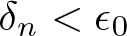 $\delta_n \lt \epsilon_0$ holds for all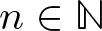 $n\in {\Bbb N}$. Then it follows from $dist(\phi_0^n, \tilde{\mathcal{G}}_m)=\delta_n \lt \epsilon_0$ that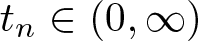 $t_n\in(0,\infty)$ and $dist(\phi_n(t_n),\tilde{\mathcal{G}}_m)=\epsilon_0$. On the other hand, $\tilde{\mathcal{G}}_m$ is compact in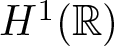 $H^1(\mathbb{R})$ modulo translations,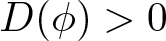 $D(\phi) \gt 0$ and $\|\phi\|_2^2=m \lt \mu_0$ for any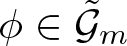 $\phi\in\tilde{\mathcal{G}}_m$. Due to the continuity, there exists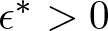 $\epsilon^* \gt 0$ such that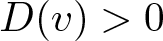 $D(v) \gt 0$ and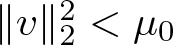 $\|v\|_2^2 \lt \mu_0$ hold for any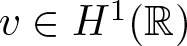 $v\in H^1(\mathbb{R})$ satisfying $dist(v,\tilde{\mathcal{G}}_m)\leq\epsilon^*$. This indicates that each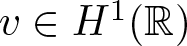 $v\in H^1(\mathbb{R})$ satisfying $dist(v,\tilde{\mathcal{G}}_m)\leq\epsilon^*$ belongs to the set $\mathcal{O}$. Then it follows from $dist(\phi_n(t_n),\tilde{\mathcal{G}}_m)=\epsilon_0$ that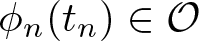 $\phi_n(t_n)\in\mathcal{O}$ by assuming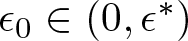 $\epsilon_0\in(0,\epsilon^*)$. Since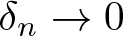 $\delta_n \to0$, it is easy to see that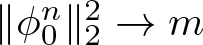 $\|\phi^n_0\|_2^2 \to m$ and $E(\phi^n_0)\to\tilde{I}(m)$ as $n\to\infty$. By the conservation laws, we have
 \begin{equation*}
\|\phi_n(t_n)\|_2^2=\|\phi^n_0\|_2^2\to m ~~{\rm{and}}~~E(\phi_n(t_n))=E(\phi^n_0)\to\tilde{I}(m),
\ {\rm as} \ n\to \infty .
\end{equation*}
\begin{equation*}
\|\phi_n(t_n)\|_2^2=\|\phi^n_0\|_2^2\to m ~~{\rm{and}}~~E(\phi_n(t_n))=E(\phi^n_0)\to\tilde{I}(m),
\ {\rm as} \ n\to \infty .
\end{equation*} Since 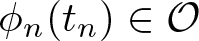 $\phi_n(t_n)\in\mathcal{O}$ and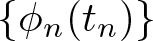 $\{\phi_n(t_n)\}$ is a minimizing sequence for $\tilde{I}_m$, we deduce from Proposition 4.7 that there exist a subsequence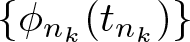 $\{\phi_{n_k}(t_{n_k})\}$, a sequence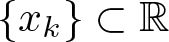 $\{x_k\}\subset \mathbb{R}$ and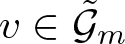 $v\in\tilde{\mathcal{G}}_m$ such that $\|\phi_{n_k}(t_{n_k})(\cdot+x_k)-v\|_{H^1}\to0$ as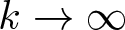 $k\to\infty$. This contradicts the fact that $dist(\phi_n(t_n),\tilde{\mathcal{G}}_m)=\epsilon_0$ for all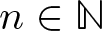 $n\in {\Bbb N}$. Hence, for the initial data $\phi_0$ sufficiently close to $\tilde{\mathcal{G}}_m$, the solution $\phi(t)$ of (1.1) exists globally.
For the stability of  $\tilde{\mathcal{G}}_m$, the proof is closely similar to that of Theorem 1.3, so we omit it to avoid unnecessary repetition.
Funding
This work was supported by the National Natural Science Foundation of China (No. 12261079, 12461035), the Applied Basic Research Project of Qinghai Province No. 2025-ZJ-722 and the US NSF DMS-2316952.
Conflict of interest
The authors declare that there is no conflict of interest in this article.
Data availability
No data were used or created in this study.


 Open access

