


Introduction
The 2016 United Kingdom (UK) referendum on European Union (EU) membership exposed a deep educational gradient in voting, whereby university graduates were much more likely to vote Remain than their non‐graduate peers (Ansell & Gingrich, Reference Ansell and Gingrich2022; Hobolt, Reference Hobolt2016; Sobolewska & Ford, Reference Sobolewska and Ford2020). That education was one of the strongest socio‐demographic determinants of the Brexit vote was unsurprising – a plethora of existing research has shown that graduates are, on average, more culturally liberal than those who have not studied at university (Bovens & Wille, Reference Bovens and Wille2017; Hainmueller & Hiscox, Reference Hainmueller and Hiscox2007; Surridge, Reference Surridge2016; Weakliem, Reference Weakliem2002), and that these liberal cultural attitudes were strongly predictive of voting to remain in the EU (Hobolt, Reference Hobolt2016).
While it is clear that EU referendum voting is divided along educational lines largely because of the differing cultural attitudinal profiles of British graduates and non‐graduates, much less is known about why it is that individuals who have and have not studied at university have such different attitudes towards EU integration. Does studying at university cause us to become less Eurosceptic? Or does it simply appear this way because graduates are a highly selected group who tend to have different pre‐adult experiences, and occupy different adult status environments, than non‐graduates?
This paper explores precisely this question by using individual and sibling fixed‐effects techniques (henceforth IFE and SFE, respectively) to analyse Harmonised British Household Panel Survey (BHPS) and Understanding Society (UKHLS) data which follows sampled households, and all individuals living within these, for over three decades from 1991 to 2022 (University of Essex, Institute for Social & Economic Research, 2022). In doing so, it makes several important contributions. Firstly, it provides an estimate of the effect of higher education (HE) on Euroscepticism and Brexit voting in Britain. Secondly, we bring additional evidence to bear on the developing debate as to whether university study has a causal or spurious effect on attitudes. Existing evidence on this from British studies (Fryer, Reference Fryer2022; Scott, Reference Scott2022; Simon, Reference Simon2022; Surridge, Reference Surridge2016), and those conducted more widely across Europe and the United States (Kuhn et al., Reference Kuhn, Lancee and Sarrasin2021; Lancee & Sarrasin, Reference Lancee and Sarrasin2015; Velásquez & Eger, Reference Velásquez and Eger2022; Weber, Reference Weber2022; Woessner & Kelly‐Woessner, Reference Woessner and Kelly‐Woessner2020), is mixed. Finally, we make a methodological contribution by providing a comparison of estimates obtained when using SFE and IFE models, both of which have been widely used to isolate the independent influence of HE on attitudes in the ‘university effects’ literature.
Our results suggest that attaining a university degree generally has only a small and statistically insignificant effect on Euroscepticism in the short‐term – increasing the favourability of EU integration by just 2 percentage points (1/13th of a standard deviation) in the full sample.Footnote 1 We view this as the direct effect of university study. When taking a longer‐term perspective, where there could be as much as 23 years between graduating and our measurement of Euroscepticism, the effect of university study is substantial. Across our various long‐term operationalisations of attitudes towards EU integration, the largest ‘university effect’ decreases Euroscepticism by 17 percentage points compared to non‐graduates. While we cannot pinpoint the precise mechanism that underpins this significant long‐term effect (substantively in both IFE and SFE models, albeit only statistically so in the IFE models), we speculate that it is largely not the experience of having studied at university itself that changes one's attitudes – but rather the indirect allocative effect that doing so has on our social networks, neighbourhoods and workplaces in the decades following graduation. In the one case where we do find evidence of a statistically significant short‐term university effect (when we restrict our sample to younger individuals only), our findings remain consistent; this short‐term direct ‘university effect’ is of a far smaller magnitude than the longer‐term allocative effects uncovered for this same group.
Higher education and Euroscepticism: The case of Brexit
The salience of EU issues in British politics grew dramatically in the decade preceding the Brexit vote. The migration crisis and shock to the Euro following the financial crash led the electorate to become more focussed on immigration and divided on the question of European integration (Hooghe & Marks, Reference Hooghe and Marks2018). There was a substantial increase in the UK Independence Party's vote share, which pushed the then Prime Minister, David Cameron, to promise an EU membership referendum should the Conservatives be re‐elected (Evans & Mellon, Reference Evans and Mellon2019). This vote saw the UK leave the EU by a slim majority of 51.9 per cent. Whilst EU integration came to dominate political rhetoric only during the 2016 referendum campaign, this ‘transnational’ European integration cleavage has been developing beneath the surface of British politics since the early 2000s (Hooghe & Marks, Reference Hooghe and Marks2018).
Educational attainment now constitutes one of the most important social and political dividing lines in advanced Western democracies (Abou‐Chadi & Hix, Reference Abou‐Chadi and Hix2021; Bovens & Wille, Reference Bovens and Wille2017; Ford & Jennings, Reference Ford and Jennings2020; Gethin et al., Reference Gethin, Martínez‐Toledano and Piketty2021; Piketty & Goldhammer, Reference Piketty and Goldhammer2020). The Brexit vote exposed this clearly in the UK, revealing a stark educational rift in attitudes (Hobolt, Reference Hobolt2016). Such is the strength of this educational divide over European integration, that even after controlling for a raft of socio‐demographic and attitudinal variables, Sobolewska and Ford (Reference Sobolewska and Ford2020, p. 235) found graduates were 25 percentage points less likely to vote Leave than those with secondary school qualifications (see also Ansell & Gingrich, Reference Ansell and Gingrich2022).
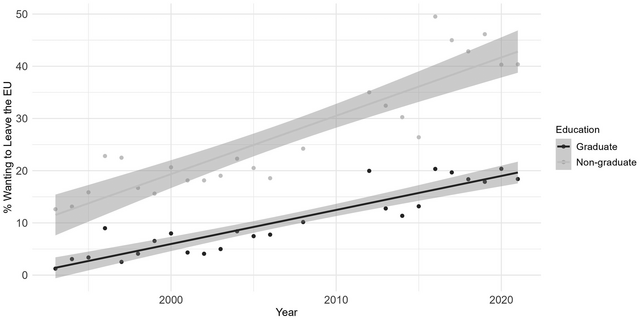
These trends, of a general rise in Eurosceptic sentiment and a widening gap between graduate and non‐graduate attitudes in this regard, can be seen in Figure 1.Footnote 2 While relatively few individuals, either graduate or non‐graduate, supported leaving the EU in the early 1990s, the British Social Attitudes (BSA) data (NatCen Social Research, 2023) shows that by the time of the 2016 referendum almost 50 per cent of non‐graduates wanted to leave compared to only around 20 per cent of graduates. In fact, over 80 per cent of non‐graduates reported either wanting to leave the EU or to stay in but reduce EU powers.

Figure 1. The educational divide in Euroscepticism.
Note: Responses to ‘Do you think Britain's long‐term policy should be…’ on a 5‐point scale in line with dependent variable Coding 1. Those who respond ‘…to leave the EU’ are graphed as a percentage of total valid responses, excluding ‘don't knows’, applying cross‐sectional survey weights. British Social Attitudes data not available for 2007 and 2009–2011. Sample size varies year‐on‐year from 910 to 3841.
While we focus on the UK here, the same educational gradient in Euroscepticism is observed across Europe (Hakhverdian et al., Reference Hakhverdian, van Elsas, van der Brug and Kuhn2013). In online Appendix A, we use Eurobarometer data to show the evolution of Euroscepticism across Western European countries (pooled and separated by nation). Across Europe, graduates – proxied by those who left education at 20 or older – are less Eurosceptic than their non‐graduate peers, with this divide particularly stark from 2000 to 2017.
A causal or spurious relationship?
Although it is well‐established that graduates are less Eurosceptic and less often voted to leave the EU in 2016 than their non‐graduate counterparts, the question of whether gaining a HE qualification is the cause of this attitudinal divide remains a relatively open one.
There are two main explanations as to why individuals with higher levels of educational attainment may be more supportive of European integration. The first proposes that education has an ‘absolute’, or direct, effect on attitudes (Persson, Reference Persson2015; Surridge, Reference Surridge2016). Proponents of this model argue that exposure to the educational or experiential environment of university study ‘liberalises’ attitudes (Weakliem, Reference Weakliem2002). For example, material delivered as part of the formal curriculum – including learning the importance of free speech and the need to respect, and be tolerant of, others, regardless of their beliefs or lifestyle – could encourage a post‐national sense of citizenship (Keating, Reference Keating2009) and make students feel more comfortable with, confident among and accepting of new places and people (Goodhart, Reference Goodhart2017; Stubager, Reference Stubager2008). Processes of informal socialisation on university campuses could also have an effect; with more liberal cultural attitudes being inherited through interactions with university professors – who are, on average, more left‐wing (Klein et al., Reference Klein, Stern and Western2005) – or through social networks developed at university (Woessner & Kelly‐Woessner, Reference Woessner and Kelly‐Woessner2020). Regardless of the precise mechanisms through which these attitudes are transmitted on campuses, the ‘absolute’ effects model proposes that there is something about the experience of studying at university, in itself, that causes graduates to become more culturally liberal and thus, more supportive of European integration.
The second explanation posits that the link between HE and favourable attitudes towards European integration may instead be spurious – driven by ‘proxy’ selection‐into‐education and post‐educational sorting effects. The selection argument starts from the premise that individuals who later enrol at HE institutions differ from those who do not in important ways. For example, children who later become graduates are more likely to come from high socio‐economic status backgrounds (Blanden & Macmillan, Reference Blanden and Macmillan2016). Family background is not only an important determinant of subsequent educational attainment but also a predictor of attitudinal formation. For example, parents from higher status backgrounds tend to have different political preferences than their lower status counterparts, and these differences are transmitted across generations (Ares & van Ditmars, Reference Ares and van Ditmars2023). Graduates also disproportionately come from particular parts of the country (Britton et al., Reference Britton, van der Erve, Waltmann and Xu2021) – and place is linked to attitudes: the ‘geography of discontent’ (McCann, Reference McCann2020). Beyond social origins, children possess other characteristics which are likely to be associated with both their socio‐political attitudes and subsequent university enrolment – for example, their levels of ambition or cognitive ability (Persson, Reference Persson2015). According to the selection model, the association between HE and more favourable attitudes towards European integration may be driven, at least in part, by a lesser tendency of Eurosceptic young people to select into university study.
The sorting model proposes that the association between educational attainment and Euroscepticism is driven by the fact that education opens pathways to a more privileged societal position. Highly educated individuals – and university graduates in particular – more often work in high‐skilled, flexible and autonomous jobs and may think differently about the world on account of doing so (Kitschelt & Rehm, Reference Kitschelt and Rehm2014). Graduates, for example, are more likely to have the opportunity to exploit the potential to migrate within Europe to seek work (Bauman, Reference Bauman1998) and are less likely to be exposed to competition with immigrants for work in low‐skilled jobs (Kriesi et al., Reference Kriesi, Grande, Lachat, Dolezal, Bornschier and Frey2008). Graduates are then more likely to favour European integration, as the privileged occupational statuses they tend to hold mean they stand to gain more from coordination with Europe than the less educated (Anderson & Reichert, Reference Anderson and Reichert1995). Beyond economic benefits, going to university also shapes our social networks, clustering graduates into specific kinds of occupations and neighbourhoods, such that they rarely mix and mingle with non‐graduates (Bovens & Wille, Reference Bovens and Wille2017). This matters because having a homogeneous social circle, compared to a more mixed group, can lead to greater polarisation in policy perspectives (Hobolt et al., Reference Hobolt, Lawall and Tilley2023).
Separating out these direct and indirect effects is both theoretically and methodologically challenging. Firstly, because if access to occupations and new kinds of social networks are at least in part a result of having studied at university, it is not theoretically clear if one should treat this as a direct or indirect consequence of HE. This may be thought of as the ‘allocative’ effect of HE and could be argued to represent the total causal effect of university study. Secondly, because we often do not have access to the detailed longitudinal data which are required if we are to attempt to isolate causal and spurious HE effects in statistical models. This applies to both selection‐into‐education and post‐educational sorting effects.
Adding further complexity is that the effects of HE, both direct and indirect, may also differ depending on one's generation. For example, the liberalising potential of HE may be weaker for recent generations – like Millennials and Gen Z – both because HE study is a more common experience for these individuals, and thus universities are now less ‘highly selected’ and more diverse environments and because their social values are already generally more liberal than older generations were at the same age (Lindskog & Oskarson, Reference Lindskog and Oskarson2023). Our descriptive analysis of BSA data (online Appendix A) provides some support for this idea.
To test this more formally, we later compare university effects estimated using the full sample (all ages) and those using samples of younger (those aged 41 or less in 2022) and older generations (those aged 42 or more in 2022) only.Footnote 3 As the span of, and timings at which EU attitudes questions were asked within, the harmonised BHPS and UKHLS data allows us to estimate the effects of obtaining a university degree in the period 1999–2022 only, splitting by generation in this way largely reflects a difference between those who studied as mature students (the older generation) and those who did not (the younger generation). If anything, we would then expect the direct effect of university study to be larger for younger generations as they will have attended university at a time when they are closer to their ‘formative’ or ‘impressionable’ years, and their attitudes are more malleable (Krosnick & Alwin, Reference Krosnick and Alwin1989).
The evidence: Educational attainment and Euroscepticism
The link between educational attainment and Euroscepticism is relatively under‐studied and the fairly scant body of empirical evidence that does exist in this regard has tended to focus on exploring how increasing levels of, or time spent in, education, influences the favourability of European integration, rather than seeking to isolate the independent causal effect of university study on these attitudes, more specifically.Footnote 4 This is problematic, given a plethora of studies suggest the educational rift in attitudes in advanced Western democracies is almost entirely a product of a graduate/non‐graduate divide (Hainmueller & Hiscox, Reference Hainmueller and Hiscox2007; Stubager, Reference Stubager2008; Surridge, Reference Surridge2016).
This evidence largely points to a spurious rather than causal relationship. Kuhn et al. (Reference Kuhn, Lancee and Sarrasin2021) find the differences in the levels of Euroscepticism observed between educational groups in Switzerland can be explained almost entirely by self‐selection due to family background. Similar evidence emerges across Europe, with Kunst et al. (Reference Kunst, Kuhn and van de Werfhorst2020) exploiting schooling reforms to provide quasi‐experimental evidence that additional years spent in education do not increase support for European integration. Given the context of growing Euroscepticism in the UK, and the EU referendum result, it is surprising that there, as yet, exist no studies that have sought to isolate the causal effect of university study on attitudes towards European integration in Britain.
While a number of studies have explored the causal role of university study, specifically, rather than increased educational attainment, more generally, in shaping economic and cultural attitudes, the evidence provided by this body of research has been more mixed. One of the most widely studied areas is attitudes towards immigration, where findings differ across national contexts. For example, while large effects of HE on attitudes towards immigration attitudes and ethnic minorities – nearly all of which could be accounted for by sorting, rather than by any direct causal effect – were uncovered in Switzerland (Lancee & Sarrasin, Reference Lancee and Sarrasin2015) and Germany (Weber, Reference Weber2022), small but significant causal HE effects on immigration attitudes were found in the Norwegian context (Velásquez & Eger, Reference Velásquez and Eger2022).
In the British context, several recent studies also provide evidence in this debate. Using an IFE analysis of the 1970 British Cohort Study, Scott (Reference Scott2022) found graduating from university to have a fairly substantial direct causal effect on socio‐political values; with the experience of studying at HE typically working to reduce racial prejudice and authoritarianism (cultural attitudes) and increase right‐wing economic attitudes. Contrastingly, Fryer's (Reference Fryer2022) analysis of British Election Study data found economic attitudes were somewhat more likely to shift in a left‐leaning than a right‐leaning, direction during the period of university study; with 34.9 per cent of students becoming more left‐wing, while just 22.9 per cent became more right‐wing. In an SFE analysis of BHPS and UKHLS data, Simon (Reference Simon2022) found HE had only a modest causal effect on cultural attitudes (environmental and gender egalitarianism), which was not universally liberalising. In fact, this study found the link between university study and economic and cultural values was largely spurious; materialising predominantly due to a self‐selection effect whereby those who experience pre‐adult environments conducive to the formation of a particular set of values disproportionately enrol at universities. Some additional support for this conclusion, in relation to cultural attitudes, is provided by Fryer's (Reference Fryer2022) analysis, which found almost 42 per cent of students did not change their attitudes towards immigration while studying at university, while 80 per cent changed their attitudes by one‐point or less across a seven‐point ethnocentrism scale.
There are several factors which may explain the different conclusions around the link between HE and liberal values drawn by these British studies. Firstly, they use different measures of socio‐political values, and, secondly, they study the effects of HE at different stages of the sector's development; with Scott largely capturing the effect of graduating from university in the late 1980s, when HE was still relatively ‘elitist’ and served only the most privileged, while Simon and Fryer explore these effects in a later time period, when the UK HE system had begun to transition to a more accessible, universal one (Boliver, Reference Boliver2011). Thirdly, these studies measure different kinds of causal effects. For example, Scott (Reference Scott2022) isolates the total causal effect of HE on attitude formation. Attitudes are recorded at 16 and then again at 26, thus Scott's estimate may include both an effect from university itself and any ‘allocative’ attitudinal changes which occur as a product of the socio‐economic position conferred by university graduation, that is, post‐educational sorting. Simon (Reference Simon2022), on the other hand, captures the direct causal effect of HE, and so studies only those attitudinal changes which take place on university campuses. It is unsurprising then that Scott found relatively stronger HE effects than Simon.
Finally, these studies’ differential uses of IFE and SFE models may contribute to explaining differences in conclusions drawn. If the HE effect manifests itself differently among only children and HE concordant siblings than it does for HE discordant siblings, then SFE models are likely to under‐ or over‐estimate the population‐level differences in attitudes engendered by university study (Campbell & Horowitz, Reference Campbell and Horowitz2016; Madsen et al., Reference Madsen, Andersen, Gerster, Andersen, Christensen and Osler2014). Exploring whether within‐sibling estimates of the influence of university study on attitudes can be generalised beyond the sibling population, in this way, is thus a productive area for future study.
This study seeks not only to do precisely this, by testing the comparability of results obtained from IFE and SFE models but also to bring additional evidence to bear on the ongoing debate as to whether studying at university engenders attitudinal change, by providing the first robust causal estimate of HE's effect on attitudes towards European integration in the modern British context. Our investigation is motivated by the research question: Does obtaining a degree cause British graduates to develop more favourable attitudes towards European integration?
Data and measures
Estimating education's causal effect is a difficult task. As it would be both practically impossible and ethically undesirable to conduct randomised experiments that explore how university study shapes adult outcomes (Persson, Reference Persson2015), scholars rely on observational data when seeking to answer these kinds of questions. Analysing panel data which contain repeated measures of attitudes over a lengthy time span and provide the information required to adequately control for selection‐into‐education effects offers a unique opportunity to isolate the independent influence of educational attainment (Surridge, Reference Surridge2016).
This study uses high‐quality data from the nationally representative BHPS and UKHLS surveys to provide a robust causal estimate of HE's effect on British individuals’ attitudes towards European integration. Exploiting the fact that individuals from almost 6700 of the 8000 originally sampled BHPS households, who were interviewed annually (so long as they were aged 16 or over) from 1991 to 2009, consented to join the larger UKHLS panel and have since continued to be interviewed bi‐annually,Footnote 5 allows us to conduct a longitudinal analysis of attitudinal change spanning several decades.
The Harmonised BHPS and UKHLS data provide repeated measures of respondents’ highest level of educational attainment and attitudes towards European integration as well as a detailed raft of other socio‐demographic variables. It therefore offers the advantage of allowing us to pinpoint when precisely it is that university‐educated individuals have graduated, to measure their attitudes pre‐ and post‐ university study and to explore whether any attitudinal changes engendered by HE differ from those observed amongst the non‐graduate group over time.
The longitudinal household design of these data also allows self‐selection effects to be controlled via matching individuals within households. Leveraging the shared backgrounds of siblings who have grown up in the same environments through estimating HE's effect on socio‐political values within‐siblings allows the effects of all family‐invariant unmeasured pre‐adult characteristics which confound this relationship to be controlled (Campbell & Horowitz, Reference Campbell and Horowitz2016; Sieben & de Graaf, Reference Sieben and de Graaf2004). Utilising the harmonised BHPS and UKHLS data not only affords the ability to provide the first robust estimate of HE's causal effect on British individuals’ attitudes towards European integration but also allows us to explore whether IFE and SFE methods of estimating this effect produce similar conclusions.
Measuring attitudinal change
Attrition is common in panel studies. Some respondents will drop out completely, and others will not respond at one or more waves and later return. This is problematic both because attrition reduces the sizes of samples for analysis and, therefore, the precision with which estimates can be made and because attrition can engender bias if those who respond differ systematically from those who do not. Given that Benzeval et al. (Reference Benzeval, Bollinger, Burton, Crossley and Lynn2020) show UKHLS respondents are broadly representative of the UK population across key demographic markers, addressing the former attrition‐based issue seems most pertinent.
For each respondent, we recorded attitudes towards European integration at two time points, herein referred to as t 0 and t 1. As our primary objective was to investigate whether obtaining a university degree causes attitudinal change, it was essential that HE attendees’ attitudes were measured both pre‐ and post‐ graduation. For graduates, t 0 values are taken at the first wave in which they report a valid (i.e., non‐missing) response on each attitudinal measure of concern, so long as they have not already graduated at this wave, and t 1 values are captured at the first wave in which they provide valid information on this same measure after having reported graduating. For non‐graduates, t 0 and t 1 simply report the first and second valid responses provided on each of the relevant attitudinal measures over the panel duration. Allowing attitudinal measures to draw on multiple waves of data, in this way, helped maximise the size of samples for analysis and minimise attrition's negative impacts.Footnote 6
This measurement strategy means graduate's pre‐HE attitudes – their t 0 values – may, in some cases, have been recorded in the early stages of their undergraduate study and thus renders controls for spurious HE effects somewhat imperfect. While it would have been preferable to ensure all graduates’ t 0 values were recorded before they began their course of HE studies, we felt this strategy was neither feasible nor desirable given concerns over the sample size.
Attitudes towards European integration
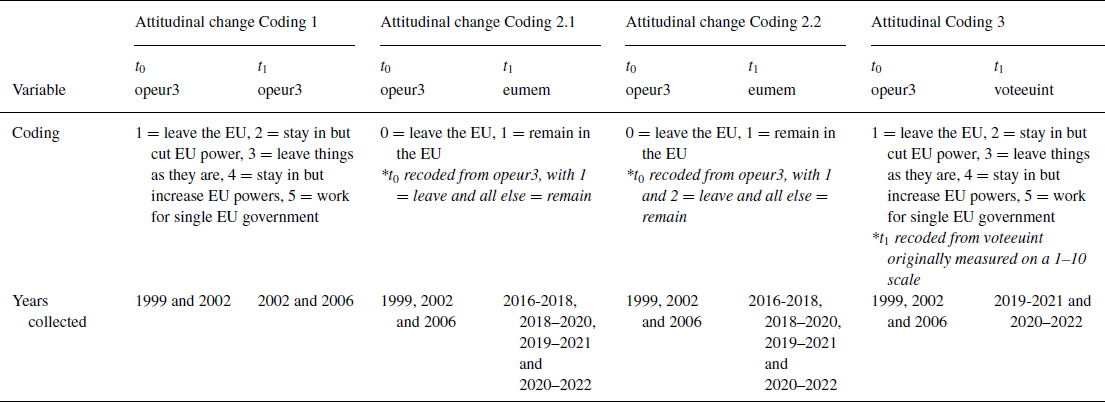
We use four different attitudinal codings to shed light on the short‐ and long‐term attitudinal changes observed among graduates and non‐graduates, all of which are coded such that higher values equal more favourable attitudes towards European integration. In Coding 1, our short‐term attitudinal coding, we use a 5‐item scale – opeur3 – which asks what UK long‐term policy should be in relation to the EU, recording t 0 values in BHPS Waves 9 (1999) and 12 (2002) and t 1 values at either Waves 12 or 16 (2006). For more detail see the first column of Table 1.
Table 1. Coding of attitudes towards European integration

Our longer‐term attitudinal codings use different variables at t 0 and t 1. Codings 2.1, 2.2 and 3 all rely on information from the BHPS variable opeur3 in 1999, 2002 or 2006 for their t 0 values, but use this in slightly different ways. While Coding 3 leaves this variable as is, in the form of a 5‐point scale, Codings 2.1 and 2.2 both recode this scale into slightly different variants of a binary leave (0) versus remain (1) specification (see Table 1 for more information). Using slightly different t 0 leave/remain definitions across Codings 2.1 and 2.2 allows us to test the sensitivity of our results to different cut‐offs.
For their t 1 measurements, Codings 2.1 and 2.2 both use the same binary variable – eumem – from UKHLS Waves 8, 10, 11 and 12 (2016–2022), which asks whether the UK should remain a member of the EU or leave, with response options of don't know, remain and leave. We exclude ‘don't knows’ from our analysis. Finally, Coding 3 uses the UKHLS Wave 11 and 12 variable (2019–2022) – voteeuint – which asks respondents to place themselves on a 0–10 scale, where 0 means the UK should do all it can to unite fully with the EU and 10 means it should do all it can to protect its independence from the EU. This variable was recoded into a 5‐point scale mirroring that used for the measurement of the Coding 3 t 0 value, by flipping scale values (0 = 10 and so on) and then grouping those who responded 0–1, 2–3, 4–6, 7–8 and 9–10, to allow for comparison over time.
Using multiple t 1 attitudinal measures not only offers the advantage of allowing us to track attitudinal change over a longer period (from 1999 to 2022 – as in columns 2–4 of Table 1 – rather than from 1999 to 2006 – as in column 1) but also to compare the more immediate, short‐term effects of HE on attitudes towards European integration with the longer‐term effects. This is important from a theoretical perspective, as it allows us to better understand whether it is the experience of studying at university, in itself, or the ‘allocative effects’ of HE that cause the graduate group's distinctive attitudes towards European integration.
One limitation of our study is that mapping onto dependent variables that vary in coding between t 0 and t 1 means we cannot say anything about time trends.Footnote 7 Importantly, however, this does not prevent us from differentiating between the effect on graduates compared to non‐graduates. We cannot, therefore, completely rule out the possibility that any differences in effects observed over short‐ and long‐ term measures are an artefact of these differing codings. We mitigate this concern by regressing our various measures of EU attitudes on a constant set of predictors, showing that this same set of variables influence each of our different t 0 and t1 measures to roughly the same extent, which we argue is evidence of consistency of concept across measures (see online Appendix C).
Educational attainment: Graduation status
As our core objective is to investigate whether obtaining a university degree is the cause of British graduates’ more favourable attitudes towards European integration, we use a binary indicator of respondents’ highest level of educational attainment which simply records whether they possess at least a bachelor's degree or not.
Given our study design necessitates we record graduates’ initial positions on European integration (t 0) before they first report having been awarded a bachelor's degree, and the variable from which t 0 is derived first appeared in BHPS Wave 9 (1999), we had to exclude all 2227 respondents who reported they had obtained a degree in BHPS Wave 9 or earlier. With these individuals excluded from our analytical sample, this left 20,454 respondents who were classified as university graduates and 86,233 who were not.
As our respondents were allocated to the graduate condition after they had obtained their first university qualification, and the UK's educational system typically requires successful completion of an undergraduate degree for progression to postgraduate studies, it can be assumed the HE effect captured here pertains to that of gaining a first undergraduate degree.
Other variables
Aside from these core attitudinal and educational variables, we also use a dummy variable which records whether individuals were the oldest of all their co‐resident siblings at the first BHPS wave in which they were surveyed, or not. The inclusion of this variable is premised on the fact there is considerable evidence to suggest that first‐born children experience different pre‐adult environments than their siblings. Parents do not have infinite resources and so as families expand, children receive a smaller share of these resources; first‐borns typically spend more time socialising with their parents than their siblings (Andeweg & Berg, Reference Andeweg and Berg2003) and are therefore more politically influenced by them. Barni et al. (Reference Barni, Roccato, Vieno and Alfieri2014), for example, show that first‐borns more often internalise their parents’ conservative values. Controlling for these within‐sibship differences in parental contact and socialisation helps to ensure maximum symmetry in siblings’ pre‐adult environments (Campbell & Horowitz, Reference Campbell and Horowitz2016) and, thus, improves our ability to identify the independent causal influence of HE on EU attitudes.
We note that we would have liked to explore potential differences in HE effects by the subject respondents studied at university (in line with Woessner & Kelly‐Woessner, Reference Woessner and Kelly‐Woessner2020) or the type of university they attended, however, the data do not allow us to do this with the required precision. Descriptive statistics for the full sample are presented in online Appendix D.
Empirical strategy
Our research questions are answered by applying two methodologies: IFE and SFE. For both strategies, we use linear models for ease of interpretation. Our results are substantively similar should we use logistic (Codings 1 and 3) or ordinal logistic models (Codings 2.1 and 2.2), see online Appendix E. In the online Appendix E logistic versions of these models, IFE models are estimated with conditional (ordinal) logits, which in the ordinal case are modelled with the blow‐up and cluster estimator using feologit (Baetschmann et al., Reference Baetschmann, Ballantyne, Staub and Winkelmann2020). These online appendix specifications include only individuals who change on the dependent variable between t 0 and t 1, which reduces sample sizes substantially.
Individual fixed‐effects models
We estimate IFE models, which analyse within‐individual variation in attitudes between our two time points of measurement, t 0 and t 1. IFE models are advantageous in that they control for all observed and unobserved time‐invariant predictors, so estimates are causal under the assumption that all unobserved heterogeneity is time‐invariant.
Our dependent variable $y$ is measured for individual, i, at t 0 and t 1. ${{\tau }_t}$ then captures any time effect and ${{u}_i}$ controls for all individual‐level time‐invariant confounders. $\beta {{x}_{it}}$ is the average within‐individual change in the dependent variable associated with graduating from university. For all individuals, i, within our model x will be 0 at the first measurement, t 0, as nobody within our sample has a degree at that point. At t 1, those individuals who have attained a degree in the intervening period will be coded x = 1.
We include a time dummy, ${{\tau }_t}$, within our specifications to allow for any general change in attitudes over time, formally time‐specific confounders. This is especially relevant for our dependent variables, which capture attitudes towards European integration, as we know that Euroscepticism has increased over time in Britain (see Figure 1). To operationalise this, we simply include the wave in which the initial, t 0, and end responses are recorded, t 1.
 $$\begin{equation*}{{y}_{it}} = \alpha + {{\tau }_t} + \beta {{x}_{it}} + {{u}_i} + {{\varepsilon }_{it}}.\end{equation*}$$
Sibling fixed‐effect models
We also use SFE models to estimate the effect of obtaining a degree on attitudes towards European integration. The basic form of these within‐sibling models is illustrated below:
 $$\begin{equation*}{{y}_{is{{t}_1}}} = \alpha + {{y}_{is{{t}_0}}} + \beta {{x}_{is}} + \mu {{F}_{is}} + {{S}_{is}} + {{u}_{s\ }} + {{\varepsilon }_{is}}.\end{equation*}$$
 The subscript i denotes individuals and the subscript s denotes sibling clusters. ${{y}_{is{{t}_1}}}$ and ${{y}_{is{{t}_0}}}$ record the eventual (t 1) and initial (t 0) attitudes towards European integration of individual i from sibling cluster s. $x$ captures whether individuals graduated from university in the period between t 0 and t 1, F is a dummy, which records whether individuals were the first‐born among their siblings s, and S represents the use of dummy variables for n−1 sibling clusters. ${{u}_s}$ is the within‐sibling error term, and ${{\varepsilon }_{is}}$ is the overall error term. The main advantage of this model is that since the sibling error term ( ${{u}_s}$) is the same for all individuals in each sibling cluster, the effects of all unobserved family‐invariant background characteristics shared by these siblings are automatically removed from the model (Campbell & Horowitz, Reference Campbell and Horowitz2016). Any remaining within‐sibling differences in attitudes towards European integration are then related to sibling‐variant characteristics, such as their differing experiences of parental socialisation only (Sieben & de Graaf, Reference Sieben and de Graaf2004).
To improve the strength of our controls for spurious HE effects, sibling clusters were formed by matching only those siblings who reported living with one another during the first BHPS wave in which they were sampled. Our definition of siblings included natural, half‐, step‐, adopted and foster siblings. As individuals’ initial attitudinal variables (t 0) were measured, at the latest, during BHPS Waves 12 or 16, depending on the precise measures of attitudinal change modelled (see Table 1), respondents were eligible to be matched only with siblings they had lived with prior to this time. Imposing this restriction helps ensure siblings had lived together during their childhood. Two different SFE identifiers are therefore used, one which uses a cut‐off for sibling co‐residence of BHPS Wave 12 and is used in the estimation of attitudinal Coding 1, and one which uses a BHPS Wave 16 cut‐off for all other codings.
Similarities and differences: Individual and sibling fixed‐effects specifications
The principles of the IFE and SFE models are the same. They are both strategies that control for individual's unmeasured time‐invariant characteristics, to try and separate out spurious pre‐HE selection effects from direct (or potentially ‘allocative’) causal effects. In the IFE specification, individuals serve as their own controls, partialling out any time‐invariant omitted variable bias. This is achieved in SFE models by using individual's siblings as controls – based on the assumption that the environments in which they grew up and were socialised in, and their cognitive abilities, will be similar. In our SFE design which uses panel data, we supplement this by including a lagged response for the individual from t 0 on the dependent variable as a further control.
In the IFE models, all individuals contribute with information to the estimation of HE effects, but in SFE models only HE discordant siblings do so (Madsen et al., Reference Madsen, Andersen, Gerster, Andersen, Christensen and Osler2014). Results of SFE models can therefore only be generalised to families where some siblings attend HE and some do not.Footnote 8 As a result of this data requirement, the sibling design is relatively power hungry and the SFE sample sizes are significantly smaller than in the IFE models.
In our research, we have the advantage of access to high‐quality panel data. Other researchers may have access to datasets with siblings' information without the longitudinal component. Our work tests the extent to which the results of SFE models estimated on cross‐sectional data are similar to those which use longitudinal data, and, thus, not only offers the advantage of controlling for initial attitudes when estimating the causal effect of HE but also considers the similarity of IFE and SFE estimates, in order to ascertain how generalisable the findings of SFE models are to the population beyond HE‐discordant siblings.
Findings
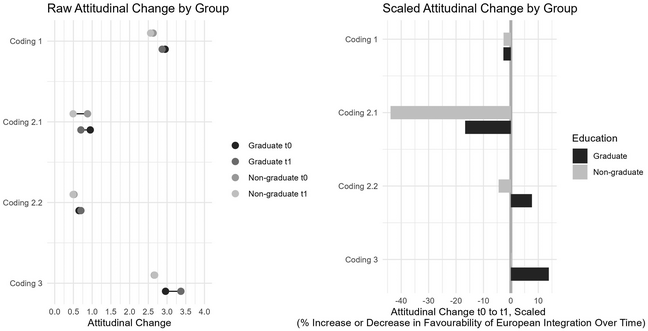
Our descriptive findings (Figure 2) reveal three initial patterns. Firstly, at t 0 those who will later go on to obtain degrees are already less Eurosceptic, on average, than individuals who will never graduate. There is a selection effect, driven by social background, ambition, cognitive ability or some other unobserved characteristic. Secondly, in Coding 1 we observe that both future graduates and non‐graduates become more Eurosceptic over time. This is in line with Figure 1 where we see an overall trend towards higher levels of Euroscepticism in Britain from the early 1990s onwards.Footnote 9 Third, we observe that when there is a relatively long period between t 0 and t 1 (at least a decade), in Codings 2.1, 2.2 and 3, that graduates tend to become less Eurosceptic over time relative to non‐graduates. Any difference in changes between graduates and non‐graduates over the shorter period in Coding 1 is small if it exists at all.

Figure 2. Change in attitudes towards European integration over time by HE status. Note: Higher scores indicate greater favourability of European integration (see Table 1 for details on coding). Graduate t 0 refers to individuals who will later become graduates but have not yet graduated.
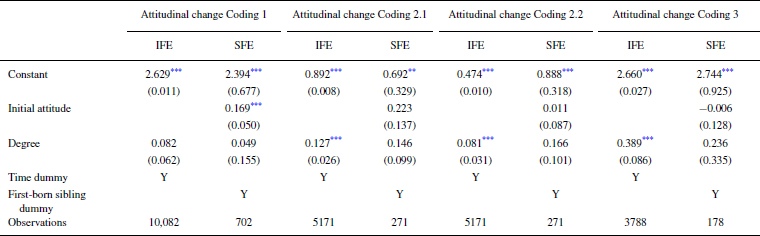
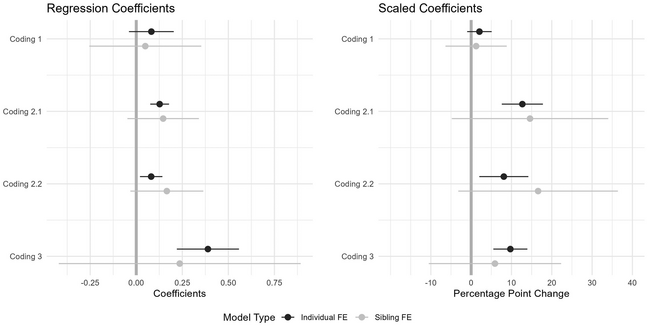
The remainder of this section presents the results of our IFE and SFE regressions for all alternative operationalisations of attitudes towards Euroscepticism (see Table 2 and Figure 3). In Figure 3, we show the coefficient estimate for attaining a degree in the intervening period between t 0 and t 1. In the left panel, we present the raw coefficient, with both IFE and SFE models together for ease of comparison. In the right‐hand panel, we then convert our coefficients onto a common scale, in terms of percentage point change. While we do not claim these models are completely comparable in terms of the absolute size of changes, given the variation in specifications and samples across models, we nevertheless feel this is suggestive in terms of the magnitude of change.
Table 2. Effects of HE on Euroscepticism, individual‐ and sibling‐ fixed‐effects models

Note: Models estimated using linear regression. Coefficients are reported with standard errors in parentheses. Codings 1 and 3 are estimated on 5‐point scales, while codings 2.1 and 2.2 are estimated on single‐point (0–1) scales. IFE observations are the number of individuals.
Abbreviations: IFE, individual fixed‐effects; SFE, sibling fixed‐effects. Statistical significance is denoted by
*** p < 0.01, **p < 0.05 and *p < 0.1.

Figure 3. Comparing individual‐ and sibling‐ fixed‐effects estimates of the HE effect. FE, fixed effects.
IFE models estimate the average effect of attaining a degree whilst controlling for time‐invariant confounders. Coding 1 is estimated over a maximum period of 7 years between t 0 and t 1. In this specification, attaining a degree has no statistically significant effect on attitudes. The HE coefficient is 0.082 [p = 0.184] on a scale from 1 (leave the EU) to 5 (work for a single EU government). The point estimate indicates that studying at university reduces Euroscepticism in the short‐term, although the magnitude of this effect is small – accounting for less than 1/13th of a standard deviation of the dependent variable.Footnote 10
In Codings 2.1 and 2.2, the 5‐point Euroscepticism scale is converted to a binary leave/remain specification (see Table 1). The estimate of the HE effect is 0.13 [p < 0.001] in Coding 2.1 and 0.081 in Coding 2.2 [p = 0.008]. These specifications are based on a linear probability model from 0 to 1. In Coding 3, the IFE coefficient for attaining a degree is 0.389 [p < 0.001], or approximately 10 percentage points, on a 5‐point scale. To give a further indication of the magnitude of the HE effect, the coefficient in Coding 2.1 accounts for 40 per cent of the standard deviation of the dependent variable, while Coding 2.2 is 15 per cent and Coding 3 is 36 per cent (all based on the dependent variable standard deviation at t 0). In sum, in the longer‐term IFE codings – where at the extreme it could be over 20 years between graduating and recording the t 1 attitude – we observe statistically significant and large effects of attaining a degree in making one less Eurosceptic, while we observe no statistically significant effects in the shorter‐term coding – where there is at most 7 years between graduating and recording the t 1 attitude.Footnote 11
The SFE models show a similar pattern to the IFE estimates. The HE coefficient is absolutely small in Coding 1, 0.049, but much larger in Codings 2.1, 2.2 and 3. The effect size is marginally greater than the IFE estimate in Coding 2.1 (0.15 vs. IFE 0.13) and Coding 2.2 (0.17 vs. IFE 0.08) but slightly smaller in Coding 3 (0.24 vs. 0.39). Whilst none of the SFE coefficients reach statistical significance, this should not be unexpected since SFE models are power hungry relative to conventional models (Madsen et al., Reference Madsen, Andersen, Gerster, Andersen, Christensen and Osler2014). The SFE sample sizes are all less than 7 per cent of the IFE models'. The relative size of the confidence intervals can be seen in Figure 3. In this context, it is surprising that in Codings 2.1 and 2.2 the SFE estimates approach statistical significance [p = 0.144 and p = 0.102, respectively], and when we run logistic rather than linear models, the HE coefficient is significant at the p < 0.05 threshold (see online Appendix Tables E.2 and E.3).
With these caveats in mind, the point estimates of our IFE and SFE models are remarkably similar. Despite their much smaller sample size and the fact only HE discordant siblings contribute to their estimates, the SFE models suggest, as do the IFE models, that while the educational divide in Euroscepticism is not large or statistically significant in the short‐run, this develops to become substantial, and highly significant (if not statistically, but practically in the case of the SFE models), in the long‐run.
Excluding the lagged individual attitude variable (t 0) in the SFE models makes almost no difference to the point estimates for HE effects (see online Appendix H). In cross‐sectional data, by definition, an initial t 0 attitude is unavailable. This finding demonstrates the usefulness of SFE models in the absence of panel data.Footnote 12
The difference between the effects of university over time may be explained in two ways. Firstly, it could be that the ‘university effect’ takes a long time to manifest. For example, the liberalising effects of the curriculum or having more left‐wing friends may take time to establish themselves. Perhaps the process of opinion formation is a lengthy one and this is why we observe a large HE effect in the latter codings. We certainly cannot fully discount the possibility that the effect of university study on attitudes towards Europe may only begin to make itself evident later in life. Secondly, and the argument we find more plausible, is that while there may not be a large short‐term effect of university study on attitudes towards European integration there is a significant allocative effect. Getting a degree opens select career paths (Savage, Reference Savage2015), offers a wage premium (Britton et al., Reference Britton, Dearden, van der Erve and Waltmann2020), changes one's social networks – including their potential partner(s) (Bovens & Wille, Reference Bovens and Wille2017; Chiappori et al., Reference Chiappori, Costa‐Dias, Crossman and Meghir2020) – and may even affect the places we choose to live (Britton et al., Reference Britton, van der Erve, Waltmann and Xu2021); all factors which have been shown to be associated with Euroscepticism. Our main results for the short‐term measure pool across waves to ensure maximum sample size; however, when we restrict to only the earliest and latest possible waves, we see a larger HE effect (online Appendix B). We see this as further evidence of long‐term allocative over short‐term, direct HE effects.
Whilst we could have controlled for some of these kinds of time‐variant factors in our models – to try and unpick precisely what it is that occurs post‐university that shapes our EU attitudes – we chose not to do so because we argue that university is a mediating variable and thus that our results are interesting in and of themselves. It could be argued that the HE effect we identify is then the total causal effect of HE. We believe that exploring how precisely post‐university ‘sorting’ shapes attitudes opens an important avenue for future work.
Effects of HE by generations
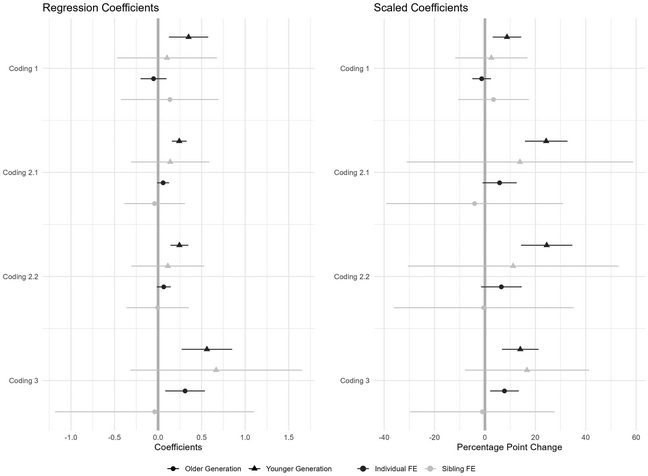
Our main models pool individuals of all ages together. As described previously, it seems plausible that HE would have different effects on attitudes for younger and older generations, and for those that attend university at younger ages, compared to those who attend as mature students. To test this, we explore how HE effects vary when we split our sample into generational subgroups, such that we loosely compare younger generations, Millennials and Gen Z (aged 41 or under in 2022), with older generations, Gen X, Baby Boomers and the Silent Generation (aged 42 or over in 2022) (see online Appendix I for full generation‐split regression results and Figure 4 for a plot of HE regression coefficients). These limits apply both to the ages of those who are ‘treated’, attaining a degree in the panel period, and to the control group. Given our sample of ‘treated’ individuals graduated in the period 1999–2020, imposing a generational split here effectively separates those who attended university as mature students (the older generation) from those who attended relatively sooner after leaving school (the younger generation). The findings presented here must be interpreted with this in mind.

Figure 4. Comparing generational estimates of the HE effect. FE, fixed effects.
We treat the results of our SFE models with caution. Our full sample SFE models are already power hungry, and these generation‐split SFE models are only more restrictive in this sense not just because individuals representing the younger and older generations are split into separate samples (as in the IFE analysis) but also because only individuals nested within HE discordant but generation concordant sibling clusters can now be included in SFE estimates. That said, our generation split IFE and SFE estimates both tend to suggest that much of the overall long‐run HE effect observed in the full sample (Codings 2.1, 2.2 and 3) is driven by the experiences of younger graduates (see Figure 4). That the allocative effects of university study on attitudes towards Europe tend to be larger for those who graduate younger is unsurprising. These individuals are less likely to already have partners, to have strong ties to a neighbourhood they plan to settle in long‐term, to have built established networks or to have determined their career path, so there is more room for university study to set them on a different trajectory which will subsequently alter their attitudes towards Europe.
The HE effect under IFE Coding 1 also shows a more substantial short‐term effect of HE for the younger generation, 0.35 [p = 0.004] on our 5‐point scale, than for the older generation or overall sample (the same is not true of the SFE coding, see Figure 4). Those who attend university at younger ages do so in their ‘impressionable years’ when their attitudes are still crystallising and are thus more susceptible to change (Krosnick & Alwin, Reference Krosnick and Alwin1989). It is unsurprising then that this short‐term HE effect is, on average, larger for younger attendees than for those who attend as mature students. The new socialisation experiences that university study often immediately exposes individuals to – for example, moving away from home for the first time and becoming immersed in new friendship groups – are likely to be significantly more common, or at least felt more strongly, among younger HE attendees than they are for those who attend later in life.
While we cannot make too much of any direct comparisons between our attitudinal codings in terms of absolute effect size, it is worth noting that even among the younger generation, where HE graduation does have a statically significant short‐term effect in liberalising attitudes towards European integration in our IFE models, the relative magnitude of the long‐term HE effects observed far exceed that of the short‐term effect. In other words, allocation effects still appear to be the primary driver of the ‘university effect’ on attitudes towards European integration, even among the younger generation.
Discussion
This study goes beyond the scope of existing research by conducting a longitudinal analysis which provides the first robust estimate of HE's causal effect on attitudes towards European integration, and Brexit voting, in the UK. Regardless of whether an IFE or SFE approach to estimation is taken, or which technique is used to fit these regression models, we find that while university study does little to increase the favourability of European integration in the short‐run, it has substantial long‐run effects. The remainder of this section sets out how the novel research presented here contributes to advancing the ‘university effects’ literature – both methodologically and substantively – and considers the implications of these findings.
The relative merits of IFE and SFE strategies are rarely discussed, and their empirical findings are even less often compared. In going beyond the scope of existing research by doing so, this study is able to show that although there are several important differences in the IFE and SFE estimation strategies (see the section Similarities and Differences: Individual and Sibling Fixed‐Effects Specifications), these methods produce remarkably similar estimates of HE's causal effect on attitudes towards European integration. While the point estimates which represent the independent influence of obtaining a university degree (versus not doing so) are not identical across the IFE and SFE specifications, they vary only subtly, always point in the same direction, are of a roughly similar magnitude and broadly tell the same story. Both sets of results suggest that while studying at university does not, in general, have a large or statistically significant causal effect on the favourability of European integration in the short‐run, doing so has a substantial and highly significant (if not statistically, but practically in the SFE models) effect in the long‐run. This finding makes an important methodological contribution to the ‘university effects’ literature in demonstrating that the concerns about the ability to generalise within‐sibling estimates of the HE effect to the general population which has been raised in existing research (e.g., Campbell & Horowitz, Reference Campbell and Horowitz2016; Madsen et al., Reference Madsen, Andersen, Gerster, Andersen, Christensen and Osler2014) may have been over‐stated. A productive area for future research would be to explore whether SFE and IFE estimates appear to show this same consistency in other settings.
This finding – that IFE and SFE estimation strategies offer substantively consistent understandings of the causal effect of HE on attitudinal formation, despite their methodological differences – has important implications for future research, as only armed with this knowledge can we make recommendations about the kinds of situations in which each of these methods is best used for making causal estimates. Given SFE models are power‐hungry relative to IFE models (Madsen et al., Reference Madsen, Andersen, Gerster, Andersen, Christensen and Osler2014), we suggest that in cases where longitudinal data are available, IFE approaches are favourable to SFE, as they not only offer larger sample sizes, and thus more opportunities to detect statistically significant effects but also afford less chance of introducing selection bias in estimates (as it will not matter whether only children and outcome‐concordant respondents differ to outcome‐discordant respondents in important ways, as it would in SFE models). SFE models, however, offer a crucial advantage over IFE models, in that they can be estimated when using cross‐sectional data, while the latter cannot. Moreover, the fact that our analysis demonstrates within‐sibling estimates of HE's causal effect on Euroscepticism which include and exclude measures of individuals’ initial attitudes are virtually indistinguishable (see online Appendix H), suggests that omitting the longitudinal component of SFE specifications does not compromise the accuracy with which this type of model can make causal estimates. We therefore argue that within‐sibling methodologies offer a productive tool for estimating causal effects in the absence of longitudinal data.
Secondly, and more substantively, in finding there are important differences in the effect of university study on attitudes towards European integration over time, this study contributes to advancing our understanding of the mechanisms which underpin the linkage of HE, Euroscepticism and Brexit voting, in Britain. While our analysis shows HE graduation has only a very small, and non‐significant, causal effect on EU attitudes, on average, when measured over a 7‐year time span (Coding 1), we show doing so has a sizeable, and highly practically – if not always statistically – significant effect when measured over a period of up to 23‐years (Codings 2.1, 2.2 and 3). The magnitude of these differences in the strength of the HE effect over time is striking; equivalent to less than a 2‐percentage point increase in favourability towards EU integration in the short‐run, but as much as a 17‐point increase in the long‐run. We interpret this as evidence of an allocative effect of university attendance, whereby it is not the experience of studying at university, in itself, but the opportunities that are typically afforded to UK graduates by virtue of having done so – for example, to command a higher occupational status and wage, to socialise within particular networks and live in certain kinds of places – that drive them to develop less Eurosceptic attitudes and voting behaviours, relative to their non‐graduate counterparts. We cannot, however, rule out the possibility that the direct effects of HE may only materialise later in life.
This finding is not only interesting in itself but also because it goes some way in reconciling the subtle differences in conclusions drawn by two recent British studies which used longitudinal data to estimate the causal effect of HE on a broader set of cultural attitudes. While both Simon (Reference Simon2022, p. 980) and Scott (Reference Scott2022) evidence that ‘HE graduation causes more egalitarian (liberal) attitudes [among individuals living in the UK]…the causal…effect reported by Scott is somewhat larger’, which Simon argues is likely due to the fact Scott reports the total causal effect of HE – which incorporates the educational and experiential effects of university study, in itself, as well as post‐university ‘sorting effects’ – and Simon captures only the direct causal effects of HE – those which occur directly on university campuses. Our findings lend credence to this suggestion, and, more generally, make an important contribution to the ongoing debate about the role played by universities in shaping public opinion in advanced Western democracies, by demonstrating that it takes time for the effects of university study on attitudinal formation to manifest themselves. An important avenue for future research will be to test precisely which post‐university adult‐status experiences appear to be particularly important drivers of the stark educational divide in attitudes which has emerged in Britain, and beyond.
Thirdly, we contribute to a wider literature, beyond the case of Britain, as to the causal effects of education on political attitudes. Evidence remains mixed on this larger scale as to whether schooling and university education have a spurious or causal effect on political attitudes (e.g., Bullock, Reference Bullock2021; Kunst et al., Reference Kunst, Kuhn and van de Werfhorst2020; Lancee & Sarrasin, Reference Lancee and Sarrasin2015; Velásquez & Eger, Reference Velásquez and Eger2022). Further work should examine to what extent our interpretation of a more substantial indirect rather than direct HE effect generalises across different national contexts and kinds of attitudes.
To conclude, this study provides an important illustration of the remarkable consistency of the causal effects estimated under IFE and SFE specifications, in a specific example relating to HE's independent influence on attitudes towards European integration in Britain in the period 1999–2022. In doing so, this paper makes an important methodological contribution – showing that within‐sibling estimates of the effect of university study on Euroscepticism are generalisable not only to HE‐discordant siblings but to the wider population. More substantively, this analysis offers novel insights in finding evidence in support of an allocative HE effect; whereby although obtaining a degree generally does little to increase the favourability of European integration in the short‐run, it has substantial long‐run effects. This offers a considerable advance in our understanding of the link between education and Euroscepticism, as it suggests it is largely not the effect of studying at university, in itself, but the opportunities individuals tend to be afforded by virtue of having done so – for example, to live, or work, in particular environments ‐ that shapes their attitudes towards European integration. Future research endeavours should not only seek to explore whether the similarity of IFE and SFE estimates, observed here, is replicated in analyses of other research problems and datasets, but to explore precisely why it is that HE's liberalising effect on attitudes towards European integration takes such a long time to manifest itself.
Acknowledgements
The authors would like to thank Jane Gingrich, Peter Hall, Bob Hancké, Neil Lee, Javier Sajuria, David Soskice and attendees of EPOP 2023 for providing invaluable feedback on earlier drafts of this article.
Funding Information
Andrew McNeil's work was supported in part by a UKRI Future Leaders Fellowship (MR/X011089/1).
Conflict of interest statement
The authors declare no conflicts of interest.
Data availability statement
The harmonised British Household Panel Study and Understanding Society data, used in this study, can be accessed at https://beta.ukdataservice.ac.uk/datacatalogue/studies/study?id=6614 The British Social Attitudes data can be accessed at https://beta.ukdataservice.ac.uk/datacatalogue/series/series?id=200006 and the Eurobarometer data can be accessed at https://www.gesis.org/en/eurobarometer‐data‐service/search‐data‐access/data‐access
Ethics statement
Neither of the author's institutions required ethical approval to be sought for the use or analysis of this kind of secondary/survey data.
Online Appendix
Additional supporting information may be found in the Online Appendix section at the end of the article:


 Open access

