Hostname: page-component-68c7f8b79f-j6k2s Total loading time: 0 Render date: 2025-12-25T20:19:06.498Z Has data issue: false hasContentIssue false

Succession in biocrusts at the Tabernas Desert, semi-arid Southeast Spain

Published online by Cambridge University Press:  12 November 2025

Roberto Alfonso Lázaro Suau*
Affiliation:
Desertificacion y Geo-Ecología, Estacion Experimental de Zonas Aridas, Almería, Spain
Consuelo Rubio Gomez-Roso
Affiliation:
Desertificacion y Geo-Ecología, Estacion Experimental de Zonas Aridas, Almería, Spain
Beatriz Roncero Ramos
Affiliation:
Department of Plant Biology and Ecology, Universidad de Sevilla, Seville, Spain
Clement Lopez-Canfin
Affiliation:
Department of Environmental Science, The University of Arizona Biosphere 2, Oracle, AZ, USA
*
Corresponding author: Roberto Alfonso Lázaro Suau; Email: lazaro@eeza.csic.es
Rights & Permissions [Opens in a new window]

Abstract

How do succession and the microhabitat interact to shape the mosaic of biocrust types in the Tabernas Desert (semi-arid Southeast Spain)? We hypothesize that succession (in human time scales) occurs only where the habitat allows it and can regress. Reviewing results from an extensive body of research conducted at the Tabernas region, we aimed (i) to show that crust types can be considered successional stages, (ii) to propose a succession model. We used two approaches: (a) direct, in situ monitoring of three sites (13, 17 and 11 years) and examination of unaltered micro-profiles of biocrusted soil; and (b) indirect assessment, by reviewing functional properties (e.g., ecohydrology, soil loss, physical–chemical properties, microbiota and gas exchange) of biocrust types hypothetically considered successional stages. Although differences among communities in these functions do not necessarily imply species replacement, they were consistent with the hypothetical successional order and the evidence of replacement from the direct approaches. Succession occurs at various speeds across space because it is controlled by habitat. Therefore, it is mainly observable in favourable habitats where the biocrust was altered, or in ecotones. We propose a succession model, including microclimatic controls, two early cyanobacterial stages and two later lichen stages, showing the regressive paths.

Information

Type
Review
Creative Commons
Creative Common License - CCCreative Common License - BY
This is an Open Access article, distributed under the terms of the Creative Commons Attribution licence (http://creativecommons.org/licenses/by/4.0), which permits unrestricted re-use, distribution and reproduction, provided the original article is properly cited.
Copyright
© The Author(s), 2025. Published by Cambridge University Press

Impact statement

Succession is an inevitable natural process. Succession occurs in biocrusts, but microhabitat, mainly microclimate, controls the speed of this natural process, causing it to vary at various points in space. Realizing this is a step towards improving our understanding of the spatial and temporal distribution of biocrusts.

Because biocrusts have multiple functions in the ecosystem, it is crucial to understand their dynamics for the sustainable management of semi-arid environments. In particular, it is an important advance for biocrust conservation.

Biocrusts should be protected, at least in areas where they are dominant, because they are highly biodiverse, protect the soil against erosion, act as carbon sinks and drive pedogenesis where vegetation is sparse. They are a useful indicator of multiple critical functions (multifunctionality) and provide effective ecosystem conservation. Biocrust conservation can be very important because, to date, very little can be done to rebuild lichen biocrusts once they are destroyed. In this context, a deeper understanding of the dynamics and distribution of biocrusts is very beneficial for the currently thriving body of research that explores the possibilities of using biocrusts to restore degraded areas. In this sense, the concept of mature cyanobacteria-dominated biocrust, including dark cyanobacteria and some pioneer lichens, could be quite useful. Moreover, the biocrusts of the Tabernas Desert are a fundamental component of an ecosystem that is perhaps unique in Europe.

Introduction

Succession is a natural process by which the composition of a community changes over time (Clements, Reference Clements1916; Drury and Nisbet, Reference Drury and Nisbet1973; Connell and Slatyer, Reference Connell and Slatyer1977). Succession in biocrusts has received extensive mention in the literature (Eldridge and Greene, Reference Eldridge and Greene1994; Belnap and Eldridge, Reference Belnap, Eldridge, Belnap and Lange2003; Belnap et al., Reference Belnap, Büdel, Lange, Belnap and Lange2003a; Lázaro et al., Reference Lázaro, Cantón, Solé-Benet, Bevan, Alexander, Sancho and Puigdefábregas2008; Büdel et al., Reference Büdel, Darienko, Deutschewitz, Dojani, Friedl, Mohr and Weber2009; Zhuang et al., Reference Zhuang, Zhang, Zhao, Wu, Chen and Zhang2009; Miralles et al., Reference Miralles, Domingo, Cantón, Trasar-Cepeda, Leirós and Gil-Sotres2012a, Reference Miralles, Lázaro, Sánchez-Marañón, Soriano and Ortega2020; Drahorad et al., Reference Drahorad, Steckenmesser, Henningsen, Lichner and Rodný2013; Chen et al., Reference Chen, Rossi, Deng, Liu, Wang, Adessi and De Philippis2014; Navarro-Noya et al., Reference Navarro-Noya, Jimenez-Aguilar, Valenzuela-Encinas, Alcántara-Hernandez, Ruiz-Valdiviezo, Ponce-Mendoza, Luna-Guido, Marsch and Dendooven2014; Chamizo et al., Reference Chamizo, Rodríguez-Caballero, Cantón, Asensio and Domingo2015; Kidron, Reference Kidron2019; Deng et al., Reference Deng, Zhang, Wang, Zhou, Ye, Fu, Ke, Zhang, Liu and Chen2020; Geng et al., Reference Geng, Zhou, Wang, Peng, Li and Li2024; Kidron and Xiao, Reference Kidron and Xiao2024). Because succession implies changes in species, it can generate biocrust types, that is, communities dominated by different autotrophic organisms, such as cyanobacteria, lichens and mosses, and these types are often considered successional stages. However, Kidron (Reference Kidron2019) and Kidron and Xiao (Reference Kidron and Xiao2024) claimed that referring to biocrust types as successional stages is only justified when stages in recovery plots are compared with control plots, as crust types occupying different locations may be due to distinct abiotic conditions, which affect the dominance of certain photoautotrophs.

Therefore, we wonder: are different crust types at the same place distinct successional stages, or are they distinct communities shaped by microhabitat differences? This may not always be obvious, mainly because (i) there is evidence that the habitat controls the crust type; and (ii) biocrusts usually considered early-successional seem invariant for decades at some sites. However, most scholars are probably aware that both succession and habitat shape crust types. Therefore, we raise the question of how succession and microhabitat interact, using the Tabernas region as our study area. This includes the sites of Tabernas and Sorbas.

According to Kidron et al. (Reference Kidron, Barzilay and Sachs2000, Reference Kidron, Vonshak and Abeliovich2009, Reference Kidron, Vonshak, Dor, Barinova and Abeliovich2010), all five crust types defined at the Nizzana Research Station (in the Negev Desert) are associated with different microhabitats. Similarly, in the Tabernas region, biocrust types are distributed according to topographical microhabitats (Lázaro et al., Reference Lázaro, Alexander, Puigdefábregas, Alexander and Millington2000; Canton et al., Cantón et al., Reference Cantón, Del Barrio, Solé-Benet and Lázaro2004a; Lázaro et al., Reference Lázaro, Cantón, Solé-Benet, Bevan, Alexander, Sancho and Puigdefábregas2008). Biocrust type also depends on habitat in other drylands across the world, such as South Africa (Thomas and Dougill, Reference Thomas and Dougill2006), Argentina (Navas Romero et al., Reference Navas Romero, Herrera Moratt, Martinez, Rodriguez and Vento2020) or California (Pietrasiak et al., Reference Pietrasiak, Johansen, LaDoux and Graham2011, Reference Pietrasiak, Drenovsky, Santiago and Graham2014). Microhabitat affects biocrust type mainly through its effects on microclimate, strongly through incident solar radiation and water availability (Kidron et al., Reference Kidron, Vonshak and Abeliovich2009; Weber et al., Reference Weber, Büdel, Belnap, Weber, Büdel and Belnap2016c; Kidron and Xiao, Reference Kidron and Xiao2024).

Succession follows different pathways under different climates (Weber et al., Reference Weber, Bowker, Zhang, Belnap, Weber, Büdel and Belnap2016b, Reference Weber, Büdel, Belnap, Weber, Büdel and Belnap2016c). In general, when the site is drier, the possibility of succession occurring is lower because it is limited by the lack of water (Felde et al., Reference Felde, Rodriguez-Caballero, Chamizo, Rossi, Uteau, Peth, Keck, De Philippis, Belnap and Eldridge2020). Moreover, the 53-year biocrust monitoring study in Utah (USA) by Finger-Higgens et al. (Reference Finger-Higgens, Duniway, Fick, Geiger, Hoover, Pfennigwerth, Van Scoyoc and Belnap2022) showed that climate change can alter crust type. Our results suggest that the same occurs between microclimates at a local scale.

Succession could occur via Connell and Slatyer’s (Reference Connell and Slatyer1977) facilitation model, because early-successional species condition a site in favour of late-successional species (Bowker, Reference Bowker2007; Colesie et al., Reference Colesie, Scheu, Green, Weber, Wirth and Büdel2012). Potential mechanisms, direct by facilitation or competition (Maestre et al., Reference Maestre, Callaway, Valladares and Lortie2009; Li et al., Reference Li, Colica, Wu, Li, Rossi, De Philippis and Liu2013; Soliveres and Eldridge, Reference Soliveres and Eldridge2020), or indirect by altering site conditions, are poorly understood (Soliveres and Eldridge, Reference Soliveres and Eldridge2020).

Cyanobacteria-dominated biocrust is widely assumed to be the first stage. Some claim that there is only evidence of two stages: cyanobacteria and, later, lichens or mosses (Eldridge et al., Reference Eldridge, Freudenberger and Koen2006; Zhuang et al., Reference Zhuang, Zhang, Zhao, Wu, Chen and Zhang2009; Uclés et al., Reference Uclés, Villagarcía, Cantón, Lázaro and Domingo2015). Others assume three stages: cyanobacteria, lichens and mosses (Felde et al., Reference Felde, Peth, Uteau-Puschmann, Drahorad and Felix-Henningsen2014; Deng et al., Reference Deng, Zhang, Wang, Zhou, Ye, Fu, Ke, Zhang, Liu and Chen2020; Li and Hu, Reference Li and Hu2021; Sun and Li, Reference Sun and Li2021). In our Tabernas studies, we often referred to a greater number of hypothetical stages, describing the biocrust types (Lopez-Canfin et al., Reference Lopez-Canfin, Lázaro and Sánchez-Cañete2022a, Reference Lopez-Canfin, Lázaro and Sánchez-Cañete2022b; Lázaro et al., Reference Lázaro, Gascón and Rubio2023; Rubio and Lázaro, Reference Rubio and Lázaro2023).

The objectives of this review article are (i) to show that, in the Tabernas region, crust types can be considered authentic successional stages even though both succession and microclimate act simultaneously in generating them; and (ii) to provide a conceptual model of biocrust succession for Tabernas, including the microclimate effect and the conditions under which succession occurs.

To achieve this, we present four case studies of direct succession – two unpublished – along with a review of publications from the Tabernas region based on crust types, hypothesized to be successional stages, and covering a range of biocrust structural and functional properties. Finally, we synthesize the work and propose a model.

Case study system

The Tabernas region includes extensive areas with high biocrust cover that have not been disturbed for more than 35 years. Of the 63 articles found in Scopus that deal with more than one biocrust type at Tabernas, none explicitly discounts the idea that succession generates biocrust types. Four (6.3%) seemed to contest it implicitly or were unclear on this position. Fourteen (22.2%) assumed, although not explicitly, that biocrust type corresponded to successional stages. Forty (63.5%) explicitly stated that biocrust type equates to succession stage. Before 2008, authors referred to succession only obliquely or indirectly. Lázaro et al. (Reference Lázaro, Cantón, Solé-Benet, Bevan, Alexander, Sancho and Puigdefábregas2008) provided evidence of the replacement of cyanobacterial biocrust by lichens over time and had two effects: (i) after this, the vast majority of articles hypothesized biocrust types as successional stages, starting with Chamizo et al. (Reference Chamizo, Cantón, Rodríguez-Caballero, Domingo and Escudero2012c) and Miralles et al. (Reference Miralles, Domingo, Cantón, Trasar-Cepeda, Leirós and Gil-Sotres2012a); and (ii) this inspired us to start long-term monitoring experiments to test the relationship between biocrust type and successional stage.

We propose that (i) biocrust types can be considered as successional stages at Tabernas in cases other than recovery studies, allowing for space-for-time sampling, as this is compatible with the association of biocrust type with microclimate (Rodriguez-Caballero et al., Reference Rodríguez-Caballero, Román, Chamizo, Roncero-Ramos and Cantón2019; Lázaro et al., Reference Lázaro, Cantón, Solé-Benet, Bevan, Alexander, Sancho and Puigdefábregas2008; Li and Hu, Reference Li and Hu2021). (ii) The biocrusts at Tabernas would exhibit the following progression: physical; incipient cyanobacterial; mature cyanobacterial; lichen biocrust dominated by Squamarina lentigera and/or Diploschistes diacapsis (Squamarina); and lichen biocrust characterized by Lepraria isidiata (Lepraria; Lázaro et al., Reference Lázaro, Gascón and Rubio2023). At the Sorbas site, the last stage can be a moss-dominated biocrust. (iii) On a human time scale, succession in biocrusts only occurs where the microclimate allows for it. (iv) Succession can sometimes split (following different pathways in different microhabitats) and be retrogressive. Often, succession is imagined as a simple, linear, one-way process. However, our data from Sorbas and the in-situ drought experiment by Rubio and Lázaro (Reference Rubio and Lázaro2025) show the existence of bifurcations and regressive succession, also noted by Kidron and Xiao (Reference Kidron and Xiao2024).

Tabernas

Most research has been done at the El Cautivo field site, located at 37.011°, 2.442°, 240–320 m a.s.l., which is a representative part of the Tabernas Desert. It is a badlands area that has developed since the late Pleistocene era (Alexander et al., Reference Alexander, Calvo, Arnau, Mather and Lázaro2008) in the Tortonian marine marls (Cantón et al., Reference Cantón, Domingo, Solé-Benet and Puigdefábregas2001; Cantón et al., Reference Cantón, Domingo, Solé-Benet and Puigdefábregas2002). It receives 200–240 mm/yr of rainfall, and the mean annual air temperature is 18–19 °C (Lázaro et al., Reference Lázaro, Rodrigo, Gutiérrez, Domingo and Puigdefábregas2001; Lázaro et al., Reference Lázaro, Rodríguez-Tamayo, Ordiales, Puigdefábregas, Mota, Cabello, Cerrillo and Rodríguez-Tamayo2004). The meso-climatic conditions favour biocrust development (Lázaro, Reference Lázaro and Pandalai2004). Soils are silty (Cantón et al., Reference Cantón, Solé-Benet and Lázaro2003). Vegetation is patchy, dominated by dwarf shrubs or tussock grasses. Biocrusts dominate about one-third of the territory and also occur in another third in the plant interspaces. For more information, see Calvo-Cases et al. (Reference Calvo-Cases, Harvey, Alexander, Canton, Lazaro, Sole-Benet, Puigdefabregas, Gutiérrez and Gutiérrez2014) and Lázaro et al. (Reference Lázaro, Gascón and Rubio2023).

Sorbas

The Sorbas field site is about 30 km east of Tabernas, at 37.083, 2.066° and 397 m a.s.l. The mean annual temperature is 17 °C, and rainfall is 274 mm/yr. Lithology consists of Miocene gypsum outcrops, and the soils are Gypsiric Leptosols. It has 30–40% plant cover, comprising tussock grasses and shrubs or dwarf shrubs often dominated by gypsophilous species. Over half of the plant interspaces are covered by biocrusts dominated by lichens, cyanobacteria or mosses in the wetter years. Additional site information is shown in the Supplementary Material.

Direct research on biocrust succession

Initial photographic monitoring

A preliminary 13-year photographic monitoring at Tabernas showed replacement of cyanobacteria by lichens over time, prompting a recovery experiment in 2005 to remove the biocrust of four biocrust types (Cyanobacteria, Squamarina, Diploschistes and Lepraria) in representative areas where they were dominant (Lázaro et al., Reference Lázaro, Cantón, Solé-Benet, Bevan, Alexander, Sancho and Puigdefábregas2008).

Recovery of various biocrust types

Rubio and Lázaro (Reference Rubio and Lázaro2023) published the recovery patterns of the four biocrust types following 17 years of in situ monitoring. Their main results are as follows (see their Figure 1):

  1. (i) The cyanobacterial biocrust cover recovered in just 8 years and recovered thickness in about 12 years, whereas the cover of the Squamarina or Diploschistes biocrust had not fully recovered in 2021, and the recovery of the Lepraria biocrust was even slower. Several authors have found that the ability to colonize and the growth rate of microbial crusts are greater than those of lichen or moss crusts (Belnap and Eldridge, Reference Belnap, Eldridge, Belnap and Lange2003; Dojani et al., Reference Dojani, Büdel, Deutschewitz and Weber2011; Lorite et al., Reference Lorite, Agea, García-Robles, Cañadas, Rams and Sánchez-Castillo2020)

  2. (ii) In the three lichen-dominated communities, a cyanobacterial biocrust forms first, reaching an extensive cover before lichens are relevant, consistent with studies in the Succulent Karoo in South Africa (Dojani et al., Reference Dojani, Büdel, Deutschewitz and Weber2011).

  3. (iii) Lichens can colonize empty spaces if they are sufficiently stable (sensu Kidron and Xiao, Reference Kidron and Xiao2024), but the spaces are not empty for long because cyanobacteria colonize them faster. Consequently, most lichens develop on cyanobacteria. Lan et al. (Reference Lan, Wu, Zhang and Hu2012) claimed that lichens require a previous cyanobacterial development. Each successional stage is determined by the resources provided by the previous stage (Deng et al. (Reference Deng, Zhang, Wang, Zhou, Ye, Fu, Ke, Zhang, Liu and Chen2020).

  4. (iv) One plot suffered a boot print in its lower left quadrat, only once, in the second year (Figure 1h). For quite a few years, that quadrat had very little biocrust. Lichens colonization could not be sustained. The development of the cyanobacteria around the footprint resulted in the formation of a depression. When the cyanobacterial crust finally developed in the depression, it became less apparent and is now being colonized by lichens.

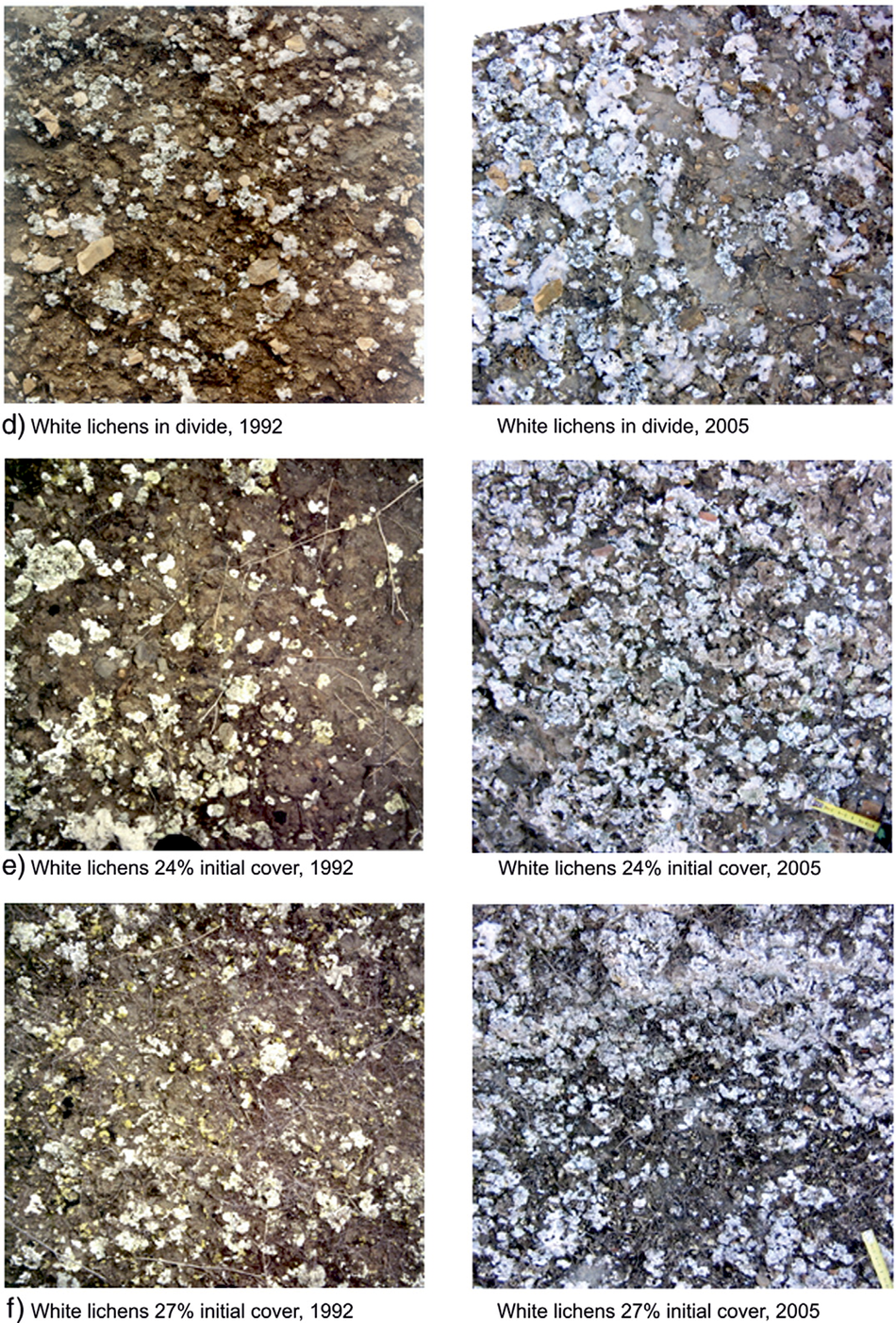
Figure 1. This is part of Figure 3 of Lázaro et al. (Reference Lázaro, Cantón, Solé-Benet, Bevan, Alexander, Sancho and Puigdefábregas2008), evidencing replacement of cyanobacterial biocrust by lichenic biocrust from a 13-year in situ photographic monitoring at the Tabernas Desert. In the early 1990s, we named ‘white lichens’ to the biocrust dominated by light lichens, but that biocrust corresponds to the Squamarina biocrust used here and includes a diversity of lichens, like the yellow Fulgensia seen in the photos.

Additional monitoring at Sorbas

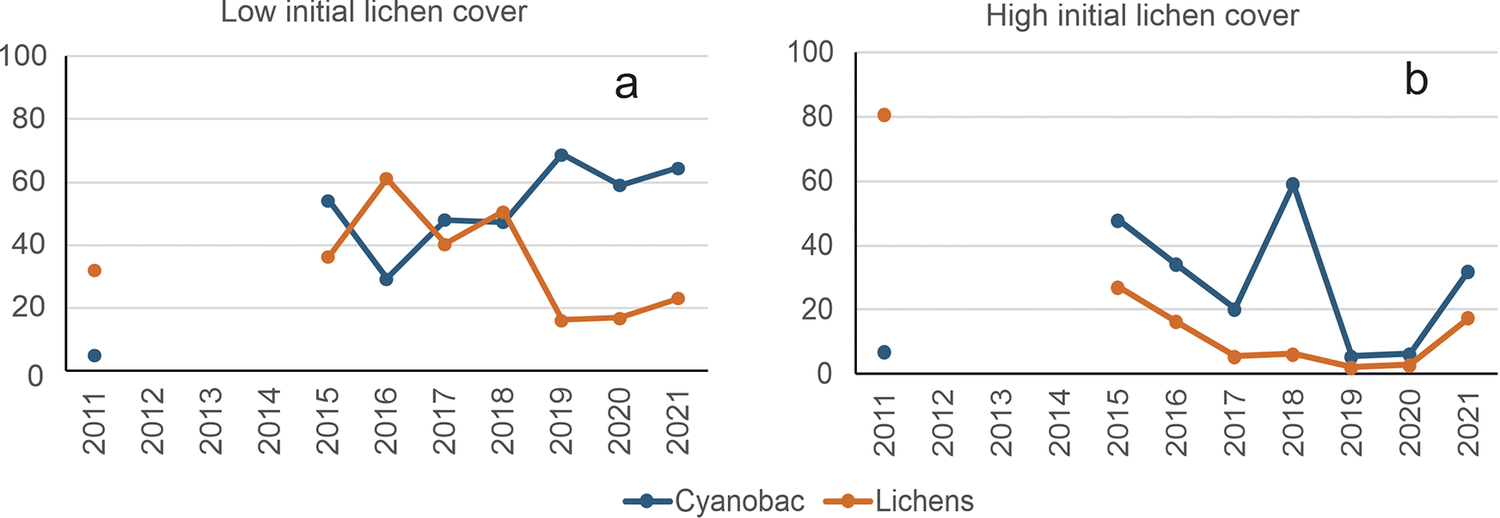
This 11-year monitoring program, distinguishing high (>60%) and low (<20%) initial lichen cover, was a climatic change study (Maestre et al., Reference Maestre, Escolar, Ladrón de Guevara, Quero, Lazaro, Delgado-Baquerizo, Ochoa, Berdugo, Gozalo and Gallardo2013; de Guevara M et al., Reference Ladrón de Guevara, Lázaro, Quero, Ochoa, Gozalo, Berdugo, Uclés, Escolar and Maestre2014). The control plots provide examples of progressive (from cyanobacteria to lichens) and regressive succession (Figure 2). The significant changes over time in some of those plots without treatments and under the same microclimate show that there are unknown intrinsic factors potentially driving biocrust succession.
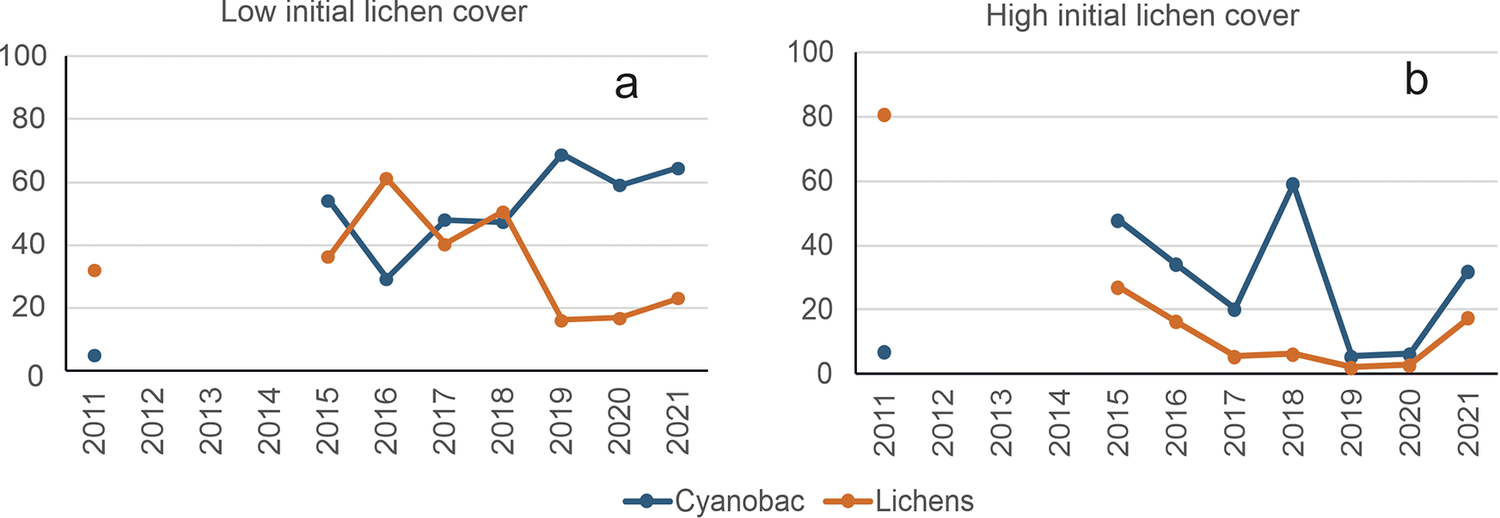
Figure 2. Evidence of succession in biocrusts in the Sorbas experimental area. Graph a: Progressive succession between 2011 and 2016 in a plot with low initial lichen cover. Graph b: Regressive succession during the same period in a nearby plot that started with high lichen cover; it is noteworthy that cyanobacteria increase while lichens decrease. Both are control plots without any treatment. Covers were approximated from sums of species frequencies.

During the first 4 years, lichen cover increased very slowly (Figure 2a), whereas cyanobacteria increased quickly. Once cyanobacteria reached about 55% cover, lichens increased quickly, reaching 60% in 1 year, partly replacing the cyanobacteria. When lichens decreased, cyanobacteria increased (Figure 2a, Figure 2b).

Biocrust micro-profiles

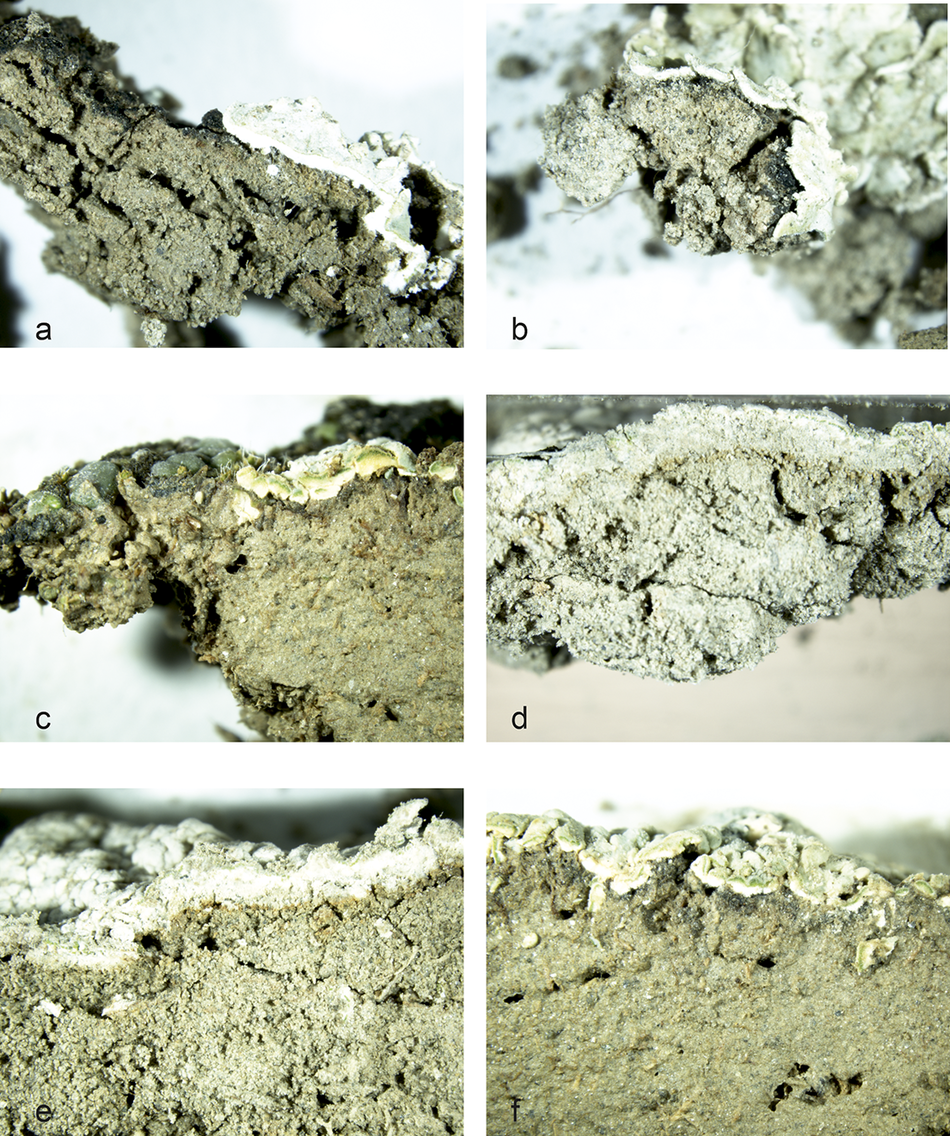
We randomly collected 40 intact soil samples with lichen biocrust, using 9-cm Petri dishes. In the laboratory, we cut small portions of the samples perpendicularly to the surface and obtained 114 photographs using a stereomicroscope. In some of the micro-profiles (Figure 3), we found lichen thalli over a thin horizon of dark or light cyanobacterial biocrust with an appearance like that of the cyanobacterial biocrust when it is alone. The dark cyanobacterial biocrust progressively disappeared towards the centre of the lichen thallus, which is likely its oldest section (Figure 3a).

Figure 3. Some examples of micro-profiles of unaltered biocrusted soil showing lichens developing over a thinner dark or light cyanobacterial biocrust. Squamarina on dark cyanobacterial biocrust is shown in photos a, b, c and f; photo c also shows Toninia on dark cyanobacteria. Photos d and e show Diploschistes developed on light cyanobacterial biocrust.

Indirect approaches: functional properties of crust types hypothesized as succession stages

These studies reinforce the understanding that succession shapes crust types because they all stem from the same hypothetical successional sequence.

Shifts in microbial community composition

At Tabernas, microbial composition changes throughout succession. The phylum Cyanobacteria, representing 21.9% of the bacteria in the cyanobacterial biocrust, was reduced by only 2.2% in the hypothetical latest-successional Lepraria crust (Miralles et al., Reference Miralles, Lázaro, Sánchez-Marañón, Soriano and Ortega2020). Differences in microbiota between Incipient and Mature cyanobacteria crusts were mainly due to phyla Actinobacteria (Actinomycetota) and Cyanobacteria, which comprise 14.4 and 12.4% of Incipient and 9.8 and 21.9% of Mature biocrusts, respectively (Miralles et al., Reference Miralles, Lázaro, Sánchez-Marañón, Soriano and Ortega2020). Incipient cyanobacteria were dominated by the bundle-forming cyanobacteria, Microcoleus spp., whereas Mature cyanobacteria were dominated by unicellular cyanobacteria, mainly the lichen photobiont Chroococcidiopsis sp. (Roncero-Ramos et al., Reference Roncero-Ramos, Muñoz-Martín, Cantón, Chamizo, Rodríguez-Caballero and Mateo2020). The soil micro-fungi species also differed among these biocrust types/stages (Grishkan et al., Reference Grishkan, Lázaro and Kidron2019). The mechanisms driving changes in microbial composition include the metabolites excreted in soil, which are different according to the biocrust type (Miralles et al., Reference Miralles, Jorge-Villar, van Wesemael and Lázaro2017), as they influence the composition of the soil microbiota (Boustie and Grube, Reference Boustie and Grube2005).

Soil microbiota also changed in other areas depending on the biocrust type (Chilton et al., Reference Chilton, Neilan and Eldridge2018; Sorochkina et al., Reference Sorochkina, Velasco Ayuso and Garcia-Pichel2018; Xu et al., Reference Xu, Li, Xiong, Kou, Zou, Jiao, Yao, Wang, Zhang and Li2024). Maier et al. (Reference Maier, Tamm, Wu, Caesar, Grube and Weber2018) reported an increase in abundance and diversity of the heterotrophic microbiota associated with biocrust succession. Li and Hu (Reference Li and Hu2021) showed that in the regions of China where the three successional stages (bacteria, lichens and mosses) were present, biocrust type, rather than soil or microclimate, accounted for the greatest differences in microbial communities.

Water cycle and availability

At Tabernas, as succession progresses, infiltration and water content increase and runoff (Chamizo et al., Reference Chamizo, Cantón, Lázaro, Solé-Benet and Domingo2012a; Rodriguez-Caballero et al., Reference Rodriguez-Caballero, Cantón, Chamizo, Lázaro and Escudero2013), Runoff Length (Lázaro et al., Reference Lázaro, Calvo-Cases, Lázaro and Molina2015) and Minimum Runoff Length decreases (Lázaro et al., Reference Lázaro, Calvo-Cases, Arnau-Rosalén, Rubio, Fuentes and López-Canfín2021). Soil moisture, water holding capacity and non-rainfall water uptake also increase (Chamizo et al., Reference Chamizo, Cantón, Rodríguez-Caballero and Domingo2016b; Cantón et al., Reference Cantón, Chamizo, Rodriguez-Caballero, Lázaro, Roncero-Ramos, Román and Solé-Benet2020; Chamizo et al., Reference Chamizo, Rodríguez-Caballero, Moro and Cantón2021), but evaporation remains similar (Chamizo et al., Reference Chamizo, Cantón, Domingo and Belnap2013). These changes are already noticeable when moving from the Incipient to the Mature cyanobacterial biocrust (Cantón et al., Reference Cantón, Chamizo, Rodriguez-Caballero, Lázaro, Roncero-Ramos, Román and Solé-Benet2020). Thus, succession increases water availability (Uclés et al., Reference Uclés, Villagarcía, Cantón and Domingo2013; Chamizo et al., Reference Chamizo, Belnap, Eldridge, Canton, Malam Isa, Weber, Büdel and Belnap2016a).

Globally, we find that the hydrological behaviour of biocrusts can vary considerably depending on the underlying soil (Warren, Reference Warren, Belnap and Lange2003b). Biocrust development progressively increases infiltration in places with non-sandy soils, as in Tabernas (Eldridge and Greene, Reference Eldridge and Greene1994; Belnap et al., Reference Belnap, Wilcox, Van Scoyoc and Phillips2013, among others), which is due to three main non-exclusive mechanisms: (i) an increase in surface roughness (Kidron et al., Reference Kidron, Monger, Vonshak and Conrod2012; Rodríguez-Caballero et al., Reference Rodríguez-Caballero, Cantón, Chamizo, Afana and Solé-Benet2012); (ii) an increase in large, irregular, elongated and interconnected pores (Miralles-Mellado et al., Reference Miralles-Mellado, Cantón and Solé-Benet2011); and (iii) increases in soil organic carbon (Gao et al., Reference Gao, Sun, Xu and Zhao2019). However, where the soil is sandy, the effect of biocrust development is the opposite, also increasing with succession, as they progressively accumulate finer soil particles and have a greater capacity for both pore clogging and water holding (Kidron, Reference Kidron2007; Malam Issa et al., Reference Malam Issa, Défarge, Trichet, Valentin and Rajot2009, Reference Malam Issa, Valentin, Rajot, Cerdan, Desprats and Bouchet2011; Wu et al., Reference Wu, Hasi and Wu2012).

Erodibility and soil losses

At Tabernas, soil loss strongly decreases throughout succession (Chamizo et al., Reference Chamizo, Cantón, Lázaro, Solé-Benet and Domingo2012a, Reference Chamizo, Rodríguez-Caballero, Román and Cantón2016c; Lázaro et al., Reference Lázaro, Gascón and Rubio2023). Solute (Lazaro and Mora, Reference Lazaro and Mora2014; Cantón et al., Reference Cantón, Chamizo, Rodriguez-Caballero, Lázaro, Roncero-Ramos, Román and Solé-Benet2020) and organic carbon (Cantón et al., Reference Cantón, Román, Chamizo, Rodríguez-Caballero and Moro2014; Chamizo et al., Reference Chamizo, Rodríguez-Caballero, Román and Cantón2016c) export also decline.

It is widely accepted that biocrusts have a greater soil protection when the crust is more developed, that is, successionally and greater cover (Warren, Reference Warren, Belnap and Lange2003a; Knapen et al., Reference Knapen, Poesen, Galindo-Morales, De Baets and Pals2007; Belnap and Büdel, Reference Belnap, Büdel, Belnap, Weber and Büdel2016; Gao et al., Reference Gao, Sun, Xu and Zhao2019). This is the most relevant biocrust effect (and service) at the ecosystem scale. Bowker et al. (Reference Bowker, Belnap, Bala Chaudhary and Johnson2008) showed that the biocrust chlorophyll a content explains the degree of protection against erosion, because chlorophyll increases with biocrust succession and cover development. Zhao et al. (Reference Zhao, Qin, Weber and Xu2014) and Gao et al. (Reference Gao, Sun, Xu and Zhao2019) also found decreasing erodibility with the biocrust successional development at the Loess Plateau region in China.

Changes in physical and chemical soil features

At Tabernas, organic carbon, nitrogen, nutrient and exopolysaccharide content increase throughout succession (Cantón et al., Reference Cantón, Solé-Benet and Domingo2004b; Miralles et al., Reference Miralles, van Wesemael, Cantón, Chamizo, Ortega, Domingo and Almendros2012b, Reference Miralles, Trasar-Cepeda, Leiros and Gil-Sotres2013; Chamizo et al., Reference Chamizo, Cantón, Miralles and Domingo2012b; Cantón et al., Reference Cantón, Román, Chamizo, Rodríguez-Caballero and Moro2014; Cantón et al., Reference Cantón, Chamizo, Rodriguez-Caballero, Lázaro, Roncero-Ramos, Román and Solé-Benet2020; Chamizo et al., Reference Chamizo, Rodríguez-Caballero, Moro and Cantón2021). Soil quality (Miralles-Mellado et al., Reference Miralles-Mellado, Cantón and Solé-Benet2011), aggregate stability, soil porosity and pore interconnections (Miralles-Mellado et al., Reference Miralles-Mellado, Cantón and Solé-Benet2011; Zethof et al., Reference Zethof, Bettermann, Vogel, Babin, Cammeraat, Solé-Benet, Lázaro, Luna, Nesme, Woche, Sørensen, Smalla and Kalbitz2020), as well a surface micro-topography, also increase (Rodríguez-Caballero et al., Reference Rodríguez-Caballero, Cantón, Chamizo, Afana and Solé-Benet2012, Reference Rodríguez-Caballero, Aguilar, Castilla, Chamizo and Aguilar2015). Moreover, the nature and proportion of metabolites and pigments change (Miralles et al., Reference Miralles, Jorge-Villar, van Wesemael and Lázaro2017). The development of lichen-dominated biocrusts prevents the accumulation of metallic nutrients induced by climate change (Moreno-Jiménez et al., Reference Moreno-Jiménez, Ochoa-Hueso, Plaza, Aceña-Heras, Flagmeier, Elouali, Ochoa, Gozalo, Lázaro and Maestre2020) and regulates major P pools, increasing the resistance in the P cycle to climate change (García-Velázquez et al., Reference García-Velázquez, Gallardo, Ochoa, Gozalo, Lázaro and Maestre2022).

Similar soil physical and chemical changes have been widely reported from other locations. Belnap et al. (Reference Belnap, Prasse, Harper, Belnap and Lange2003b) showed that biocrusts increase the silt/clay fraction and the content of nitrogen, carbon and metal chelators. Chen et al. (Reference Chen, Rossi, Deng, Liu, Wang, Adessi and De Philippis2014) found that the colloidal fraction of the excreted polysaccharides had a larger molecular weight and more types of monosaccharides in the older biocrusts. Felde et al. (Reference Felde, Peth, Uteau-Puschmann, Drahorad and Felix-Henningsen2014) found in the Negev that the total porosity and the pore sizes increased from cyanobacteria to lichen to moss crusts, and the pore geometry changed from tortuous to linear. Barger et al. (Reference Barger, Weber, Garcia-Pichel, Zaady, Belnap, Belnap, Weber and Büdel2016) showed that nitrogen fixation increases throughout biocrust succession. Dou et al. (Reference Dou, Xiao, Revillini and Delgado-Baquerizo2024) showed that biocrust’s capacity to increase dryland carbon stocks depends on its successional stage.

Changes in the soil-atmosphere gas exchange

In Sorbas, the net photosynthesis was two to four times greater in lichen biocrusts than in cyanobacterial crusts (Ladrón de Guevara et al., Reference Ladrón de Guevara, Lázaro, Quero, Ochoa, Gozalo, Berdugo, Uclés, Escolar and Maestre2014). In Tabernas, late and early-successional biocrusts had similar net CO2 fluxes, but photosynthesis and dark respiration rates were higher in the late-successional ones (Miralles et al., Reference Miralles, Ladrón de Guevara, Chamizo, Rodríguez-Caballero, Ortega, van Wesemael and Cantón2018). Chamizo et al. (Reference Chamizo, Rodríguez-Caballero, Sánchez-Cañete, Domingo and Cantón2022) found that although CO2 efflux was mostly affected by rainfall amount and timing, it depends on the biocrust type. Distinguishing the five successional stages mentioned in Section 2, the CO2 uptake was progressively offset by the increase in respiration throughout succession (Lopez-Canfin et al., Reference Lopez-Canfin, Lázaro and Sánchez-Cañete2022a). Water vapour adsorption by dry soils was more relevant in the early stages, which has ecological implications because it is coupled with nocturnal soil CO2 uptake (Lopez-Canfin et al., Reference Lopez-Canfin, Lázaro and Sánchez-Cañete2022b).

In general, photosynthesis and respiration increase throughout succession in all drylands (Sancho et al., Reference Sancho, Belnap, Colesie, Raggio, Weber, Weber, Büdel and Belnap2016; Weber et al., Reference Weber, Bowker, Zhang, Belnap, Weber, Büdel and Belnap2016b). Early-successional cyanobacterial biocrusts show lower carbon fixation values than lichen or moss biocrusts (Zaady et al., Reference Zaady, Kuhn, Wilske, Sandoval-Soto and Keselmeier2000). Garcia-Pichel and Belnap (Reference Garcia-Pichel and Belnap1996) found that physicochemical microenvironments have gas-exchange consequences within early-successional biocrust stages. Soil organic matter, which has a positive effect on soil CO2 fluxes because microbial respiration associated with its decomposition is a major component of soil respiration, also increases throughout biocrust succession (Dou et al., Reference Dou, Xiao, Revillini and Delgado-Baquerizo2024). By accelerating succession in the greenhouse (Richardson et al., Reference Richardson, Kong, Taylor, Le Moine, Bowker, Barber, Basler, Carbone, Hayer, Koch, Salvatore, Sonnemaker and Trilling2022), CO2 fluxes also increased from cyanobacteria to lichen and moss biocrusts.

Drought resistance and resilience

At Tabernas, the earliest cyanobacterial biocrust lost more than 50% of its cover during a prolonged in situ experimental drought. The intermediate Squamarina-Diploschistes biocrust lost almost 30%, and the latest Lepraria biocrust only lost 20% (Rubio and Lázaro, Reference Rubio and Lázaro2025).

The observed increase in drought resistance may have been related to the fact that the crusts were in a later successional stage, in which biodiversity and functional redundancy are greater, providing a greater resistance to, and resilience against, disturbance (Biggs et al., Reference Biggs, Yeager, Bolser, Bonsell, Dichiera, Hou, Keyser, Khursigara, Lu, Muth, Negrete and Erisman2020). This growing resistance to cover loss reinforces the understanding that ecosystem services increase throughout biocrust succession. This is based on findings of decreasing erodibility with succession (Lázaro et al., Reference Lázaro, Gascón and Rubio2023), increasing water collection and retention (Chamizo et al., Reference Chamizo, Cantón, Rodríguez-Caballero and Domingo2016b) and growing nutrient accumulation (Zhang et al., Reference Zhang, Gao, Yu, Zhang, Yan, Wu, Song and Li2022).

Macro-geomorphological effects of biocrusts

Catchment asymmetry is a global phenomenon that can occur due to several causes and is at the cutting edge of geomorphological knowledge (Langston and Tucker, Reference Langston and Tucker2018). Although it is more frequent in temperate drylands, where biocrusts can be the main soil cover, very little is known about the effect of biocrusts on these processes. However, Churchill (Reference Churchill1981) found in the Badlands National Park catchments, having the pole-oriented hillslopes less steep; according to Figure 4 in that research, the northern slopes have biocrusts in the upper half, whereas the southern slopes do not.
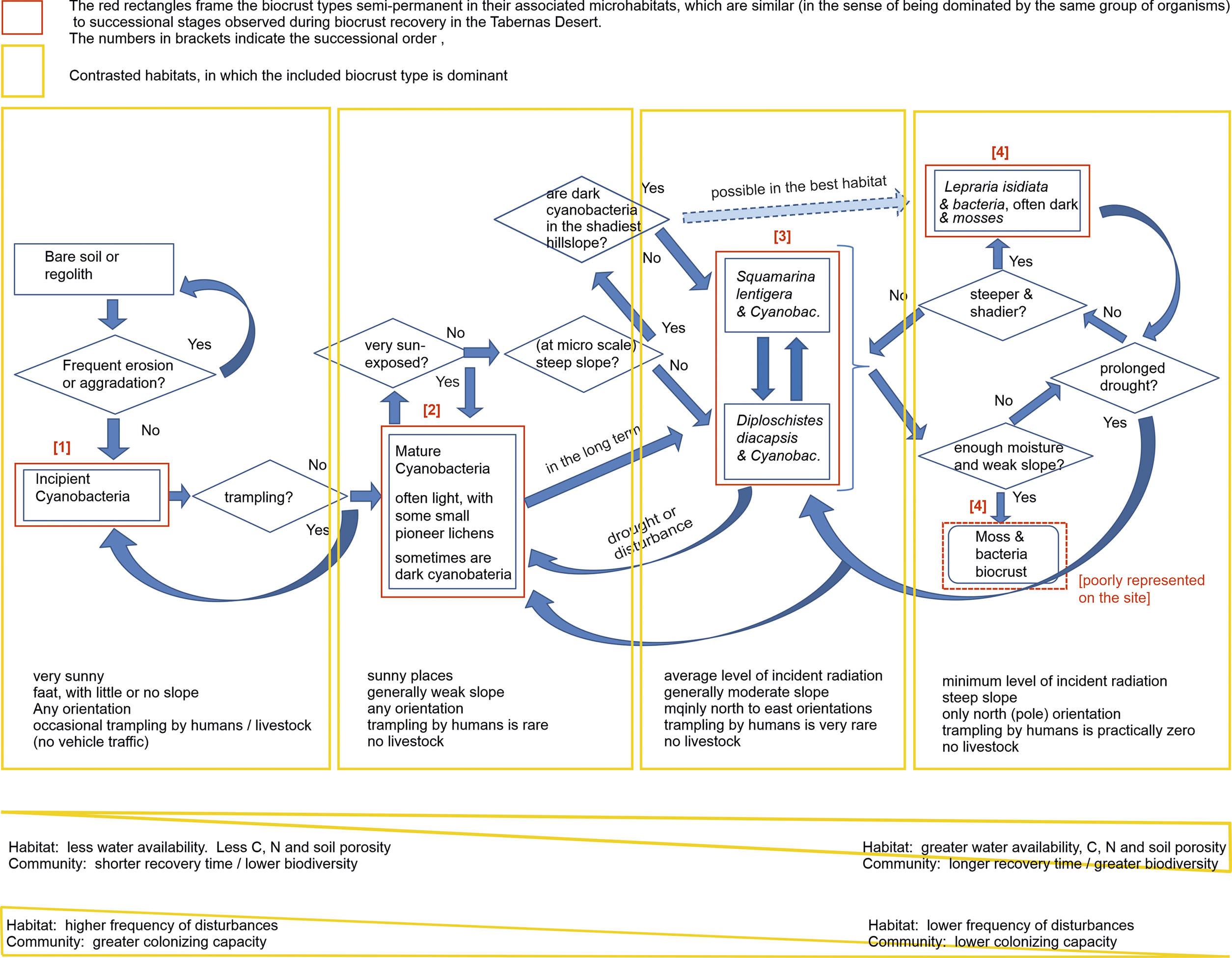
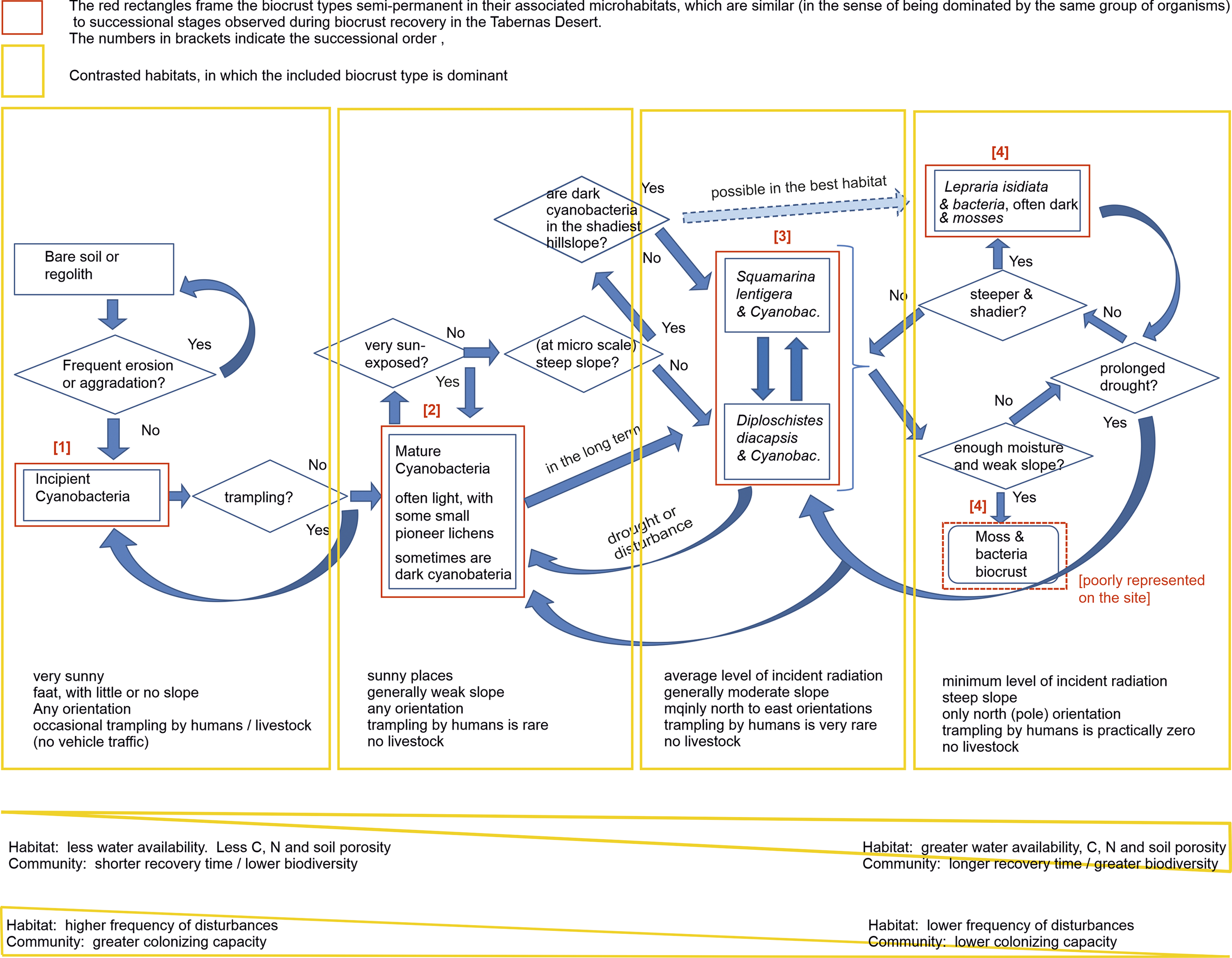
Figure 4. Conceptual model of biocrust succession for the Tabernas Desert, southeast Spain. Only the biocrust types distinguishable by the naked eye are included. The model relates each type of biocrust/successional stage to the habitat in which it dominates. Straight arrows indicate progressive succession. In each habitat, you can see the succession up to the dominant type in that habitat; thus, the complete succession can only be seen in the most favourable habitats for lichen biocrusts. Curved arrows indicate regressive succession. The arrow with broken lines and a less intense colour indicates that such progress is possible, although it does not always occur.

At Tabernas, we analysed more than 6,400 catchments, very often finding catchment asymmetry. This asymmetry occurs because one of the two hillslopes draining into the same channel is more stable, and the channel mainly undermines the opposite hillslope, which progressively becomes steeper. Biocrusts are stabilizing forces and develop better in the shadier hillslopes. In most asymmetries, the most stable hillslope was the shadier one, which was the best for the progress of biocrust succession. Therefore, although the effect of cyanobacteria stabilizing soil is well known, the known larger stabilizing capacity of lichens seems great enough for feedback catchment asymmetry (Lázaro et al., Reference Lázaro, Calvo-Cases, Rodriguez-Caballero, Arnau-Rosalén, Alexander, Rubio, Cantón, Solé-Benet and Puigdefábregas2022).

Other indirect approaches to biocrust succession are in the Supplementary Material.

Microhabitat control over crust types

The association between microhabitats and biocrust types observed for decades in Tabernas was verified by Rodriguez-Caballero et al. (Reference Roncero-Ramos, Román, Rodríguez-Caballero, Chamizo, Águila-Carricondo, Mateo and Cantón2019b), who claimed that terrain attributes, such as slope and potential incoming solar radiation, are the main drivers of the distribution of biocrust types. Cyanobacteria dominate in stable zones with high solar radiation because they produce photo-protective pigments (Miralles et al., Reference Miralles, Jorge-Villar, van Wesemael and Lázaro2017). Lichens cover mainly the upper half of the shadier north-oriented hillslopes because they are often outcompeted by vegetation on the footslopes.

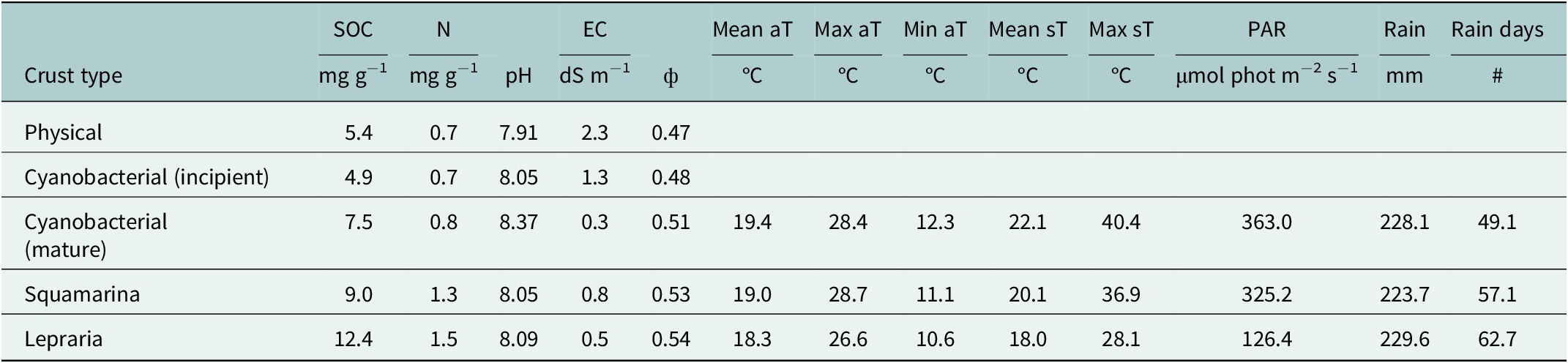
Successional trends were apparent for soil features of microhabitats corresponding to different crust types, and microclimatic variables at stations in Incipient and Mature cyanobacteria, Squamarina and Diploschistes and Lepraria (Table 1). These trends were particularly apparent in soil organic carbon and nitrogen, soil porosity, soil temperatures, photosynthetically active radiation and the number of days with at least one record in the rain gauge.

Table 1. Soil properties are averages of five replicates sampled in typical crust-type sites, from Lopez-Canfin et al. (Reference Lopez-Canfin, Lázaro and Sánchez-Cañete2022a)

Note: The microclimatic variables are the averages of the yearly values of the 2004–2021 period. Mean aT, Max aT and Min aT are mean, maximum and minimum air temperatures, respectively. Mean sT and Max sT are mean and maximum temperatures at the soil surface, respectively. Rain is the average of the yearly total rainfall volume. N Rain d is the number of days with at least one record in the rain gauge, which is likely related to a larger number of non-rainfall water inputs in the more shady habitats, as rainfall is similar across these habitats.

Abbreviations: SOC, soil organic carbon; N, nitrogen; EC, electrical conductivity; PAR, photosynthetically active radiation; ф, soil porosity.

The control of microclimate and soil properties on biocrust types has been found in various other drylands (Lan et al., Reference Lan, Wu, Zhang and Hu2012; Kidron, Reference Kidron2019; Navas Romero et al., Reference Navas Romero, Herrera Moratt, Martinez, Rodriguez and Vento2020; Kidron and Xiao, Reference Kidron and Xiao2024). However, soil properties change over time with community development, which could make the soil more suitable for more competitive biocrust types. According to Colesie et al. (Reference Colesie, Scheu, Green, Weber, Wirth and Büdel2012), this is precisely at the core of the successional process. Thus, microclimate would be the main driver of the microhabitat effect because most of the differences in soil may not be an abiotic factor but rather due to succession. Arias-Real et al. (Reference Arias-Real, Delgado-Baquerizo, Sabater, Gutiérrez-Cánovas, Valencia, Aragón, Cantón, Datry, Giordani, Medina, de los Ríos, Romaní, Weber and Hurtado2024) found that microhabitat and succession are closely related, and water availability can be the core driver of biodiversity and functional patterns. Thus, microhabitat acts simultaneously with succession, controlling the speed of succession, consistent with Felde et al. (Reference Felde, Rodriguez-Caballero, Chamizo, Rossi, Uteau, Peth, Keck, De Philippis, Belnap and Eldridge2020). Further, the duration of moisture in the topsoil can often be the main driver of biocrust type (Kidron, Reference Kidron2019; Kidron and Xiao, Reference Kidron and Xiao2024). However, the existence of poorly understood factors highlighted in Sorbas suggests that it is better to invoke microhabitat rather than water content as the causal agent of these changes.

Synthesis

Our results as a whole

At Tabernas, in relatively shady habitats where lichens can develop, they replace cyanobacteria (Lázaro et al., Reference Lázaro, Cantón, Solé-Benet, Bevan, Alexander, Sancho and Puigdefábregas2008; Rubio and Lázaro, Reference Rubio and Lázaro2023), confirmed by our results in Sorbas and the soil micro-profiles. These changes in the crust type are due to succession because they occur over time within certain microclimates. The crust types of the recovery phases were similar to those dominating in the different microclimates. This allowed us to accept the space-for-time samplings for the indirect studies. Thus, the changes in various structural and functional biocrust properties according to the biocrust type were related to succession because they varied consistently with the hypothetical succession pathway. The results of these indirect studies, in themselves, do not imply species replacement, which was demonstrated by direct research. Indirect research provided information on those functional changes that might be due to the successional process, consistent with Garcia-Pichel et al. (Reference Garcia-Pichel, Felde, Drahorad, Weber, Weber, Büdel and Belnap2016). These changes in properties over time trend towards a more stable, structured and fertile soil, which one would expect for succession progress.

Initially, we had identified two challenges to accept that succession can configure the crust types: (i) the verified association between crust types and microclimates, and (ii) the persistence of cyanobacterial biocrusts in some sites. Both facts suggest that the microclimate is the main driver of biocrust type. In each microhabitat, in the absence of disturbances or long drought, the corresponding biocrust type can be permanent at the human time scale (Kidron and Xiao, Reference Kidron and Xiao2024). However, after a disturbance, succession will occur in the relatively shady habitats where the microclimate allows for lichen development, and not (or very slowly) in the more exposed habitats where cyanobacteria can remain dominant for a long time. Weber et al. (Reference Weber, Bowker, Zhang, Belnap, Weber, Büdel and Belnap2016b) and Felde et al. (Reference Felde, Rodriguez-Caballero, Chamizo, Rossi, Uteau, Peth, Keck, De Philippis, Belnap and Eldridge2020) suggest that water availability can determine the successional endpoint. All crust types undergo succession, but succession does not occur in some places because of habitat constraints. Succession can also be seen in soft ecotones (Lázaro et al., Reference Lázaro, Cantón, Solé-Benet, Bevan, Alexander, Sancho and Puigdefábregas2008) because of climatic oscillations.

We concur with Kidron and Xiao (Reference Kidron and Xiao2024) that the multiple functions and features of cyanobacteria (reviewed above) do not necessarily imply the development of lichens or mosses. This occurs because such development may be limited by microhabitat, but that does not contradict that succession can shape crust types.

Although the factors controlling crust type (vegetation, radiation, geomorphology and soil; Bowker et al., Reference Bowker, Belnap, Büdel, Sannier, Pietrasiak, Eldridge, Rivera-Aguilar, Weber, Büdel and Belnap2016) are similar at intermediate (m1-m2) and micro (m−2-m−3) scales, changes at Tabernas seem much slower at intermediate scales (sensu Mallen-Cooper et al., Reference Mallen-Cooper, Cornwell, Slavich, Sabot, Xirocostas and Eldridge2023). Our ongoing research suggests that this is due to microscale changes spatially offsetting each other, but also to lower spatial resolution in data at larger scales.

Successional model integrating microclimate

The conceptual model in Figure 4 synthesizes our understanding of the biocrust distribution and dynamics at Tabernas.

Cyanobacterial biocrusts constitute a widespread matrix on which lichen biocrusts eventually develop. In the sunniest and eventually trampled areas, this biocrust remains for decades in an incipient developmental stage. The cessation of trampling gives rise to mature cyanobacteria, including light cyanobacteria everywhere and dark cyanobacteria that were only dominant in the early recovery stages of the shadiest plots. Cyanobacteria produce significant physical and chemical changes in the soil (Cantón et al., Reference Cantón, Chamizo, Rodriguez-Caballero, Lázaro, Roncero-Ramos, Román and Solé-Benet2020), facilitating lichen biocrusts. Cyanobacteria dominate in the sunniest areas (35 years of observation), although, in the long term, they share dominance with lichens, as can be observed in the oldest geomorphological levels of the drainage network (Lázaro et al., Reference Lázaro, Alexander, Puigdefábregas, Alexander and Millington2000). In shadier sites, the cyanobacterial biocrust is replaced by lichens of the Squamarina-Diploschistes community within about 15–20 years (Rubio and Lázaro, Reference Rubio and Lázaro2023). The Lepraria community is the latest stage because it develops more slowly, and many species of the previous stages appear during such a process (Rubio and Lázaro, Reference Rubio and Lázaro2023). In the shadiest sites, mature dark cyanobacteria could (experiment ongoing) sometimes slowly generate a Lepraria community, skipping the Squamarina-Diploschistes stage. Mosses only form metric-scale patches in Sorbas during wet winters. Disturbances, such as prolonged droughts, can reverse the direction of succession, further receding with more intense or long-lasting disturbances, consistent with our data from Sorbas and Rubio and Lázaro (Reference Rubio and Lázaro2025).

This model is consistent with previous knowledge. Because cyanobacteria are autotrophs and among the oldest organisms on Earth (Weber et al., Reference Weber, Belnap, Büdel, Belnap, Weber and Büdel2016a), they can be the first colonizers. The first would be filamentous bundle-forming cyanobacteria that move upwards when hydrated and downwards when desiccating, spreading their exopolysaccharides (Belnap et al., Reference Belnap, Büdel, Lange, Belnap and Lange2003a; Zhang, Reference Zhang2005), which stabilize soil (Roncero-Ramos et al., Reference Roncero-Ramos, Román, Rodríguez-Caballero, Chamizo, Águila-Carricondo, Mateo and Cantón2019b). Later, less mobile unicellular or heterocystous cyanobacteria appear, together with green algae (Belnap and Eldridge, Reference Belnap, Eldridge, Belnap and Lange2003; Garcia-Pichel et al., Reference Garcia-Pichel, Johnson, Yougkin and Belnap2003; Sorochkina et al., Reference Sorochkina, Velasco Ayuso and Garcia-Pichel2018) when the surface is not degraded (Roncero-Ramos et al., Reference Roncero-Ramos, Muñoz-Martín, Cantón, Chamizo, Rodríguez-Caballero and Mateo2020). Pioneer lichens follow, gradually followed by other species of lichens and mosses (Belnap and Eldridge, Reference Belnap, Eldridge, Belnap and Lange2003; Lan et al., Reference Lan, Wu, Zhang and Hu2012). The fact that lichens replace cyanobacteria is consistent with the aspect preferences found by Bowker et al. (Reference Bowker, Belnap, Davidson and Goldstein2006), irrespective of the spatial scale. The successional order is consistent with the accelerating succession in greenhouse results from Richardson et al. (Reference Richardson, Kong, Taylor, Le Moine, Bowker, Barber, Basler, Carbone, Hayer, Koch, Salvatore, Sonnemaker and Trilling2022). Regressive succession was noticed in other areas (Zelikova et al., Reference Zelikova, Housman, Grote, Neher and Belnap2012). The occasional splitting of succession (following different pathways in different microhabitats) replicates in microhabitats at the local scale the fact that different global habitats can have specific successional sequences (Weber et al. (Reference Weber, Bowker, Zhang, Belnap, Weber, Büdel and Belnap2016b).

It is noteworthy that our model only deals with the crust types easily recognizable in situ by the naked eye. Interestingly, bundle-forming cyanobacteria dominate the Incipient type, whereas unicellular cyanobacteria dominate in the Mature type (Roncero-Ramos et al., Reference Roncero-Ramos, Muñoz-Martín, Cantón, Chamizo, Rodríguez-Caballero and Mateo2020).

Conclusion

In the Tabernas region, biocrust types of different successional stages are often the same as those associated with different microclimates. The successional pathway may split and regress. Our model, consistent with previous knowledge, includes two earlier stages of cyanobacteria-dominated biocrusts (Incipient and Mature) and two later stages of lichen biocrusts (Squamarina-Diploschistes, Lepraria). Each stage corresponds to a habitat, from the most sun-exposed and trampled surfaces (old pathways) to the shadiest and best preserved biocrusts. Our model considers the order in which species tend to appear due to their requirements and interspecific relationships. It clarifies how microclimate and succession interact to shape biocrust type. Biocrust composition is necessarily in equilibrium with the microhabitat, as well as with biotic factors such as facilitation or competition. Consequently, succession occurs at very different speeds across space. In the moistest habitats, all the stages will develop. In the driest, at human time scales, the biocrust will remain dominated by cyanobacteria. Therefore, any biocrust type can seem permanent because each microhabitat will display the most advanced crust type it can support. Thus, succession can be observed in moist habitats after biocrust disturbance, and in ecotones because of climate oscillations.

Our results show that space-for-time sampling in biocrusts is feasible. To verify and exploit this on a global scale would facilitate the research on biocrust dynamics and functionality, which is important in drylands.

Open peer review

For open peer review materials, please visit https://doi.org/10.1017/dry.2025.10009.

Supplementary material

The supplementary material for this article can be found at http://doi.org/10.1017/dry.2025.10009.

Data availability statement

The data that support the findings of this study are available from the corresponding author upon reasonable request.

Acknowledgements

The authors would like to thank Domingo Álvarez Gómez, technician of the geomorphology laboratory of our institute, for his meticulous help with the micro-profile sections in samples of unaltered biocrusted soil. The authors also thank Lydia N. Bailey, biologist at the Fort Collins Science Center, for her question on the scale during our talk at the Biocrust 5 Conference, which gave rise to this article.

The authors would like to express special thanks to the Viciana brothers, landowners of the El Cautivo field site, where they carried out most of these investigations, as well as to Lindy Whals and Francisco Contreras, owner and manager of the Sorbas farm where the experiments are located.

Author contribution

RL conceived and designed the article, obtained and processed data, interpreted results, wrote the first draft and provided most of the funding. CR and CLC collaborated in several field campaigns, elaborated data and published some of the most recent articles on which this article is based. BRR contributed to the article’s design and provided most of the literature review. All authors discussed the interpretation of the results and reviewed the writing of the final version.

Financial support

This study was supported by the research projects DINCOS (CGL2016-78075-P) and INTEGRATYON3 (PID2020-117825GB-C21 and C22), both funded by MCIN/AEI/10.13039/501100011033, along with the European ERDF funds, as well as the BAGAMET (P20_00016) and PCBio (CA32507) projects, funded by the Andalusian Plan for Research, Development and Innovation (PAIDI-2020) and Andalusia’s Complementary Plans for Biodiversity, respectively, of the Junta de Andalucía. The Consuelo Rubio’s predoctoral student contract FPU18/00035 and the Clement Lopez’s postdoctoral Marie Sklodowska-Curie grant agreement number 101109110 also facilitated this work. Views and opinions expressed are, however, those of the authors only and do not necessarily reflect those of the European Union (EU) or the European Research Executive Agency (REA). Beatriz Roncero-Ramos was supported by the Junta de Andalucía (PAIDI-DOCTOR 21_00571).

Competing interests

The authors declare none.
References

Alexander, RW, Calvo, A, Arnau, E, Mather, AE and Lázaro, R (2008) Erosion and stabilization sequences in relation to base level changes in the El Cautivo badlands SE Spain. Geomorphology 100, 8390.Google Scholar
Arias-Real, R, Delgado-Baquerizo, M, Sabater, S, Gutiérrez-Cánovas, C, Valencia, E, Aragón, G, Cantón, Y, Datry, T, Giordani, P, Medina, NG, de los Ríos, A, Romaní, AM, Weber, B and Hurtado, P (2024) Unfolding the dynamics of ecosystems undergoing alternating wet-dry transitional states. Ecology Letters 27, e14488.Google Scholar
Barger, NN, Weber, B, Garcia-Pichel, F, Zaady, E and Belnap, J (2016) Patterns and controls on nitrogen cycling of biological soil crusts. In Belnap, J, Weber, B and Büdel, B (eds), Biological Soil Crusts: An Organizing Principle in Drylands, Ecological Studies, Vol. 226. Berlin – Heidelberg: Springer Verlag, pp. 257285.Google Scholar
Belnap, J and Büdel, B (2016) Biological soil crusts as soil stabilizers. In Belnap, J, Weber, B and Büdel, B (eds.), Biological Soil Crusts: An Organizing Principle in Drylands, Ecological Studies, Vol. 226. Basel, Switzerland: Springer Verlag, pp. 305320.Google Scholar
Belnap, J, Büdel, B and Lange, O (2003a) Biological soil crusts: Characteristics and distribution. In Belnap, J and Lange, OI (eds.), Biological Soil Crusts: Structure, Function and Management, Ecological Studies, Vol. 150. Berlin – Heidelberg: Springer Verlag, pp. 330.Google Scholar
Belnap, J and Eldridge, DJ (2003) Disturbance and recovery of biological soil crusts. In Belnap, J and Lange, OI (eds.), Biological Soil Crusts: Structure, Function and Management, Ecological Studies, Vol. 150. Berlin – Heidelberg: Springer Verlag, pp. 363383.Google Scholar
Belnap, J, Prasse, R and Harper, KT (2003b) Influence of biological soil crusts on soil environments and vascular plants. In Belnap, J and Lange, OI (eds.), Biological Soil Crusts: Structure, Function and Management, Ecological Studies, Vol. 150. Berlin – Heidelberg: Springer Verlag, pp. 281300.Google Scholar
Belnap, J, Wilcox, BP, Van Scoyoc, MV and Phillips, SL (2013) Successional stage of biological soil crusts: An accurate indicator of ecohydrological condition. Ecohydrology 6, 474482.Google Scholar
Biggs, CR, Yeager, LA, Bolser, DG, Bonsell, C, Dichiera, AM, Hou, Z, Keyser, SR, Khursigara, AJ, Lu, K, Muth, AF, Negrete, B and Erisman, BE (2020) Does functional redundancy affect ecological stability and resilience? A review and meta-analysis. Ecosphere 11, e03184.Google Scholar
Boustie, J and Grube, M (2005) Lichens a promising source of bioactive secondary metabolites. Plant Genetic Resources 3, 273287.Google Scholar
Bowker, MA (2007) Biological soil crust rehabilitation in theory and practice: An underexploited opportunity. Restoration Ecology 15, 1323.Google Scholar
Bowker, MA, Belnap, J, Bala Chaudhary, V and Johnson, NC (2008) Revisiting classic water erosion models in drylands: The strong impact of biological soil crusts. Soil Biology and Biochemistry 40, 23092316.Google Scholar
Bowker, MA, Belnap, J, Büdel, B, Sannier, C, Pietrasiak, N, Eldridge, DJ and Rivera-Aguilar, V (2016) Controls on distribution patterns of biological soil crusts at micro- to global scales. In Weber, B, Büdel, B and Belnap, J (eds.), Biological Soil Crusts: An Organizing Principle in Drylands, Ecological Studies, Vol. 226. Basel, Switzerland: Springer, pp. 173197.Google Scholar
Bowker, MA, Belnap, J, Davidson, DW and Goldstein, H (2006) Correlates of biological soil crust abundance across a continuum of spatial scales: Support for a hierarchical conceptual model. Journal of Applied Ecology 43, 152163.Google Scholar
Büdel, B, Darienko, T, Deutschewitz, K, Dojani, S, Friedl, T, Mohr, K and Weber, B (2009) Southern African biological soil crusts are ubiquitous and highly diverse in drylands, being restricted by rainfall frequency. Microbiology Ecology 57, 229247.Google Scholar
Calvo-Cases, A, Harvey, AM, Alexander, RW, Canton, Y, Lazaro, R, Sole-Benet, A and Puigdefabregas, J (2014) Badlands in the Tabernas Basin, Betic chain. In Gutiérrez, F and Gutiérrez, M (eds.), Landscapes and Landforms of Spain. Dordrecht: Springer Science, part of World Geomorphological Landscapes, pp. 197212.Google Scholar
Cantón, Y, Chamizo, S, Rodriguez-Caballero, E, Lázaro, R, Roncero-Ramos, B, Román, JR and Solé-Benet, A (2020) Water regulation in cyanobacterial biocrusts from drylands: Negative impacts of anthropogenic disturbance. Water 12, 720.Google Scholar
Cantón, Y, Del Barrio, G, Solé-Benet, A and Lázaro, R (2004a) Topographic controls on the spatial distribution of ground cover in the Tabernas badlands of SE Spain. Catena 55, 341365.Google Scholar
Cantón, Y, Domingo, F, Solé-Benet, A and Puigdefábregas, J (2001) Hydrological and erosion response of a badlands system in semiarid SE Spain. Journal of Hydrology 252, 6584.Google Scholar
Cantón, Y, Domingo, F, Solé-Benet, A and Puigdefábregas, J (2002) Influence of soil-surface types on the overall runoff of the Tabernas badlands (south-East Spain): Field data and model approaches. Hydrological Processes 16, 26212643.Google Scholar
Cantón, Y, Román, JR, Chamizo, S, Rodríguez-Caballero, E and Moro, MJ (2014) Dynamics of organic carbon losses by water erosion after biocrust removal. Journal of Hydrology and Hydromechanics 62, 258268.Google Scholar
Cantón, Y, Solé-Benet, A and Domingo, F (2004b) Temporal and spatial patterns of soil moisture in semiarid badlands of SE Spain. Journal of Hydrology 285, 199214.Google Scholar
Cantón, Y, Solé-Benet, A and Lázaro, R (2003) Soil-geomorphology relations in gypsiferous materials of the Tabernas Desert (Almería. SE Spain). Geoderma 115, 193222.Google Scholar
Chamizo, S, Belnap, J, Eldridge, DJ, Canton, Y and Malam Isa, O (2016a) The role of biocrusts in arid land hydrology. In Weber, B, Büdel, B and Belnap, J (eds.), Biological Soil Crusts: An Organizing Principle in Drylands. Basel, Switzerland: Springer, pp. 321346.Google Scholar
Chamizo, S, Cantón, Y, Domingo, F and Belnap, J (2013) Evaporative losses from soils covered by physical and different types of biological soil crusts. Hydrological Processes 27, 324332.Google Scholar
Chamizo, S, Cantón, Y, Lázaro, R, Solé-Benet, A and Domingo, F (2012a) Crust composition and disturbance drive infiltration through biological soil crusts in semiarid ecosystems. Ecosystems 15, 148161.Google Scholar
Chamizo, S, Cantón, Y, Miralles, I and Domingo, F (2012b) Biological soil crust development affects physicochemical characteristics of soil surface in semiarid ecosystems. Soil Biology and. Biochemistry 49, 96105.Google Scholar
Chamizo, S, Cantón, Y, Rodríguez-Caballero, E and Domingo, F (2016b) Biocrusts positively affect the soil water balance in semiarid ecosystems. Ecohydrology 9, 12081221.Google Scholar
Chamizo, S, Cantón, Y, Rodríguez-Caballero, E, Domingo, F, and Escudero, A (2012c) Runoff at contrasting scales in a semiarid ecosystem: A complex balance between biological soil crust features and rainfall characteristics. Journal of Hydrology 452-453, 130138.Google Scholar
Chamizo, S, Rodríguez-Caballero, E, Cantón, Y, Asensio, C and Domingo, F (2015) Penetration resistance of biological soil crusts and its dynamics after crust removal: Relationships with runoff and soil detachment. Catena 126, 164172.Google Scholar
Chamizo, S, Rodríguez-Caballero, E, Moro, MJ and Cantón, Y (2021) Non-rainfall water inputs: A key water source for biocrust carbon fixation. Science of the Total Environment 792, 148299.Google Scholar
Chamizo, S, Rodríguez-Caballero, E, Román, JR and Cantón, Y (2016c) Effects of biocrust on soil erosion and organic carbon losses under natural rainfall. Catena 148, 117125.Google Scholar
Chamizo, S, Rodríguez-Caballero, E, Sánchez-Cañete, EP, Domingo, F and Cantón, Y (2022) Temporal dynamics of dryland soil CO2 efflux using high-frequency measurements: Patterns and dominant drivers among biocrust types, vegetation and bare soil. Geoderma 405, 115404.Google Scholar
Chen, L, Rossi, F, Deng, S, Liu, Y, Wang, G, Adessi, A and De Philippis, R (2014) Macromolecular and chemical features of the excreted extracellular polysaccharides in induced biological soil crusts of different ages. Soil Biology and Biochemistry 78, 19.Google Scholar
Chilton, AM, Neilan, BA and Eldridge, DJ (2018) Biocrust morphology is linked to marked differences in microbial community composition. Plant and Soil 429, 6575.Google Scholar
Churchill, RR (1981) Aspect-related differences in badland slope morphology. Annals of the American Association of Geographers 71(3), 374388.Google Scholar
Clements, FE (1916) Plant Succession: An Analysis of the Development of Vegetation, Publication Sciences, Vol. 242. Washington, USA: Carnegie Institution.Google Scholar
Colesie, C, Scheu, S, Green, TGA, Weber, B, Wirth, R and Büdel, B (2012) The advantage of growing on moss: Facilitative effects on photosynthetic performance and growth in the cyanobacterial lichen Peltigera rufescens. Oecologia 169, 599607.Google Scholar
Connell, JH and Slatyer, RO (1977) Mechanisms of succession in natural communities and their role in community stability and organization. The American Naturalist 111(982), 11191144.Google Scholar
Deng, S, Zhang, D, Wang, G, Zhou, X, Ye, C, Fu, T, Ke, T, Zhang, Y, Liu, Y and Chen, L (2020) Biological soil crust succession in deserts through a 59-year-long case study in China: How induced biological soil crust strategy accelerates desertification reversal from decades to years. Soil Biology and Biochemistry 141, 107665.Google Scholar
Dojani, S, Büdel, B, Deutschewitz, K and Weber, B (2011) Rapid succession of biological soil crusts after experimental disturbance in the succulent Karoo, South Africa. Applied Soil Ecology 48, 263269.Google Scholar
Dou, W, Xiao, B, Revillini, D and Delgado-Baquerizo, M (2024) Biocrusts enhance soil organic carbon stability and regulate the fate of new-input carbon in semiarid desert ecosystems. Science of the Total Environment 918, 170794.Google Scholar
Drahorad, SL, Steckenmesser, D, Henningsen, PF, Lichner, L and Rodný, M (2013) Ongoing succession of biological soil crusts increases water repellency – A case study on Arenosols in Sekule, Slovakia. Biologia 68, 10891093.Google Scholar
Drury, WH and Nisbet, ICT (1973) Succession. Journal of the Arnold Arboretum 54, 331368.Google Scholar
Eldridge, DJ, Freudenberger, D and Koen, TB (2006) Diversity and abundance of biological soil crust taxa in relation to fine and coarse scale disturbances in a grassy eucalypt woodland in eastern Australia. Plant and Soil 281, 255268.Google Scholar
Eldridge, DJ and Greene, RSB (1994) Microbiotic soil crusts: A review of their roles in soil and ecological processes in the rangelands of Australia. Australian Journal of Soil Research 32, 389415.Google Scholar
Felde, VJMNL, Peth, S, Uteau-Puschmann, D, Drahorad, S and Felix-Henningsen, P (2014) Soil microstructure as an under-explored feature of biological soil crust hydrological properties: Case study from the NW Negev Desert. Biodiversity and Conservation 23, 16871708.Google Scholar
Felde, VJNML, Rodriguez-Caballero, E, Chamizo, S, Rossi, F, Uteau, D, Peth, S, Keck, H, De Philippis, R, Belnap, J and Eldridge, DJ (2020) Comment on ‘Kidron, G. J. (2019). Biocrust research: A critical view on eight common hydrological-related paradigms and dubious theses. Ecohydrology 13, e2215.Google Scholar
Finger-Higgens, R, Duniway, MC, Fick, S, Geiger, EL, Hoover, DL, Pfennigwerth, AA, Van Scoyoc, MW and Belnap, J (2022) Decline in biological soil crust N-fixing lichens linked to increasing summertime temperatures. Proceedings of the National Academy of Sciences (PNAS) 119, e2120975119.Google Scholar
Gao, L, Sun, H, Xu, M and Zhao, Y (2019) Biocrusts resist runoff erosion through direct physical protection and indirect modification of soil properties. Journal of Soils and Sediments 20, 133142.Google Scholar
Garcia-Pichel, F and Belnap, J (1996) Microenvironments and microscale productivity of cyanobacterial desert crusts. Journal of Phycology 32, 774782.Google Scholar
Garcia-Pichel, F, Felde, VJMNL, Drahorad, SL and Weber, B (2016) Microstructure and weathering processes within biological soil crusts. In Weber, B, Büdel, B and Belnap, J (eds.), Biological Soil Crusts: An Organizing Principle in Drylands, Ecological Studies, Vol. 226. Basel, Switzerland: Springer, pp. 237255.Google Scholar
Garcia-Pichel, F, Johnson, SL, Yougkin, D and Belnap, J (2003) Small-scale vertical distribution of bacterial biomass and diversity in biological soil crusts from arid lands in the Colorado plateau. Microbial Ecology 46, 312321.Google Scholar
García-Velázquez, L, Gallardo, A, Ochoa, V, Gozalo, B, Lázaro, R and Maestre, FT (2022) Biocrusts increase the resistance to warming-induced increases in topsoil P pools. Journal of Ecology 110, 20742087.Google Scholar
Geng, Y, Zhou, P, Wang, Z, Peng, C, Li, G and Li, D (2024) The roles of rare and abundant microbial species in the primary succession of biological soil crusts are differentiated in metal tailings ponds with different states. Journal of Hazardous Materials 472, 134577.Google Scholar
Grishkan, I, Lázaro, R and Kidron, G (2019) Cultured microfungal communities in biological soil crusts and bare soils at the Tabernas Desert, Spain. Soil Systems 3, 3654.Google Scholar
Kidron, GJ (2007) Milimeter-scale microrelief affecting runoff yield over microbiotic crust in the Negev Desert. Catena 70, 266273.Google Scholar
Kidron, GJ (2019) Biocrust research: A critical view on eight common hydrological-related paradigms and dubious theses. Ecohydrology 12, e2061.Google Scholar
Kidron, GJ, Barzilay, E and Sachs, E (2000) Microclimate control upon sand microbiotic crusts, western Negev Desert. Israel. Geomorphology 36, 118.Google Scholar
Kidron, GJ, Monger, HC, Vonshak, A and Conrod, W (2012) Contrasting effects of microbiotic crusts on runoff in desert surfaces. Geomorphology 139140.Google Scholar
Kidron, GJ, Vonshak, A and Abeliovich, A (2009) Microbiotic crusts as biomarkers for surface stability and wetness duration in the Negev Desert. Earth Surface Processes and Landforms 34, 15941604.Google Scholar
Kidron, GJ, Vonshak, A, Dor, I, Barinova, S and Abeliovich, A (2010) Properties and spatial distribution of microbiotic crusts in the Negev Desert. Catena 82, 92101.Google Scholar
Kidron, GJ and Xiao, B (2024) A false paradigm? Do biocrust types necessarily reflect ‘successional stages’? Ecohydrology 17(1), e2610.Google Scholar
Knapen, A, Poesen, J, Galindo-Morales, IP, De Baets, S and Pals, A (2007) Effects of microbiotic crusts under cropland in temperate environments on soil erodibility during concentrated flow. Earth Surface Processes and Landforms 32, 18841901.Google Scholar
Lan, S, Wu, L, Zhang, D and Hu, C (2012) Successional stages of biological soil crusts and their microstructure variability in Shapotou (China). Environmental Earth Sciences 65, 7788.Google Scholar
Langston, AL and Tucker, GE (2018) Developing and exploring a theory for the lateral erosion of bedrock channels for use in landscape evolution models. Earth Surface Dynamics 6, 127.Google Scholar
Ladrón de Guevara, M, Lázaro, R, Quero, JL, Ochoa, V, Gozalo, B, Berdugo, M, Uclés, O, Escolar, C and Maestre, FT (2014) Simulated climate change reduced the capacity of lichen-dominated biocrusts to act as carbon sinks in two semi-arid Mediterranean ecosystems. Biodiversity and Conservation 23, 17871807.Google Scholar
Lázaro, R (2004) Implications of precipitation on vegetation of water-limited lands. In Pandalai, SG (ed.), Recent Research Development in Environmental Biology. Volume I. Kerala: Research Signpost, pp. 553591.Google Scholar
Lázaro, R, Alexander, RW and Puigdefábregas, J (2000) Cover distribution patterns of lichens, annuals and shrubs in the Tabernas Desert, Almería, Spain. In Alexander, RW and Millington, AC (eds.), Vegetation Mapping: From Patch to Planet. Chichester: John Wiley & Sons, Ltd, pp. 1940.Google Scholar
Lázaro, R, Calvo-Cases, A, Arnau-Rosalén, E, Rubio, C, Fuentes, D and López-Canfín, C (2021) Defining minimum runoff length allows for discriminating biocrusts and rainfall events. Journal of Hydrology and Hydromechanics 69, 387399.Google Scholar
Lázaro, R, Calvo-Cases, A, Lázaro, A and Molina, I (2015) Effective run-off flow length over biological soil crusts on silty loam soils in drylands. Hydrological Processes 29, 25342544.Google Scholar
Lázaro, R, Calvo-Cases, A, Rodriguez-Caballero, E, Arnau-Rosalén, E, Alexander, R, Rubio, C, Cantón, Y, Solé-Benet, A and Puigdefábregas, J (2022) Biocrusts and catchment asymmetry in Tabernas Desert (Almeria, Spain). Geoderma 406, 115526.Google Scholar
Lázaro, R, Cantón, Y, Solé-Benet, A, Bevan, J, Alexander, R, Sancho, LG and Puigdefábregas, J (2008) The influence of competition between lichen colonization and erosion on the evolution of soil surfaces in the Tabernas badlands (SE Spain) and its landscape effects. Geomorphology 102, 252266.Google Scholar
Lázaro, R, Gascón, C and Rubio, C (2023) Runoff and soil loss in biocrusts and physical crusts from the Tabernas Desert (Southeast Spain) according to rainfall intensity. Frontiers in Microbiology 14, 1171096.Google Scholar
Lazaro, R and Mora, JL (2014) Sediment content and chemical properties of water runoff on biocrusts in drylands. Biologia 69, 15391554.Google Scholar
Lázaro, R, Rodrigo, FS, Gutiérrez, L, Domingo, F and Puigdefábregas, J (2001) Analysis of a 30-year rainfall record (1967-1997) in semi-arid SE Spain for implications on vegetation. Journal of Arid Environments 48, 373395.Google Scholar
Lázaro, R, Rodríguez-Tamayo, ML, Ordiales, R and Puigdefábregas, J (2004) El Clima. In Mota, J, Cabello, J, Cerrillo, MI and Rodríguez-Tamayo, ML (eds.), Subdesiertos de Almería: Naturaleza de Cine. Almería: Junta de Andalucía, Consejería de Medio Ambiente, pp. 6379.Google Scholar
Li, H, Colica, G, Wu, P, Li, D, Rossi, F, De Philippis, R and Liu, Y (2013) Shifting species interaction in soil microbial community and its influence on ecosystem functions modulating. Microbial Ecology 65, 700708.Google Scholar
Li, Y and Hu, C (2021) Biogeographical patterns and mechanisms of microbial community assembly that underlie successional biocrusts across northern China. npj Biofilms and Microbiomes 7, 15.Google Scholar
Lopez-Canfin, C, Lázaro, R and Sánchez-Cañete, EP (2022a) Disparate responses of soil-atmosphere CO2 exchange to biophysical and geochemical factors over a biocrust ecological succession in the Tabernas Desert. Geoderma 425, 116067.Google Scholar
Lopez-Canfin, C, Lázaro, R and Sánchez-Cañete, EP (2022b) Water vapor adsorption by dry soils: A potential link between the water and carbon cycles. Science of the Total Environment 824, 153746.Google Scholar
Lorite, J, Agea, D, García-Robles, H, Cañadas, EM, Rams, S and Sánchez-Castillo, P (2020) Plant recovery techniques do not ensure biological soil-crust recovery after gypsum quarrying: A call for active restoration. Restoration Ecology 28, S86S95.Google Scholar
Maestre, FT, Callaway, RM, Valladares, F and Lortie, CJ (2009) Refining the stress-gradient hypothesis for competition and facilitation in plant communities. Journal of Ecology 97, 199205.Google Scholar
Maestre, FT, Escolar, C, Ladrón de Guevara, M, Quero, JL, Lazaro, R, Delgado-Baquerizo, M, Ochoa, V, Berdugo, M, Gozalo, B and Gallardo, A (2013) Changes in biocrust cover drive carbon cycle responses to climate change in drylands. Global Change Biology 19, 38353847.Google Scholar
Maier, S, Tamm, A, Wu, D, Caesar, J, Grube, M and Weber, B (2018) Photoautotrophic organisms control microbial abundance, diversity, and physiology in different types of biological soil crusts. International Society of Microbial Ecology Journal 12, 10321046.Google Scholar
Malam Issa, O, Défarge, C, Trichet, J, Valentin, C and Rajot, JL (2009) Microbiotic soil crusts in the Sahel of Western Niger and their influence on soil porosity and water dynamics. Catena 77, 4855.Google Scholar
Malam Issa, O, Valentin, C, Rajot, JL, Cerdan, O, Desprats, JF and Bouchet, T (2011) Runoff generation fostered by physical and biological crusts in semiarid sandy soils. Geoderma 167–168, 2229.Google Scholar
Mallen-Cooper, M, Cornwell, WK, Slavich, E, Sabot, MEB, Xirocostas, ZA and Eldridge, DJ (2023) Limited range shifting in biocrusts despite climate warming: A 25-year resurvey. Journal of Ecology 111, 21942207.Google Scholar
Miralles, I, Domingo, F, Cantón, Y, Trasar-Cepeda, C, Leirós, MC and Gil-Sotres, F (2012a) Hydrolase enzyme activities in a successional gradient of biological soil crusts in arid and semi-arid zones. Soil Biology and Biochemistry 53, 124e132.Google Scholar
Miralles, I, Jorge-Villar, SE, van Wesemael, B and Lázaro, R (2017) Raman spectroscopy detection of biomolecules in biocrusts from differing environmental conditions. Spectrochimica Acta Part A: Molecular and Biomolecular Spectroscopy 171, 4051.Google Scholar
Miralles, I, Ladrón de Guevara, M, Chamizo, S, Rodríguez-Caballero, E, Ortega, R, van Wesemael, B and Cantón, Y (2018) Soil CO2 exchange controlled by the interaction of biocrust successional stage and environmental variables in two semiarid ecosystems. Soil Biology and Biochemistry 124, 1123.Google Scholar
Miralles, I, Lázaro, R, Sánchez-Marañón, M, Soriano, M and Ortega, R (2020) Biocrust cover and successional stages influence soil bacterial composition and diversity in semiarid ecosystems. Science of the Total Environment 709, 134654.Google Scholar
Miralles, I, Trasar-Cepeda, C, Leiros, MC and Gil-Sotres, F (2013) Labile carbon in biological soil crusts in the Tabernas desert, SE Spain. Soil Biology and Biochemistry 58, 18.Google Scholar
Miralles, I, van Wesemael, B, Cantón, Y, Chamizo, S, Ortega, R, Domingo, F and Almendros, G (2012b) Surrogate descriptors of C-storage processes on crusted semiarid ecosystems. Geoderma, 189190.Google Scholar
Miralles-Mellado, I, Cantón, Y and Solé-Benet, A (2011) Two-dimensional porosity of crusted silty soils: Indicators of soil quality in semiarid rangelands? Soil Science Society of America Journal 75, 13301342.Google Scholar
Moreno-Jiménez, E, Ochoa-Hueso, R, Plaza, C, Aceña-Heras, S, Flagmeier, M, Elouali, FZ, Ochoa, V, Gozalo, B, Lázaro, R and Maestre, FT (2020) Biocrusts buffer against the accumulation of soil metallic nutrients induced by warming and rainfall reduction. Communications Biology 3, 325.Google Scholar
Navarro-Noya, YE, Jimenez-Aguilar, A, Valenzuela-Encinas, C, Alcántara-Hernandez, RJ, Ruiz-Valdiviezo, VM, Ponce-Mendoza, A, Luna-Guido, M, Marsch, R and Dendooven, L (2014) Bacterial communities in soil under moss and lichen-moss crusts. Geomicrobiology Journal 31, 152160.Google Scholar
Navas Romero, AL, Herrera Moratt, MA, Martinez, E, Rodriguez, RA and Vento, B (2020) Spatial distribution of biological soil crusts along an aridity gradient in the central-west of Argentina. Journal of Arid Environments 176, 104099.Google Scholar
Pietrasiak, N, Drenovsky, RE, Santiago, LS and Graham, RC (2014) Biogeomorphology of a Mojave Desert landscape – Configurations and feedbacks of abiotic and biotic land surfaces during landform evolution. Geomorphology 206, 2336.Google Scholar
Pietrasiak, N, Johansen, JR, LaDoux, T and Graham, RC (2011) Comparison of disturbance impacts to and spatial distribution of biological soil crusts in the little San Bernardino Mountains of Joshua tree National Park, California. Western North American Naturalist 71, 539552.Google Scholar
Richardson, AD, Kong, GV, Taylor, KM, Le Moine, JM, Bowker, MA, Barber, JJ, Basler, D, Carbone, MS, Hayer, M, Koch, GW, Salvatore, MR, Sonnemaker, AW and Trilling, DE (2022) Soil-atmosphere fluxes of CO2, CH4, and N2O across an experimentally-grown, successional gradient of biocrust community types. Frontiers in Microbiology 13, 979825.Google Scholar
Rodríguez-Caballero, E, Aguilar, , Castilla, YC, Chamizo, S and Aguilar, FJ (2015) Swelling of biocrusts upon wetting induces changes in surface micro-topography. Soil Biology and Biochemistry 82, 107111.Google Scholar
Rodríguez-Caballero, E, Cantón, Y, Chamizo, S, Afana, A and Solé-Benet, A (2012) Effects of biological soil crusts on surface roughness and implications for runoff and erosion. Geomorphology 145, 8189.Google Scholar
Rodriguez-Caballero, E, Cantón, Y, Chamizo, S, Lázaro, R and Escudero, A (2013) Soil loss and runoff in semiarid ecosystems: A complex interaction between biological soil crusts, micro-topography and hydrological drivers. Ecosystems 16, 529546.Google Scholar
Rodríguez-Caballero, E, Román, JR, Chamizo, S, Roncero-Ramos, B and Cantón, Y (2019) Biocrust landscape-scale spatial distribution is strongly controlled by terrain attributes: Topographic thresholds for colonization in a semiarid badland system. Earth Surface Processes and Landforms 44, 27712779.Google Scholar
Roncero-Ramos, B, Muñoz-Martín, MA, Cantón, Y, Chamizo, S, Rodríguez-Caballero, E and Mateo, P (2020) Land degradation effects on composition of pioneering soil communities: An alternative successional sequence for dryland cyanobacterial biocrusts. Soil Biology and Biochemistry 146, 107824.Google Scholar
Roncero-Ramos, B, Román, JR, Rodríguez-Caballero, E, Chamizo, S, Águila-Carricondo, P, Mateo, P and Cantón, Y (2019b) Assessing the influence of soil abiotic and biotic factors on Nostoc commune inoculation success. Plant and Soil 444, 5770.Google Scholar
Rubio, C and Lázaro, R (2023) Patterns in biocrust recovery over time in semiarid Southeast Spain. Frontiers in Microbiology 14, 1184065.Google Scholar
Rubio, C and Lázaro, R (2025) Drought affects biocrust more than increased rainfall in the Tabernas Desert (SE Spain). Cambridge Prisms: Drylands 2, 111.Google Scholar
Sancho, LG, Belnap, J, Colesie, C, Raggio, J and Weber, B (2016) Carbon budgets of biological soil crusts at micro-, meso-, and global scales. In Weber, B, Büdel, B and Belnap, J (eds.), Biological Soil Crusts: An Organizing Principle in Drylands, Ecological Studies, Vol. 226. Basel, Switzerland: Springer, pp. 287304.Google Scholar
Soliveres, S and Eldridge, DJ (2020) Dual community assembly processes in dryland biocrust communities. Functional Ecology 34(4), 877887.Google Scholar
Sorochkina, K, Velasco Ayuso, S and Garcia-Pichel, F (2018) Establishing rates of lateral expansion of cyanobacterial biological soil crusts for optimal restoration. Plant and Soil 429, 199211.Google Scholar
Sun, J and Li, X (2021) Role of shrubs in the community assembly of biocrusts: The biotic and abiotic influences along a biocrust succession gradient. Plant and Soil 460, 163176.Google Scholar
Thomas, AD and Dougill, AJ (2006) Distribution and characteristics of cyanobacterial soil crusts in the Molopo Basin, South Africa. Journal of Arid Environments 64, 270283.Google Scholar
Uclés, O, Villagarcía, L, Cantón, Y and Domingo, F (2013) Microlysimeter station for long term non-rainfall water input and evaporation studies. Agricultural and Forest Meteorology 182–183, 1320.Google Scholar
Uclés, O, Villagarcía, L, Cantón, Y, Lázaro, R and Domingo, F (2015) Non-rainfall water inputs are controlled by aspect in a semiarid ecosystem. Journal of Arid Environments 113, 4350.Google Scholar
Warren, SD (2003a) Biological soil crusts and hydrology in north American deserts. In Belnap, J and Lange, OL (eds.), Biological Soil Crusts: Structure, Function and Management. Berlin, Heidelberg: Springer–Verlag, pp. 327337.Google Scholar
Warren, SD (2003b) Synopsis: Influence of biological soil crusts on arid land hydrology and soil stability. In Belnap, J and Lange, OL (eds.), Biological Soil Crusts: Structure, Function and Management. Berlin-Heidelberg: Springer–Verlag, pp. 349360.Google Scholar
Weber, B, Belnap, J and Büdel, B (2016a) Synthesis on biological soil crust research. In Belnap, J, Weber, B and Büdel, B (eds), Biological Soil Crusts: An Organizing Principle in Drylands, Ecological Studies, Vol. 226, Basel, Switzerland: Springer, pp. 527534.Google Scholar
Weber, B, Bowker, M, Zhang, Y and Belnap, J (2016b) Natural recovery of biological soil crusts after disturbance. In Weber, B, Büdel, B and Belnap, J (eds.), Biological Soil Crusts: An Organizing Principle in Drylands. Basel, Switzerland: Springer, pp. 479498.Google Scholar
Weber, B, Büdel, B and Belnap, J (2016c) Biological soil crusts as an organizing principle in drylands. In Weber, B, Büdel, B and Belnap, J (eds.), Biological Soil Crusts: An Organizing Principle in Drylands. Basel, Switzerland: Springer, pp. 313.Google Scholar
Wu, YS, Hasi, E and Wu, X (2012) Characteristics of surface runoff in a sandy area in southern mu us sandy land. Chinese Science Bulletin 57, 270275.Google Scholar
Xu, L, Li, C, Xiong, W, Kou, Y, Zou, P, Jiao, B, Yao, M, Wang, J, Zhang, B and Li, X (2024) The composition of soil fungal communities is more dependent on biocrust type than on shrub cover in the Mu Us Desert. Fungal Ecology 70, 101352.Google Scholar
Zaady, E, Kuhn, U, Wilske, B, Sandoval-Soto, L and Keselmeier, J (2000) Patterns of CO2 exchange in biological soil crusts of successional stages. Soil Biology and Biochemistry 32, 959966.Google Scholar
Zelikova, TJ, Housman, DC, Grote, EE, Neher, DA and Belnap, J (2012) Warming and increased precipitation frequency on the Colorado plateau: Implications for biological soil crusts and soil processes. Plant and Soil 355, 265282.Google Scholar
Zethof, JHT, Bettermann, A, Vogel, C, Babin, D, Cammeraat, ELH, Solé-Benet, A, Lázaro, R, Luna, L, Nesme, J, Woche, SK, Sørensen, SJ, Smalla, K and Kalbitz, K (2020) Prokaryotic community composition and extracellular polymeric substances affect soil microaggregation in carbonate containing semiarid grasslands. Frontiers in Environmental Science 8, 51.Google Scholar
Zhang, Y (2005) The microstructure and formation of biological soil crusts in their early developmental stage. Chinese Science Bulletin 50, 117121.Google Scholar
Zhang, Y, Gao, M, Yu, C, Zhang, H, Yan, N, Wu, Q, Song, Y and Li, X (2022) Soil nutrients, enzyme activities, and microbial communities differ among biocrust types and soil layers in a degraded karst ecosystem. Catena 212, 106057.Google Scholar
Zhao, Y, Qin, N, Weber, B and Xu, M (2014) Response of biological soil crusts to raindrop erosivity and underlying influences in the hilly loess plateau region, China. Biodiversity and Conservation 23, 16691686.Google Scholar
Zhuang, B, Zhang, Y, Zhao, J, Wu, N, Chen, R and Zhang, J (2009) Microalgal species variation at different successional stages in biological soil crusts of the Gurbantunggut Desert, northwestern China. Biology and Fertility of Soils 45, 539547.Google Scholar
Figure 0

Figure 1. This is part of Figure 3 of Lázaro et al. (2008), evidencing replacement of cyanobacterial biocrust by lichenic biocrust from a 13-year in situ photographic monitoring at the Tabernas Desert. In the early 1990s, we named ‘white lichens’ to the biocrust dominated by light lichens, but that biocrust corresponds to the Squamarina biocrust used here and includes a diversity of lichens, like the yellow Fulgensia seen in the photos.

Figure 1

Figure 2. Evidence of succession in biocrusts in the Sorbas experimental area. Graph a: Progressive succession between 2011 and 2016 in a plot with low initial lichen cover. Graph b: Regressive succession during the same period in a nearby plot that started with high lichen cover; it is noteworthy that cyanobacteria increase while lichens decrease. Both are control plots without any treatment. Covers were approximated from sums of species frequencies.

Figure 2

Figure 3. Some examples of micro-profiles of unaltered biocrusted soil showing lichens developing over a thinner dark or light cyanobacterial biocrust. Squamarina on dark cyanobacterial biocrust is shown in photos a, b, c and f; photo c also shows Toninia on dark cyanobacteria. Photos d and e show Diploschistes developed on light cyanobacterial biocrust.

Figure 3

Figure 4. Conceptual model of biocrust succession for the Tabernas Desert, southeast Spain. Only the biocrust types distinguishable by the naked eye are included. The model relates each type of biocrust/successional stage to the habitat in which it dominates. Straight arrows indicate progressive succession. In each habitat, you can see the succession up to the dominant type in that habitat; thus, the complete succession can only be seen in the most favourable habitats for lichen biocrusts. Curved arrows indicate regressive succession. The arrow with broken lines and a less intense colour indicates that such progress is possible, although it does not always occur.

Figure 4

Table 1. Soil properties are averages of five replicates sampled in typical crust-type sites, from Lopez-Canfin et al. (2022a)

Supplementary material: File

Lázaro Suau et al. supplementary material

Lázaro Suau et al. supplementary material
Download Lázaro Suau et al. supplementary material(File)
File 486.7 KB

Author comment: Succession in biocrusts at the Tabernas Desert, semi-arid Southeast Spain — R0/PR1

Comments

No accompanying comment.

Review: Succession in biocrusts at the Tabernas Desert, semi-arid Southeast Spain — R0/PR2

Conflict of interest statement

no

Comments

The question raised by the authors is whether or not it is justified to refer to biocrusts as successional stages. The aim of the manuscript is indeed welcome. In light of the frequently used term of ‘successional stages’ in the literature, accounts that challenge this view are welcome, as well the findings that are indicated by the authors showing succession.

As also indicated by the authors, this was already challenged 5 years ago (Kidron, 2019), but more specifically was challenged in a recent paper (Kidron and Xiao, 2024, Ecohydrology),. Since the authors were not aware of the above-mentioned paper that thoroughly addressed this issue, this paper should be thoroughly addressed. A major revision is therefore called for.

Main points

1. I suggest the authors to increase the focus of the paper which I found hard to follow. For instance, there are sections in which the authors refer to successional stages although it is not certain that succession took place in these loci. Paragraph 4.3 which describes succession should have been in the Introduction.

2. The main point addressed by the authors was already addressed in the two manuscripts mentioned above, which point to conditions when it is justified to refer to biocrusts as ‘successional stages’ and also emphasize the fact that the succession may not only be progressive. The authors have made important observations also on loci where succession took place and this should be also emphasized. A dialogue with other sites where variable biocrusts were defined is welcome.

3. All the data that support the authors' view such as the abiotic conditions should be part of the main text. Also, all the data should be accompanied by text and the reader cannot be only addressed to supplementary material.

4. Paragraph 3.2. Not clear. The description is relevant to succession as well as to variable crust types that did not exhibit succession. A clear focus is needed.

5. P.8 recovery time is still in controversy and this should be discussed.

6. 4.1. Do the differences here necessarily imply succession? Also, the last paragraph in 4.2 can apply to succession. All in all a clear focus is needed.

7. English editing is required.

Review: Succession in biocrusts at the Tabernas Desert, semi-arid Southeast Spain — R0/PR3

Conflict of interest statement

Not applicable.

Comments

Here, the authors examine a common practice in the biocrust literature which is to observe different biocrust community types in the field, then assume that the differences between them are caused by succession without any additional information such as gradients in time since disturbance or actual observations of communities shifting in time post-disturbance. This is an important point to make, and an important conversation to have. An observed difference in communities means only that communities are different; the observation alone does not allow us to infer with high confidence that succession accounts for the difference. They advance a biocrust successional model which incorporates the role of microclimate, and includes multiple bi-directional successional pathways. There are only a few synthesis papers about biocrust succession, and this one takes a unique angle. I commend the authors for maintaining a photo-monitoring record for so long.

Though I welcome a paper like this, I think that several key revisions would be helpful to maximize clarity and impact.

General areas to improve

1. Scope of the paper – At times it is unclear if this paper is meant to be about biocrust succession in general, or biocrust succession in the authors’ study areas. I think the authors envision their study area as a case study that is broadly informative about biocrust succession, but they could be more clear about that.

2. Clarity of the problem – The authors might want to explicitly put forth a problem statement. At various places in the manuscript, the authors seem to be invoking more than one interlinked problem. For example, the abstract opens with the problem that authors assume different biocrust types are different because of successional processes (as opposed to alternative mechanisms). I think this is the true focus of the paper. But on P2L41 it seems as though the authors are challenging that succession occurs in biocrusts at all. In the paragraph beginning on P2L44, readers might be unsure if the “problem” is the assumption of succession, or the lack of a common concept of the successional sequence. In the paragraph beginning on P3L9, the ambiguity of the concept of biocrust development seems to be the problem. Are all of these problems, and do they nest into some sort of hierarchy (i.e., are some problems a specific part of a broader problem?).

3. Methodology - I am having some difficulty comprehending how the “indirect approach” allows you to determine if biocrust types are created by succession or microhabitat. To me it seems like the authors are collecting cases in which different types of biocrusts are hypothesized (but not demonstrated) to be successional stages, then examining some differences in their properties. How can this tell us if the difference in biocrust types was brought about by succession or not? It seems to me that all it can tell us is that different community compositions lead to different functional properties. What am I missing?

4. Framing - This paper is framed as a re-examination of prevailing assumptions in the literature, but not all literature runs counter to your main points. You may find some prior support in the literature for the idea that both succession and environment dictate the biocrust community composition. For example, in Weber et al. 2016 (in your reference list), it is acknowledged that though some common successional patterns are reported from many places, 1. They are not universal, i.e., multiple successional sequences occur in different places, 2. Environmental factors like water availability can dictate the successional endpoint, and 3. Environmental factors like sand deposition can induce distinct successional pathways. This seems to support your proposition that succession only occurs where the microclimate allows and that it can branch out (L8-11). Felde et al. 2020 also includes the following passage, which seems to support some of the main points here: “As biocrusts develop, the trajectory of change and the resulting species composition will depend on abiotic factors such as climate, soils, and specific microclimatic conditions. In more mesic environments, high biomass and developmental stage are likely synonymous. In more arid environments, however, later stages of development are likely to be limited by the lack of moisture, so that biocrusts will remain dominated by cyanobacteria or cyanolichens.”

5. Framing – Right from the beginning of the abstract, I felt that there was sort of a false dichotomy being set up. It asks what causes distinct biocrust types in the same location, succession OR microclimate. For me, and I think a lot of readers, I would immediately say BOTH. Microclimate influences on biocrust development are also documented in the literature, and the fact that microclimate can shape biocrusts of course doesn’t mean that succession cannot, or vice-versa. If instead you start with the expectation that both forces can lead to different kinds of biocrusts, the more interesting questions are which of these distinct influences is the stronger and how do they interact with each other.

Minor comments:

General – it might be useful to include a definition of succession earlier in the introduction.

General – You should probably have a look at Finger-Higgens et al. 2022. PNAS 119: e2120975119. This paper also includes a long-term record of biocrust composition and documents some changes. Though they don’t frame it as a succession study, it does fit the broad-sense definition of succession (community change through time).

General – One can induce biocrust succession, for example in the greenhouse. Of course this is artificially accelerated (weeks rather than decades), but some of the putative successional sequences can be observed in this way. Altering water availability in such experiments also provides a way to test elements of your model. It’s not an ideal way to study succession, but neither is space-for-time, or very long-term repeated observations! Each has strengths and weaknesses. Just food for thought, maybe you have some thoughts about this that could be included in the discussion.

P2L41 (and following paragraph) – Here the authors summarize some example descriptions of successional sequences reported from or assumed to occur in biocrusts. Most are variations of the commonly-reported cyanobacteria then mosses and/or lichens sequence. Though sequences like this are common, these are not the full picture. Around the world you can find biocrusts in which cyanobacteria are not the initial colonizers (e.g., acidic soils). You can also find cases where mosses are early colonizers (post-fire, mesic). In addition to the summarized accounts not being comprehensive, the main point of summarizing these accounts of succession is unclear. Are you saying that there is one true universal sequence, and many authors have it wrong? Or are you saying that the successional sequence differs in different locations? Or are you commenting further on the problem of assuming succession led to different types.

P2L49 – Here there is an abrupt narrowing of focus from biocrusts in general to biocrusts in the Tabernas Desert. Could you make the case that the Tabernas Desert is an instructive test case for a general understanding of biocrust succession?

P1L28 – Needs to be restructured to form a complete sentence.

P1L55 – The term “mother biocrust” has not been defined yet. Readers cannot understand this statement yet.

P2L11 – Unclear what the 2 positions are, it only becomes clear later, and I’m not sure these really are positions that biocrust ecologists take (see general comment 5).

Page 2L6 – A more effective opener here might state: Why do different types of biocrusts occupy the same site? Are they distinct successional seres, or distinct communities shaped by microhabitat differences?

P2L15 – Would it be more clear to say you studied structural and functional properties of putatively different successional states of biocrusts? (instead of “topics”, which is vague)

P2L19 – hypothetical

P2L19 – Unclear, what does successional order predict about the “topics”

P2L40 – What does it mean to verify or accept succession in biocrusts? Believe that it happens? I think we can assume that it happens because succession is a universal dynamic of ecological communities and ecosystems. That is distinct from assuming that every compositional difference observed is caused by succession.

P3L19-21 – This statement does not seem to follow from the previous statements and perhaps doesn’t fit in this paragraph.

P3L23-25 – Which theory? Succession theory in general? It is no longer a general principle in succession theory that early successional species facilitate later ones. You are describing Connel & Slatyer’s “facilitation” model. This is one of three models they put forward. Modern successional thinking allows for multiple pathways and stable states.

P4L8 – Is this a general statement about the pace of biocrust succession, or a statement about succession in Tabernas?

P7L34-43 – I think you should briefly summarize the results, then refer to the supplemental material for additional detailed and documentation.

I hope you find these suggestions constructive - Matthew Bowker

Recommendation: Succession in biocrusts at the Tabernas Desert, semi-arid Southeast Spain — R0/PR4

Comments

Thank you for submitting your manuscript to Drylands. I have received comments from reviewers on your manuscript. This manuscript addresses an important topic in biocrust ecology: How to disentangle biocrust successional dynamics from community responses to environmental variability. Although this topic is of great relevance to the readers of “Drylands” this manuscript requires major modifications in light of the appended reviewer comments. The biggest concern with this manuscript, and I agree with the reviewers on that, was that the manuscript reads more like a review article than a formal research article. Although it does present new data (most qualitative), the majority of the data in the manuscript is derived from an assortment of previous conducted and published studies. No formal data analysis was performed and much of the method section refer to other works. This concern leads me to the decision to reject the paper as a research article. However, I highly encourage the authors to resubmit a revised version either as a standard review article or as a case study. I think this manuscript could be easily shaped into an interesting review article especially after the authors reviewed and reflected on the progressive thinking found on the same topic in the seminal recent work by Kidron. Incorporating these two papers as well as addressing the constructive comments and references suggested by Reviewer 2 will help frame the content of this manuscript conceptually and strengthen the scope and merit of this work.

Decision: Succession in biocrusts at the Tabernas Desert, semi-arid Southeast Spain — R0/PR5

Comments

No accompanying comment.

Author comment: Succession in biocrusts at the Tabernas Desert, semi-arid Southeast Spain — R1/PR6

Comments

Dear Editor

We are sending the version R1 of the manuscript DRY-2024-0019 with the hope that it

will be considered for publication in journal Drylands of Cambridge Prisms.

It is authored by

by R. Lázaro, C. Rubio, B. Roncero-Ramos and C. Lopez-Canfin,

and its title (slightly modified) is:

Succession in biocrust at the Tabernas Desert, semiarid Southeast Spain

It has been prepared after addressing all the suggestions of the editors and reviewers, to

whom we are very grateful because, after taking into account their recommendations, the

manuscript has improved considerably.

This manuscript has not been published nor is it under consideration for possible

publication in any other journal.

A very cordial greeting

Roberto Lázaro

Almeria, 16/02/2025

Review: Succession in biocrusts at the Tabernas Desert, semi-arid Southeast Spain — R1/PR7

Conflict of interest statement

Reviewer declares none.

Comments

While thinking that there is an overuse of the term ‘succession’, I do respect the authors' view and recommend publication in Cambridge Prism: Drylands.

I have however a minor comment that may increase the clarity of the ms:

In line 385 “At Tabernas, in relatively shady habitats where lichens can develop” and in line 410 “habitat and succession interact to shape crust type” or line 493-494 ‘whether the successive crust types…are associated with the microhabitats“ as well as in Figure 4 (the arrow indicating ”possible in the best habitats") the habitats are taken as an independent factor, While Kidron et al (2010) or Kidron and Xiao (2024) maintain that it is ’wetness surface duration‘ that mainly encompass the properties described herein as a suitable ’habitat'. A clarification of this comment in the Discussion would be welcome.

Review: Succession in biocrusts at the Tabernas Desert, semi-arid Southeast Spain — R1/PR8

Conflict of interest statement

Reviewer declares none.

Comments

The authors have provided a thoroughly improved revised version. In its current form as a review article, the manuscript holds greater merit for Drylands readership compared to the original submission. The newly added problem statement in the introduction effectively frames the content of the article. The authors have done an excellent job highlighting the unique context of long-term research biocrust succession and the comprehensive understanding of environmental conditions at the Tabernas and Sorbas study sites. However, the manuscript still requires further revisions to enhance clarity, structure, and overall flow before it’s acceptance. I hope the following suggestions will be both helpful and constructive for the authors.

General comments:

• I suggest revising the Impact Statement to improve the clarity and progression of ideas

• Some ideas in the introduction still require clarification and more explicitly set up the objectives of the review article (see manuscript file for suggestions)

• I recommend restructuring the content of the Introduction (Section 1), Case Study System (Section 2), and Approaches (Sections 3 and 4) to improve the overall flow and coherence (see manuscript for detailed suggestions).

• Throughout the manuscript, and particularly in Section 4, the authors should more explicitly clarify whether the various biocrust types discussed are considered hypothesized or confirmed successional stages, to more effectively link these insights to the paper’s core arguments

• Consider emphasizing how variations in ecological scale influence the interpretation of successional processes throughout the manuscript

• I recommend revising the titles of Sections 3 and 4 to more clearly convey the content of each section and also to illustrate their logical connection

Specific comments are embedded in the manuscript file.

Nicole Pietrasiak

Recommendation: Succession in biocrusts at the Tabernas Desert, semi-arid Southeast Spain — R1/PR9

Comments

No accompanying comment.

Decision: Succession in biocrusts at the Tabernas Desert, semi-arid Southeast Spain — R1/PR10

Comments

No accompanying comment.

Author comment: Succession in biocrusts at the Tabernas Desert, semi-arid Southeast Spain — R2/PR11

Comments

Dear Editor

We are sending the version R2 of the manuscript DRY-2024-0019 with the hope that it will be considered for publication in journal Drylands of Cambridge Prisms.

It is authored by

by R. Lázaro, C. Rubio, B. Roncero-Ramos and C. Lopez-Canfin,

and titled:

Succession in biocrust at the Tabernas Desert, semiarid Southeast Spain

It has been prepared after addressing all the suggestions of the editors and reviewers on the version R1. We are grateful because we realize that, after taking into account their recommendations, the manuscript has still improved.

This manuscript has not been published nor is it under consideration for possible publication in any other journal.

We pasted in the Drylands website our response to the reviewers about their revision of the R1 version, and we are uploading three files: the title page, the main text R2 with the changes accepted, and the main text R2 with the changes marked. However, the main text with the changes highlighted is still not an option among the possible “file designation” categories on the file upload screen. Therefore, we had to upload that file designating it as supplementary material. However, please, be careful not to override the actual supplementary material, the final version of which is the R1 release. The remaining files of this manuscript have not undergo any change with regard to the R1 version.

A very cordial greeting

Roberto Lázaro

Almeria, 27/05/2025

Review: Succession in biocrusts at the Tabernas Desert, semi-arid Southeast Spain — R2/PR12

Conflict of interest statement

no competing interests

Comments

The authors presented the complex interactions that may exist in the Tabernas that may lead to succession ‘which are often the same as those associated with the different microclimates’. The ms expands on the issue that was recently dealt with in the literature, adding additional knowledge to the existing literature.

Review: Succession in biocrusts at the Tabernas Desert, semi-arid Southeast Spain — R2/PR13

Conflict of interest statement

Reviewer declares none.

Comments

The authors are to be commended for the thoughtful revisions undertaken. The recent edits have notably enhanced the clarity and coherence of the manuscript, which is developing into a compelling contribution to “Drylands”. Overall, this is a solid and engaging manuscript that is nearly ready for publication. Only a few minor items remain to be addressed, as outlined below:

1) A few sentences and paragraphs would benefit from clearer articulation and improved logical flow to ensure the authors' ideas are communicated with maximum clarity and impact—this applies in particular to the impact statement, introduction and synthesis sections;

2) The authors may consider strengthening the logical connection between biocrust functional changes and successional dynamics. Currently, the section on direct research into biocrust succession—which is heavily based on an amazing set of long-term monitoring efforts—provides a more robust and compelling line of evidence for species replacement as a successional process. In contrast, the section discussing functional changes relies more heavily on indirect assessments that were mainly not necessarily designed with succession in mind.

It may be worth considering whether presenting the direct evidence for succession first would enhance the logical flow and argumentative strength of the review. This structure could allow the authors to build a more coherent narrative, leading from clearly established successional patterns to the discussion of functional consequences. At the same time, the authors could highlight the important caveats—namely, that functional changes are not always a direct result of succession alone, and that factors such as landscape context and soil characteristics must also be considered. (See Lines 452-454).

Specific comments:

Impact Statement:

Lines 20-23: This sentence was very long and difficult to follow. The sentence includes several complex ideas. Consider breaking it into two or three sentences so each one focuses on a single concept. That will make the message clearer and more impactful.

Lines 24-25: For conciseness omit “which is widely documented in the literature”.

Line 25: Word choice: The application of “correct” is subjective. How would we know what is the correct way? Would “sustainable” be a good alternative option?

Lines 26-28. For conciseness omit this sentence. It is repeating the content of the previous sentence.

Lines 29-31: This idea should be moved to a place after Lines 32-41. Lines 32-41 logically connect to Lines 24-26.

Lines 42-43. Connect this point with the content of Line 29-28.

Introduction:

Line 89: Remove “.” after “?”

Line 89: Replace: “It is not obvious” with “This may not always be obvious”

Lines 97-111: These two paragraphs present important arguments supporting the authors’ central question regarding the interaction between succession and habitat of biocrusts. However, the core message becomes somewhat obscured due to inconsistent use of terminology. Specifically, references to “climate” and “microclimate” are interwoven in a way that blurs the distinction between these concepts, which operate at different ecological scales. Similarly, “habitat” and “microclimate” are treated somewhat interchangeably, though they represent distinct ecological concepts. Clarifying and more clearly distinguishing these terms—and organizing the ideas accordingly—would help sharpen the argument and enhance the overall coherence of this section.

Indirect approaches

Line 195-197: I could not understand the meaning of this sentence. See general comment above on the indirect approaches.

Line 201: Italicize lichen genus epithet and add “crust”. Please check throughout the manuscript for other instances. See also in Figure captions and Table 1

Line 202: Replace: “Incipient and Mature cyanobacteria” with “Incipient and Mature cyanobacteria crusts”.

Line 267-268: Does this sentence fit better in section 3.5?

Line 269-270: Specify how biocrusts affected soil texture and chemistry.

Line 270-272: Specify what the EPS differences were in Chen et al. as well as what microstructural difference were found in Felde et al.

Line 459: Replace “difficulties” with “challenges”.

Line 479: Replace “Al” wit “At”.

Lines 479-485: I could not understand the meaning of this paragraph. What is the key idea or take away of this paragraph?

Line 491: Replace “matrix, widespread everywhere,” with “widespread matrix”.

Line 494: Delete “everywhere”. Repetitive to “dominant”.

Line 495: Delete “widespread”. Repetitive to “dominant”.

Line 450: It was unclear why sunniest areas are eventually trampled. Please clarify.

Line 513: Can the authors please clarify what they mean with “among the oldest organisms” – is this referring to age in the biocrust? Age since colonization and succession?

526-529: I could not understand the meaning of this sentence. How can we make a link from local succession series to the global scale while there are also specific sequences? Please clarify what is a global pattern versus what are unique patterns to local environments.

Recommendation: Succession in biocrusts at the Tabernas Desert, semi-arid Southeast Spain — R2/PR14

Comments

Thank you for submitting an engaging manuscript that is nearly ready for acceptance. Only a few minor items remain to be addressed.

Decision: Succession in biocrusts at the Tabernas Desert, semi-arid Southeast Spain — R2/PR15

Comments

No accompanying comment.

Author comment: Succession in biocrusts at the Tabernas Desert, semi-arid Southeast Spain — R3/PR16

Comments

Dear editor in chief Prof David Eldridge,

We are sending the version R3 of the manuscript DRY-2024-0019 with the hope that it will be considered for publication in journal Drylands of Cambridge Prisms.

It is authored by

R. Lázaro, C. Rubio, B. Roncero-Ramos and C. Lopez-Canfin,

and titled:

Succession in biocrust at the Tabernas Desert, semiarid Southeast Spain

It has been prepared after addressing all the suggestions of the editor and reviewers on the version R2. We are grateful because we realize that, after taking into account their recommendations, the manuscript has improved.

This manuscript has not been published nor is it under consideration for possible publication in any other journal.

We are uploading three files: the main text R3 with the changes marked, the main text R3 with the changes accepted, and the title page because the number of word changed. The remaining files of this manuscript have not undergo any change with regard to the R2 version.

A very cordial greeting

Roberto Lázaro

Almeria, 06/08/2025

Recommendation: Succession in biocrusts at the Tabernas Desert, semi-arid Southeast Spain — R3/PR17

Comments

Dear Authors, David Eldridge and I provide some language and style edits to support readability. We will be happy to accept the manuscript once all the changes have been made and a new manuscript version is available. Please use the attached manuscript file, which shows edits in track changes, as your starting point. Best, Nicole and David.

Decision: Succession in biocrusts at the Tabernas Desert, semi-arid Southeast Spain — R3/PR18

Comments

No accompanying comment.

Author comment: Succession in biocrusts at the Tabernas Desert, semi-arid Southeast Spain — R4/PR19

Comments

No accompanying comment.

Recommendation: Succession in biocrusts at the Tabernas Desert, semi-arid Southeast Spain — R4/PR20

Comments

Dear Authors, congratulations on the acceptance of your paper. Please work with the editorial administrator and type setter on the remaining minor formatting and edits. It would be great if the work of the two reviewers could be acknowledged. Best, Nicole

Decision: Succession in biocrusts at the Tabernas Desert, semi-arid Southeast Spain — R4/PR21

Comments

No accompanying comment.