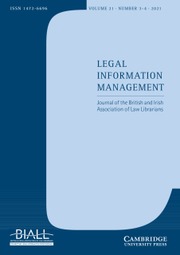


You will probably be aware by now that there have been some big changes at Legal Information Management recently. To begin with, from the very next issue (Spring 2026, out in March) we will be published by Edinburgh University Press (EUP), something that we’re very excited about. The search for a new publisher was long and arduous, but we think that with EUP we have found a partner that will be able to continue the excellent work of Cambridge University Press (CUP) over the past 23 years.
Regrettably, though, the issue of LIM you are now reading is also the very last to be published in print format. We, as Co-Editors of this publication, are sad about this, as are the Editorial Board and BIALL Council. It’s a great shame, but it was simply unavoidable.
The reason for the move to online only was mainly down to cost. It was unsustainable for BIALL to continue to fund the publication in print format. Also, there was a certain inevitability about it. Other titles in the same space have long been online only, such as Spectrum (the journal of the American Association of Law Libraries), while print is not, perhaps, the most sustainable way to publish in this day and age. On top of all this, we were guided by the recent LIM readership survey, in which a majority of respondents said they would be comfortable with a switch to online only, should this prove necessary. But rest assured that other than the fact that LIM will no longer make a satisfying thump when it lands on your desk, everything else will remain pretty much the same.
It should be noted that the reason for the change in publisher was that CUP’s publishing model has evolved in recent years, and LIM simply did not fit in with its new philosophy. We would like to take this opportunity to thank our contacts at CUP, Jamie Davidson and Craig Baxter, both for their patience and for their professionalism throughout the past three years that we have been at the helm of the good ship LIM, and also for their help in making the switch between CUP and EUP as seamless as possible.
Not completely seamless, though, as moving to EUP has meant a totally different production schedule, which in turn made it look likely that Winter would come out almost at the same time as Spring. This would not work, of course, partly because CUP is out of contract next year, but also because it would be very difficult to put two full issues out at the same time. As an expedient, it was decided that the best way around this was to publish a double issue for Autumn and Winter. This is what you’re reading now, the very last print edition of LIM – put it to one side, one day it might be a collectible!
IN THIS ISSUE
We think we’ve put together a great issue to finish off LIM’s time as a print publication, and while the switch to online might be seen as a necessary evil at this time, the question as to whether AI is for evil or for good is still very much up in the air. Most in the sector are cautiously optimistic, though, as is reflected in this issue, which contains four articles dedicated to furthering our understanding of how we will work with artificial intelligence.
Our first AI piece is by Alex Robinson (p140), and this offers practical strategies for the successful adoption of AI tools, including how to navigate this burgeoning and often confusing market. Meanwhile, on page 145, Matthew Leopold asks whether AI can be trusted, offering an entertaining and illuminating take on this question – which involves more than a whiff of magic. Meanwhile, recently retired Academic Services Librarian at the Bodleian Library, Margaret Watson, has penned a very nice piece which is focussed on the ethics of using generative AI in an academic law environment (p151). Finally, Andrew Thatcher outlines Eversheds Sutherland’s approach to integrating generative AI knowledge tools. They’re all great pieces, so make sure you put some time aside to read them (p157).
AI also comes up in our wide-ranging interview with Mark Engsberg (page 135), the US Army lawyer turned information professional who is now President of the International Association of Law Libraries (IALL), and a man who has some great advice for those starting out on a career in legal information – spoiler alert, it involves two letters, I and A, but not necessarily in that order.
There is a fair amount of AI related material in our in-house supplied article this issue, too, where Co-Editor Jas Breslin gets to grips with all things to do with copyright and licensing (page 172), while immediately after this, on page 176, Serena Dederding from The Copyright Licensing Agency (CLA) explores how UK law firms can adopt generative AI to enhance productivity, while at the same time managing copyright risks.
It’s not all AI, though, and on page 162 Clare Bilobrk reprises her 2025 BIALL Conference paper, which looks at the barriers to effective engagement with KM tools, before going on to offer some practical strategies for overcoming these.
Many of the other pieces in this issue are also based on Conference papers, including the four AI articles above, while another is the article submitted by Greg Bennett (p167). This runs through his analysis of job adverts for librarians, which assessed where the criteria asked for involved expertise that currently only law librarians can offer, and what this tells us about the current and future state of the profession. It’s a very interesting piece, and quite encouraging, too.
Meanwhile, on page 178 Holly Mottram explains why the precise use of words really does matter, both in legal information research and international diplomacy, and there are some very interesting examples of misunderstandings from history in this piece. There’s also a bit of history from Sam Lloyd, Executive Director of CRO Corporate Services Limited, who gives us a personal take on his 50-plus years working in the corporate information service provision sector, outlining the many changes in technology and working practices that have taken place along the way (page 183).
Other things to look out for include our rundown of the BIALL 2025 Award Winners on page 189, while our regular retrospective flicks through the issues of The Law Librarian, as LIM was then known, published in 1995 – a year when actual royalty contributed to an article in these very pages.
ACKNOWLEDGMENTS
We’ve already thanked our contacts at CUP, and we will be sorry not to be working with them in the future, as we will all of those who have recently left the Editorial Board: Helen Garner, Jake Hearn, Alison Million and Alfred Ye. In their place we have two new board members in Mark Leonard and Luca Fois (there’s room for more if you fancy it?), while Renate Ní Uigín has now stepped up to take on the role of Chair, and Susanna Winter is Deputy Chair. We’ve already had a board meeting with the new team and suffice to say it was as fun-filled and productive as always, and we’re very much looking forward to going into this new LIM era with such a great bunch of people.
Many of the Board members are also proofreaders, and as always we need to thank them for the excellent work they’ve done to turn this issue around efficiently and expertly in what has been a very hectic schedule.
One last thing, it is a little sad that this will no longer be a physical publication after this issue, but ideas are not material, and we’re confident that what we save in paper we will make up for in inspirational copy. Because it’s an exciting time to be in this business, and it’s up to those involved in the sector to record it. Which is why we still need input from BIALL members. So, if you have an idea for an article that would be right for LIM, please email us at limeditor@biall.org.uk



