Skip to main content Accessibility help
×
  • Coming soon
  • Show more authors
  • Select format
  • Publisher:
    Cambridge University Press
    Publication date:
    15 February 2026
    31 January 2026
    ISBN:
    9781009304740
    9781009304788
    9781009304733
    Dimensions:
    (216 x 140 mm)
    Weight & Pages:
    0.5kg, 200 Pages
    Dimensions:
    (216 x 140 mm)
    Weight & Pages:
    0.25kg, 200 Pages
Selected: Digital
Add to cart View cart Buy from Cambridge.org

Book description

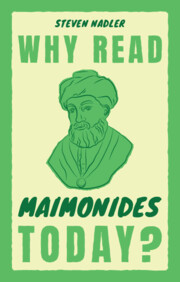
Maimonides (Moshe/Moses ben Maimon, 1138–1204) was not only the dominant rabbinic and Jewish intellectual figure of the later medieval period, but also one of history's greatest philosophers. As the author of the Mishneh Torah (ca. 1180), a compendium and systematization of the Jewish legal code, he remains an unsurpassed (if not uncontroversial) authority on halakha (Jewish law). His philosophical masterpiece, however, is the Guide of the Perplexed (1185-1190), in which he systematically presents his views on theology, metaphysics, cosmology, natural science, epistemology, Scriptural hermeneutics, law and ethics. This accessible and highly readable book introduces the reader to Maimonides' life and thought, and uses a number of enduring and popular philosophical topics – including the problem of evil, freedom of the will, and the relationship between virtue and happiness - to show that he continues to be interesting and relevant to readers today.

Reviews

‘In this volume, Steven Nadler has provided a lucid and engaging introduction to Maimonides' thought, one that emphasizes the continued relevance of Maimonides to a contemporary readership.'

Tamar Rudavsky - Distinguished  Professor of Philosophy, The Ohio State University

Metrics

Full text views

Total number of HTML views: 0
Total number of PDF views: 0 *
Loading metrics...

Book summary page views

Total views: 0 *
Loading metrics...

* Views captured on Cambridge Core between #date#. This data will be updated every 24 hours.

Usage data cannot currently be displayed.

Accessibility standard: WCAG 2.1 AA

Why this information is here

This section outlines the accessibility features of this content - including support for screen readers, full keyboard navigation and high-contrast display options. This may not be relevant for you.

Accessibility Information

The PDF of this book complies with version 2.1 of the Web Content Accessibility Guidelines (WCAG), covering newer accessibility requirements and improved user experiences and achieves the intermediate (AA) level of WCAG compliance, covering a wider range of accessibility requirements.

Content Navigation
Table of contents navigation

Allows you to navigate directly to chapters, sections, or non‐text items through a linked table of contents, reducing the need for extensive scrolling.

Index navigation

Provides an interactive index, letting you go straight to where a term or subject appears in the text without manual searching.

Reading Order and Textual Equivalents
Single logical reading order

You will encounter all content (including footnotes, captions, etc.) in a clear, sequential flow, making it easier to follow with assistive tools like screen readers.

Visual Accessibility
Use of colour is not sole means of conveying information

You will still understand key ideas or prompts without relying solely on colour, which is especially helpful if you have colour vision deficiencies.

Structural and Technical Features
ARIA roles provided

You gain clarity from ARIA (Accessible Rich Internet Applications) roles and attributes, as they help assistive technologies interpret how each part of the content functions.