
Skip to main content Accessibility help
×
  • Cited by 3
    • Volume 1
      Show more authors
    • You may already have access via personal or institutional login
    • Select format
    • Publisher:
      Cambridge University Press
      Publication date:
      30 April 2024
      04 July 2024
      ISBN:
      9781009072182
      9781316512814
      Dimensions:
      (229 x 152 mm)
      Weight & Pages:
      0.633kg, 240 Pages
      Dimensions:
      Weight & Pages:
    You may already have access via personal or institutional login
  • Selected: Digital
    Add to cart View cart Buy from Cambridge.org

    Book description

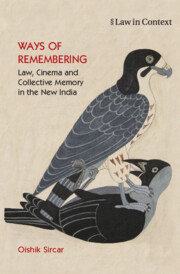
    Ways of Remembering tells a story about the relationship between secular law and religious violence by studying the memorialisation of the 2002 Gujarat pogrom—postcolonial India's most litigated and mediatized event of anti-Muslim mass violence. By reading judgments and films on the pogrom through a novel interpretive framework, the book argues that the shared narrative of law and cinema engenders ways of remembering the pogrom in which the rationality of secular law offers a resolution to the irrationality of religious violence. In the public's collective memory, the force of this rationality simultaneously condemns and normalises violence against Muslims while exonerating secular law from its role in enabling the pogrom, thus keeping the violent (legal) order against India's Muslim citizens intact. The book contends that in foregrounding law's aesthetic dimensions we see the discursive ways in which secular law organizes violence and presents itself as the panacea for that very violence.

    Reviews

    ‘Ways of Remembering is an engrossing study of the interface between law and cinema in shaping the public memory of the 2002 Gujarat pogrom. It offers vital new insights into the spectacle of anti-Muslim violence that grounds the ‘New India’. Sircar brilliantly and provocatively maps out the convergence between the ideologies of Hindutva and liberal Hindus, between religious hatred and neo-liberal governmentality to challenge the faith in secular constitutionalism as the solution to the anti-Muslim hatred that is now ubiquitous in India. This book is indispensable to understanding how national publics are mobilized in the contemporary rise of neoliberal fascisms in India, and around the world. It is an unforgettable read.’

    Sunera Thobani - University of British Columbia, Canada

    ‘The 2002 anti-Muslim Gujarat pogrom decisively advanced Hindutva’s political fortunes and concomitantly its ideological appeal among a widening national public. A strikingly original study, Ways of Remembering is about how two sources—cinema and law—played their part in the construction of a pro-Hindutva collective memorialisation of that event. The best micro-studies always provide significant and powerful macro-level insights. Sircar’s innovative ‘jurisprudential aesthetic’ method that examines three Bollywood films (that allude to the pogrom) and the chain of adjudication on one paradigmatically brutal case (the Best Bakery killings), can be situated in this tradition.’

    Achin Vanaik - University of Delhi, India

    ‘Launching a dramatically innovative aesthetic jurisprudence, Oishik Sircar examines the art of memory through legal and cinematic reconstructions of a traumatic event. Generating layer upon layer of novelty, Ways of Remembering provides the inestimable intellectual service of breaking out of the Western legal episteme, and the dictates of planet Hollywood. Skilfully wielding an array of new filmic and legal techniques for engaging the past, this book scrutinises a massacre and its reconstruction, criminal act and legal trial, so as to evidence the power and impact of the lens through which events are framed and viewed.’

    Peter Goodrich - Cardozo School of Law, USA

    ‘Rare is the shedding of new light on an historical event that has been thoroughly dissected, but Ways of Remembering does just that. Providing connective tissue between the current-day force of Hindutva with the Gujarat pogrom of 2002, Oishik Sircar brilliantly illuminates the reconstitution of violence through legal and cinematic narrative collusion. What emerges as well is an innovative approach to textual reading that generates novel questions and insights about memory making and the state. The result is a book about the past that is unexpectedly timely.’

    Jasbir K. Puar - Rutgers University, USA

    Refine List

    Actions for selected content:

    Select all | Deselect all
    • View selected items
    • Export citations
    • Download PDF (zip)
    • Save to Kindle
    • Save to Dropbox
    • Save to Google Drive

    Save Search

    You can save your searches here and later view and run them again in "My saved searches".

    Please provide a title, maximum of 40 characters.
    ×

    Contents

    Metrics

    Altmetric attention score

    Full text views

    Total number of HTML views: 0
    Total number of PDF views: 0 *
    Loading metrics...

    Book summary page views

    Total views: 0 *
    Loading metrics...

    * Views captured on Cambridge Core between #date#. This data will be updated every 24 hours.

    Usage data cannot currently be displayed.

    Accessibility standard: Unknown

    Why this information is here

    This section outlines the accessibility features of this content - including support for screen readers, full keyboard navigation and high-contrast display options. This may not be relevant for you.

    Accessibility Information

    Accessibility compliance for the PDF of this book is currently unknown and may be updated in the future.