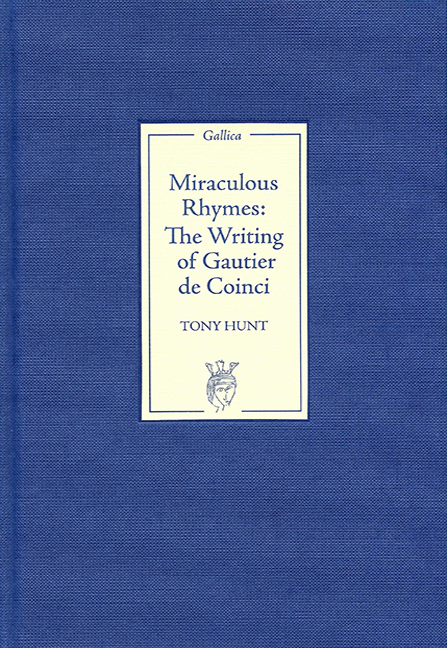
Miraculous Rhymes

-
Select format
-
- Publisher:
- Boydell & Brewer
- Publication date:
- 29 April 2017
- 19 September 2007
- ISBN:
- 9781846155741
- 9781843841265
- Dimensions:
- Weight & Pages:
- Dimensions:
- Weight & Pages:
- Subjects:
- Literature, Area Studies, European History after 1450, History, Anglo Saxon and Medieval Literature, European Studies
- Series:
- Gallica
You may already have access via personal or institutional login- Subjects:
- Literature, Area Studies, European History after 1450, History, Anglo Saxon and Medieval Literature, European Studies
- Series:
- Gallica
Show more authors 
You may already have access via personal or institutional login
Book description
The well-connected, northern-French monk and musician Gautier de Coinci (1177/8-1236) occupies an unassailable position as one of the most exceptional vernacular writers of the Middle Ages, concerning whom there is nevertheless no full length study in English. In a meticulously planned and supervised collection of miracles of Our Lady, which survive in a remarkable number of manuscripts, some beautifully illustrated, Gautier deploys his outstanding talents as a composer of songs, an acerbic satirist, an audacious inventor of rich and equivocal rhymes (of a virtuosity unparalleled before the "Grands Rhetoriqueurs" on the eve of the Renaissance), a confident lexical innovator, an exuberant exponent of rhetorical wordplay, an incisive observer of contemporary society, and a man of profound personal piety.
This study of word-patterning in Gautier seeks to compensate for the dearth of stylistic studies of Old French and to examine in detail the relationship between rhetoric and religion, "courtoisie" and Mariolatry, aristocratic tastes and the way to spiritual renewal. Gautier's writing strategy is shown to be a means to rise beyond secular, aristocratic values by building on them and transcending them rather than opposing and rejecting them.
TONY HUNT is a Fellow of St Peter's College, Oxford.
Contents
Contents
Metrics
Full text views
Full text views helpTotal number of HTML views: 0
Total number of PDF views: 0 *
 Loading metrics...
* Views captured on Cambridge Core between #date#. This data will be updated every 24 hours.
Usage data cannot currently be displayed.
Accessibility standard: Unknown
Why this information is here
This section outlines the accessibility features of this content - including support for screen readers, full keyboard navigation and high-contrast display options. This may not be relevant for you.
Accessibility Information
Accessibility compliance for the PDF of this book is currently unknown and may be updated in the future.