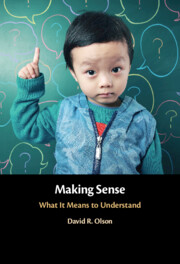

Understanding, as Descartes, Locke and Kant all insisted, is the primary 'faculty' of the mind; yet our modern sciences have been slow to advance a clear and testable account of what it means to understand, of children's acquisition of this concept and, in particular, how children come to ascribe understanding to themselves and others. By drawing together developmental and philosophical theories, this book provides a systematic account of children's concept of understanding and places understanding at the heart of children's 'theory of mind'. Children's subjective awareness of their own minds, of what they think, depends on learning a language for ascribing mental states to themselves and others. This book will appeal to researchers in developmental psychology, cognitive science, education and philosophy who are interested in the cognitive and emotional development of children and in the more basic question of what it means to have a mind.
'When David R. Olson asked his apparently pre-verbal 1-year-old to get her shoes, she promptly complied - much to his surprise. That incident planted the seed for a deep enquiry. Had she truly understood him? What does it mean to ascribe understanding to such a young child? We also need to consider who is doing the ascribing. Are young children able to ascribe understanding to themselves? And what about animals and computers? Drawing on the contributions of philosophers, linguists, and psychologists, David R. Olson proposes that understanding is a uniquely human capacity, slowly acquired as part of a web of language practices. His book is a provocative and original contribution to the study of children’s theory of mind.'
Paul Lansley Harris - Harvard Graduate School of Education, USA
Loading metrics...
* Views captured on Cambridge Core between #date#. This data will be updated every 24 hours.
Usage data cannot currently be displayed.
This section outlines the accessibility features of this content - including support for screen readers, full keyboard navigation and high-contrast display options. This may not be relevant for you.
Accessibility compliance for the PDF of this book is currently unknown and may be updated in the future.