Lord Kames

-
Select format
-
- Publisher:
- Edinburgh University Press
- Publication date:
- 12 September 2017
- 20 May 2015
- ISBN:
- 9780748676743
- 9780748676736
- Dimensions:
- Weight & Pages:
- 00kg,
- Dimensions:
- Weight & Pages:
- Subjects:
- Law, English Legal System
Show more authors 
You may already have access via personal or institutional login
Book description
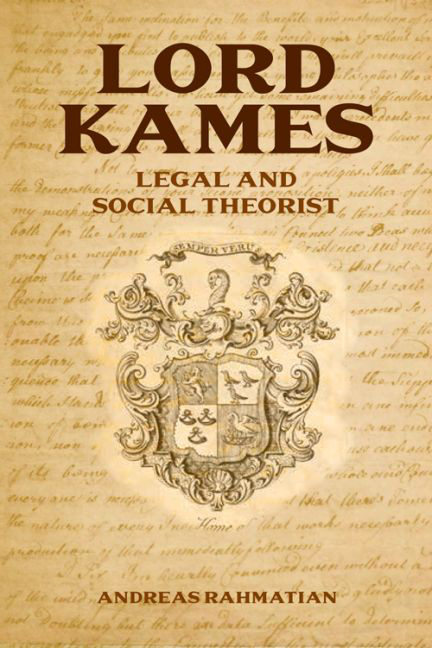
The Scottish jurist, judge, legal historian and philosopher Henry Home (1696-1782) took the title Lord Kames when he was elevated to the bench of the Scottish Court of Session in 1752. In the 18th century, his books were influential and widely read; the educated classes and representatives of the Enlightenment in England, France and in the German states were all familiar with his aesthetic and philosophical writings. Andreas Rahmatian explains Kames' conceptions of legal philosophy, including black-letter law, legal science, legal theory, legal sociology and anthropology in its early stages, setting them in the context of the Scottish Enlightenment. He looks at how Kames came to be one of the forefathers of comparative law, sociology of law, legal psychology and 'legal science' in its proper meaning, as opposed to 'law'.
Contents
Contents
Metrics
Full text views
Full text views helpTotal number of HTML views: 0
Total number of PDF views: 0 *
 Loading metrics...
* Views captured on Cambridge Core between #date#. This data will be updated every 24 hours.
Usage data cannot currently be displayed.
Accessibility standard: Unknown
Why this information is here
This section outlines the accessibility features of this content - including support for screen readers, full keyboard navigation and high-contrast display options. This may not be relevant for you.
Accessibility Information
Accessibility compliance for the PDF of this book is currently unknown and may be updated in the future.