
Skip to main content Accessibility help
×
  • Cited by 3
    • Show more authors
    • You may already have access via personal or institutional login
    • Select format
    • Publisher:
      Cambridge University Press
      Publication date:
      26 October 2023
      16 November 2023
      ISBN:
      9781108989756
      9781108839297
      Dimensions:
      (229 x 152 mm)
      Weight & Pages:
      0.49kg, 246 Pages
      Dimensions:
      Weight & Pages:
    You may already have access via personal or institutional login
  • Selected: Digital
    Add to cart View cart Buy from Cambridge.org

    Book description

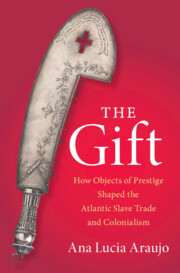
    The Gift explores how objects of prestige contributed to cross-cultural exchanges between Africans and Europeans during the Atlantic slave trade. An eighteenth-century silver ceremonial sword, commissioned in the port of La Rochelle by French traders, was offered as a gift to an African commercial agent in the port of Cabinda (Kingdom of Ngoyo), in twenty-first century Angola. Slave traders carried this object from Cabinda to Abomey, the capital of the Kingdom of Dahomey in twenty-first century's Republic of Benin, from where French officers looted the item in the late nineteenth century. Drawing on a rich set of sources in French, English, and Portuguese, as well as artifacts housed in museums across Europe and the Americas, Ana Lucia Araujo illuminates how luxury objects impacted European–African relations, and how these economic, cultural, and social interactions paved the way for the European conquest and colonization of West Africa and West Central Africa.

    Awards

    Finalist, 2024 Paul Lovejoy Prize, Brill

    Reviews

    ‘A remarkable counternarrative told through the history of material objects troubles what we know about commodification in West and West Central Africa. The Gift brilliantly reframes the best thinking on circulation at the height of the trans-Atlantic slave trade. In the expansive tapestry woven by Ana Lucia Araujo, readers will discern new ways of seeing and thinking about cultural objects and the elaboration of power in the Atlantic World. A rewarding and necessary book.’

    Herman Bennett - author of African Kings and Black Slaves: Sovereignty and Dispossession in the Early Modern Atlantic

    ‘A brilliant fusion of social and art history, this gem of a book dazzles with scholarly depth. A testament to dual training, an exquisite narrative captivates, enlightens, and transcends conventional boundaries. A truly enriching, must-read gift.’

    Roquinaldo Ferreira - author of Cross-Cultural Exchange in the Atlantic World: Angola and Brazil during the Era of the Slave Trade

    ‘Following the itinerary and many lives of a silver knife, gifted and re-gifted across the commercial, familial, and political networks linking France to west and west-central Africa in the 18th and 19th century, Araujo crafts a productively speculative account that gives new depths to our understanding of the Atlantic slave trade.’

    Cécile Fromont - author of Images on a Mission in Early Modern Kongo and Angola

    ‘In tracing a ceremonial silver sword and its meanings from France to Central and West Africa and back to Europe, this creative and nuanced book sheds light on gift-giving in the Atlantic slave trade, French connections to multiple African regions, and the depredations of colonial invaders. As it reminds us, material objects have stories to tell!’

    Lisa Lindsay - author of Atlantic Bonds: A Nineteenth Century Odyssey from America to Africa

    ‘… Araujo's combined training as a social and art historian is evident in The Gift, which is painstakingly researched, deeply analyzed, and well written.’

    Mary A. Afolabi Source: Journal of Global Slavery

    ‘[This] is a splendid book that showcases meticulous historical research. It combines an innovative and convincing argument about the ways that a single material item embodied gift-based manipulations of social hierarchies within the evolving intercultural Atlantic slave trade of the eighteenth and nineteenth centuries, and an earnest call for the decolonization of global museum collections.’

    Seth Mallios Source: The William and Mary Quarterly

    ‘… Araujo’s book is a superb study of a material object that shows how disparate places in Africa were linked through the slave trade and the vital role of objects of prestige in commercial exchanges. Araujo reminds us of the importance of histories of material culture and studying the provenance of African objects housed in museums. The book should be read widely by historians and museologists.’

    Avenel Rolfsen Source: African Studies Review

    ‘[The book] is heir to the new historiographical methodologies that, initially inspired by archaeology, have opened historians’ eyes to the history of objects, through which the history of humans can be reconstructed.… The appearance of this prestigious object and the changes it underwent as it moved from one place to another is the guiding thread of Araujo’s brilliant historical analysis. The importance of this prestigious object is revealed less by the silver from which it was forged and more by its power to materially symbolize all the historical contexts in which this itinerant object traveled.’

    Junia Ferreira Furtado Source: Hispanic American Historical Review

    ‘Richly illustrated, meticulously researched, and engagingly written, The Gift is a tour-de-force example of what can happen when multilingual archival and museum research, detailed looking, and a depth of historical expertise combine with an intimate understanding of the internal dynamics of African societies.’

    Matthew Francis Rarey Source: American Historical Review

    ‘Araujo shows how historians can create works that inform even when details are missing from the record, and should be commended for the effort taken to investigate the multiple links between Europe and Africa during the transatlantic trade in enslaved people and after.’

    Graham Kerr Source: Journal for Eighteenth-Century Studies

    ‘Araujo's approach to the Atlantic slave trade is refreshingly innovative, with her primary focus on the cross-cultural exchanges that played such an important part in forging deals between local rulers in the West African kingdoms and merchants and ships' captains eager to do business them.’

    Alan Forrest Source: French History

    Refine List

    Actions for selected content:

    Select all | Deselect all
    • View selected items
    • Export citations
    • Download PDF (zip)
    • Save to Kindle
    • Save to Dropbox
    • Save to Google Drive

    Save Search

    You can save your searches here and later view and run them again in "My saved searches".

    Please provide a title, maximum of 40 characters.
    ×

    Contents

    Metrics

    Altmetric attention score

    Full text views

    Total number of HTML views: 0
    Total number of PDF views: 0 *
    Loading metrics...

    Book summary page views

    Total views: 0 *
    Loading metrics...

    * Views captured on Cambridge Core between #date#. This data will be updated every 24 hours.

    Usage data cannot currently be displayed.

    Accessibility standard: Unknown

    Why this information is here

    This section outlines the accessibility features of this content - including support for screen readers, full keyboard navigation and high-contrast display options. This may not be relevant for you.

    Accessibility Information

    Accessibility compliance for the PDF of this book is currently unknown and may be updated in the future.