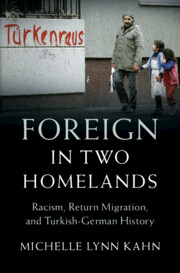

What happens when migrants are rejected by the host society that first invited them? How do they return to a homeland that considers them outsiders? Foreign in Two Homelands explores the transnational history of Turkish migrants, Germany's largest ethnic minority, who arrived as 'guest-workers' (Gastarbeiter) between 1961 and 1973. By the 1980s, amid rising racism, neo-Nazis and ordinary Germans blamed Turks for unemployment, criticized their Muslim faith, and argued they could never integrate. In 1983, policymakers enacted a controversial law: paying Turks to leave. Thus commenced one of modern Europe's largest and fastest waves of remigration: within one year, 15% of the migrants—250,000 men, women, and children—returned to Turkey. Their homeland, however, ostracized them as culturally estranged 'Germanized Turks' (Almancı). Through archival research and oral history interviews in both countries and languages, Michelle Lynn Kahn highlights migrants' personal stories and reveals how many felt foreign in two homelands. This title is also available as Open Access on Cambridge Core.
Finalist, 2025 Prize for the Best Book in History and Social Sciences, German Studies Association
Finalist, 2025 David Barclay Book Prize, German Studies Association
‘A complex interlacing of multiple histories: of West Germany and Turkey; of Cold War Europe and postwar migration; of governments, businesses, and schools. Running through all of these are the stories of individuals and families who left home and were never quite able to return. That Kahn doesn’t lose sight of the people most affected makes her book wonderfully engaging … While her subjects struggled to find belonging in either homeland, Kahn’s book should have no trouble finding its place as a critical contribution to the study of modern European and migration histories.’
Sarah Thomsen Vierra Source: Central European History
Loading metrics...
* Views captured on Cambridge Core between #date#. This data will be updated every 24 hours.
Usage data cannot currently be displayed.
This section outlines the accessibility features of this content - including support for screen readers, full keyboard navigation and high-contrast display options. This may not be relevant for you.
Accessibility compliance for the PDF of this book is currently unknown and may be updated in the future.