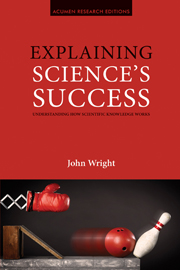
Explaining Science's Success

-
The digital format of this book is no longer available to purchase from Cambridge Core. Other formats may be available.
-
Select format
-
- Publisher:
- Acumen Publishing
- Publication date:
- 05 April 2014
- 29 November 2012
- ISBN:
- 9781844655335
- 9781844655328
- Dimensions:
- Weight & Pages:
- 00kg,
- Dimensions:
- Weight & Pages:
- Subjects:
- Philosophy of Science, Philosophy
- Series:
- Acumen Research Editions
You may already have access via personal or institutional login- Subjects:
- Philosophy of Science, Philosophy
- Series:
- Acumen Research Editions
Show more authors 
You may already have access via personal or institutional login
Book description
Paul Feyeraband famously asked, what's so great about science? One answer is that it has been surprisingly successful in getting things right about the natural world, more successful than non-scientific or pre-scientific systems, religion or philosophy. Science has been able to formulate theories that have successfully predicted novel observations. It has produced theories about parts of reality that were not observable or accessible at the time those theories were first advanced, but the claims about those inaccessible areas have since turned out to be true. And science has, on occasion, advanced on more or less a priori grounds theories that subsequently turned out to be highly empirically successful. In this book the philosopher of science, John Wright delves deep into science's methodology to offer an explanation for this remarkable success story.
Reviews
"Formulated with great clarity and supported by well-developed arguments, and the historical case studies provide helpful illustrations. . . warmly recommended.'"
Source: Dialectica
"Wright is to be applauded for tackling some of the most difficult and neglected problems in the philosophical study of scientific explanation. Recommended.'"
Source: Choice
Contents
Contents
Metrics
Altmetric attention score
Full text views
Full text views helpTotal number of HTML views: 0
Total number of PDF views: 0 *
 Loading metrics...
* Views captured on Cambridge Core between #date#. This data will be updated every 24 hours.
Usage data cannot currently be displayed.
Accessibility standard: Unknown
Why this information is here
This section outlines the accessibility features of this content - including support for screen readers, full keyboard navigation and high-contrast display options. This may not be relevant for you.
Accessibility Information
Accessibility compliance for the PDF of this book is currently unknown and may be updated in the future.