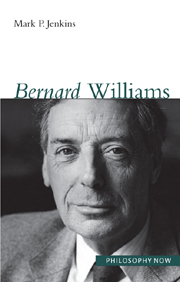

From his earliest work on personal identity to his last on the value of truthfulness, the ideas and arguments of Bernard Williams (1929-2003) have proved sometimes controversial, often influential, and always worth studying. This book provides a comprehensive account of Williams's many significant contributions to contemporary philosophy. Topics covered include personal identity, various critiques of moral theory, practical reasoning and moral motivation, truth and objectivity, and the relevance of ancient Greece to modern life. The book not only positions Williams among these important philosophical topics, but also with regard to the views of other philosophers, including prominent forerunners such as Hume and Nietzsche and contemporary thinkers such as Parfit, McDowell, Korsgaard and Nussbaum. Despite the fragmentary nature of Williams's work and the resistance of his views to familiar labels, Jenkins reveals the recurring themes and connections within his writings and the philosophical underpinnings to his work.
"I have never found better accounts of Williams's arguments or more deft treatments of the places where Williams was unclear or uncertain, however suggestive. Jenkins gives us a vastly more systematic and analytically articulated Williams than Williams himself was ready to supply."
Candace Vogler
Loading metrics...
* Views captured on Cambridge Core between #date#. This data will be updated every 24 hours.
Usage data cannot currently be displayed.
This section outlines the accessibility features of this content - including support for screen readers, full keyboard navigation and high-contrast display options. This may not be relevant for you.
Accessibility compliance for the PDF of this book is currently unknown and may be updated in the future.