Skip to main content Accessibility help
×
Hostname: page-component-68c7f8b79f-tw422 Total loading time: 0 Render date: 2025-12-30T04:05:52.939Z Has data issue: false hasContentIssue false

Introduction

Published online by Cambridge University Press:  08 October 2025

Vered Shwartz
Affiliation:
University of British Columbia, Vancouver

Summary

Picture, for a moment, enlisting the help of automatic translation when you seek medical attention in a foreign country and need to explain, in no uncertain terms, where you experience pain and in what intensity. I have experienced this in my first year in the US after moving there from Israel. Now consider that I’m not only a user of language technologies but also a researcher working on these technologies. As such, I’m also aware of their limitations. For example, I know that translation systems may translate figurative expressions literally, or that certain inputs can make them generate incorrect “translations” in the form of a religious text.

Information

Type
Chapter
Information
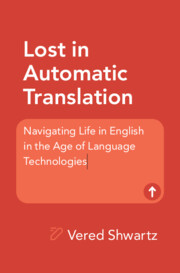
Lost in Automatic Translation
Navigating Life in English in the Age of Language Technologies
, pp. 1 - 2
Publisher: Cambridge University Press
Print publication year: 2025

Introduction

Picture, for a moment, enlisting the help of automatic translation when you seek medical attention in a foreign country and need to explain, in no uncertain terms, where you experience pain and in what intensity. I have experienced this in my first year in the US after moving there from Israel. Now consider that I’m not only a user of language technologies but also a researcher working on these technologies. As such, I’m also aware of their limitations. For example, I know that translation systems may translate figurative expressions literally, or that certain inputs can make them generate incorrect “translations” in the form of a religious text.

English is not only the world’s foremost go-to language for communication and collaboration on research, information, and ideas. It also dominates the internet, which started as a network for researchers in the US. And given that the most dominant tech companies are US-based, language technologies – including automatic translation and personal assistants – tend to be English-centric.

Mastering English past the point of literal translation has been as crucial for me in my work as a natural language processing expert and for my life in English-speaking countries – first in the US and then in Canada. Many of my fellow English as a foreign language (EFL) colleagues feel the same. We’ve all embarked on a journey that included acquiring vocabulary and learning to form grammatical sentences as well as using and understanding figurative expressions, euphemisms, cultural references and norms, and nonverbal communication. Despite achieving a level of proficiency where we can confidently articulate our thoughts in English, our accents may still give us away. It can be frustrating when we cannot make ourselves fully understood, when a person can’t make out the words we speak, or when Siri or Alexa fail to activate until we fake an American accent (one of the many occasions where my accent lessons paid dividends).

The goal of passing as a native English speaker can be challenging to reach, and I have collected numerous examples of the frustrating but often humorous experiences from the EFL community navigating life in an English-speaking world. Beyond the entertainment value of recounting such anecdotes, they reveal deeper insights that can help advance our understanding of linguistics, natural language processing, and language education.

As a means for conveying and preserving shared values and traditions, language is intrinsic to the expression of culture. By extension, language learning can help foster empathy and bridge differences – an important function in today’s globalized society. What then is the role of language technologies, such as personal assistants like Siri and Alexa, automatic translation, and chatbots? Will they aid us in the quest to master foreign languages and better understand one another? Or will they make language learning obsolete?

The last decade has seen an exponential increase in the development and adoption of language technologies, including generative artificial intelligence tools like ChatGPT and Gemini. While such technologies appear capable of answering sophisticated questions with high accuracy and even generating creative texts like poems, their answers, at times, can be incorrect or inconsistent despite sounding confident and plausible. What’s more, the technology doesn’t really “understand” language the way humans do (and it is certainly not sentient).

As a natural language processing expert, I believe language technologies, in general, can help improve communication capabilities for both native and non-native speakers. Yet questions remain about how reliable they are, what impact they will have – for example, on the labor market, education, and society as a whole – and what we stand to lose or gain when we count on them without addressing their issues.

This book is the result of my deep love and respect for the diversity of human language and its power to enable us to learn more about each other, understand different perspectives, and work together to build a more inclusive global community. It’s my hope that through a thoughtful approach, and a healthy sense of humor, language technologies can help rather than hinder us in this quest.

Accessibility standard: WCAG 2.1 AA

Why this information is here

This section outlines the accessibility features of this content - including support for screen readers, full keyboard navigation and high-contrast display options. This may not be relevant for you.

Accessibility Information

The HTML of this book complies with version 2.1 of the Web Content Accessibility Guidelines (WCAG), covering newer accessibility requirements and improved user experiences and achieves the intermediate (AA) level of WCAG compliance, covering a wider range of accessibility requirements.

Content Navigation

Table of contents navigation
Allows you to navigate directly to chapters, sections, or non‐text items through a linked table of contents, reducing the need for extensive scrolling.
Index navigation
Provides an interactive index, letting you go straight to where a term or subject appears in the text without manual searching.

Reading Order & Textual Equivalents

Single logical reading order
You will encounter all content (including footnotes, captions, etc.) in a clear, sequential flow, making it easier to follow with assistive tools like screen readers.
Short alternative textual descriptions
You get concise descriptions (for images, charts, or media clips), ensuring you do not miss crucial information when visual or audio elements are not accessible.

Visual Accessibility

Use of colour is not sole means of conveying information
You will still understand key ideas or prompts without relying solely on colour, which is especially helpful if you have colour vision deficiencies.

Structural and Technical Features

ARIA roles provided
You gain clarity from ARIA (Accessible Rich Internet Applications) roles and attributes, as they help assistive technologies interpret how each part of the content functions.

Save book to Kindle

To save this book to your Kindle, first ensure no-reply@cambridge.org is added to your Approved Personal Document E-mail List under your Personal Document Settings on the Manage Your Content and Devices page of your Amazon account. Then enter the ‘name’ part of your Kindle email address below. Find out more about saving to your Kindle.

Note you can select to save to either the @free.kindle.com or @kindle.com variations. ‘@free.kindle.com’ emails are free but can only be saved to your device when it is connected to wi-fi. ‘@kindle.com’ emails can be delivered even when you are not connected to wi-fi, but note that service fees apply.

Find out more about the Kindle Personal Document Service.

  • Introduction
  • Vered Shwartz, University of British Columbia, Vancouver
  • Book: Lost in Automatic Translation
  • Online publication: 08 October 2025
  • Chapter DOI: https://doi.org/10.1017/9781009552356.001
Available formats
×

Save book to Dropbox

To save content items to your account, please confirm that you agree to abide by our usage policies. If this is the first time you use this feature, you will be asked to authorise Cambridge Core to connect with your account. Find out more about saving content to Dropbox.

  • Introduction
  • Vered Shwartz, University of British Columbia, Vancouver
  • Book: Lost in Automatic Translation
  • Online publication: 08 October 2025
  • Chapter DOI: https://doi.org/10.1017/9781009552356.001
Available formats
×

Save book to Google Drive

To save content items to your account, please confirm that you agree to abide by our usage policies. If this is the first time you use this feature, you will be asked to authorise Cambridge Core to connect with your account. Find out more about saving content to Google Drive.

  • Introduction
  • Vered Shwartz, University of British Columbia, Vancouver
  • Book: Lost in Automatic Translation
  • Online publication: 08 October 2025
  • Chapter DOI: https://doi.org/10.1017/9781009552356.001
Available formats
×